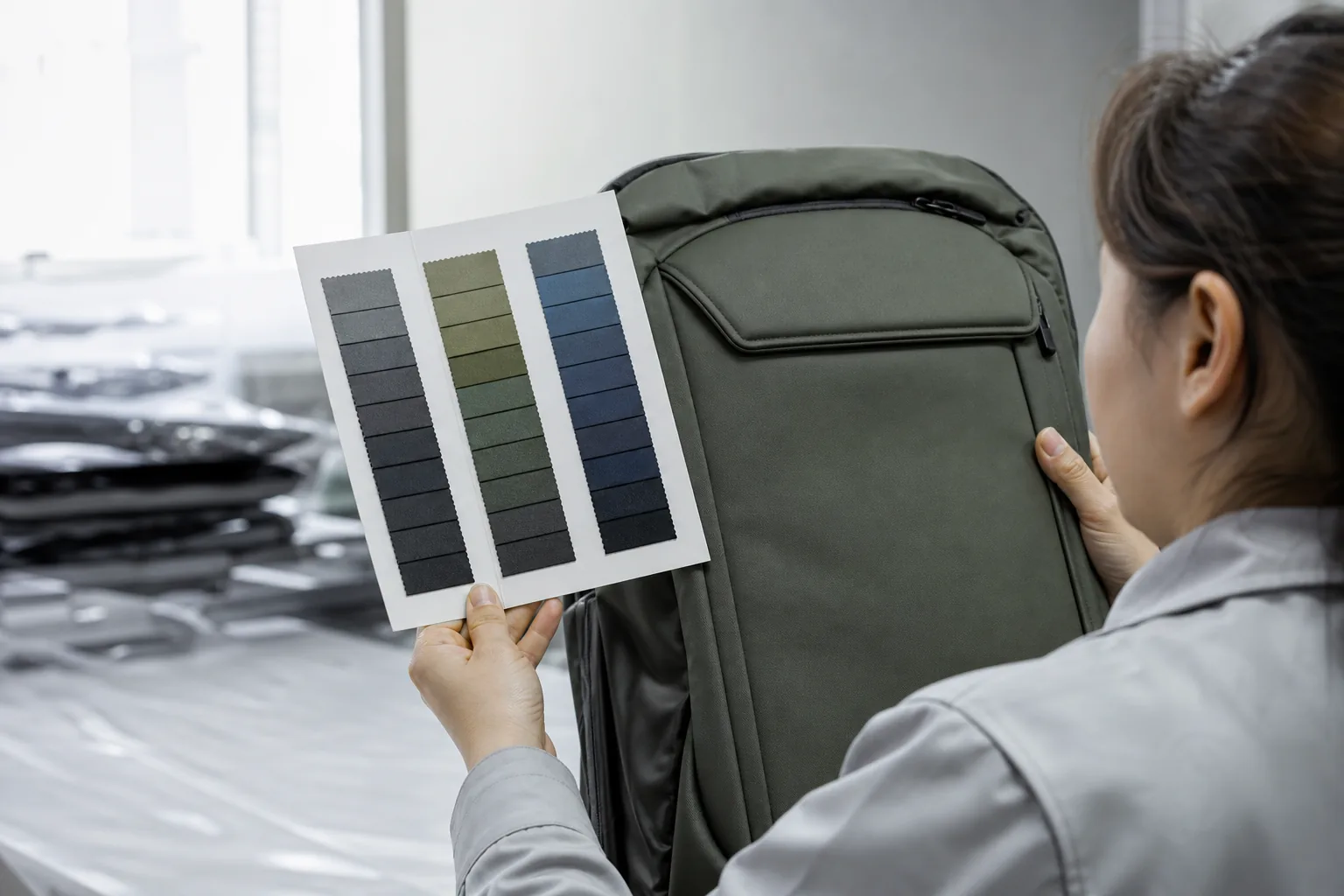
Colour Matching Across Materials: How Do You Keep Bags Consistent?
Colour Matching Across Materials: How Do You Keep Bags Consistent?
A bag is rarely one material. Fabric body, coated panels, webbing, binding tape, mesh, thread, PU trim and metal hardware all have to read as the same colour, and they are produced by processes that have nothing in common.
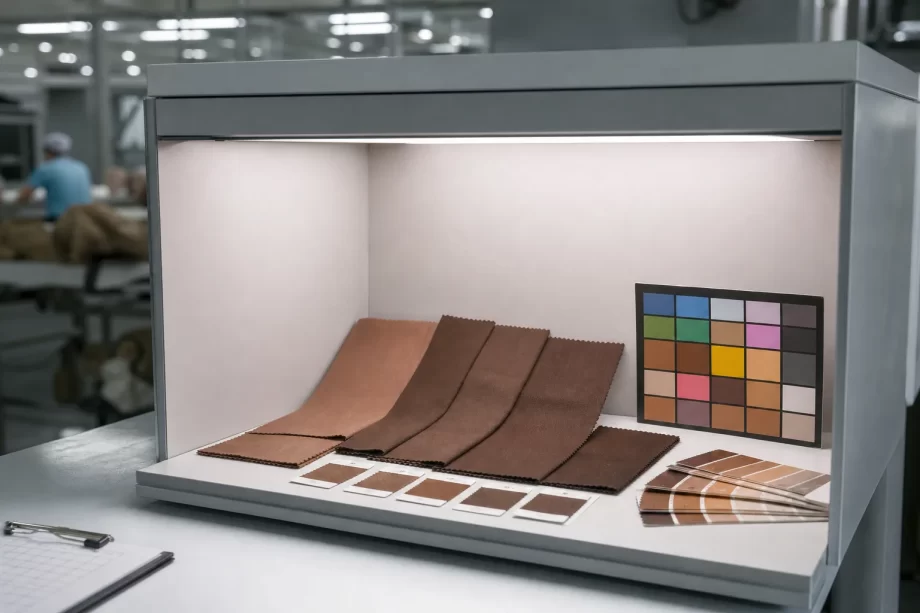
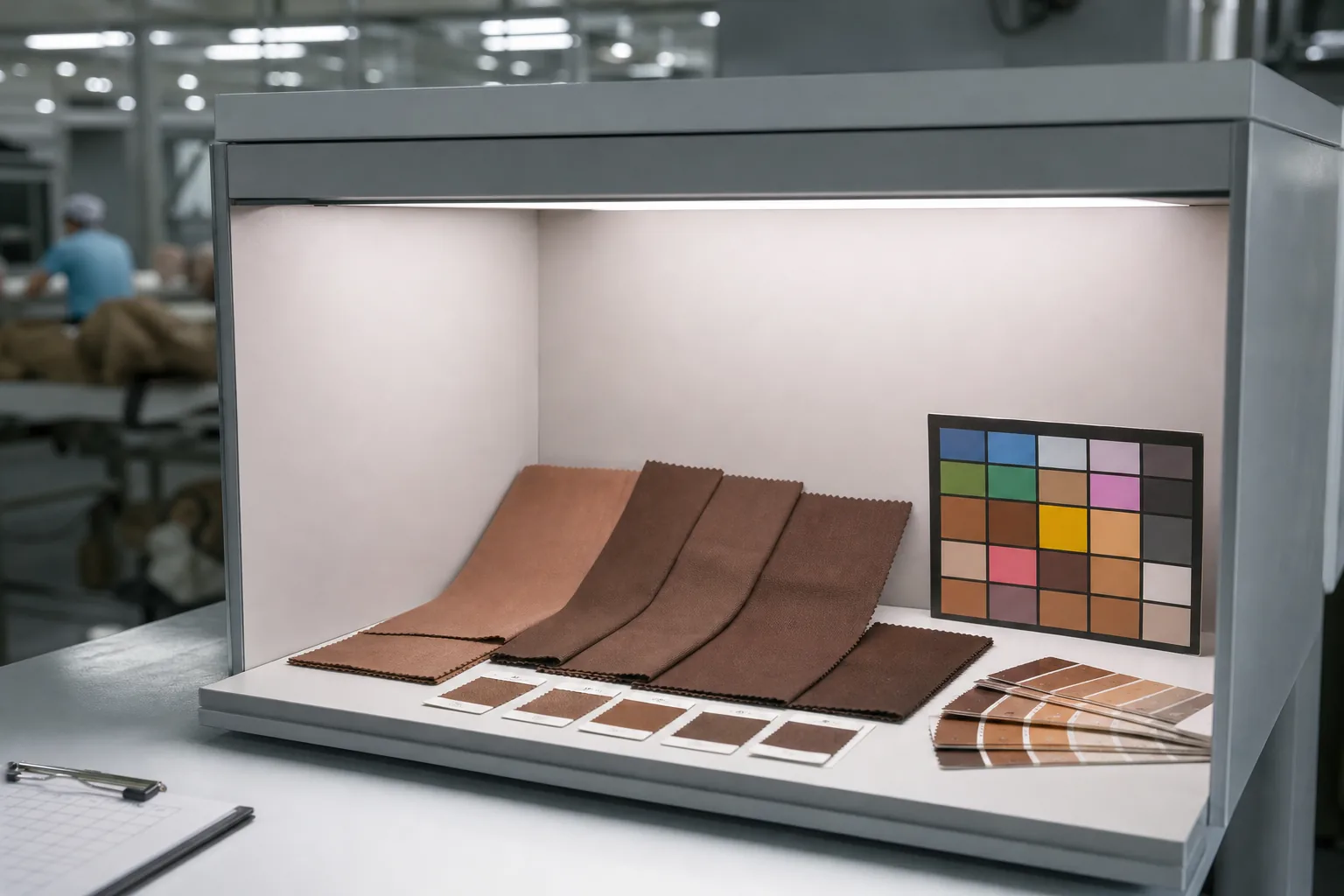
Colour lab bench with fabric swatches under a neutral light booth
That is why colour complaints survive every reasonable effort. The dyer hits the target on the greige fabric, the coating line hits the target on its own substrate, and the finished bag still shows a visible seam line where the two meet. Nothing failed in isolation. The failure is that the two processes were matched to a number rather than to each other, and the number was assessed under a light source that is not the one the customer will stand in.
This guide covers how a factory holds a colour across mixed materials: why the same reading produces different appearances, how light sources change the verdict, how tolerances are set numerically, how dye and coating behaviour diverge, and how batch-to-batch control is actually run so that the next shipment matches the last one.
Two surfaces can reflect the same average light and still appear different, because appearance depends on the shape of the reflectance curve rather than on a single number.
The Cause Table
Cause
Mechanism
Substrate difference
Different base reflectance
Surface texture
Diffuse versus specular
Gloss level
Highlight shift
Dye chemistry
Curve shape
Coating pigment
Opacity
Thickness
Hiding power
The Appearance Material Table
Material
Colour behaviour
Woven nylon
Dye absorbs into fibre
Coated polyester
Pigment sits on surface
Webbing
High tension, varied take-up
Binding tape
Narrow, edge shading
Mesh
Open structure, shadow
PU trim
Gloss and depth
The Appearance Table
Factor
Effect
Illumination
Metamerism
Observer
Individual response
Angle
Gloss shift
Background
Contrast effect
Size of area
Small samples look darker
Texture
Light scattering
The Failure Table
Failure
Root cause
Seam line visible
Materials matched separately
Batch variation
Process drift
Darker on arrival
Light source change
Faded after use
Light fastness
Patchy panel
Dye uniformity
Shade in stitching
Thread not specified
The Appearance Cost Table
Cost
Trigger
Re-dye
Batch rejection
Re-coating
Colour miss
Rework
Panel mismatch
Air freight
Replacement
Markdown
Buyer concession
Reputation
Repeat complaint
Match materials to each other rather than to a standard in isolation, because two materials that each pass their own tolerance can still sit visibly apart when sewn into the same panel.
Light Sources and Metamerism
The same two samples can match under one lamp and fail under another, and that phenomenon decides more colour disputes than any manufacturing error.
The Illuminant Table
Source
Character
Daylight
Full spectrum
Tungsten
Warm, red rich
Fluorescent
Spiky spectrum
LED retail
Variable
Cool white
Blue rich
Sodium
Narrow band
The Metamerism Table
Situation
Behaviour
Spectra identical
No shift
Spectra close
Slight shift
Spectra different
Strong shift
Match under daylight
May fail in store
Match under tungsten
May fail outdoors
No check
Uncontrolled
The Illuminant Assessment Table
Condition
Standard
Light booth
Controlled
Illuminants
Two minimum
Background
Neutral grey
Viewing angle
Defined
Sample size
Representative
Observer count
Three
The Illuminant Complaint Table
Complaint
Likely cause
Looks different in shop
Metamerism
Different in photo
Camera white balance
Different outside
Illuminant change
Different at night
Warm lighting
Different side by side
Contrast effect
Different alone
No reference
The Illuminant Control Table
Control
Purpose
Dual illuminant check
Catch metamerism
Physical standard
Shared reference
Photographic protocol
Consistent images
Retail light sampling
Match market
Written approval
Dispute record
Retained samples
Traceability
Approve colour under at least two illuminants including the one the product will be sold under, because a pair that matches in the factory booth and separates in a retail LED display produces a return that no inspection record can defend.
Setting Numerical Tolerances
A tolerance is a decision about how much difference the customer will accept, written as a number the supplier can be measured against.
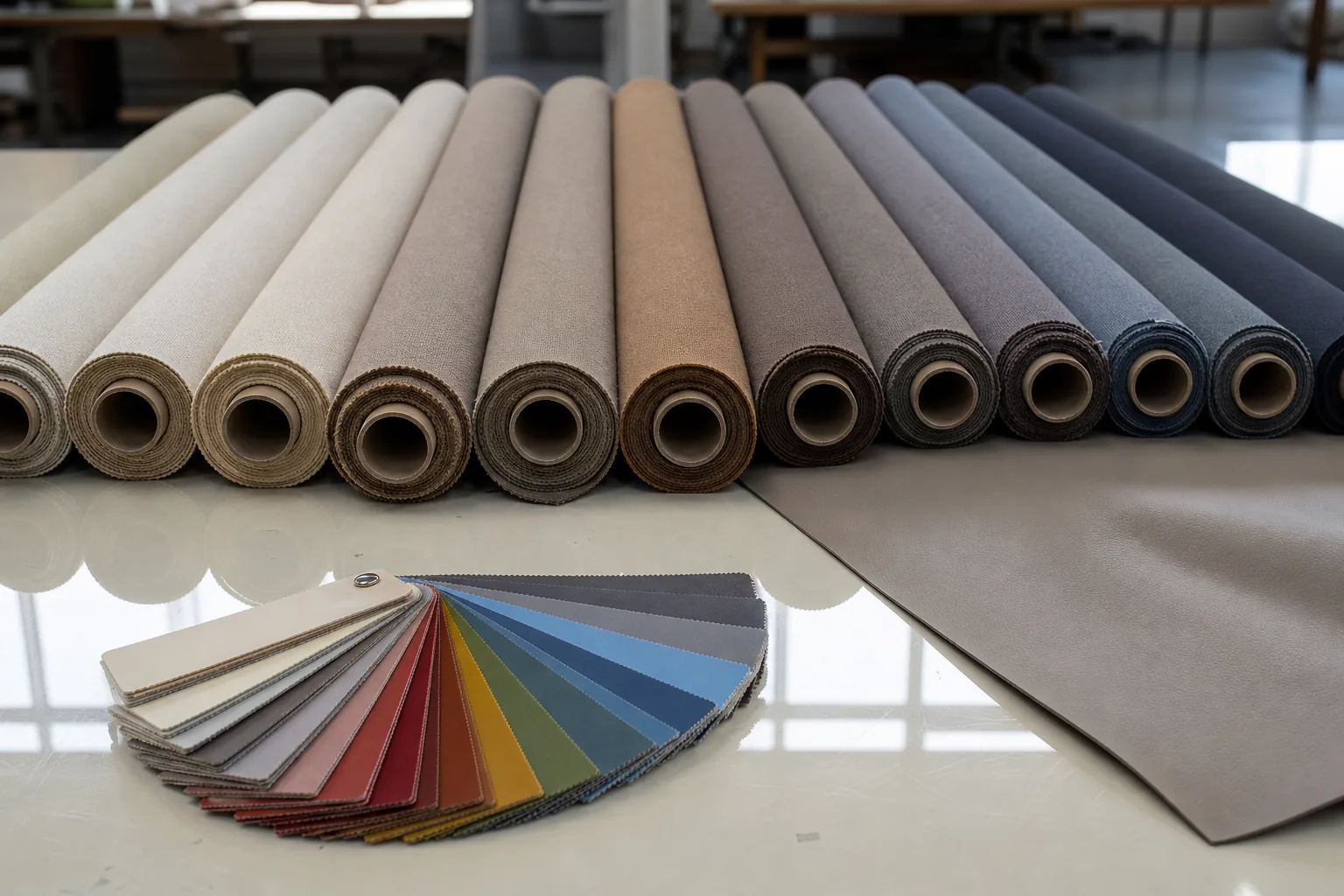
Dyed fabric rolls and a coated sheet showing subtle tone differences under daylight
The Tolerance Table
Level
Use
Tight
Critical match
Moderate
General apparel
Loose
Accessories
Per material
Differentiated
Per market
Buyer driven
Unlimited
Unacceptable
The Metric Table
Metric
Meaning
Colour difference value
Overall distance
Lightness
Light to dark
Red-green axis
Hue shift
Blue-yellow axis
Hue shift
Chroma
Saturation
Hue angle
Direction
The Allocation Table
Material
Relative tightness
Main body fabric
Tightest
Adjacent panels
Tight
Webbing
Moderate
Binding
Moderate
Mesh
Loose
Lining
Loosest
The Tolerance Direction Table
Deviation
Comment
Lighter
Often accepted
Darker
More visible
Greener
Reads dirty
Redder
Reads warm
Duller
Reads cheap
Brighter
Reads synthetic
The Agreement Table
Item
Recorded
Standard sample
Signed
Tolerance values
Written
Illuminants
Named
Measurement geometry
Stated
Sampling plan
Agreed
Dispute route
Defined
Tighten the tolerance for materials that touch each other and loosen it for materials that do not, because a lining that matches loosely costs nothing visible while a binding that misses by the same amount draws the eye along the whole seam.
Instrumental Measurement and Visual Assessment
Instruments remove opinion from the measurement and cannot replace the eye, so a working programme uses both in a fixed order.
The Instrument Table
Device
Use
Spectrophotometer
Spectral data
Colorimeter
Simple difference
Light booth
Visual check
Standard card
Reference
Software
Storage and trend
Calibration tile
Accuracy
The Geometry Table
Setting
Effect
Aperture size
Sample coverage
Specular included
Gloss measured
Specular excluded
Colour only
UV included
Optical brightener
UV excluded
Base colour
Port orientation
Repeatability
The Measurement Procedure Table
Step
Requirement
Calibrate
Each session
Condition sample
Fixed standard
Measure points
Multiple
Average
Reduce local variation
Compare
Against approved standard
Record
With settings
The Visual Table
Condition
Standard
Booth light
Specified
Distance
Fixed
Angle
Fixed
Duration
Brief
Observers
More than one
Result
Pass or refer
The Measurement Conflict Table
Situation
Action
Instrument passes, eye fails
Investigate texture
Eye passes, instrument fails
Check settings
Both fail
Reject
Borderline
Reference the buyer
Ambiguous
Retain sample
Disagreement
Third party
Measure first and look second on every lot, because the eye adapts within seconds and a visual check performed before the instrument reading tends to confirm whatever the observer expected to see.
Dye and Coating Behaviour
Dye enters a fibre and pigment sits on top of it, and the two processes fail in different directions under the same production pressures.
The Dye Table
Factor
Effect
Fibre type
Uptake variation
Bath temperature
Depth
Time
Penetration
pH
Shade shift
Liquor ratio
Levelness
Drying
Migration
The Coating Table
Factor
Effect
Pigment dispersion
Streaking
Film thickness
Depth
Substrate colour
Show-through
Drying profile
Mottling
Gloss
Perceived shade
Adhesion layer
Hiding
The Divergence Table
Behaviour
Dye
Coating
Depth control
Time and temp
Film weight
Levelness
Bath movement
Dispersion
Repeatability
Recipe driven
Line driven
Rework
Re-dye
Strip and re-coat
Fastness
Fibre bond
Binder
Appearance
Absorbed
Reflected
The Match Order Table
Sequence
Reason
Dye first
Hardest to adjust
Coat second
Can be tinted
Trim third
Small area
Thread fourth
Fine tune
Hardware last
Fixed range
Never reverse
Rework cost
The Rework Table
Situation
Option
Dye slightly light
Re-dye deeper
Dye too dark
Strip, risk
Coating light
Add pigment
Coating streaked
Re-coat
Trim mismatch
Re-source
Thread mismatch
Re-order
Fix the colour on the dyed body fabric before the coating line is set, because a coating can be tinted toward a fabric while a fabric cannot be economically pulled back toward a coating.
Substrate and Surface Texture
Texture changes perceived colour before any pigment is involved, because a rough surface scatters light in more directions than a smooth one.
The Texture Table
Surface
Appearance
Plain weave
Even matte
Ripstop
Grid highlights
Twill
Directional sheen
Coated gloss
Deep, reflective
Coated matte
Flatter, lighter
Mesh
Shadowed
The Substrate Table
Base
Effect on colour
White greige
Brighter result
Ecru greige
Warmer result
Dyed yarn
Deeper tone
Solution dyed
Very stable
Recycled content
Variable base
Blended fibre
Uneven uptake
The Hiding Table
Coating weight
Hiding
Very light
Substrate shows
Light
Partial
Standard
Full
Heavy
Full plus body
Pigmented base
Improved
Clear coat
None
The Substrate Direction Table
Viewing
Effect
Along warp
Lighter
Across weft
Deeper
Against light
Transparent
With light
Solid
Folded
Edge lighter
Stretched
Paler
The Substrate Control Table
Control
Purpose
Texture specified
Predictability
Greige standard
Base control
Coating weight
Hiding
Viewing direction
Consistency
Sample orientation
Fair comparison
Photo angle
Record
Compare samples in the same orientation and against the same light direction, because a twill or ripstop panel turned ninety degrees changes apparent depth enough to fail a match that is actually correct.
Webbing, Tape, Thread and Trim
These narrow components cover a small area and attract a disproportionate share of complaints, because they run alongside large panels where any difference is easy to see.
The Component Table
Component
Colour risk
Webbing
Tension shade
Binding tape
Edge shading
Thread
Fine shade
Zipper tape
Supplier range
Mesh
Shadow
Elastic
Dye uptake
The Webbing Table
Factor
Effect
Weave density
Depth
Tension in dyeing
Streaks
Thickness
Bulk tone
Finish
Sheen
Width
Edge effect
Batch
Variation
The Thread Table
Issue
Cause
Thread too light
Different substrate
Thread too dark
Higher twist
Thread shiny
Filament
Thread dull
Spun
Contrast seam
Deliberate design
Unplanned contrast
Specification gap
The Zipper Table
Element
Control
Tape colour
Matched to body
Slider finish
Hardware family
Pull colour
Trim family
Teeth finish
Plating
Length
Function
Supplier
Qualified
The Component Approval Table
Item
Confirmed
Webbing shade
Against body
Binding shade
Against panel
Thread shade
Against both
Zipper tape
Against body
Pull
Against hardware
Samples retained
Signed
Approve thread and binding against the actual body fabric rather than against a colour card, because a card match at small scale routinely reads one step lighter along a full seam.
Hardware Colour and Finish
Metal and plastic hardware cannot be dyed to a fabric shade, so the match is made by choosing a finish family and holding the platers to it.
The Finish Table
Finish
Character
Matte black
Low reflection
Satin nickel
Warm grey
Antique brass
Brown gold
Gunmetal
Cool dark
Painted
Colour matched
Anodised
Tinted metal
The Plating Table
Process
Consistency
Electroplated
Good
Painted
Moderate
Powder coated
Good
Anodised
Good
Lacquered
Variable
Uncoated
Oxidation
The Match Table
Hardware
Pairs with
Antique brass
Warm browns
Gunmetal
Cool tones
Matte black
Any dark
Nickel
Neutral
Copper
Warm accent
Painted
Exact match
The Durability Table
Test
Indicates
Salt spray
Corrosion
Abrasion
Coating wear
Perspiration
Staining
Adhesion
Flaking
Colour fastness
Transfer
Cycle test
Function
The Risk Table
Risk
Consequence
Plating batch change
Visible mismatch
Coating thickness
Tone shift
Supplier change
Family break
Mixed lots
Uneven finish
No reference
Uncontrolled
Cheap finish
Wear through
Standardise hardware by finish family and supplier code rather than by sample name, because two platers will both call a finish antique brass and produce two visibly different metals.
Standard Samples and Approval
The standard sample is the single object every later decision refers back to, and its condition decides whether those decisions are even meaningful.
The Standard Table
Property
Requirement
Size
Large enough to assess
Condition
Unfaded, clean
Storage
Dark, dry
Age limit
Replaced periodically
Duplicates
Three copies
Signatures
Both parties
The Approval Approval Table
Stage
Decision
Lab dip
Colour direction
Bulk sample
Production match
Trim approval
Component match
Pre-production
Full assembly
First article
Line verification
Golden sample
Reference
The Lab Dip Table
Aspect
Guidance
Submissions
Two or three
Size
Minimum area
Substrate
Production greige
Recorded
Measured values
Feedback
Written, specific
Round limit
Three
The Storage Table
Condition
Risk
Daylight
Fading
Damp
Mildew
Heat
Yellowing
Dust
Contamination
Handling
Soiling
Sealed bag
Recommended
The Authority Table
Role
Approves
Buyer
Final colour
Designer
Intent
Factory quality
Conformance
Supplier
Production
Merchandiser
Records
Nobody
No shipping
Keep the approved standard sealed and dark and use a working copy for daily comparison, because a reference that has been handled on a bench for six months is no longer the colour anyone approved.
Bulk Production Control
Control in bulk is a sampling routine with a defined reaction, and the reaction matters more than the sampling.
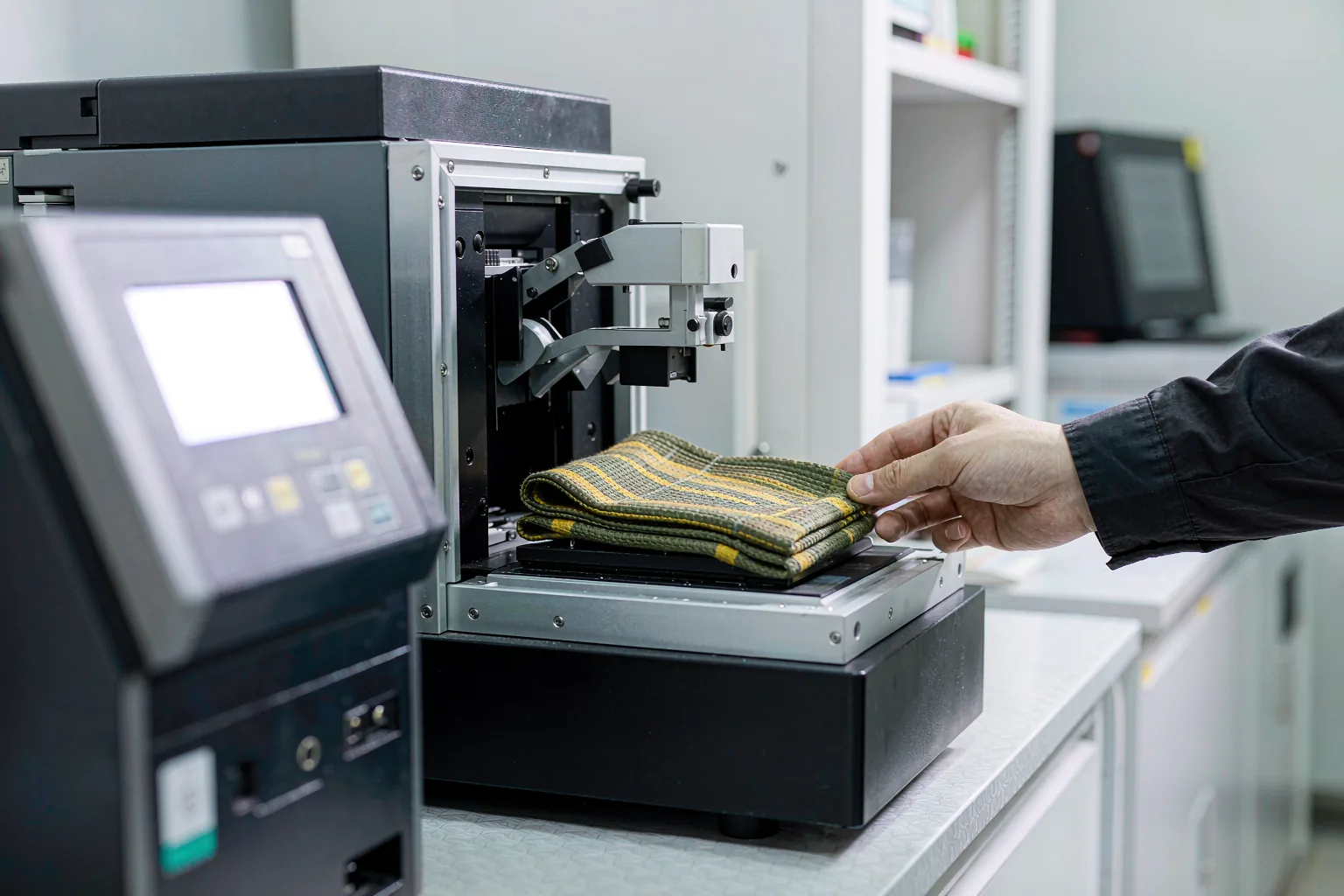
Spectrophotometer measuring a coated fabric sample in a laboratory
The Lot Table
Lot size
Sample
First lot
Full inspection
Repeat
Statistical
After change
Full inspection
Complaint
Tightened
Expedited
Full
Routine
Reduced
The Checkpoint Table
Point
Action
Greige in
Base check
After dyeing
Measure
After coating
Measure
After cutting
Panel check
Assembly
Seam check
Final
Pack check
The Reaction Table
Result
Action
Within tolerance
Release
Borderline
Secondary review
Slight miss
Segregate lots
Clear miss
Reject
Trend visible
Process correction
Repeat miss
Supplier review
The Segregation Table
Situation
Handling
Shade blocks
Keep separate
Slight variation
Assign to inner panels
Visible variation
Different SKU
Mixed in one order
Never
Documented
Yes
Undocumented
Claim risk
The Bulk Record Table
Field
Purpose
Lot number
Traceability
Measured values
Conformance
Standard used
Reference
Inspector
Accountability
Photograph
Evidence
Disposition
Decision
Segregate shade blocks rather than blending them across a production run, because a slight variation spread evenly is acceptable while the same variation clustered in one panel becomes a visible patch on the finished bag.
Batch Traceability and Retained Samples
Traceability is what turns a complaint into a diagnosis instead of an argument, and it needs only a numbered sample and a folder.
The Trace Table
Level
Record
Fibre lot
Supplier
Yarn lot
Mill
Greige roll
Number
Dye batch
Recipe
Coating batch
Line record
Finished roll
Assignment
The Retention Table
Item
Period
Approved standard
Life of product
Production sample
One year
Roll sample
One year
Test report
Contract period
Photograph
Claim period
Measurement log
Contract period
The Trace Complaint Table
Complaint
Trace needed
Shade shift
Dye batch
Streaks
Coating line
Fading
Fastness data
Staining
Hardware finish
Seam contrast
Thread lot
Panel patch
Roll assignment
The Investigation Table
Step
Purpose
Identify lot
Narrow scope
Retrieve sample
Compare
Re-measure
Quantify
Review record
Find deviation
Compare batches
Pattern
Conclude
Corrective action
The Corrective Table
Finding
Action
Recipe drift
Re-standardise
Line drift
Calibrate
Substrate change
Re-qualify
Supplier change
Re-approve
Specification gap
Rewrite
Human error
Retrain
Retain a physical sample from every dye and coating batch for at least a year, because a shade complaint that arrives two seasons later can only be diagnosed against the actual material, not against a number in a database.
Light Fastness and Ageing
A colour that matches on the day of shipment and separates after a season of window display has failed, and the failure is decided by chemistry rather than by matching skill.
The Fastness Table
Rating basis
Meaning
Blue wool scale
Light resistance
Grey scale
Change assessment
Hours tested
Exposure
Condition
Wet or dry
Substrate
Fibre dependent
Pass level
Market defined
The Fastness Material Table
Material
Typical weakness
Dyed nylon
Moderate fading
Dyed polyester
Good
Coated surface
Chalking
Pigment print
Fade uneven
Webbing
Variable
Thread
Often overlooked
The Exposure Table
Condition
Stress
Direct sun
Strongest
Window glass
Filtered but strong
Fluorescent interior
Gradual
Humidity plus light
Accelerated
Heat alone
Yellowing
Storage in dark
Minimal
The Fastness Test Table
Test
Purpose
Xenon arc
Simulated sunlight
UV exposure
Narrow band
Humidity cycle
Combined stress
Heat ageing
Yellowing
Wash test
Colour loss
Crock test
Transfer
The Fastness Specification Table
Market
Emphasis
Outdoor
High fastness
Fashion
Moderate
Children
Stricter
Automotive adjacent
Very high
Promotional
Basic
Contract
Buyer defined
Test the thread and the binding alongside the body fabric, because the small components are frequently specified for strength and ignored for fastness, and they are the first place a faded bag shows its age.
Wet, Abraded and Stressed Appearance
Colour also changes when the material is wet, stretched or rubbed, and those conditions are the ones a bag actually experiences.
The Condition Table
Condition
Effect
Wet fabric
Darker
Wet coating
Glossier
Abraded surface
Lighter
Stretched panel
Paler
Creased fold
Edge lightening
Soiled area
Duller
The Mechanism Table
Change
Cause
Darkening when wet
Less scattering
Lighter when abraded
Fibre damage
Gloss shift
Surface flattening
Pale at stretch
Thinner coverage
Edge lightening
Coating crack
Dulling
Contamination
The Stress Test Table
Test
Measures
Wet crock
Transfer
Dry crock
Surface rub
Martindale
Abrasion change
Flex
Coating crack
Water spot
Staining
Perspiration
Colour change
The Construction Table
Decision
Effect
Coating weight
Crack resistance
Binder choice
Flex life
Dye class
Wet fastness
Finish
Surface strength
Lamination
Hiding
Edge treatment
Fold durability
The Stress Specification Table
Requirement
Written as
Crock rating
Minimum value
Flex cycles
Count
Abrasion cycles
Count
Water spotting
Pass level
Perspiration
Pass level
Wet fastness
Minimum value
Specify wet crock and flex performance on any material that will be folded, because a coating that passes a flat colour check and cracks along a fold announces itself as a pale line on a perfectly matched bag.
Supplier Qualification for Colour
Colour capability is a property of a supplier, not of a shipment, and it needs to be qualified before it is relied upon.
The Capability Table
Factor
Question
Colour kitchen
In house or outsourced
Spectrophotometer
Available
Light booth
Available
Standard storage
Controlled
Batch size
Match to order
Rework ability
Strip or re-dye
The Supplier Assessment Table
Item
Evidence
Equipment list
Documented
Calibration record
Current
Sample performance
Three lots
Repeatability
Measured spread
Traceability
Lot system
Responsiveness
Correction speed
The Trial Table
Stage
Test
Lab dip
Direction
Pilot lot
Repeatability
First bulk
Conformance
Second bulk
Stability
Spot order
Flexibility
Ongoing
Monitoring
The Scorecard Table
Metric
Weight
First pass rate
High
Repeatability
High
Response time
Moderate
Documentation
Moderate
Price
Moderate
Capacity
Moderate
The Disqualifier Table
Signal
Concern
No measurement
Opinion only
No retained samples
No traceability
Frequent rework
Process control
Vague tolerances
Dispute risk
Multiple subcontractors
Consistency
Price far below market
Hidden variability
Qualify a colour supplier on repeatability across three consecutive lots rather than on the quality of the first sample, because almost any dyehouse can hit a target once and far fewer can hit it every month.
Writing the Colour Specification
A specification is the document that survives when the people who agreed the colour have moved on, so it has to be complete enough to be executed by strangers.
The Field Table
Field
Content
Standard reference
Number and date
Tolerance
Numeric
Illuminants
Named
Geometry
Stated
Materials covered
Listed
Sampling
Defined
The Material Row Table
Material
Specification
Body fabric
Against standard
Coated panel
Against body
Webbing
Against body
Binding
Against panel
Thread
Against body
Trim
Family code
The Reference Table
Reference type
Durability
Physical sample
Good, if stored
Numeric values
Best
Photograph
Poor
Colour card
Approximate
Verbal description
Useless
Previous product
Degrades
The Language Table
Phrase
Problem
Close match
Undefined
As per sample
Sample condition
Same as before
Which version
Visually acceptable
Subjective
No obvious difference
Unmeasurable
Buyer approval
Process, not limit
The Governance Table
Item
Owner
Standard custody
Quality
Revision control
Merchandiser
Distribution
Quality
Change approval
Buyer
Archive
Document control
Review cycle
Annual
Replace descriptive language with measured limits wherever a number can be agreed, because visual phrases survive negotiation and not production, and every dispute is settled against the number rather than the adjective.
Disputes and Resolution
Colour disputes are almost never about whether two samples look different. They are about which sample, under which light, measured against which limit.
Inspector comparing a finished backpack panel against a master colour standard card
The Dispute Table
Claim
Typical basis
Too dark
Visual against card
Too light
Photo comparison
Different shade
Different illuminant
Patchy
Dye uniformity
Faded
Fastness
Mismatched panels
Mixed lots
The Evidence Table
Evidence
Weight
Approved standard
High
Measurement record
High
Retained production sample
High
Loading photographs
Moderate
Buyer photograph
Low
Verbal report
Lowest
The Dispute Procedure Table
Step
Method
Receive claim
Written detail
Identify lot
Traceability
Compare physically
Standard present
Re-measure
Same geometry
Assess illuminant
Both parties
Decide
Written outcome
The Outcome Table
Finding
Resolution
Within tolerance
Explained
Outside, our fault
Rework or credit
Outside, spec gap
Shared review
Transport related
Insurance route
Fastness failure
Material change
Repeat
Supplier action
The Prevention Table
Measure
Effect
Dual illuminant approval
Fewer light disputes
Numeric limits
Objective basis
Retained samples
Fast diagnosis
Photograph protocol
Consistent evidence
Early escalation
Lower cost
Written specification
Clear duties
Settle a dispute by comparing the delivered material against the retained production sample from its own lot, because the approved standard tells you what was intended while the lot sample tells you what was actually made.
Defect Grading and Sampling
Colour has to be translated into a pass or fail decision on a piece of paper, and the grading language determines whether that decision holds.
The Grade Table
Grade
Description
Conforming
Within tolerance
Minor
Slight, non-critical
Major
Visible difference
Critical
Unacceptable
Shade block
Segregated
Rework
Correctable
The Location Table
Area
Severity
Front panel
Highest
Side panel
High
Back panel
Moderate
Base
Moderate
Inner lining
Low
Hidden seam
Lowest
The Sampling Table
Basis
Level
Critical defect
Zero accepted
Major
Tight limit
Minor
Defined limit
Colour shade
Per lot
Repeat order
Reduced
Complaint history
Increased
The Grading Record Table
Field
Purpose
Grade
Decision
Location
Severity context
Measurement
Evidence
Inspector
Accountability
Photo
Reference
Disposition
Flow
The Escalation Table
Trigger
Route
Critical found
Stop line
Major cluster
Supervisor
Shade block
Segregate
Repeat issue
Quality manager
Buyer concern
Account manager
Claim
Formal process
Grade colour defects by location as well as by magnitude, because a slight difference on a hidden lining seam is not the same defect as the same difference across the front panel of the same bag.
The Cost of Colour Control
Colour control spends money in a predictable place and saves it in a less visible one, which is why it is the first item cut and the first item missed.
The Cost Control Cost Table
Element
Type
Measurement equipment
Capital
Light booth
Capital
Standards and storage
Recurring
Inspection labour
Recurring
Re-dye and rework
Variable
Rework freight
Variable
The Saving Table
Avoided cost
Relative size
Rejected bulk
High
Air freight replacement
High
Markdown concession
Moderate
Rework labour
Moderate
Claim handling
Low
Lost repeat order
Highest
The Investment Table
Item
Priority
Light booth
First
Spectrophotometer
Second
Standard storage
Third
Sample archive
Fourth
Training
Continuous
Software
Later
The Payback Table
Scenario
Effect
One bulk rejection avoided
Pays equipment
One air freight avoided
Pays a year
One repeat order retained
Pays programme
Reduction in rework
Ongoing
Faster approval
Time saving
Fewer disputes
Management time
The Budget Table
Line
Basis
Equipment
One-off
Materials
Per lot
Labour
Per inspection
Training
Annual
External tests
Per material
Certification
Per market
Buy the light booth before the spectrophotometer, because most colour disputes are about appearance under a light source rather than about a number, and a number alone cannot settle an appearance argument.
Coordinating Dyehouse and Coater
The two suppliers that determine the final colour rarely talk to each other, and the factory sits between them holding the only shared reference.
The Interface Table
Interface
Risk
Standard distribution
Different copies
Substrate supply
Base variation
Timing
Coating before dye
Feedback
Second hand
Rework
Blame shift
Approval
Split authority
The Communication Table
Item
Method
Standard issue
Physical plus data
Change notice
Written
Sample exchange
Both parties
Meeting
At pilot stage
Record
Shared folder
Escalation
Named contact
The Sequencing Table
Order
Reason
Dye pilot
Establishes base
Approve dye
Lock variable
Coating trial
Match to base
Approve coating
Lock second
Bulk dye
Production
Bulk coat
Follows dye
The Responsibility Table
Party
Owns
Factory
Standard custody
Dyehouse
Base match
Coater
Adjustment
Buyer
Final approval
Quality
Verification
Merchandiser
Timeline
The Coordination Conflict Table
Conflict
Resolution
Each claims match
Shared booth check
Different standards
Audit origin
Late change
Cost and time
Rework disputed
Traceability
Capacity pressure
Re-sequence
Repeat failure
Joint review
Issue one physical standard to both suppliers with the same issue number and date, because two copies made at different times become two references and the difference is discovered only after both bulk lots arrive.
Pre-Shipment Checklist
Design Stage
Item
Done
Standard sample approved
☐
Dual illuminant checked
☐
Numeric tolerance set
☐
Materials listed
☐
Trim family agreed
☐
Specification issued
☐
Production Stage
Item
Done
Greige base checked
☐
Dye lot measured
☐
Coating lot measured
☐
Shade blocks segregated
☐
Components verified
☐
Retained samples filed
☐
Dispatch Stage
Item
Done
Final visual check
☐
Assembly seam match
☐
Photographs taken
☐
Records attached
☐
Buyer notified
☐
Sample archive updated
☐
FAQ
These are the questions that come up most often when a colour programme is reviewed with a buyer, answered from the production side where the constraint is always what can be measured and held rather than what can be agreed in a meeting.
Why do two materials that match in the factory look different in a shop?
Because the reflectance curves differ even when the average colour is close, which is metamerism. A factory booth usually runs a controlled illuminant, and a retail environment mixes LED, fluorescent and daylight. The pair that matched under one source separates under another. Approving under two illuminants, including the one the product sells under, catches this before production.
Should we match the coating to the fabric or the fabric to the coating?
Match the fabric first and tint the coating to it. Dyeing is the harder process to pull back once it has gone too dark, while a coating can be adjusted with pigment additions at the line. Setting the coating before the fabric commits two variables at once and leaves no economical way to correct the larger one.
How tight should the colour tolerance be?
Tight enough for materials that touch and looser for materials that do not. A binding tape runs along the seam beside a large panel, so any difference there is easy to see, while the lining sits inside the bag and can be looser. Applying one tolerance to every component either overprices the hidden parts or under-controls the visible ones.
What causes a visible patch on a single panel?
Usually a shade block inside one lot rather than a dyeing failure. Small variations spread evenly are invisible, but the same variation clustered in one roll becomes a patch once that roll is cut into a panel. Segregating shade blocks at the roll stage and assigning them deliberately is the control.
Do small components really need fastness testing?
Yes, and they are usually the first to fail. Thread, binding and webbing are often specified for strength and cost, then left out of the fastness programme. Because they run in narrow lines across the bag, a faded thread reads as a faded product even when the body fabric has held its colour well.
Can a photograph settle a colour claim?
Rarely on its own. Camera white balance, exposure and the screen used to view it all change the appearance of the same material. A photograph is useful as supporting evidence when it is taken under a fixed protocol and accompanied by measurement records, but the physical sample from the same lot is what decides the outcome.
How do we handle a buyer who approves colour verbally?
Convert it to a signed standard before bulk. A verbal approval has no reference object and no limit, so there is nothing to measure against when a complaint arrives months later. The practical route is to submit a physical sample, record the measured values, ask for written confirmation and retain a sealed copy.
What is the first piece of equipment a small factory should buy?
A light booth. Most colour disputes concern appearance rather than numeric difference, and a booth gives both parties a common viewing condition for a modest cost. A spectrophotometer adds precision and trend data, but it cannot resolve an argument about how a material looks in a shop window.
Conclusion
Colour consistency across mixed materials is a control system rather than a skill held by one experienced person. It starts with an approved standard that is physically stored and sealed, continues with numeric tolerances that differ by material and by proximity, and depends on dual illuminant approval so that a match survives the light it will actually be sold under.
The processes diverge in predictable ways. Dye enters the fibre and is slow to correct; pigment sits on the surface and can be tinted. Texture and gloss shift perceived depth before any pigment is involved. Hardware cannot be matched at all and must be standardised by finish family. Small components cause a disproportionate share of complaints because they run beside large panels where any difference is visible.
What makes it hold is unglamorous: measure first and look second, segregate shade blocks instead of blending them, retain a sample from every dye and coating batch, and write limits as numbers rather than as adjectives. A factory that does those four things ships seasonal colour programmes without the annual argument, and one that does not will keep discovering that the sample matched and the shipment did not.