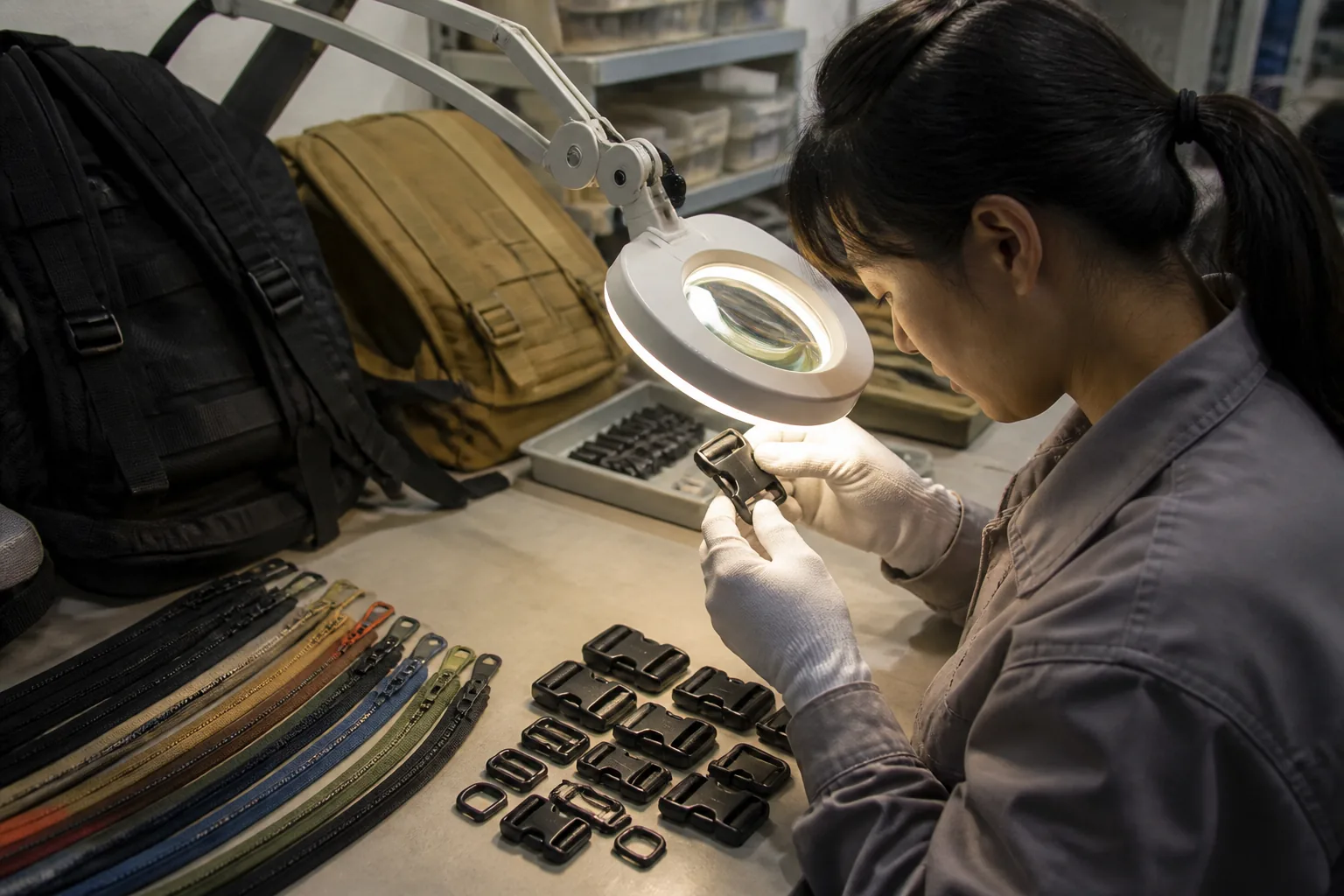
Backpack Trim Selection: What Makes Hardware Look and Feel Premium?
Backpack Trim Selection: What Makes Hardware Look and Feel Premium?
A buyer handling a sample for the first time touches three things before reading a single specification: the fabric, the zipper pull, and the buckle. Two of those three are trim.
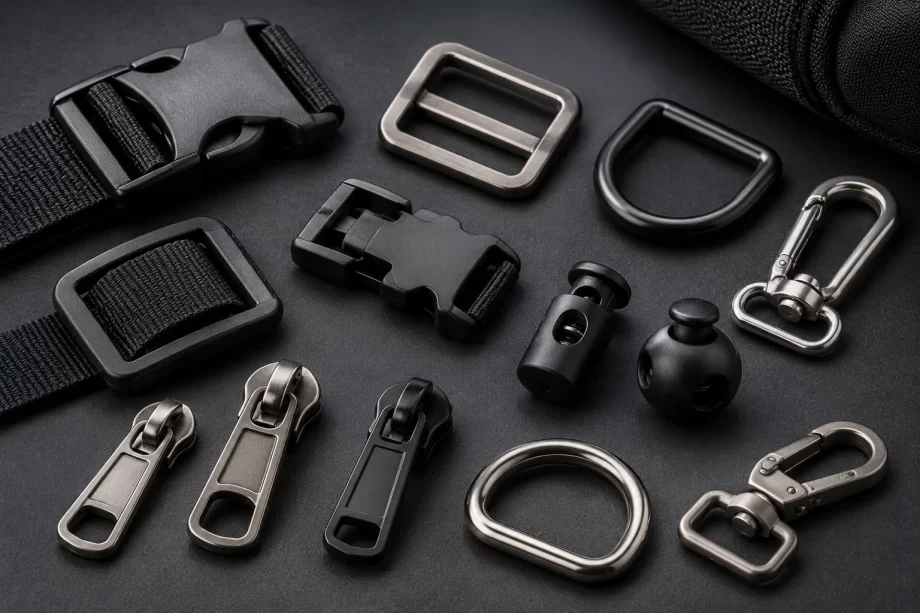
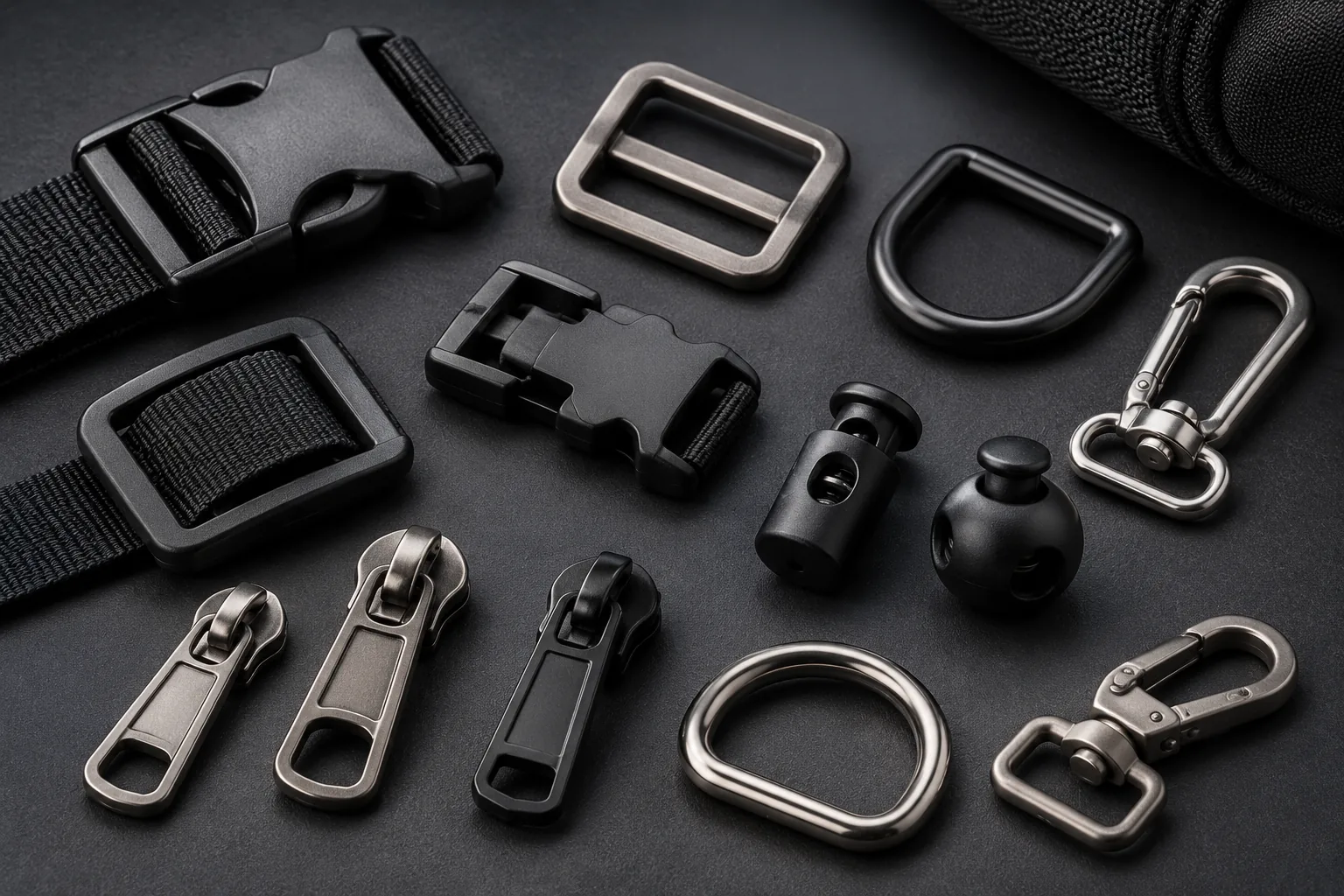
Backpack hardware trim components arranged on a dark surface
Trim is where perceived value is decided out of proportion to its cost. A buckle worth a few cents can make a bag feel expensive or cheap, and the difference is not price alone. It is mass, surface consistency, the sound a slider makes, the way a pull returns, the absence of a visible seam where the plating stops.
Factories that get this right treat trim as an engineered system rather than a catalogue purchase. They specify alloy and finish by name, test the assembly rather than the component, and match the aesthetic family across every metal part on the bag. Those that do not end up shipping a bag whose zipper pull, D-ring and adjuster are three slightly different metals, which the eye registers immediately even when the buyer cannot name the problem.
This guide covers how trim selection is actually made in production: which properties create the premium impression, how finishes behave over time, how durability is proven before bulk, how cost tiers map to realistic use, and how to control a trim schedule so the fifth shipment matches the first.
The impression is built from measurable properties, and once they are named they can be specified rather than hoped for.
The Signal Table
Signal
Perception
Mass
Solid, expensive
Surface uniformity
Precision
Edge finish
Care
Movement
Quality mechanism
Sound
Mechanical confidence
Alignment
Assembly discipline
The Property Table
Property
Effect on feel
Alloy density
Weight in hand
Wall thickness
Rigidity
Plating thickness
Depth of colour
Polish
Reflectance
Spring tension
Snap
Tolerance
Rattle or silence
The Premium Failure Table
Failure
Reads as
Thin plating
Cheap shine
Sharp edge
Unfinished
Loose joint
Sloppy
Rattle
Low tolerance
Colour drift
Inconsistent
Plastic imitation
Substitute
The Premium Comparison Table
Tier
Character
Entry
Light, plated zinc
Mid
Heavier zinc, better plate
Upper
Brass or alloy, thick plate
Premium
Machined, tight tolerance
Luxury
Branded, hand finished
Overbuilt
Heavier than needed
Judge trim by three senses in a fixed order, weight, movement and sound, because the hand detects mass before the eye resolves a finish and the ear catches a loose mechanism that a visual check passes.
Trim Categories and Where They Sit
Each trim family has a different failure mode and a different cost curve, so they are specified separately even when they appear together.
The Category Table
Category
Function
Buckles
Load connection
Adjusters
Length control
D-rings
Attachment
Hooks
Quick connect
Zippers
Access
Pullers
Grip
The Category Material Table
Material
Character
Zinc alloy
Common, castable
Brass
Heavy, durable
Aluminium
Light, anodised
Steel
Strong, plated
Acetal
Engineering plastic
Nylon
Light duty
The Placement Table
Location
Requirement
Shoulder anchor
High load
Sternum
Low load
Compression
Moderate
Lid
Access speed
Hip belt
High load
Internal
Light duty
The Application Table
Use case
Trim priority
Commuter
Aesthetics
Hiking
Strength
Travel
Security
School
Durability
Laptop
Slim profile
Promotional
Cost
The Risk Table
Risk
Consequence
Under-specified load
Field failure
Over-specified
Cost and weight
Mixed finishes
Visual mismatch
Single supplier
Supply risk
No test data
Unproven claim
Uncontrolled change
Drift
Match the trim tier to the load path rather than to the retail price, because a premium-priced commuter bag does not need a mountaineering buckle and a load-bearing hip belt cannot be built from a decorative one.
Surface Finishes and Plating Quality
Finish is the first thing judged and the first thing to degrade, so it is specified in microns rather than in adjectives.
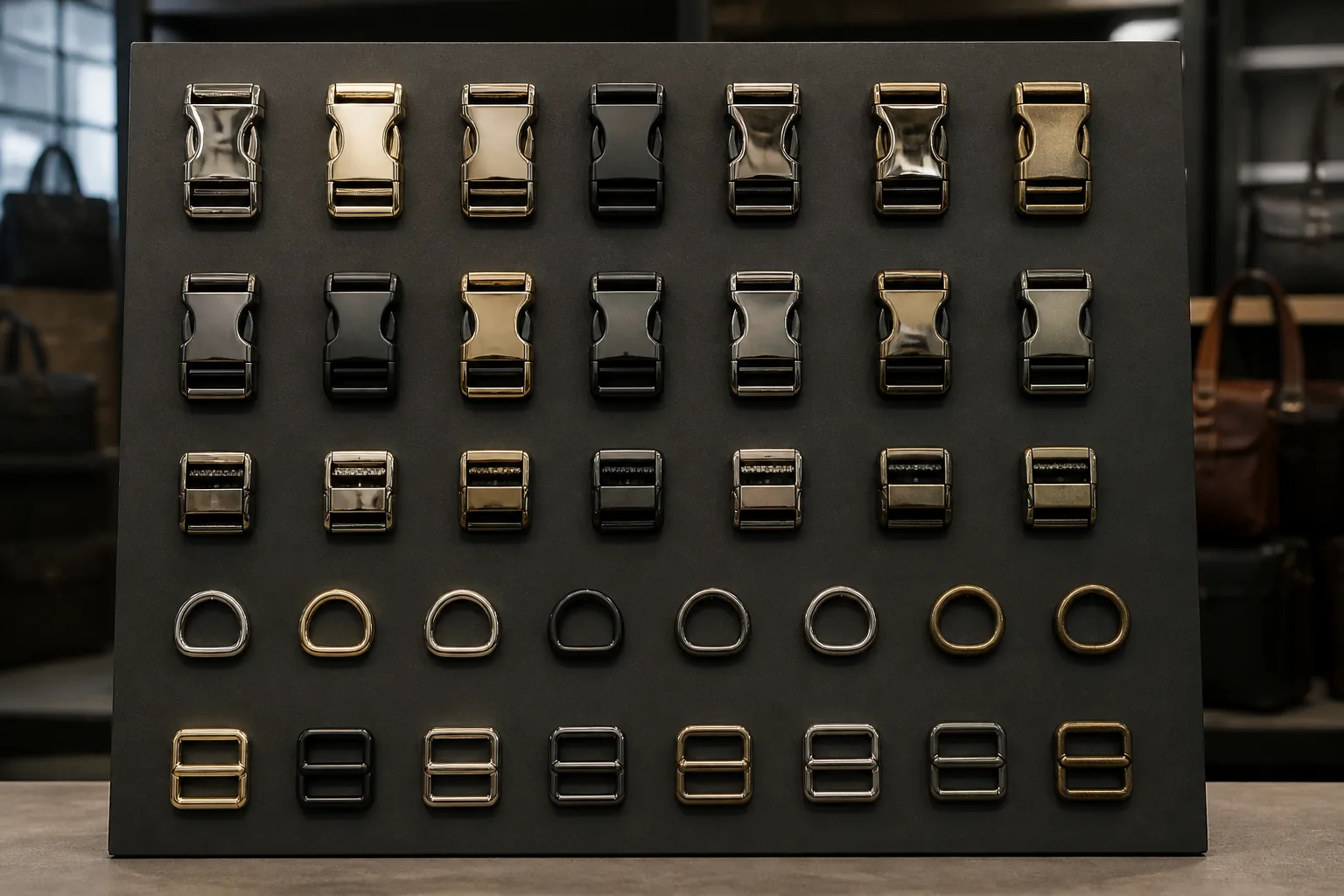
Trim sample board with metal and plastic buckles mounted in rows
The Finish Table
Finish
Maintenance
Matte black
Low visible wear
Satin nickel
Smudge tolerant
Antique brass
Hides scratches
Polished chrome
Shows marks
Painted
Chips visibly
Anodised
Resists abrasion
The Plating Table
Layer
Purpose
Base metal
Structure
Copper strike
Adhesion
Nickel layer
Levelling
Top plate
Appearance
Lacquer
Protection
Seal
Durability
The Thickness Table
Specification
Expectation
Very thin
Fails quickly
Thin
Indoor use
Standard
General
Thick
Demanding
Multi-layer
Premium
Unspecified
Unknown
The Finish Defect Table
Defect
Cause
Pitting
Contamination
Blistering
Adhesion failure
Colour uneven
Bath control
Sharp flash
Mould or die
Dull patch
Polish skip
Peeling
Poor pre-treatment
The Finish Test Table
Test
Indicates
Salt spray
Corrosion
Adhesion tape
Bonding
Abrasion rub
Wear
Humidity
Stability
Perspiration
Skin contact
Impact
Chip risk
Specify plating thickness in microns and require the salt spray hours that go with it, because a finish named antique brass tells a supplier nothing about how it will look after a year of handling.
Alloy Choice and Weight Distribution
Weight in the hand is a deliberate design decision, and it can be engineered without adding meaningful carried load.
The Alloy Table
Alloy
Behaviour
Zinc
Castable, low cost
Zinc plus aluminium
Stronger
Brass
Heavy, premium
Aluminium
Light, softer
Stainless steel
Strong, heavy
Engineering plastic
Light, quiet
The Weight Table
Component
Contribution
Buckles
Noticeable
Adjusters
Low
D-rings
Low
Zipper sliders
Moderate
Pullers
Can be tuned
Hardware set
Cumulative
The Distribution Table
Strategy
Effect
Heavy at anchor points
Feels solid
Heavy at pullers
Noticeable in use
Balanced set
Coherent
Random mix
Inconsistent
All lightweight
Reads cheap
All heavy
Overbuilt
The Trade Table
Choice
Cost
Brass over zinc
Higher unit cost
Machined over cast
Higher tooling
Thicker plate
Process cost
Tighter tolerance
Inspection cost
Custom finish
Minimum order
Branded pull
Tooling
The Justification Table
Segment
Justified weight
Everyday carry
Moderate
Travel
Moderate to high
Technical
Function over feel
Fashion
Feel over function
Promotional
Minimal
Children
Light and safe
Place the mass where the hand meets the product, at pullers and at the primary buckle, rather than spreading it evenly, because the perceived weight of a bag is judged at two or three contact points and not at the scale.
Mechanisms: Buckles, Adjusters and Hooks
A mechanism is judged by what it does under a thumb, and the tolerances behind that movement decide whether it feels precise or loose.
The Mechanism Mechanism Table
Type
Character
Side release
Common, user friendly
Cam lock
Fast adjustment
Ladder lock
Secure, static
G-hook
Minimal, technical
Magnetic
Convenient, premium
Snap hook
Removable
The Action Table
Quality
Sensation
Tight tolerance
Clean engagement
Loose tolerance
Wobble
Strong spring
Positive click
Weak spring
Ambiguous
Smooth release
Controlled
Sticky release
Frustrating
The Mechanism Failure Table
Failure
Cause
Accidental release
Weak retention
Won’t release
Over-tension
Slipping under load
Cam wear
Jamming
Debris or tolerance
Cracking
Brittle plastic
Corroded spring
Plating failure
The Mechanism Load Table
Mechanism
Typical duty
Sternum buckle
Light
Shoulder release
Moderate
Hip belt buckle
Heavy
Compression hook
Moderate
Lid buckle
Light
Attachment clip
Light
The Selection Table
Priority
Choose
Security
Metal hook
Speed
Magnetic or cam
Simplicity
Side release
Weight
Plastic
Premium feel
Machined metal
Serviceability
Replaceable
Test every mechanism with the actual webbing it will be used with, because a buckle that releases cleanly on a sample strap can bind on a thicker or stiffer production webbing of the same nominal width.
Zippers and Sliders
The zipper is the most operated mechanism on the bag, and its quality is felt every single time the bag is opened.
The Chain Table
Type
Character
Coil
Flexible, light
Vislon
Moulded, strong
Metal
Heavy, premium
Invisible
Concealed
Water resistant
Coated
Two-way
Versatile
The Slider Table
Feature
Effect
Metal body
Weight, feel
Painted body
Colour match
Locking
Security
Auto-lock
Stays closed
Non-lock
Free movement
Replaceable pull
Service
The Size Table
Number
Use
Small
Internal pockets
Medium
Main light access
Large
Main compartment
Extra large
Heavy load
Two-way large
Travel
Mixed sizes
Function driven
The Zipper Failure Table
Failure
Cause
Split behind slider
Damaged teeth
Stiff operation
Alignment
Slider derailed
Tolerance
Pull detached
Weak attachment
Coating peel
Poor bonding
Corrosion
Plating
The Specification Table
Item
Recorded
Chain type
Code
Slider finish
Family
Pull type
Reference
Tape colour
Standard
Length
Per pattern
Test cycles
Target
Match slider finish to the rest of the metal family rather than to the tape colour, because a painted slider that matches the fabric perfectly still looks wrong beside an antique brass buckle on the same panel.
Pullers, Cord and Grip
A puller is the smallest component on the bag and the one the hand returns to most often, which makes it disproportionately important.
The Puller Table
Type
Character
Cord loop
Light, quiet
Cord with tab
Better grip
Leather tab
Premium, warm
Metal tab
Heavy, precise
Molded tab
Cost effective
Knotted cord
Simple
The Grip Table
Factor
Effect
Width
Finger comfort
Thickness
Purchase
Texture
Slip resistance
Stiffness
Control
Length
Leverage
Weight
Perceived quality
The Attachment Table
Method
Durability
Bartack
Strong
Box and cross
Strongest
Rivet
Strong, visible
Knot only
Weak
Glued
Unreliable
Screw pin
Serviceable
The Puller Material Table
Material
Wear
Braided cord
Frays slowly
Leather
Patinas
Coated webbing
Durable
TPU
Cleanable
Metal
Scratches
Plastic
Cracks
The Detail Table
Detail
Impression
Even stitching
Care
Tidy knot
Craft
Symmetry
Discipline
Colour match
Coherence
Weight balance
Intent
Replaceability
Service
Give the main compartment a puller large enough for two fingers and a gloved hand, because the grip is the part of the bag the user touches most and an undersized pull communicates cheapness more efficiently than any other single detail.
Durability Testing and Standards
Trim failures are expensive out of proportion to component cost, because a failed buckle can return a whole bag, so testing is done before bulk rather than after.
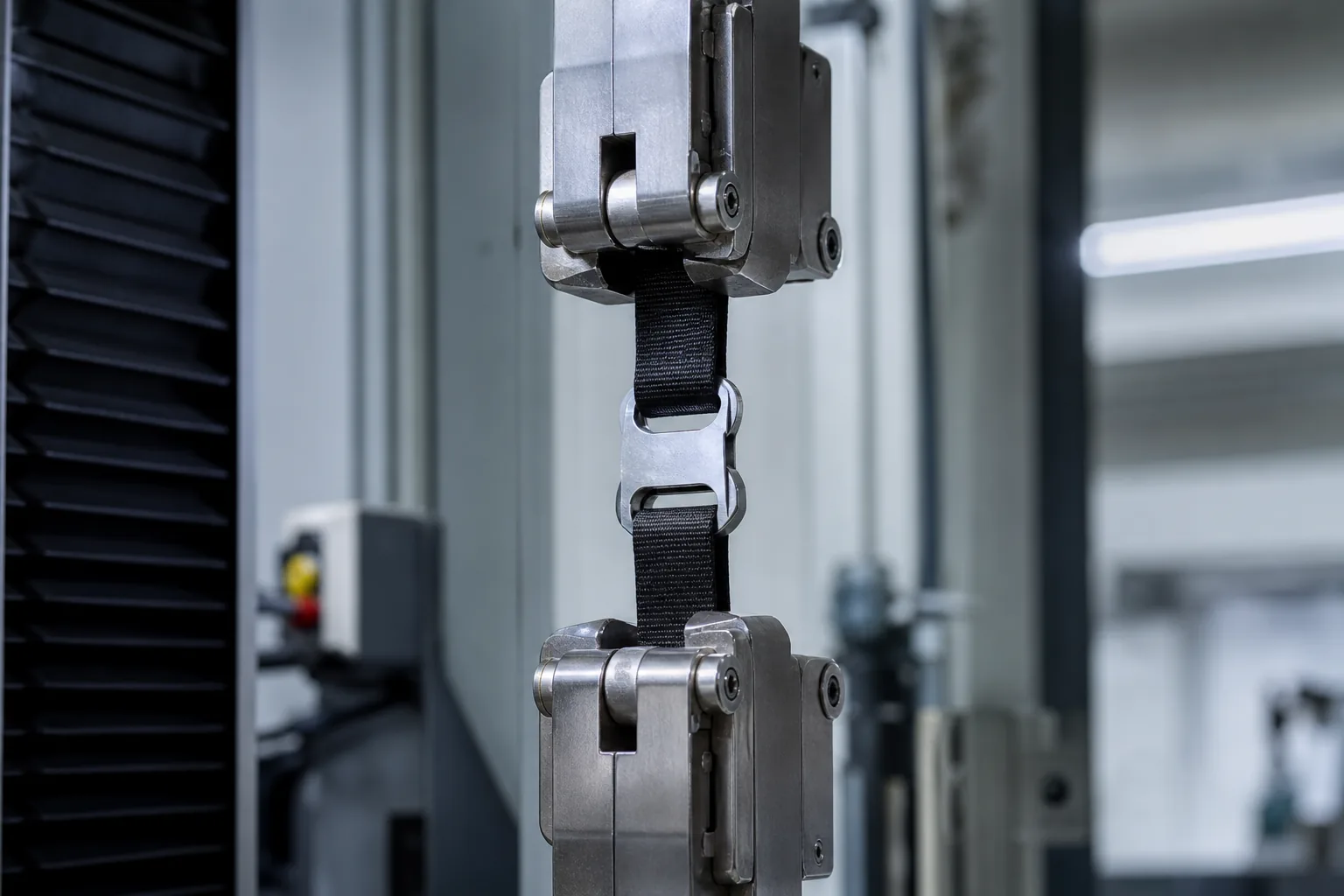
Tensile testing machine pulling a metal buckle attached to webbing
The Test Standard Test Table
Test
Purpose
Static load
Strength
Cycle test
Endurance
Salt spray
Corrosion
Drop test
Impact
Abrasion
Surface wear
Temperature
Range
The Cycle Table
Component
Cycles
Buckle open close
Thousands
Zipper traverse
Thousands
Adjuster movement
Thousands
Hook engagement
Thousands
Puller flex
Thousands
Strap flex
Thousands
The Test Standard Load Table
Point
Standard
Shoulder anchor
Highest
Hip belt
High
Compression
Moderate
Accessory loop
Low
Internal clip
Low
Key hook
Minimal
The Standard Table
Reference
Covers
Buyer protocol
Most common
Brand internal
Stricter
Lab method
Repeatable
Industry guide
Baseline
Retail requirement
Specific
No standard
Unproven
The Report Table
Item
Content
Sample
Identification
Method
Procedure
Result
Values
Failure mode
Description
Photograph
Evidence
Conclusion
Pass or fail
Test the trim as an assembly with its webbing, because a buckle rated for a load on a test rig and the same buckle sewn onto a strap with the wrong stitch pattern are two different products.
Corrosion and Real World Exposure
Salt spray hours are a laboratory number, and the field is a different test, so the specification has to translate between them.
The Exposure Table
Environment
Stress
Coastal
High salt
Urban commute
Perspiration
Tropical
Humidity
Winter road salt
Aggressive
Gym
Sweat and abrasion
Storage
Condensation
The Corrosion Mechanism Table
Corrosion type
Appears as
Surface oxidation
Dulling
Pitting
Small dark spots
Galvanic
At mixed metal contact
Crevice
Around joints
Stress
Cracks
Fretting
Wear debris
The Salt Spray Table
Hours
Suitable for
Very low
Indoor only
Low
Light duty
Moderate
General
High
Outdoor
Very high
Marine
Unspecified
Risk
The Prevention Table
Measure
Effect
Thicker plating
Longer life
Lacquer seal
Barrier
Rinsing after use
Removes salt
Avoid mixed metals
Less galvanic
Stainless choice
Inherent resistance
Drainage design
Less pooling
The Corrosion Claim Table
Complaint
Real cause
Buckle rusted
Plate too thin
Green skin marks
Copper contact
White powder
Zinc corrosion
Slider stiff
Corrosion in channel
Pull discoloured
Lacquer wear
Spotting
Galvanic pair
Specify corrosion performance against the market the bag is sold into rather than against a generic standard, because a finish that survives a dry inland city is not the same specification as one that survives a coastal commuter’s daily perspiration.
Incoming Inspection and AQL
Trim arrives in bulk bags of thousands of pieces, and the inspection that catches problems is a sampling routine with clear reject rules.
Inspector examining finished backpack buckles and zipper pullers under a magnifier lamp
The Incoming Table
Check
Method
Quantity
Count
Finish
Visual against standard
Colour
Under light
Function
Sample operate
Dimensions
Gauge
Marking
Supplier code
The Sampling Table
Lot size
Sample
Small
Higher proportion
Medium
Standard
Large
Statistical
First lot
Full
Repeat
Reduced
Complaint
Tightened
The Incoming Defect Table
Class
Example
Critical
Structural crack
Major
Function failure
Major
Finish miss
Minor
Cosmetic mark
Minor
Flash
Accept
Within limit
The Disposition Table
Result
Action
Pass
Release to store
Marginal
Segregate
Fail
Return
Fail repeated
Supplier review
Mixed lots
Re-identify
Unlabelled
Quarantine
The Incoming Record Table
Field
Purpose
Lot number
Trace
Supplier
Accountability
Result
Decision
Inspector
Ownership
Photograph
Evidence
Date
Timeline
Quarantine any trim delivery that arrives without a lot code, because an unlabelled carton of buckles cannot be traced to a plating batch when a corrosion complaint arrives six months later.
Sample Boards and Approval
A trim board is the physical dictionary every later decision refers to, and it is worth more than any photograph in a specification pack.
The Board Table
Element
Content
Components
All trim
Finish name
Supplier code
Size
Actual
Mounting
Fixed
Label
Reference
Date
Version
The Approval Table
Stage
Decision
Shortlist
Options
Board
Visual family
Sample bag
In context
Handling test
Feel
Sign off
Frozen
Archive
Retained
The Sample Board Comparison Table
Method
Reliability
Physical board
Highest
Sample bag
High
Photograph
Low
Catalogue image
Lowest
Description
None
Memory
None
The Freeze Table
Change
Consequence
Finish change
Re-approval
Supplier change
Re-test
Alloy change
Re-test
Dimension change
Re-fit
Colour change
Re-board
Silent change
Claim risk
The Sample Board Record Table
Item
Retention
Board
Life of product
Approval sheet
Contract period
Test reports
Contract period
Photographs
Claim period
Correspondence
Contract period
Revision log
Permanent
Approve trim in the context of a finished sample bag rather than on a board alone, because components that look coherent mounted in rows can still read as mismatched once they sit on a curved panel under the light of a shop.
Cost Tiers and Value Engineering
Trim is a small share of landed cost and a large share of perceived quality, which makes it the most efficient place to spend and the most damaging place to save.
The Tier Table
Tier
Typical content
Economy
Plated zinc, basic
Standard
Better plate, tested
Mid premium
Alloy with finish control
Premium
Machined, tight tolerance
Luxury
Branded, hand finish
Hybrid
Premium at touch points
The Spend Table
Location
Return
Primary buckle
High
Main puller
High
Zipper slider
High
D-rings
Moderate
Internal hardware
Low
Hidden clips
Lowest
The Saving Table
Saving
Risk
Thinner plate
Corrosion
Cheaper alloy
Breakage
Fewer tests
Field failure
Single source
Supply
No spares
Service cost
Mixed finish
Visual defect
The Engineering Table
Lever
Result
Standardise sizes
Volume price
Share finishes
Fewer SKUs
Reduce variants
Inventory
Combine orders
Freight
Simplify geometry
Tooling
Qualify second source
Resilience
The Calculation Table
Factor
Weight
Unit cost
Base
Failure rate
Multiplier
Return cost
Multiplier
Assembly time
Modifier
Inspection cost
Modifier
Brand damage
Unquantified
Spend the trim budget at the two or three points the customer touches and standardise everything else, because a premium puller and a matched buckle buy more perceived value than upgrading every internal clip on the bag.
Supplier Qualification for Trim
Trim suppliers are judged on process control rather than on catalogue range, because the same drawing from two factories produces two different products.
The Capability Table
Factor
Evidence
Own plating
Control
Subcontracted plating
Audit needed
Mould ownership
Continuity
Test lab access
Verification
Batch marking
Traceability
Capacity
Delivery
The Audit Table
Area
Question
Incoming metal
Certified
Plating bath
Monitored
Thickness gauge
Calibrated
Salt spray
In house or external
Final inspection
Documented
Packing
Protected
The Sample Table
Stage
Purpose
Catalogue sample
Appearance
Test sample
Data
Pilot lot
Consistency
First bulk
Conformance
Repeat bulk
Stability
Annual
Requalification
The Scorecard Table
Metric
Weight
Conformance rate
High
Test documentation
High
Lead time
Moderate
Responsiveness
Moderate
Price
Moderate
Flexibility on small lots
Moderate
The Warning Table
Signal
Concern
No test data
Unverified
Vague finish names
Inconsistency
Frequent alloy substitution
Hidden change
No lot marking
Traceability
Only catalogue photos
Reality gap
Price far below market
Material risk
Qualify a trim supplier on three consecutive conforming lots and an unannounced process audit, because a first order is a sample of the supplier’s attention and the third order is a sample of their system.
Restricted Substances and Sustainability
Trim carries a disproportionate compliance load, because platings, dyes and plasticisers are the components regulators scrutinise most closely.
The Substance Table
Area
Concern
Nickel release
Skin contact
Lead
Solder and alloy
Cadmium
Plating
Phthalates
Soft plastic
Azo dyes
Tape colour
PFAS
Water repellency
The Documentation Table
Document
Purpose
Declaration of conformity
Compliance
Test report
Evidence
Material safety data
Handling
RSL acknowledgement
Buyer requirement
Certificate of origin
Customs
Change notification
Continuity
The Market Table
Region
Emphasis
Europe
Nickel release, RSL
North America
Lead, phthalates
Japan
Detailed documentation
Australia
Labelling
Global brand
Own RSL
Marketplace
Category rules
The Compliance Material Table
Choice
Sustainability angle
Recycled zinc
Lower footprint
Recycled aluminium
Energy saving
Bio based plastic
Feedstock
Mono material
Recyclability
Replaceable parts
Longevity
Repairable design
Service life
The Compliance Claim Table
Claim
Requires
Recycled content
Traceable certificate
Nickel free
Test evidence
Vegan
Material declaration
PFAS free
Full chain statement
Recyclable
Design plus route
Durable
Test data
Collect restricted substance declarations with every trim purchase order rather than once per year, because a supplier that changes its plating subcontractor mid-year invalidates the declaration already on file.
The Trim Schedule and BOM Control
A trim schedule is a living document, and the reason bags drift between shipments is almost always a schedule that was allowed to drift with them.
The Schedule Table
Field
Content
Reference
Internal code
Supplier
Approved source
Finish code
Exact
Size
Metric
Material
Specification
Application
Where used
The Change Table
Change type
Route
Cosmetic
Approval required
Functional
Re-test
Supplier
Re-qualify
Cost driven
Buyer sign off
Emergency
Written waiver
Silent
Prohibited
The BOM Table
Level
Control
Style
Trim set
Colourway
Finish family
Size variant
Component size
Market variant
Compliance
Spare parts
List
Packaging
Included
The Inventory Table
Situation
Practice
Long lead time
Buffer stock
Seasonal finish
Pre-buy
Single source
Second source
Excess stock
Risk of stale plate
Mixed lots
Segregate
Ageing
Inspect before use
The Drift Table
Symptom
Cause
Slight colour change
Different plating bath
Weight difference
Alloy substitution
Stiffer action
Tolerance change
Different sheen
Polish skip
New sharp edge
Mould wear
Nothing documented
Unmanaged
Treat any trim substitution as a design change requiring re-approval even when the price and function are identical, because the customer will notice a finish difference that the purchasing department recorded as an equivalent part.
Keeping Metals Coherent Across a Bag
A bag typically carries three to six metal components from different suppliers, and the eye judges them as one family whether or not they were specified as one.
The Family Table
Family
Members
Warm gold
Buckles, D-rings
Cool silver
Sliders, hooks
Blackened
All of the above
Two tone
Deliberate accent
Mixed
Usually accidental
None
Plastic only
The Variable Table
Variable
Risk
Base metal
Tonal difference
Plating thickness
Depth
Polish level
Sheen
Lacquer
Warmth
Supplier
Family break
Batch
Subtle shift
The Control Table
Control
Method
Single family code
Written standard
Master set
Physical sample
Light check
Dual source
Batch comparison
Against master
Supplier briefing
All parties
Periodic review
Sampling
The Exception Table
Design intent
Acceptable
Contrast accent
Deliberate mix
Logo plate
Different finish
Branded pull
Signature metal
Functional steel
Hidden
Reflector
Non metal
Accidental
Not acceptable
The Perception Table
Combination
Reads as
All matched
Considered
Slight mismatch
Careless
Strong contrast
Designed
Random mix
Cheap
Matched to fabric
Coherent
Ignored
Inconsistent
Issue one finish code to every trim supplier rather than one per material, because a code that describes the intended appearance is the only thing that keeps a plater and a zipper supplier aligned without a physical sample in front of both.
Field Failures and What They Reveal
Every trim failure in the field points back to a specification or inspection gap, and the pattern is consistent across markets.
The Field Failure Table
Failure
Underlying gap
Buckle cracked
Impact not tested
Strap slipped
Cam wear untested
Slider split
Chain mismatch
Pull torn off
Stitch pattern
Rust spotting
Plate too thin
Paint chipped
Coating adhesion
The Season Table
Timing
Trigger
First weeks
Assembly defect
First months
Handling weakness
First winter
Cold brittleness
First summer
Perspiration corrosion
Year two
Wear and fatigue
Later
Storage degradation
The Customer Table
Segment
Failure mode
Students
Abrasion
Commuters
Edge wear
Travellers
Slider stress
Hikers
Load failure
Children
Impact
Corporate
Storage ageing
The Diagnosis Table
Evidence
Conclusion
Clean break
Brittle material
Bent then broke
Overload
Corrosion at joint
Plating gap
Wear pattern
Friction
Matched failures
Batch issue
Scattered failures
Design issue
The Correction Table
Finding
Action
Material weakness
Change alloy
Specification gap
Rewrite
Inspection miss
Tighten AQL
Supplier drift
Requalify
Design stress
Modify geometry
User misuse
Improve labelling
Treat a repeat failure as a specification problem rather than a supplier problem, because the same defect appearing across two suppliers usually means the drawing asked both of them to build something that fails.
Building a Trim Standard
The difference between a factory that ships consistent trim and one that renegotiates it every season is a written standard with a named owner.
The Element Table
Element
Content
Finish families
Named set
Approved sources
Per component
Test protocol
Fixed
Tolerance
Written
Approval authority
Named
Review cycle
Annual
The Governance Table
Role
Owns
Design
Intent and family
Engineering
Specification
Quality
Inspection and tests
Purchasing
Suppliers
Production
Application
Merchandiser
Schedule control
The Maturity Table
Level
Character
Ad hoc
Catalogue picks
Documented
Written list
Tested
Data on file
Controlled
Change process
Optimised
Value engineered
Standardised
Reused sets
The Programme Table
Action
Frequency
Board review
Seasonal
Supplier audit
Annual
Test refresh
Annual
Specification audit
Annual
Price review
Contract cycle
Failure review
Continuous
Give the trim standard a single owner in engineering rather than shared custody across design and purchasing, because shared custody is how a finish family quietly acquires a fourth slightly different metal.
Development Lead Times and Tooling
Custom trim extends the development calendar more than most buyers expect, and the tooling decision determines whether a finish can be reproduced in later seasons.
The Lead Time Table
Stage
Duration
Drawing review
Days
Mould quote
One week
Mould making
Weeks
First shots
Days
Plating trial
Days
Approval
Days
The Tooling Table
Item
Ownership
Mould
Buyer or factory
Die
Supplier
Plating jig
Supplier
Logo insert
Buyer
Sample set
Buyer
Maintenance
Negotiated
The Constraint Table
Constraint
Effect
Minimum order
Volume
Colour batch
Finish runs
Plating bath size
Lot quantity
Mould cost
Upfront
Lead time
Planning
Change cost
Late edits
The Reuse Table
Approach
Benefit
Standard body, custom insert
Low tooling
Stock part, custom finish
Brand look
Shared mould across styles
Amortised
Family of components
Coherent
Annual refresh
Predictable
One off design
Expensive
Keep the mould in a location you control or hold written custody terms, because a custom buckle whose tooling sits with a supplier who later exits the business removes the component from the range entirely.
Spare Parts and Aftercare
Trim is the part of a bag that wears first and the easiest part to make serviceable, which makes it a cheap route to a longer product life.
The Spare Table
Part
Priority
Main buckle
High
Zipper puller
High
Cord
High
D-ring
Moderate
Adjuster
Moderate
Internal clip
Low
The Kit Table
Content
Purpose
Buckle
Replacement
Puller
Repair
Cord length
Repair
Instructions
Guidance
Tool
Fitting
Bag
Storage
The Service Table
Route
Availability
Spares in box
Universal
Dealer stock
Regional
Mail request
Post purchase
Repair centre
Local
Warranty
Defect
No support
Risk
The Design Table
Feature
Effect
Screw pin puller
Replaceable
Open channel slider
Serviceable
Standard webbing width
Substitutable
Common buckle size
Sourced
Sewn fixed parts
Not serviceable
Riveted hardware
Difficult
Include a spare puller and cord in every carton for load-bearing styles, because a two-cent cord converts a returned bag into a repaired one and signals that the product was designed to be maintained.
Pre-Shipment Checklist
Design Stage
Item
Done
Finish family named
☐
Alloy specified
☐
Plating thickness stated
☐
Load points identified
☐
Pullers sized
☐
Trim board approved
☐
Production Stage
Item
Done
Incoming lots inspected
☐
Finish compared to master
☐
Function tested on webbing
☐
Stitch pattern verified
☐
Mixed lots segregated
☐
Spares reserved
☐
Dispatch Stage
Item
Done
Final visual on bag
☐
Metal family coherent
☐
Photographs taken
☐
Records filed
☐
Supplier lots logged
☐
Change log updated
☐
FAQ
These are the questions buyers raise most often at trim review, answered from the production side where every claim has to survive a test report and a repeat order rather than a showroom conversation.
Does heavier hardware always feel more premium?
Up to a point. Mass at the points the hand touches, the main buckle and the primary puller, reads as quality because it confirms solidity. Beyond that, extra weight becomes carried load with no perceptual return. The right approach is concentrated mass at two or three contact points rather than a uniformly heavy hardware set.
Is plating thickness really more important than the finish name?
Yes, because the name describes an appearance and the thickness determines how long that appearance survives. Two suppliers can both deliver antique brass that matches on day one and diverge within months, and the difference is the microns and the pre-treatment beneath them. Specify the number and require the salt spray evidence.
Why do zipper sliders look wrong even when they match the tape?
Because the tape is fabric and the slider is metal, and the eye compares the slider to the other metal on the bag rather than to the fabric beside it. A painted slider matched to the tape colour can sit next to an antique brass buckle and still read as a mismatch. Slider finish belongs to the metal family, not to the fabric.
How many trim suppliers should a bag programme use?
As few as practical, with a qualified second source for the critical components. Consolidating finishes across suppliers keeps the metal family coherent and reduces inventory, while a second source for buckles and zippers protects delivery. The mistake is a different supplier for each component with no shared finish code.
What causes a buckle to crack in cold weather?
Brittle material combined with an impact that was never tested. Many programmes test static load and cycle life at room temperature, then ship into markets where the bag is dropped onto frozen ground. Cold impact testing on the actual production material is what exposes the risk before the return arrives.
Are metal components a compliance risk?
They are one of the larger ones, because platings and alloys carry nickel, lead and cadmium concerns that fabrics do not. Nickel release in particular matters on any part that touches skin repeatedly. Collect declarations with each purchase order and keep test reports current, since a supplier changing its plating subcontractor invalidates earlier paperwork.
Should spare parts be included with the bag?
For the load-bearing and most handled components, yes, and it is inexpensive. A spare puller, cord or buckle in the box converts a failure into a five-minute repair rather than a return. It also signals a repairable design, which buyers increasingly treat as a quality marker rather than an afterthought.
How do we stop trim drifting between shipments?
Freeze the trim schedule with exact finish codes and approved sources, require written approval for any substitution, and compare each incoming lot against a physical master set under a controlled light. Drift is not usually a decision anyone made; it is the accumulated result of small undocumented equivalences.
Conclusion
Trim selection is a small line in a bill of materials and a large factor in how a bag is judged. The premium impression comes from properties that can be written down: mass concentrated at contact points, plating measured in microns, tolerances that make a mechanism click rather than rattle, and a finish family applied consistently across every metal on the bag.
The failures are equally predictable. Thin plating corrodes, untested mechanisms crack in cold, mixed suppliers produce three subtly different metals, and unlabelled lots make a complaint impossible to trace. None of these are exotic engineering problems. They are the ordinary result of treating trim as a purchase rather than a specification.
A factory that names its finishes, tests assemblies rather than components, inspects incoming lots against a master set, and gives one person authority over the trim schedule will ship the fifth order looking like the first. That consistency is what buyers describe as premium, and it costs far less than the returns it prevents.