
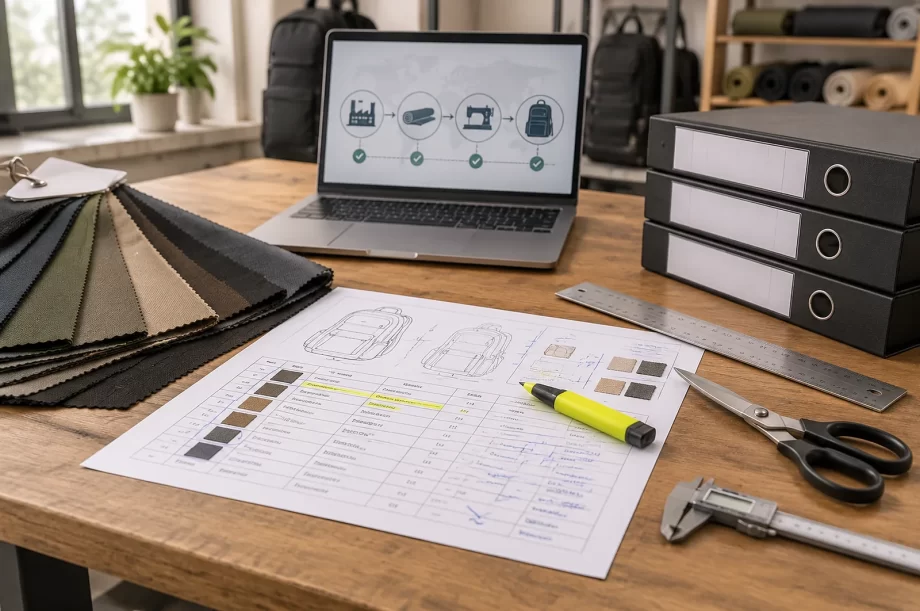
UFLPA Documentation: What Should a Bag Factory Prepare First?
A detention notice under the Uyghur Forced Labor Prevention Act never arrives at a factory. It arrives at the importer of record, is scanned, and forwarded to the supplier with a short covering message asking for everything by the end of the week. At that moment the quality of a factory’s records stops being an administrative matter and becomes the single variable that decides whether a container is released, re-exported, or destroyed. The bag itself cannot answer the question. Only paper can.
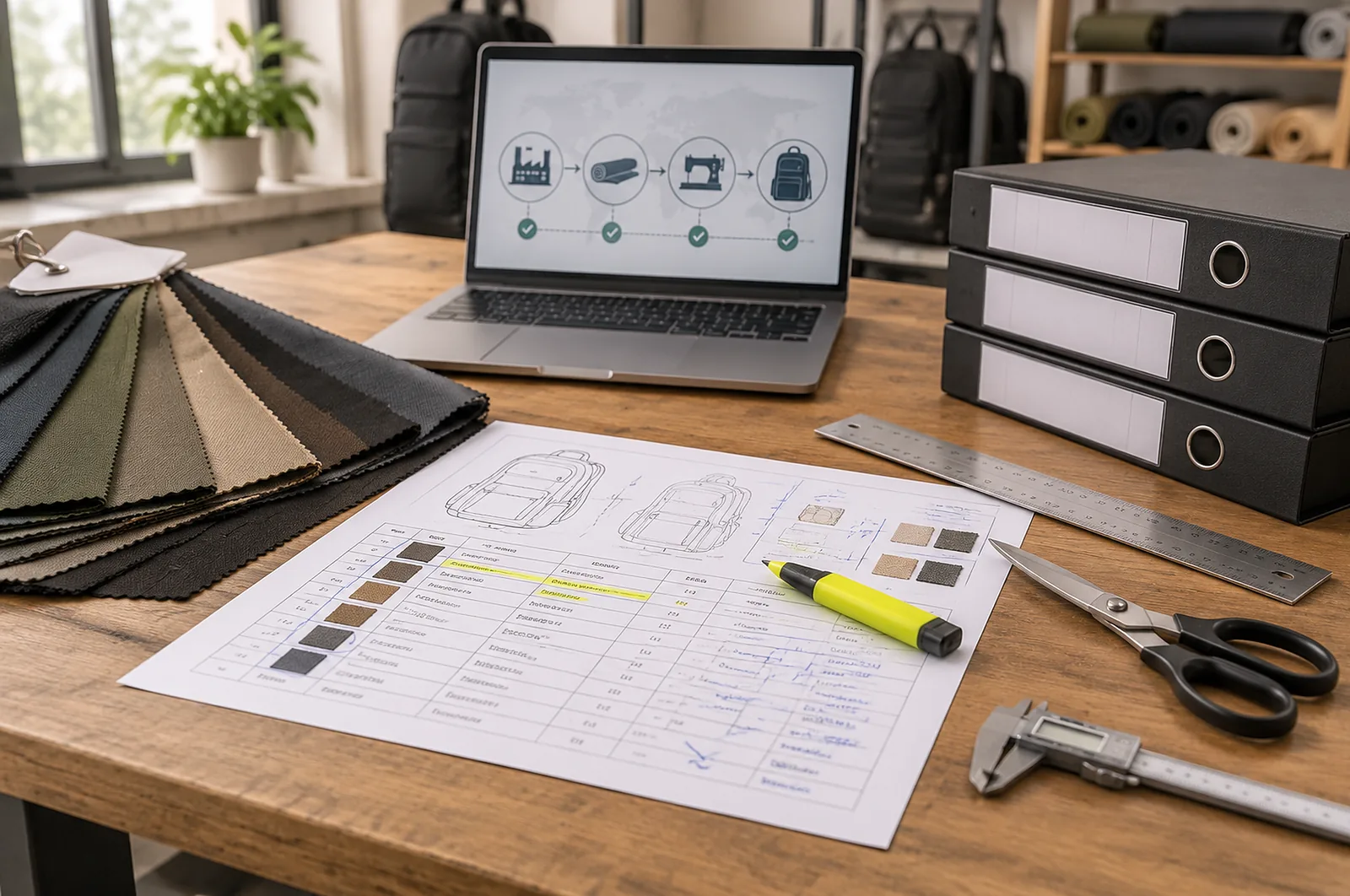
This article is written for the manufacturing side of the trade: the cut-and-sew plant, the material trader acting as a consolidator, and the factory’s export office. It sets out what the regulation actually requires an importer to prove, and therefore what a factory must be able to produce, in what order, and with what level of proof. It is a documentation architecture problem before it is a legal problem, and the architecture can be built in a quarter if it is built in the right sequence.
- What the Regulation Actually Asks a Factory to Prove
- Two Routes, Two Different Files
- Layer One: The Supplier Map, Built Before You Need It
- Layer Two: The Bill of Materials That Traces
- Layer Three: Transactions That Reconcile
- Layer Four: Production Records and the Bundle Trail
- What Carries Weight and What Does Not
- The First Ninety Days: What to Prepare in What Order
- Naming, Versioning and Retention: The Boring Part That Wins Cases
- Responding to a Detention: The Evidence Sprint
- Where Bag Files Actually Break
- Getting Data Out of Mills, Dyehouses and Vendors
- What the File Costs, and How It Changes Sourcing
- Audit Your Own File Before Your Customer Does
- FAQ
- The File Is a Manufacturing Capability
The manufacturer’s view: the presumption attaches to the goods, not to your reputation, your certifications, or your twenty years of export history. A complete component-level file can clear a container in two to three weeks. A persuasive letter cannot clear it at all.
What the Regulation Actually Asks a Factory to Prove
The core mechanic is a rebuttable presumption. Goods mined, produced, or manufactured wholly or in part in the Xinjiang region, or by an entity on the UFLPA Entity List, are presumed to be made with forced labor and are therefore prohibited from entering the United States under 19 U.S.C. § 1307. The presumption has applied to goods entered on or after 21 June 2022. Two features of that sentence determine everything a factory has to prepare.
The first is that the burden is not on the government to prove a link. CBP applies the presumption at the border. The importer must then displace it with documentation. There is no inspection that “clears” a factory in the abstract; admissibility is argued shipment by shipment, on the paper submitted for that entry.
The second is the phrase in part. A backpack is not one material. It is a shell fabric, a lining, a coating, a zipper tape, a slider, a puller, webbing, buckles, foam, thread, binding tape, woven labels, printed patches, a hangtag, and a polybag. Any one of those inputs, however small its share of the free-on-board value, can hold an entire consignment if its origin cannot be shown. A buckle worth a few cents is not a rounding error in this analysis; it is a full stop.
The value share of a component is irrelevant to admissibility. A thread cone that costs less per bag than the carton it ships in can detain the carton.
Why “We Do Not Buy From There” Is Not an Answer
Factories say this constantly, and it is usually true at the level they can see. It is also usually incomplete, because a bag factory’s direct purchases are only the first tier of a chain that runs through yarn spinners, greige weavers, dyehouses, coating lines, trim traders, and alloy foundries. A Chinese cut-and-sew plant may buy fabric from a trader who buys from a mill that buys greige from a weaving mill that buys yarn from a spinner. Nobody in that chain is lying. The information simply is not held in one place, and the factory has never had a commercial reason to collect it.
The regulation supplies that reason. Documentation is the mechanism by which a multi-tier chain is collapsed into a single defensible statement about a specific shipment.
The Three Things CBP Actually Reads
Strip away the legal language and the request reduces to three questions, in this order:
- Who touched the goods, in what role, at what address? A list of parties and a flow chart of the production process.
- What did the finished bag consume, in what quantity, from which supplier? A bill of materials that traces to named sources.
- Did those transactions physically and financially happen? Invoices, contracts, purchase orders, bills of lading, packing lists, and proof of payment, reconciling inputs to output.
Everything below in this article is an elaboration of those three questions.
Two Routes, Two Different Files
Importers have two ways to argue a detention, and the difference decides how much work lands on the factory.
The applicability review route contends that the regulation does not apply at all, because the goods and their inputs carry no nexus to the region or to a listed entity. This is the route almost every legitimate backpack shipment should be able to take, and it is the route a factory’s records are built to support. The evidence standard here is documentary plausibility: a coherent, complete, internally consistent chain.
The exception route concedes the nexus and argues that the goods were nevertheless not made with forced labor. That requires clear and convincing evidence, a standard explicitly higher than a preponderance, together with compliance with the task force’s importer guidance and satisfactory responses to every information request. It is slow, expensive, and rarely the first choice of a well-documented supply chain.
| Feature | Applicability review | Exception to the presumption |
|---|---|---|
| What is argued | No nexus to the region or a listed entity | Nexus exists, but no forced labor was used |
| Standard of proof | Complete, consistent documentary record | Clear and convincing evidence |
| Typical bag scenario | Component origins all documented outside the region | Inherited inputs from a listed entity upstream |
| Who does the work | Factory supplies the file, importer submits it | Factory plus lab testing, audit, and legal counsel |
| Timeline in practice | Weeks, if the package is complete | Months, and not guaranteed |
| Factory’s realistic role | Build and maintain the package | Provide evidence and host inspections |
A complete, well-organised package is reviewed on a scale of weeks rather than months, and where the importer can show that a supply chain is identical to one already reviewed and cleared, detention periods have run in the region of ten to fourteen days. That speed is not a reward for good intentions. It is a reward for a file that a reviewer can navigate without asking follow-up questions.
The plain implication for a factory is that the entire return on documentation investment sits in route one. Every hour spent making the applicability file cleaner is an hour that shortens a detention. Every hour spent on argument and correspondence is an hour that does not.
Layer One: The Supplier Map, Built Before You Need It
The first artefact is a map of every party that touches the goods, with a role, a legal name, a physical address, and a document that proves the relationship. Detention notices request precisely this: all parties involved in manufacture, manipulation, or export; a list of suppliers with names and addresses; a flow chart of the production process; and maps showing where each stage takes place.
Most factories have a customer list disguised as a supplier list. The distinction matters. A supplier list records who you pay. A supply chain map records who transforms the material, in what sequence, and where the material physically moves between each step.
The Tiers a Backpack Actually Has
| Tier | Typical parties in a bag programme | What they must be able to produce | Common gap |
|---|---|---|---|
| Tier 1 | Cut-and-sew factory, finishing and packing | Work orders, cutting records, output reports | No component-level consumption record |
| Tier 2 | Fabric mill or fabric trader, lining supplier | Invoice, lot number, delivery note, yarn source | Trader cannot name the mill behind the roll |
| Tier 2 | Dyehouse and coating line | Batch records, process tickets, greige source | Batch numbers not linked to the delivered roll |
| Tier 2 | Zipper, buckle, webbing, foam vendors | Part-level material declaration and invoice | Generic certificate covering an entire product family |
| Tier 2 | Thread, binding, label, packaging suppliers | Invoice and specification sheet | Treated as consumables, never documented |
| Tier 3 | Yarn spinner, greige weaver, alloy or resin supplier | Production and shipment records | Refuses to disclose; no authorization in place |
Two practical rules follow. First, build the map from the bill of materials outward, not from the purchase ledger backward, because the ledger only contains what procurement happened to buy directly. Second, hold a signed authorization from each tier-two supplier permitting you to share its records with your customer and, where necessary, to have the supplier submit directly to CBP. Trade secret anxiety is the single most common reason upstream data never arrives, and the standard fix is procedural: suppliers submit sensitive commercial documents straight to the authorities, while the factory submits the structural file.
A supply chain map that names only the companies on your invoices is not a map. It is a contact list, and a reviewer will read it as an omission rather than as brevity.
What the Map Should Look Like on Paper
Keep it to a single diagram plus one table. The diagram runs left to right: fibre, yarn, greige, dyeing and finishing, coating, component manufacture, cutting, sewing, finishing, packing, export. Each box carries a plant name and a location. The table underneath lists the same parties with legal name, address, role, the materials supplied, the document reference that proves each supply relationship, and the date the relationship was last verified. Anything not verified in the last twelve months should be flagged rather than quietly carried forward, because a stale entry discovered during a review costs more credibility than a gap that was disclosed.
Layer Two: The Bill of Materials That Traces
A commercial bill of materials lists what to buy. A traceable bill of materials lists what to buy and where each line came from, and it is the difference between a costing document and evidence.
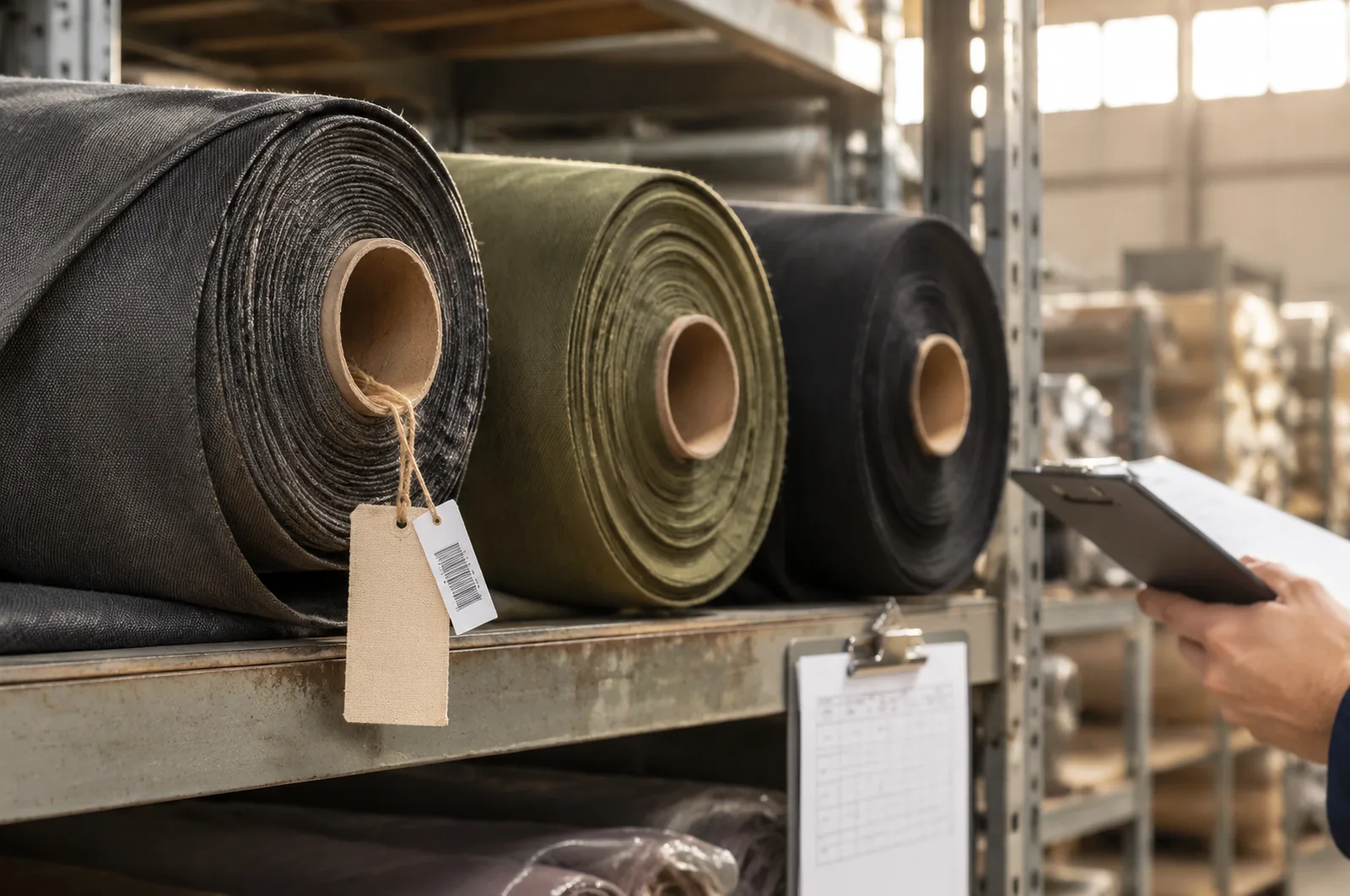
The unit of traceability is the component, not the product. For a typical 25-litre daypack the traceable BOM will carry between twenty-five and sixty lines depending on construction complexity, and each line needs four attributes before it is useful: material description with a specification reference, net consumption per unit, supplier identity, and the lot or batch reference actually consumed in the shipment being defended.
| BOM line group | Traceability depth required | Why reviewers probe it |
|---|---|---|
| Shell fabric and coating | Mill, dyehouse, coating line, yarn source | Largest material share, most likely to be commingled |
| Lining and interlining | Mill and lot, fibre composition | Often bought through a trader with no mill visibility |
| Webbing, tape, binding | Manufacturer and lot | Frequently traded as generic stock with no origin file |
| Zippers and sliders | Component manufacturer and part number | Metal and tape origins are separate questions |
| Buckles, adjusters, hooks | Moulding plant, resin grade | Injection moulders buy resin from multiple suppliers |
| Foam and padding | Foam plant, density grade, lot | Often a local purchase with minimal paperwork |
| Thread and consumables | Supplier, ticket size, lot | Usually excluded, which leaves an unexplained input |
| Labels, patches, hangtags | Printer and weaver, order reference | Woven labels are a separate upstream trade |
| Packaging | Carton plant and polybag supplier | Overlooked until a reviewer asks about the carton |
Two Problems Specific to Bags
Commingling. A dyehouse runs batches for several customers from greige held in common stock. A mill blends yarn from more than one spinner. When a batch is commingled, no single document proves that the material in your bag came from a particular upstream source. The honest handling is to document the commingled pool, name every input to it, and demonstrate that none of those inputs is on a prohibited footing. Pretending the batch was dedicated is worse than disclosing the pool.
Substitution. Mills substitute a qualified equivalent when a lot runs short, and production does not always record the swap. Substitution discovered after the fact turns a clean file into an inconsistent one. The control is procedural: no substitution without a written change note, and the change note carries into the BOM version used for that production run.
Build the BOM so that a stranger can answer one question for any component: which named company made this material, in which plant, on which date, and under which invoice? If the answer requires a phone call, the file is not finished.
Layer Three: Transactions That Reconcile
Documents that identify parties are structural. Documents that prove transactions are evidential. The distinction is the one a reviewer applies when deciding whether a chain is real or reconstructed.
The test applied to each link in the chain has two halves: the goods physically moved, and the money financially moved. A purchase order proves intent. An invoice proves a claim. A bill of lading, delivery note, or warehouse receipt proves movement. A bank record proves payment. Reviewers look for at least one document from each half at every tier, and they look for the quantities to agree across all of them.
| Document | What it actually proves | Defect that destroys its value |
|---|---|---|
| Purchase order | That a commercial relationship existed on a date | Issued retrospectively; date after shipment |
| Commercial invoice | Stated value, quantity, and parties | Quantities that cannot cover the finished output |
| Packing list | What was in the box, at what count | Missing lot or batch reference |
| Bill of lading, air waybill | Physical movement between named parties | Consignee is a forwarder with no onward link |
| Delivery note, gate pass | Transfer of custody at plant level | Unsigned, undated, or handwritten without a stamp |
| Bank transfer, SWIFT confirmation | Payment actually made | Amount or date inconsistent with the invoice |
| Import declaration for inputs | Lawful entry of imported material | None on file although the input is imported |
| Contract or framework agreement | Terms, specification, and origin obligations | Has no clause obliging origin disclosure |
The Reconciliation That Reviewers Actually Perform
The arithmetic is simple and it is where most files fail. Take the quantity of shell fabric purchased for a production run. Subtract documented waste and offcuts. Compare the remainder against the metres that the BOM says were consumed to produce the finished bags. Now do the same for zippers, buckles, and thread. If 4,800 metres of fabric were delivered, and 3,100 bags of a design consuming 1.4 metres each were shipped, the numbers do not close, and the reviewer will ask why. The answer may be entirely innocent, such as stock carried forward from a previous run, but it has to be in the file before the question is asked.
Reconciliation is the cheapest credibility test available to a factory. Run the arithmetic yourself, in advance, and attach the calculation. A reviewer who does not have to do the subtraction rarely finds a reason to doubt the answer.
Layer Four: Production Records and the Bundle Trail
Production records are what connect a document stack to a physical bag. They are also the layer most factories underestimate, because the records exist for operational reasons and were never designed to answer an origin question.
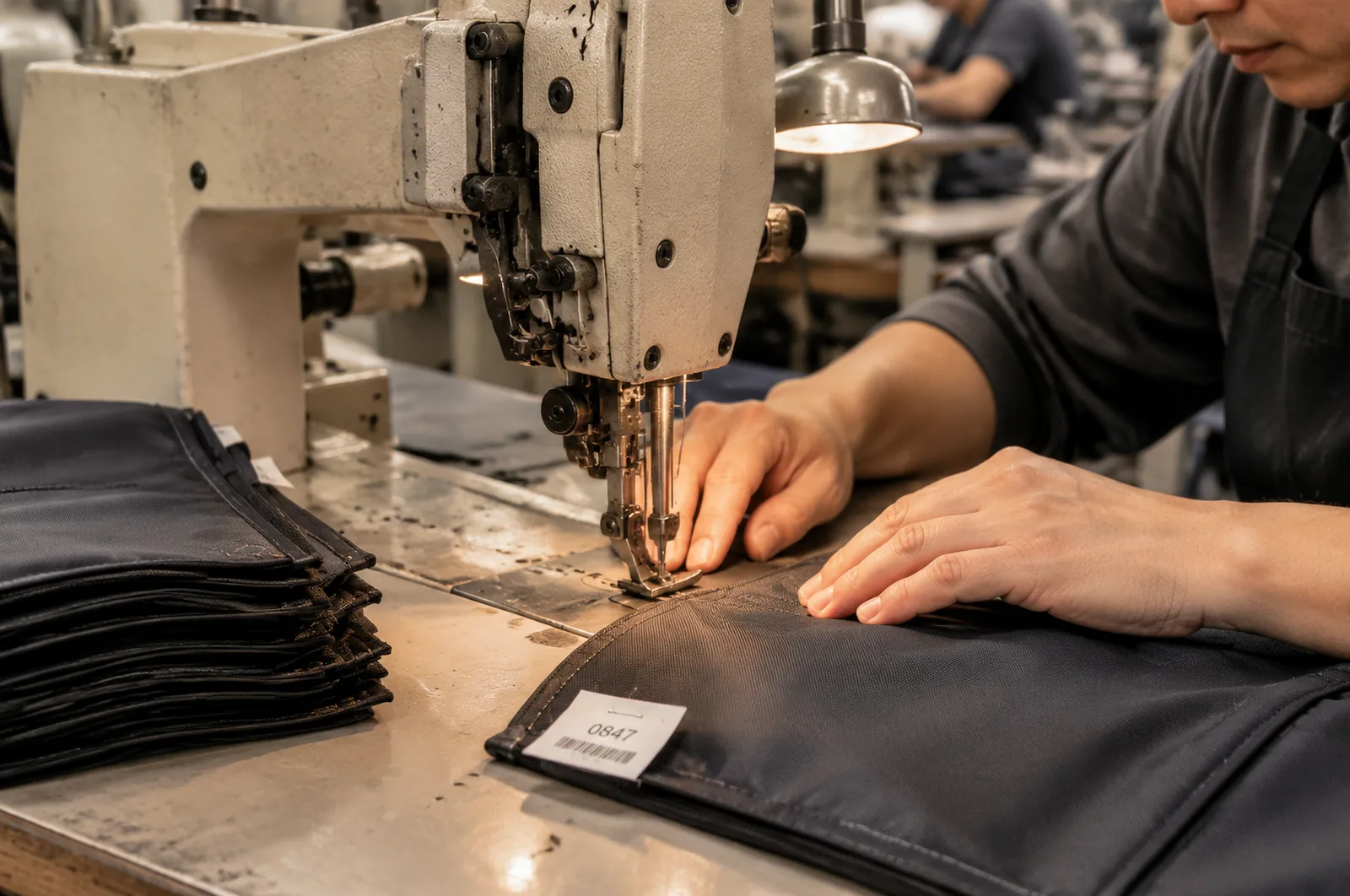
For a cut-and-sew operation the useful trail runs in one direction: fabric lot received, cutting order issued, bundle ticket printed, bundles issued to the line, daily output recorded, finished goods packed, carton marked, container loaded. Each step already generates a document. The documentation programme does not create a parallel system; it links the documents that already exist.
| Record | Where it is generated | What it links |
|---|---|---|
| Material receiving slip | Warehouse | Supplier invoice to fabric lot |
| Cutting order and marker report | Cutting room | Fabric lot to cut quantity and shade |
| Bundle ticket | Cutting room | Cut panels to a specific work order |
| Material issue slip | Line supervisor | Bundle to line and date |
| Daily output sheet | Production office | Work order to finished quantity |
| Inline inspection record | QC station | Output to defect and rework disposition |
| Packing list and carton mark | Finishing | Finished quantity to carton and shipment |
| Container loading record | Shipping | Carton to consignment |
Making the Trail Survivable
Three changes turn operational records into evidence. First, print the fabric lot number on the bundle ticket rather than only the work order number, so a finished panel can be walked back to a roll. Second, keep the cutting marker report with the cutting order, since it explains the difference between issued metres and consumed metres. Third, archive the daily output sheets for the full production window rather than discarding them at month end, because a review may begin ninety days after the container sailed.
Factories that run digital work orders already have most of this. Factories running paper can achieve the same result with a stamped lot number and a bound file, provided the file is complete and retrievable inside a day.
What Carries Weight and What Does Not
Not all documents are equal, and the ranking is predictable. Records generated by a party with no interest in the outcome carry the most weight. Records generated by the party under review carry less. Declarations carry the least, because a declaration is an assertion rather than a trace.
| Evidence type | Practical weight | Why |
|---|---|---|
| Customs entry records for imported inputs | High | Generated by an authority, not by the supplier |
| Bank payment records | High | Independent of the trading relationship |
| Bills of lading and carrier documents | High | Issued by third-party carriers |
| Mill and dyehouse batch records | Medium to high | Operational records generated before the dispute |
| Invoices and purchase orders | Medium | Self-generated but cross-checkable |
| Supplier declarations and code of conduct signatures | Low | Assertion without supporting trace |
| Certifications and audit reports | Low on origin, medium on systems | Prove process discipline, not material origin |
| Photographs and site visit notes | Supporting only | Illustrative, not probative |
The practical consequence is uncomfortable for factories that have invested in certification. A social compliance audit certificate is genuinely valuable for a supplier qualification programme and nearly useless as origin evidence. It shows that a plant has disciplined systems. It does not show that the fabric in container one came from mill A rather than mill B.
Declarations support a file. They are not a file. A package consisting of signed letters and no transaction records reads as an admission that the transaction records do not exist.
The First Ninety Days: What to Prepare in What Order
The sequence matters more than the effort. Factories that start with the finished-goods file build a beautiful document set that collapses the moment someone asks where the webbing came from. The order below is derived from the dependency structure: each step needs the output of the one before it.
- Days 1 to 3, scope the exposure. List every active programme shipped to the United States in the last twelve months. For each, list the bill of materials lines and mark which lines have a named supplier with a physical address. Anything unmarked is the actual starting workload.
- Days 4 to 14, build the party map. Contact each tier-two supplier for legal name, plant address, and a signed authorization to disclose records to your customer. This step sets the critical path, because upstream response times are outside your control and must be started first.
- Days 10 to 30, build the traceable BOM. For each active programme, produce one version-controlled BOM carrying specification, consumption, supplier, and lot field. Do not attempt to backfill historical lots; design the template and apply it forward.
- Days 20 to 45, pull the transaction layer. Assemble invoices, packing lists, bills of lading, and payment confirmations for one representative shipment per programme. One complete shipment is worth more than partial files for ten.
- Days 30 to 60, connect production records. Add the fabric lot to the bundle ticket, bind the cutting marker report to the cutting order, and archive daily output for the current quarter and the previous two.
- Days 45 to 75, run the arithmetic. Reconcile inputs to output for the sample shipments. Document the variance and its explanation. This is where most real problems surface, and where they are cheapest to fix.
- Days 60 to 85, translate and index. Produce English translations of every document not already in English, and build a table of contents that mirrors the way the request is structured rather than the way your folder tree grew.
- Days 75 to 90, dry run. Hand the package to someone who has never worked on the account and give them four hours to answer five questions: who made the shell fabric, which dyehouse processed it, which invoice covers it, how many metres were consumed, and what proves payment. Anything they cannot answer becomes a work item.
Step two is the one that decides whether the programme finishes in a quarter or slips into a year. Upstream authorizations are the only part of this build that a factory cannot compress by working harder.
Naming, Versioning and Retention: The Boring Part That Wins Cases
A reviewer opens a package and forms an impression in the first minute. If the folders are named in a way that maps onto the request, the impression is competence, and every subsequent document is read generously. If the folders are named after internal work orders and the reviewer has to ask which one corresponds to the shipment, the impression is that the supplier is improvising.
Adopt a naming convention that survives staff turnover. A workable pattern is shipment reference, then document class, then date, then sequence: the consignment or invoice number, a two- or three-letter class code for the document type, an ISO date, and a two-digit index. The rule that matters is not the specific pattern but that it is applied without exception, including to documents that arrive late and get appended after the package has been submitted.
| Retention item | Minimum practical retention | Reason |
|---|---|---|
| Supplier authorization letters | Life of the relationship plus five years | Proves the right to disclose |
| Transaction set per shipment | Five years from entry | Reviews can begin long after arrival |
| BOM version per production run | Five years | Ties consumption to a specific build |
| Cutting, output, and inspection records | Three to five years | Supports reconciliation |
| Batch and lot records from mills | Three years or per contract | Upstream availability decays fastest |
| Sealed production sample per run | Life of the programme | Physical reference when documents conflict |
Two governance habits protect the file. First, one named owner per programme, with a deputy, so that a request does not circulate internally for three days before anyone accepts it. Second, a change log. When a mill changes, a fabric is substituted, or a component vendor is replaced, the change is recorded with a date and the affected programmes. A reviewer who finds an unexplained change between two shipments of the same design will treat the entire file as unreliable.
Responding to a Detention: The Evidence Sprint
When a notice arrives, the clock is already running. Detention notices are issued with a statement of the basis and an attachment specifying the information requested, and the initial detention period is finite, commonly thirty days, with extensions available on request to the port or centre director before the period expires. That structure dictates the response shape.
| Phase | What happens | Factory’s job |
|---|---|---|
| Notice received | Importer forwards the request attachment | Acknowledge within one working day and name the coordinator |
| Triage | Identify the specific entry, design, and component named | Confirm which BOM version and which lots were used |
| Data pull | Retrieve supplier and transaction records | Issue a structured request list to each tier-two supplier with a deadline |
| Assembly | Build the package in the requested order | Include an executive summary and a table of contents |
| Translation | Convert every non-English document | Machine translation alone is not sufficient for key records |
| Submission | Importer files with CBP | Keep a submission index and a copy identical to what was sent |
| Follow-up | Reviewer asks clarifying questions | Answer with documents, not with argument |
| Resolution | Release, re-export, or exclusion | Record the outcome and the defects that caused the delay |
Three behaviours shorten a detention measurably. Submit a complete package rather than a partial one with a promise of more, because review cannot begin on an incomplete file. Ask for an extension in writing before the period expires rather than after. And where the supply chain has already been reviewed and cleared for another entry, say so explicitly and supply a summary tracing report that names the suppliers at every stage with a business record reference for each, since that is the pattern that has produced the fastest releases.
Never answer a document request with a narrative. A covering letter that explains why the supply chain is clean, unaccompanied by invoices and batch records, is read as an absence of evidence and it consumes the days you needed to gather it.
Where Bag Files Actually Break
Eight failures account for most of the avoidable delay in this category. None of them is exotic. All of them are structural.
| Failure | What it looks like | Fix |
|---|---|---|
| Trader without mill visibility | Invoice names a fabric trader; no mill behind it | Contractual obligation to name the producing mill per lot |
| Commingled greige | Dyehouse cannot attribute a batch to one weaver | Disclose the pool and document every input to it |
| Generic component certificates | One declaration covers an entire hardware family | Part-level declaration per component number |
| Thread and trim excluded | Consumables absent from the BOM | Add all consumables as BOM lines with suppliers |
| Substitution without record | A different mill supplied part of a run | Written change note tied to the BOM version |
| Subcontract cutting | Panels cut outside the plant, unrecorded | Disclose the subcontractor and hold its records |
| Unpaid or unsettled invoices | Goods moved, payment not yet evidenced | Payment proof or contractual terms in the file |
| Packaging omission | Cartons and polybags undocumented | Include packaging suppliers in the map |
The pattern behind the pattern is that every failure is a case where a document exists but is not connected to the shipment under review. Factories rarely lack invoices. They lack the index that makes an invoice answer a specific question about a specific bag.
Getting Data Out of Mills, Dyehouses and Vendors
Upstream cooperation is a commercial negotiation, not a documentation task, and it responds to contract language far more reliably than to requests.
Four clauses do most of the work:
- A materials disclosure clause obliging the supplier to name its own production sites and the origin of its principal inputs on request.
- An audit and records clause giving the buyer the right to review production records relevant to origin.
- A notification clause requiring notice before a change of production site or a change of sub-supplier.
- A disclosure authorization clause permitting the supplier to release records to the buyer’s customers and, where required, directly to a customs authority.
Beyond contract, three practices raise response rates. Explain the purpose once, in writing, in plain language, so that the supplier understands it is a border requirement rather than a commercial intrusion. Accept a two-tier disclosure model, where sensitive cost and customer data are redacted and only origin-relevant fields are shared. And refresh the data annually on a scheduled cycle rather than in a crisis, because a request that arrives during a detention is read as an emergency and is answered badly.
Treat origin data as a qualification criterion, not a favour. A mill that cannot name its yarn source within five working days is a supply risk regardless of its price, and that judgement belongs in the supplier scorecard rather than in a post-detention review.
What the File Costs, and How It Changes Sourcing
Documentation has a real cost, and it should be stated in the same terms as any other production input so that it can be quoted and recovered.
| Cost item | Order of magnitude | Timing |
|---|---|---|
| Coordination and file assembly, per programme | One to three weeks of one administrator’s time | Front-loaded in the first quarter |
| Upstream engagement and authorization letters | Weeks of correspondence, no cash cost | Critical path |
| Translation of key records | Per page, ongoing | Per shipment |
| Digital traceability upgrade | Capital project | Optional but reduces per-shipment effort |
| Third-party origin or traceability audit | Per audit day plus travel | Annual or per customer request |
| Compliance review of contract clauses | Legal time | One-off |
The sourcing consequence is more interesting than the cost. When records become a condition of entry, supplier selection changes shape. A mill that is twenty minutes closer but cannot produce a lot-level record becomes more expensive than a mill that costs slightly more and answers in three days. Factories that understand this start asking for origin documentation during sampling, before the first bulk order, which is also the point at which a supplier is most willing to agree.
For buyers, the mirror-image advice is to ask a prospective factory one question during qualification: show me the last shipment where a component origin question was answered, and show me how long it took. The answer distinguishes a factory with a file from a factory with a filing cabinet.
Audit Your Own File Before Your Customer Does
Run this check quarterly. It takes half a day per active programme and it is the cheapest risk reduction available.
| Check | Pass condition |
|---|---|
| Party map current | Every BOM supplier has a name, address, and role verified in twelve months |
| Authorizations signed | Each tier-two supplier has a disclosure authorization on file |
| BOM completeness | Consumables, trim, labels, and packaging all present as lines |
| BOM version control | The version used for the last shipment is identifiable |
| Lot linkage | A finished carton can be traced to a fabric lot without a phone call |
| Transaction set complete | Invoice, packing list, carrier document, and payment proof for the last shipment |
| Reconciliation performed | Input quantity minus waste agrees with BOM consumption, with variance explained |
| Substitution log | All material changes recorded with dates and affected programmes |
| Language readiness | All key records available in English |
| Index present | A table of contents maps to the structure of a typical information request |
| Retrieval time | Five sample questions answered from the file within four hours |
| Owner named | A coordinator and a deputy are assigned, with contact details circulated |
Two failures in this table are worth more than the rest: retrieval time and lot linkage. A file that exists but cannot be navigated in a working day provides no protection, because the detention clock is not interested in how good the records are, only in how quickly they can be assembled.
FAQ
Does our factory have to comply with a United States law, given that our customer is the importer?
Compliance responsibility sits with the importer of record, but the evidence sits with the supply chain. In practice a factory that cannot produce records loses the order, because the importer cannot clear the goods without them. Treat documentation as a condition of the commercial relationship rather than as a customer’s private problem.
We have never purchased anything from the region. Why do we need a file at all?
Because the assertion has to be evidenced at component level, and the components you buy pass through several hands before they reach you. A fabric trader, a commingled greige pool, or a hardware consolidator can introduce an origin you never see on an invoice. The file exists to prove the negative, and proving a negative requires documents rather than confidence.
Which single document should we build first?
The party map with signed disclosure authorizations. It is the only element whose lead time you do not control, it is the first thing a reviewer looks for, and it determines which other documents are even obtainable.
Is a social compliance audit certificate accepted as origin evidence?
It is accepted as evidence of a disciplined management system and is useful in supplier qualification. It does not demonstrate where a specific material came from. Reviews of origin are answered with transaction and production records, not with certificates.
How detailed does the bill of materials have to be?
Detailed enough that each line names a supplier and carries a lot or batch reference, and complete enough to include consumables such as thread, binding tape, labels, and packaging. A BOM that covers only the visible materials leaves unexplained inputs that a reviewer will notice.
What do we do when a supplier refuses to share records for commercial confidentiality reasons?
Use a two-tier disclosure model. Redact cost and unrelated customer data, share only origin-relevant fields, and where sensitivity remains, arrange for the supplier to submit its records directly to the customs authority while you submit the structural file. Put the obligation in the supply agreement so that the position is agreed before a shipment is detained.
How long should records be kept?
At minimum for five years from the date of entry, and longer where a customer contract requires it. Reviews regularly begin many months after arrival, and upstream batch records are usually the first thing to disappear, so agree a retention period with mills and dyehouses rather than assuming they keep records.
How quickly can a complete package clear a detained shipment?
Where the package is complete, organised, translated, and internally consistent, reviews are typically measured in weeks. Where the importer can show the supply chain is identical to one previously cleared and supplies a summary tracing report, detention periods in the region of two weeks have been reported. The variable under a factory’s control is completeness and speed of assembly, not the law.
Does any of this help outside the United States market?
Yes, for two reasons. Buyers in other markets increasingly ask for the same traceability before placing orders, and the file you build for one destination answers most of the questions asked by the others. A supply chain that can be described at component level is a commercial asset independent of any single regulation.
The File Is a Manufacturing Capability
Treat origin documentation as a production capability and it stops feeling like paperwork. A factory that can state, for any carton in its warehouse, which mill wove the shell, which dyehouse processed it, which invoice paid for it, and how many metres it consumed, has something more useful than a compliance artefact. It has a supply chain it can actually manage, renegotiate, and defend.
The build is unglamorous: a party map, authorizations, a traceable bill of materials, a transaction set, production records that carry a lot number, and an index that a stranger can follow. None of those six items requires a consultant. All of them require someone to own the work and a deadline that is not a detention notice.
Start with the authorizations this week. Everything else in the file depends on them, and they are the only part of the programme that cannot be accelerated by working late.