
Country of Origin Marking: Where Must a Bag Show Its Origin?
A country of origin mark is the cheapest component in a backpack and the most expensive one to get wrong. A woven label costs a few cents. A consignment held at a port of entry because the mark sits on a hangtag instead of the bag costs storage, demurrage, a delayed retail launch, and sometimes the order itself. The mark is also the only statement on the product that a customs officer, a retailer’s compliance auditor, and a consumer can all read and all hold the seller to.
For a factory, the difficulty is not the sewing. It is that three separate questions get collapsed into one short phrase printed on a label: which country is the legal origin of the goods, where must that fact physically appear, and how durable must the appearance be. Each has its own legal test, and a factory that answers all three from a single sentence in a purchase order will eventually ship a container that answers none of them correctly.
This article is written from the manufacturing side of the trade. It explains how origin is determined for a bag, what makes a mark legally sufficient, which positions on a backpack actually work in production and at retail, how requirements diverge between the United States, the European Union, the United Kingdom, and other major destinations, and how to lock the specification into the tech pack so that a line of forty operators produces the same compliant mark on every piece. It is written for the product developer, the compliance coordinator, and the export office of a cut-and-sew plant.
- What “Country of Origin” Means for a Bag
- The Determination Question: Substantial Transformation
- The Marking Question: Where the Mark Must Appear
- Marking Methods and What “Permanent” Actually Means
- The Label Stack: Origin Among Fibre, Care, and Identity
- Beyond the United States: How Other Markets Differ
- Preferential Origin Is a Different Answer
- Putting Marking Into the Tech Pack
- Auditing Marking on the Line
- FAQ
- The Mark Is a Specification, Not a Formality
The manufacturer’s view: an origin mark is not branding and it is not decoration. It is a regulated statement of fact, and the burden of making it true, permanent, and visible sits with whoever sews it into the bag.
What “Country of Origin” Means for a Bag
Under United States law the country of origin of an imported article is the country of manufacture, production, or growth of that article. Where material or labour from one country is added to material from another, the added work must effect a substantial transformation before the finished article can claim the country where that work happened as its origin. If the work is not substantial, the article keeps the origin of the material it was made from.
That definition is deliberately short, and almost all of the practical difficulty for bag factories lives inside the words substantial transformation. A backpack is not a single material that travels through a single process. It is a shell fabric woven in one country and coated in a second, zippers assembled in a third, webbing woven in a fourth, foam, thread, binding tape, and labels sourced from wherever price and lead time pointed, and all of it cut, sewn, trimmed, packed, and inspected in the factory that ships it. The bag has one legal origin despite having a dozen geographic inputs.
Determination, Marking, and Label Content Are Three Different Things
Most origin failures in this industry begin with a conversation in which three distinct obligations are treated as one. They are answered by different rules, checked by different people, and fixed in different documents.
| Concept | Question it answers | Governing logic | Who checks it | Typical factory failure |
|---|---|---|---|---|
| Origin determination | Which country is legally the origin of these goods? | Wholly obtained, or last substantial transformation | Customs authority, on entry or audit | Assuming the fabric’s origin is the bag’s origin |
| Origin marking | Where and how must that country be shown on the goods? | Statutory marking rules on the article or its container | Customs inspectors, retailer compliance teams | Marking a hangtag or polybag rather than the article |
| Label content | What else must appear alongside origin? | Textile, care, safety, and consumer information rules | Market surveillance, retailers, test laboratories | Combining origin with care data on a removable tag |
Keeping the three apart has an immediate operational benefit. Origin determination is a procurement and engineering question that belongs with the product developer and the bill of materials. Marking is a construction question that belongs with the pattern maker and the sample room. Label content is a documentation question that belongs with compliance and the label supplier. When one person owns all three informally, all three drift.
A bag can be correctly determined and incorrectly marked, and it can be marked with a country that was never lawfully its origin. Customs treats those as two different failures with two different penalty structures.
The Ultimate Purchaser Is the Person the Mark Must Reach
Marking requirements are anchored to a specific person: the ultimate purchaser. In the ordinary retail case this is the consumer who buys the bag. The mark therefore has to be readable at the moment of purchase and afterwards, which explains why a mark buried inside a sealed polybag behind a printed carton does not satisfy the rule.
For a factory this has a direct consequence that is often missed in sample approval. The place the mark must be legible from is not the inspection table under a task lamp. It is the retail shelf, the e-commerce unboxing, and the later moment when a consumer, a reseller, or an auditor turns the bag over looking for a country name. A mark that only reads correctly when the bag is flattened on a bench is a mark that will be disputed.
The Determination Question: Substantial Transformation
The test is qualitative, and it is applied to facts rather than to percentages. Work performed in a country must result in a new article with a different name, a different character, or a different use from the materials that entered the process. If the operations leave the material essentially as it was, the origin does not move.
For bags, the operations that reliably matter are the ones that convert flat material into a three-dimensional article with a distinct function. Cutting pattern pieces and assembling them into a wearable, load-bearing pack is the classic case: the fabric entering the factory is a textile in roll or panel form classified as a fabric; the article leaving it is a travel or sports bag with structure, compartments, harness, and hardware. The name, the character, and the use have all changed.
Why There Is No Percentage Threshold
Factories frequently ask what share of the free-on-board value must be added locally, or what share of the material must be sourced domestically, for the bag to carry a given country’s origin. For non-preferential origin there is no such threshold. A rule of origin expressed as a percentage belongs to preferential programmes and trade agreements, which are a different question answered by a different legal instrument.
The practical trap follows immediately. A cost sheet showing sixty percent of the bill of materials purchased locally feels like a strong origin story and proves nothing. Equally, a bag assembled in one country from almost entirely imported components can still be wholly that country’s origin, because transformation rather than sourcing is what counts. Conviction built on value share is the most common way a factory talks itself into a mark it cannot defend.
Value share is evidence of commercial effort, not evidence of origin. Never let a costed bill of materials stand in for an origin analysis.
The Name, Character, and Use Test Applied to Bags
Three questions, asked in sequence, resolve most real programmes. They are worth writing into the product development file because they also function as a sanity check on a supplier’s claim.
- Name: does the article have a name distinct from its inputs? A coated fabric has no bag name; a 28-litre daypack does.
- Character: has the physical structure changed in a way that matters? Seams, bar-tacks, padding, binding, and hardware create a structure that did not exist in the roll.
- Use: is the end function different? Rolled goods are consumed by a cutting room; a finished pack is used to carry loads.
Where all three answers change in the same country, origin sits there with very little argument. Where only one changes, or where the change happens across two countries, the file needs a written analysis rather than an assumption.
Worked Scenarios for a Backpack Programme
The scenarios below are the ones that recur most often in bag sourcing. They are stated as practical positions rather than as rulings; a specific consignment with unusual facts deserves a written opinion or a binding ruling request from the importer.
| Sourcing pattern | Where the work happens | Practical origin position | What the file must show |
|---|---|---|---|
| Fabric woven and coated abroad; cut, sewn, trimmed, packed in the factory country | All conversion in one country | Factory country | Cutting records, work orders, output reports linking lots to cartons |
| Fabric woven in country A, coated in country B, cut and sewn in country C | Conversion spread across three countries | Usually country C, as the last substantial transformation | Coating specification and invoices, to show the article left B as fabric |
| Pre-cut panels from country A, only sewing and finishing in country B | Assembly only | Generally country B where full assembly and finishing occur, but fact-specific | Panel supplier records and a written analysis of what B actually performs |
| Imported bag body, local logo embroidery and packing only | Decoration and packing | Origin stays with the body’s country | Embroidery and packing records, and an explicit note that origin did not move |
| Fabric and trim all imported; bag designed, cut, sewn locally | Full conversion locally | Factory country | Design, pattern, cutting, and assembly records in one file |
Two of these rows cause most of the disputes. The third row is the one where factories over-claim: sewing pre-cut panels can be a substantial transformation for a bag, but it is decided on what the operation actually is, not on the label the customer wants. The fourth row is where factories under-claim and then mark a bag with the origin of its imported body when the local operation genuinely did not change the article. The fifth row, which is the normal case for an export-oriented backpack plant, is the easiest to defend and the one most factories fail to document.
The Components That Do Not Move Origin
Zippers, sliders, buckles, webbing, foam, thread, and labels are components. Assembling them into a bag does not give the bag the origin of the components, and it does not give the components the origin of the bag on any separate analysis. The one place components matter is where a component is itself a substantial article and the mark is required on it, which is rare for a backpack but ordinary for some luggage categories and for goods sold as component sets.
The useful discipline is to treat the bill of materials as an origin map: every line carries a country, components are flagged as components, and materials are attached to the process that converts them. If a material line has no known conversion country, the finished bag’s origin claim rests on an assumption, and assumptions are what an audit is designed to find.
The Marking Question: Where the Mark Must Appear
United States law requires every imported article to be marked with its country of origin in a manner that is legible, indelible, permanent, and conspicuous, and in English, so that the ultimate purchaser can see it. Those four words do the real work, and each has a manufacturing meaning.
The Four Qualities and What They Require in Production
Legible is about size, contrast, and embossing depth. A 3 mm woven label in a 4 mm seam allowance is not legible in the sense the rule means, even if a bench inspector can read it with magnification. Practical factory guidance: the country name should read without effort at arm’s length under ordinary retail lighting, in a typeface that survives dye bleed and coating sheen.
Indelible is about the ink or yarn not running, fading, or washing out. Woven labels are inherently strong here because the letters are structural. Printed marks depend entirely on the ink system and the substrate, and on a coated fabric the wrong ink will craze within a few flex cycles.
Permanent is about attachment. A mark that can be detached without damaging the article, or that is designed to be removed before sale, is not permanent. This single word is why a hangtag never satisfies marking for a bag and why an adhesive sticker is the most common defect found on incoming inspection.
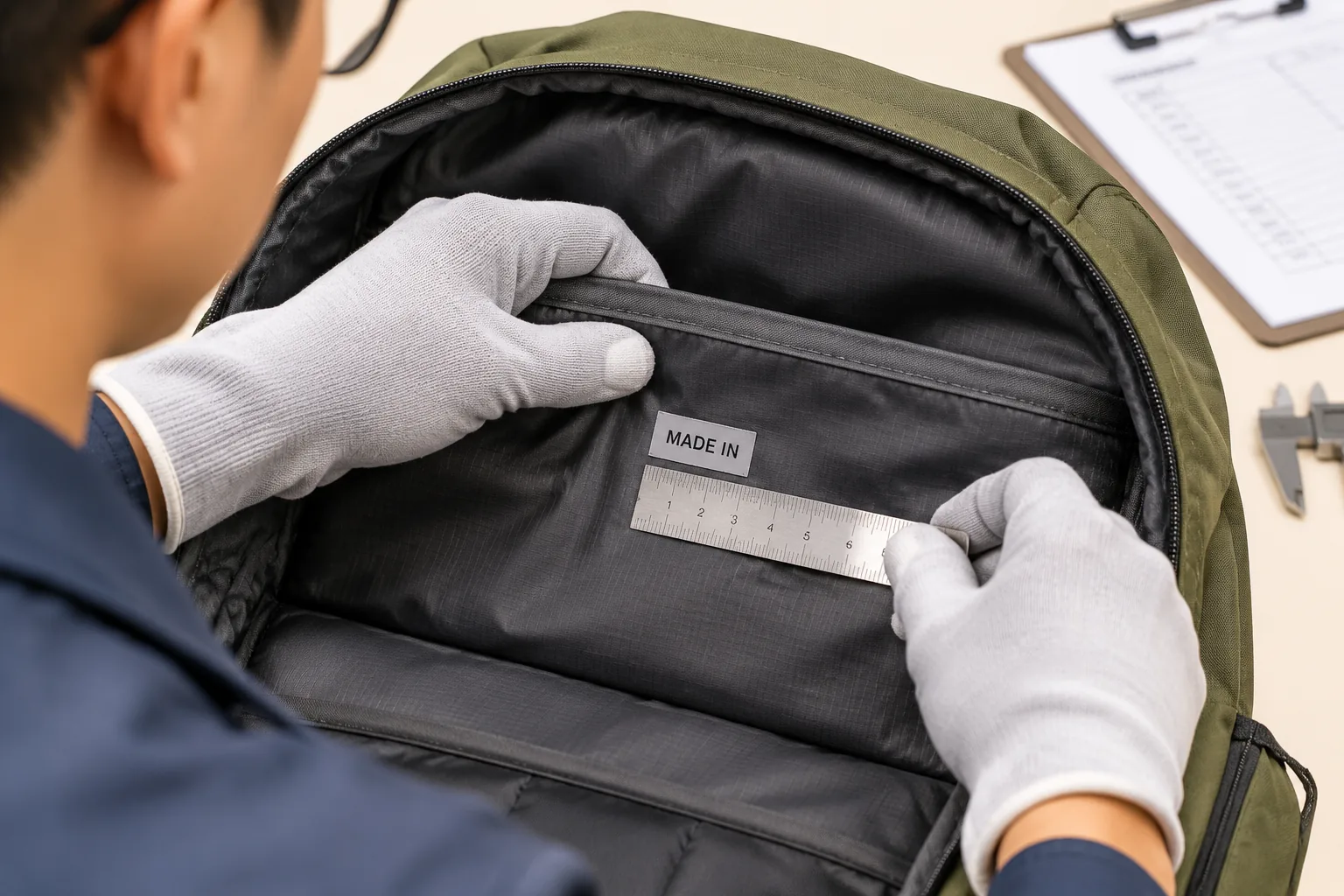
Conspicuous is about being seen by the ultimate purchaser in the normal course of handling and use. An interior seam label at the top of the main compartment qualifies because every user opens the bag. A label under the base panel qualifies only if it is reachable without tools.
Marking is judged by the buyer’s experience, not by the inspector’s. If the country name cannot be found by someone opening the bag for the first time, the mark fails regardless of how well it is sewn.
Positions on a Backpack That Survive Retail
The table below reflects what holds up across school packs, laptop packs, hiking packs, and tactical programmes. Positions are ranked by how reliably they satisfy the conspicuous test with the least structural risk.
| Position | Visibility to buyer | Durability risk | Structural risk | Best used for |
|---|---|---|---|---|
| Interior seam label at top of main compartment | High, seen on first open | Low if bar-tacked both ends | Low, sits in a flat seam | Default for most packs |
| Inside the laptop or hydration sleeve | High for tech and outdoor packs | Low | Very low, sleeve is a clean panel | Laptop, commuter, hydration |
| Interior bottom panel, printed or heat transfer | Medium, requires opening and looking down | Medium, abrasion from contents | Low | Minimalist bags with no exposed seams |
| Side seam label on the body, exterior | Very high | Medium, exposed to abrasion | Medium, interrupts a structural seam | Brand-forward retail packs |
| Underside of the top lid or flap | Medium to high | Low | Low | Hiking and flap-closure packs |
| Base panel exterior | Low, seen only when set down | High, ground contact | Medium | Not recommended as primary mark |
| Shoulder strap face | Medium | High, flex and sweat exposure | Low | Secondary mark only |
| Hangtag, sticker, or polybag print | High at purchase, zero after | Not applicable | None | Never as the only mark |
Two rules emerge from this table. First, the primary mark belongs on an interior seam that every user opens, because it is the only position that is simultaneously highly visible and structurally cheap. Second, exterior marks are a brand decision and a secondary location; they should never be the only place the country appears, because abrasion, colour matching, and seam interruption all work against them.
Article Versus Container: Which One Carries the Mark
Where the article itself cannot be marked without injury or without damaging its value, the rules allow the mark to sit on the container or retail packaging instead, provided the ultimate purchaser still sees it. This exception exists for goods that are impractical to mark, and it is narrower than factories usually assume. A backpack can be marked; therefore a backpack must be marked.
The container rule becomes genuinely relevant in two situations a bag factory does encounter. The first is a bag shipped inside a printed retail carton where the carton is the presentation unit. The second is a bag that is itself a container for other goods, in which case the marking of the outer container and the marking of the bag as an article are two separate obligations.
When the Article Is Excepted From Marking
A narrow set of exceptions covers articles that cannot be marked, that would be injuriously affected, or that fall into expressly excepted categories: raw materials, some semi-finished goods, and goods where marking is physically impossible. A finished backpack is not in that group, and any instruction to rely on an exception needs the importer’s written analysis attached to the file.
Marking Methods and What “Permanent” Actually Means
The method decides whether the mark survives the durability the rule requires. Cost differences between methods are small compared with the cost of a rejected shipment, so the selection should be driven by substrate and by where the mark will live.
| Method | Permanence | Substrate fit | Durability in use | Relative cost | Notes for production |
|---|---|---|---|---|---|
| Woven or printed end-fold label, sewn in | Permanent | All woven and coated fabrics | Excellent, survives laundering and abrasion | Low | Bar-tack both ends, avoid single-needle attachment |
| Heat transfer or foil print directly on lining | Permanent to the fabric | Uncoated and some coated linings | Good, unless the coating delaminates | Low | Verify adhesion after three flex cycles and a wash |
| Screen print on the shell | Permanent | Flat, non-textured surfaces | Moderate, wears at high-friction points | Low to medium | Ink must be specified for the base fabric |
| Deboss or blind emboss on PU or leather trim | Permanent | PU, leather, some TPU | Excellent | Medium | Depth must stay legible after finishing and edge paint |
| Woven selvedge or jacquard tape in a seam | Permanent | Woven tape applications | Excellent | Medium | Reading direction must be fixed in the drawing |
| Embroidered country name | Permanent | Most shells | Good, but legibility degrades at small sizes | Medium to high | Requires a digitised file and stitch density control |
| Adhesive sticker or decal | Not permanent | Any | Fails in transit and at retail | Very low | Not acceptable as the primary mark |
| Hangtag or swing tag | Not permanent | None | Removed at purchase | Low | Documentation only, never the mark |
| Printed polybag | Not permanent | None | Discarded before use | Very low | Not acceptable as the article’s mark |
The heat transfer row deserves a warning. On a coated lining, a transfer can look perfect at inspection and lift at the edges after a few weeks in a warm container. The adhesion test belongs in the approval protocol, not in the complaint file: apply the mark, flex the panel, run a wash or a rub test to the standard the destination market expects, then inspect the edge for lifting.
The cheapest legal mark is a sewn label in an interior seam. The most expensive illegal one is a beautifully printed sticker that a customs officer peels off with a thumbnail.
Sewn Labels: Specification Details That Decide Compliance
A sewn label is only as good as its specification. Five fields control the outcome, and all five belong on the label drawing rather than in an email.
- Dimensions and fold type: end-fold, centre-fold, or straight cut, with the folded dimensions stated, because the visible area after sewing is what gets read.
- Yarn and weave: damask or taffeta, with yarn density that keeps small capitals from closing up after dyeing.
- Text and case: the exact string, spelled out, in capitals, with no abbreviations and no punctuation variants between markets.
- Colour and contrast: a light ground with dark text, checked against the actual lining colour rather than against a white swatch.
- Attachment: stitch type, stitch density, bar-tack position, and the seam it is set into, plus a tolerance for how far the label may sit below the seam.
Printed Marks and Substrate Behaviour
Where the mark is printed, the fabric is part of the ink system. The same ink that bonds to a 210D uncoated polyester will fail on a PU-coated 600D. Approval should therefore be per substrate, not per artwork: a printed origin mark approved on the sample’s lining must be re-approved when the lining is changed for a cost reduction, which is exactly the change that happens between the sample and bulk without anyone revisiting the label.
The Label Stack: Origin Among Fibre, Care, and Identity
Origin rarely travels alone. A retail bag typically carries a fibre content statement, care instructions, a country of origin, and the seller’s identity, and different markets attach different obligations to each. The stack, not the single labels, is what a retailer audits.
One Combined Label or Several Separate Ones
Combining fields onto one label reduces cost and sewing operations and increases the consequence of any single error. Separating them adds operations but localises risk. The practical pattern for export programmes is a combined interior label carrying origin plus seller identity, with fibre and care content on a second label when the destination requires it, because care symbols are the field most likely to change between markets.
| Field | United States | European Union | Typical buyer expectation | Factory control |
|---|---|---|---|---|
| Country of origin | Required on the article | No general mandate for bags, but claims must be truthful | Required on the article by most retailers | Woven label in an interior seam |
| Fibre content | Required for textile fibre products within scope, as a percentage | Required for textile products under the Textile Regulation, with tolerance rules | Required, with tolerance stated | Test report plus label artwork |
| Care instructions | Not mandatory for bags under the apparel care rule | Recommended, symbol based, no mandatory scheme for bags | Required by nearly every retailer | Symbol set per destination |
| Seller identity | Required with the origin mark | Required for many product groups, as an EU address | Required as a code or address | Label artwork and change control |
| Warnings | Product specific | Product specific, language of the member state | Product specific | Separate label when needed |
The table is a working summary for programme planning and not a substitute for a market-specific legal check, because the scope rules for textile products, and the exceptions that apply to articles such as bags, vary by jurisdiction and change over time. What does not change is the factory’s obligation: get the requirement in writing from the buyer, keep the written requirement in the file, and label to it.
Language and Bilingual Markets
The country name itself is short, but the surrounding fields are not. Canada expects bilingual presentation for many consumer products, the European Union expects the language of the member state for mandatory information, and several markets expect care and warning text in more than one language on the same label.
Every additional language is an additional part number. If the label matrix is not in the tech pack as a table, two variants will be sewn into the same carton.
Beyond the United States: How Other Markets Differ
The United States is unusual in requiring origin marking on the article itself across the board. Most other markets regulate the truth of the claim rather than the existence of the mark, which produces a different kind of risk: fewer detentions at the border and more exposure for a false or misleading statement.
The European Union
Non-preferential origin in the union is determined under the Union Customs Code, which applies a last-substantial-transformation test: goods whose production involves more than one country originate where they underwent their last substantial transformation, meaning a process that results in a new product or represents an important stage of manufacture. There is no general requirement to mark bags with their origin, but any origin statement that does appear must be accurate, and misleading origin claims are treated as unfair commercial practices.
For a factory the operative sentence is the second one. An unmarked bag is acceptable in the union; a bag marked with a country that is not its origin is not. Because retailers increasingly demand the mark anyway, the practical outcome is that European programmes still need a correct determination and a correct label, just for commercial reasons rather than statutory ones.
The United Kingdom
The position mirrors the union in substance. There is no blanket marking mandate for imported bags, and the exposure runs through consumer protection law, where a false or misleading indication of origin is an offence. The United Kingdom also expects an identifiable responsible party for many product groups, so the label stack usually carries a UK address alongside the origin.
Canada, Australia, Japan, and the Rest of the Portfolio
Canada requires origin marking for specified classes of imported goods rather than for all goods, so a bag programme needs a category check rather than an assumption. Australia regulates origin claims tightly, with a substantial transformation concept embedded in its safe harbour rules for country-of-origin representations. Japan relies on fair labelling and misrepresentation rules rather than a border marking mandate.
The working conclusion for a multi-market programme is simple and worth stating plainly: build one correct origin determination, mark the article as if every destination were the strictest one, and keep a per-market label matrix that records what else each destination requires. That approach costs a few cents per bag and removes an entire class of dispute.
The strictest market sets the specification. The destination matrix sets the variants. Nothing else on the label should be decided at the last minute.
Preferential Origin Is a Different Answer
A bag can have two origins for two purposes, and confusing them is a recurring source of duty recovery claims and lost preference.
Marking origin answers a consumer protection question: where was this made, for the purpose of telling the buyer. Preferential origin answers a duty question: does this shipment qualify for a reduced or zero rate under a trade agreement. The two are decided by different rules. A trade agreement’s product-specific rule for bags may require a change of tariff heading, a maximum value of non-originating materials, or a specific production process, and those conditions can be satisfied or failed independently of the transformation test.
| Question | Instrument | Test applied | Consequence of error |
|---|---|---|---|
| What country do we mark? | Non-preferential origin rules | Last substantial transformation | Detention, marking duty, re-marking or re-export |
| Do we get the agreed rate? | Trade agreement and its product-specific rule | Tariff shift, value tolerance, or process rule | Duty recovered with interest, penalties, origin verification |
| Is the claim evidence complete? | Origin declaration and supplier records | Documentary proof of originating status | Preference denied retroactively across past entries |
A single label cannot serve both purposes, and it should not try. The mark states the country. The origin declaration is a separate document that proves eligibility, and it must be supported by supplier declarations that the factory has actually collected.
Putting Marking Into the Tech Pack
If the mark is specified in the tech pack as a drawing with a position, a method, a size, and a text string, most marking defects disappear before production. If it is specified as a sentence in the buyer’s comments, the mark becomes an operator decision, and operators make consistent decisions only about things that are drawn.
| Tech pack field | What must be stated | Why it matters in production |
|---|---|---|
| Determination record | Country determined, method used, and the analysis date | Gives the line a single authoritative string to print |
| Mark text | Exact characters, case, and spacing | Prevents “Made in China” versus “Made in P.R.C.” drift |
| Position drawing | Panel, seam, distance from seam, and orientation | Removes operator interpretation at the machine |
| Method and material | Woven, printed, transferred, debossed, with supplier code | Drives the correct label purchase and ink system |
| Dimensions | Cut size and visible size after folding and sewing | Ensures legibility survives the seam allowance |
| Attachment spec | Stitch type, density, bar-tack, and seam allowance | Prevents single-needle attachment and label loss |
| Durability requirement | Wash, rub, or adhesion test to be passed | Sets the approval gate before bulk |
| Variant matrix | Language, market, and SKU combinations | Prevents two variants in one carton |
| Container marking | Whether outer carton or retail packaging also carries the mark | Separates article marking from packaging marking |
| Change control | Who approves a text or position change, and how | Stops silent changes during cost reduction |
The last row is the one that fails quietly. A lining change to save cost, a new label supplier with a different yarn, a typo corrected in the artwork but not in the drawing: each is a small change that can invalidate an approved mark. A change control line that names an approver and requires a re-approval sample costs nothing to write and prevents the most expensive kind of rework, which is rework on goods already in a container.
Auditing Marking on the Line
Marking is auditable in thirty seconds per bag once the specification exists, and it should be audited at a defined point rather than discovered at final inspection.
The Inspection Point and the Sample
The correct point is the station where the labelled panel is joined, not the packing table. Catching a wrong variant at the sewing station costs one panel; catching it at packing costs the bag, and catching it after loading costs a container. A simple rule works well in practice: the first piece of every label reel is checked against the drawing and photographed, and the reel is signed off before it enters the line.
| Check | Method | Pass criterion | Frequency |
|---|---|---|---|
| Text accuracy | Compare to tech pack string character by character | Exact match, no abbreviation | Every reel change |
| Position | Measure from seam to label edge | Within drawing tolerance | First piece and hourly |
| Legibility | Read at arm’s length under normal light | Readable without effort | First piece and hourly |
| Attachment | Pull test by hand at both ends | No lift, no partial stitch | Hourly sample |
| Permanence | Adhesion or rub test per method | No lifting, no transfer loss | Per style approval and per substrate change |
| Variant match | Label language and market against carton SKU | Match | Every carton closed |
| Wash durability | Laboratory wash to destination standard | Mark intact and legible | Per style, per label supplier |
What a Marking Failure Actually Costs
The direct cost is small and the indirect cost is not. Where goods arrive unmarked or improperly marked, the available outcomes are re-marking under customs supervision, export or destruction, or assessment of an additional duty on the value of the goods, and any of those outcomes delays the shipment by weeks. Add storage, demurrage, a missed retail window, and the buyer’s own chargeback for a compliance failure, and the arithmetic stops resembling a label cost at all.
There is a second cost that factories rarely price: the audit trail. A buyer who finds one unmarked carton will ask for evidence about every other carton in the programme, and the factory that cannot produce a label inspection record for each shipment will spend the next quarter reconstructing records instead of quoting new business.
A marking defect is never one bag. It is every bag in the carton, every carton in the shipment, and every shipment in the programme until someone proves the process changed.
FAQ
Does the country of origin mark have to be sewn into the bag, or can it be printed on the retail packaging?
For a finished backpack the mark belongs on the article. Packaging marking is accepted only where the article itself falls within a narrow exception, such as goods that cannot be marked without injury. A backpack can be marked, so the packaging does not carry the obligation for it. If the buyer wants packaging marking as well, treat that as an additional requirement rather than a substitute.
Our fabric is imported but we cut and sew the bag ourselves. What do we mark?
The bag’s origin is normally your country, because cutting and assembling pattern pieces into a three-dimensional load-bearing article changes the name, character, and use of the material. The mark should follow the transformation, not the fabric purchase. Keep the fabric invoices and your cutting and output records together, because that combination is what supports the claim if it is questioned.
Is there a minimum percentage of local content before we can mark a country?
Not for non-preferential origin. Percentage thresholds and value tolerances belong to preferential origin under trade agreements, which is a separate determination. A bag assembled locally from imported components can still be locally originating, and a bag with high local material content can still fail if the transformation happened elsewhere.
Can we use a hangtag as the origin mark?
No. A hangtag is detachable, so it fails the permanence requirement, and it is usually removed at retail. It is a useful place for marketing copy, care information, and multilingual content, but the origin mark itself must be attached to the article in a way that cannot be removed without damaging it.
Where exactly should the mark sit on a backpack?
The most reliable position is an interior seam at the top of the main compartment, followed by the inside of the laptop or hydration sleeve. Both are seen by every user on first opening, both sit in flat seams with low structural risk, and both are cheap to control in production. Exterior marks are a brand decision and should be secondary.
What does “permanent” mean when an inspector tests it?
It means the mark cannot be removed without damaging the article and does not degrade in normal use. In practice a sewn label with both ends bar-tacked passes; a sticker does not; a heat transfer passes only if it survives flex and wash testing on that specific substrate. Approve the method per fabric, because a transfer that holds on an uncoated lining may lift from a coated one.
We ship to the European Union where marking is not mandatory. Should we still mark?
Yes, for two reasons. Retailers in the union increasingly require the mark as a condition of supply, and an origin statement that appears on the product must be accurate and not misleading. Marking correctly costs almost nothing; a misleading origin claim is a consumer protection exposure with commercial consequences.
Can one label carry both the origin mark and a trade agreement origin claim?
Keep them separate. The mark states the country of origin for the buyer. Preferential eligibility is proved by an origin declaration supported by supplier records, and it depends on a different rule that can be satisfied or failed independently. A label cannot establish eligibility, and treating it as if it could is how preference claims fail in verification.
What records should we keep to defend the mark?
The determination record with the country and the analysis behind it, the approved label drawing with the exact character string, the label supplier’s specification, the first-piece and hourly inspection records for each shipment, and the durability test report for the method on that substrate. A factory that can produce those four items in a day answers an origin question without arguing about it.
Does the outer carton also need a country of origin mark?
Carton and shipping marks are governed by the buyer’s packing specification and by the destination’s import requirements, which are separate from the article marking obligation. Many programmes require origin on the carton as well. Specify both in the tech pack so that article marking and packaging marking are never assumed to be one requirement.
The Mark Is a Specification, Not a Formality
Origin marking looks like the least technical item in the whole bill of materials. It is in fact the only item that carries a legal statement about the entire product, and it is the only one that a stranger can use to challenge everything else in the file. A factory that treats it as a label purchase will eventually meet a shipment where the mark exists, is legal in isolation, and is still wrong, because it does not match the country the goods actually originate in.
The fix is unglamorous and quick. Determine the origin once, in writing, with the transformation analysis attached. Draw the mark with a position, a method, a dimension, and an exact string. Approve the method against the real substrate with a durability test. Put the determination, the drawing, the variant matrix, and the change approver into the tech pack. Audit at the station where the labelled panel is joined, and photograph the first piece of every reel.
None of those five steps requires a consultant or a capital purchase. All of them require one named owner and a decision that the mark is an engineered part of the bag rather than a sentence added at packing. The factories that get origin marks right are not the ones with the most compliance staff. They are the ones who decided, once, that a three-cent label deserves a drawing.