
Tactical Backpacks and MOLLE Systems: What Goes into Making Them
Walk into any tactical gear factory and the difference from a standard backpack line is immediate: thicker fabrics, denser stitching, rows of webbing loops, and machines built to push heavy needles through multiple layers of 1000-denier nylon. Tactical backpacks are not ordinary backpacks with extra pockets. They are load-bearing equipment, built to standards closer to military gear than to consumer luggage, and every stage of their manufacturing is engineered for abuse.
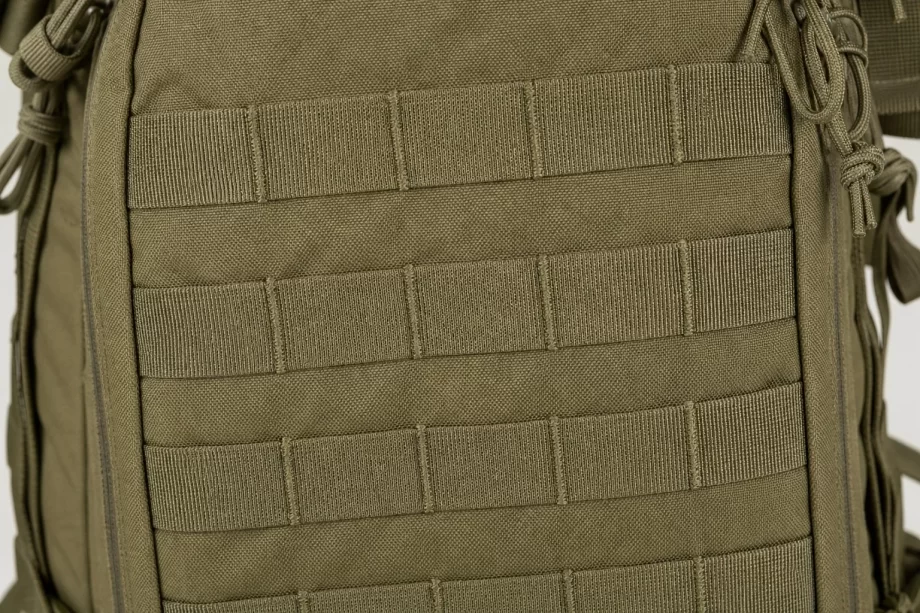
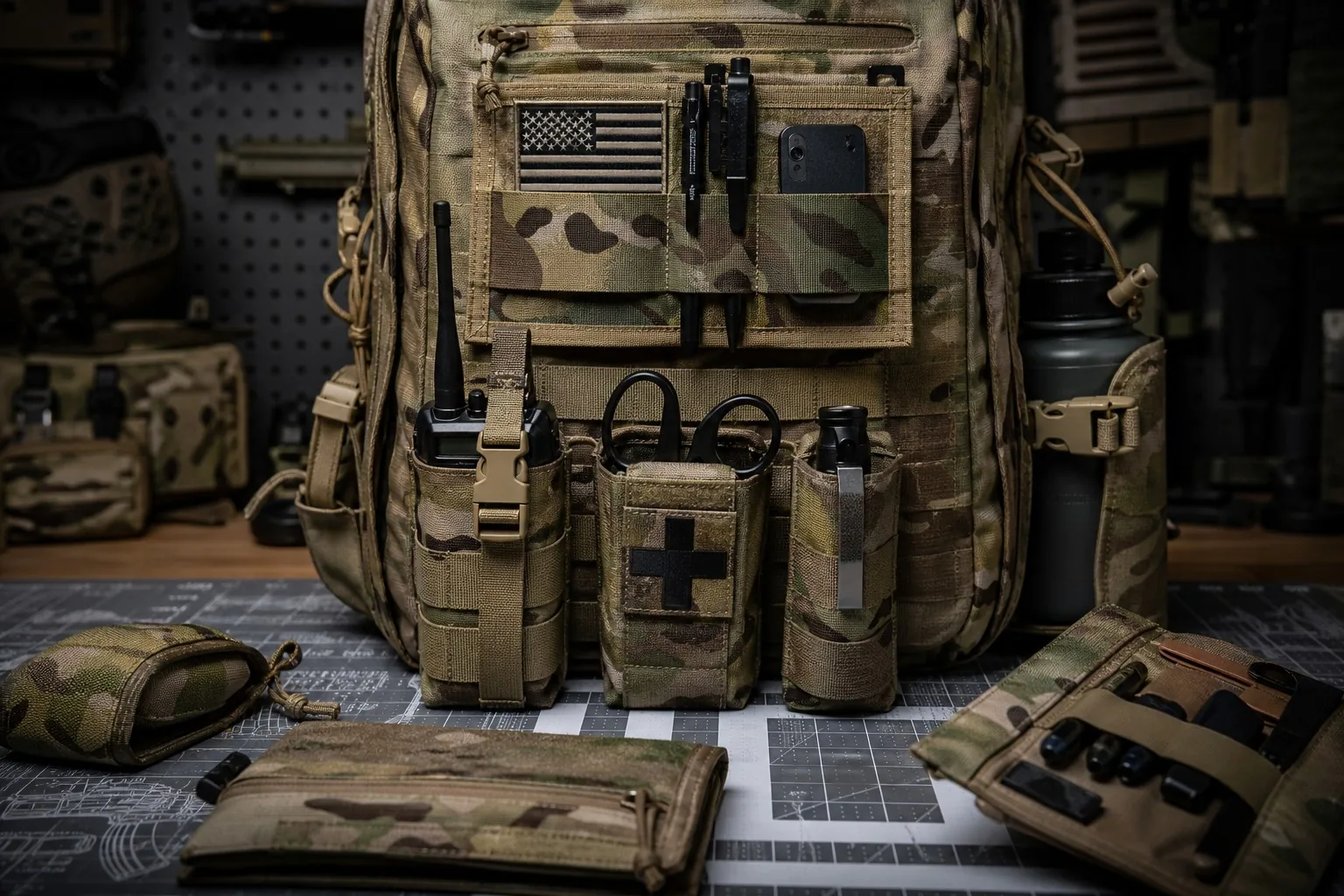
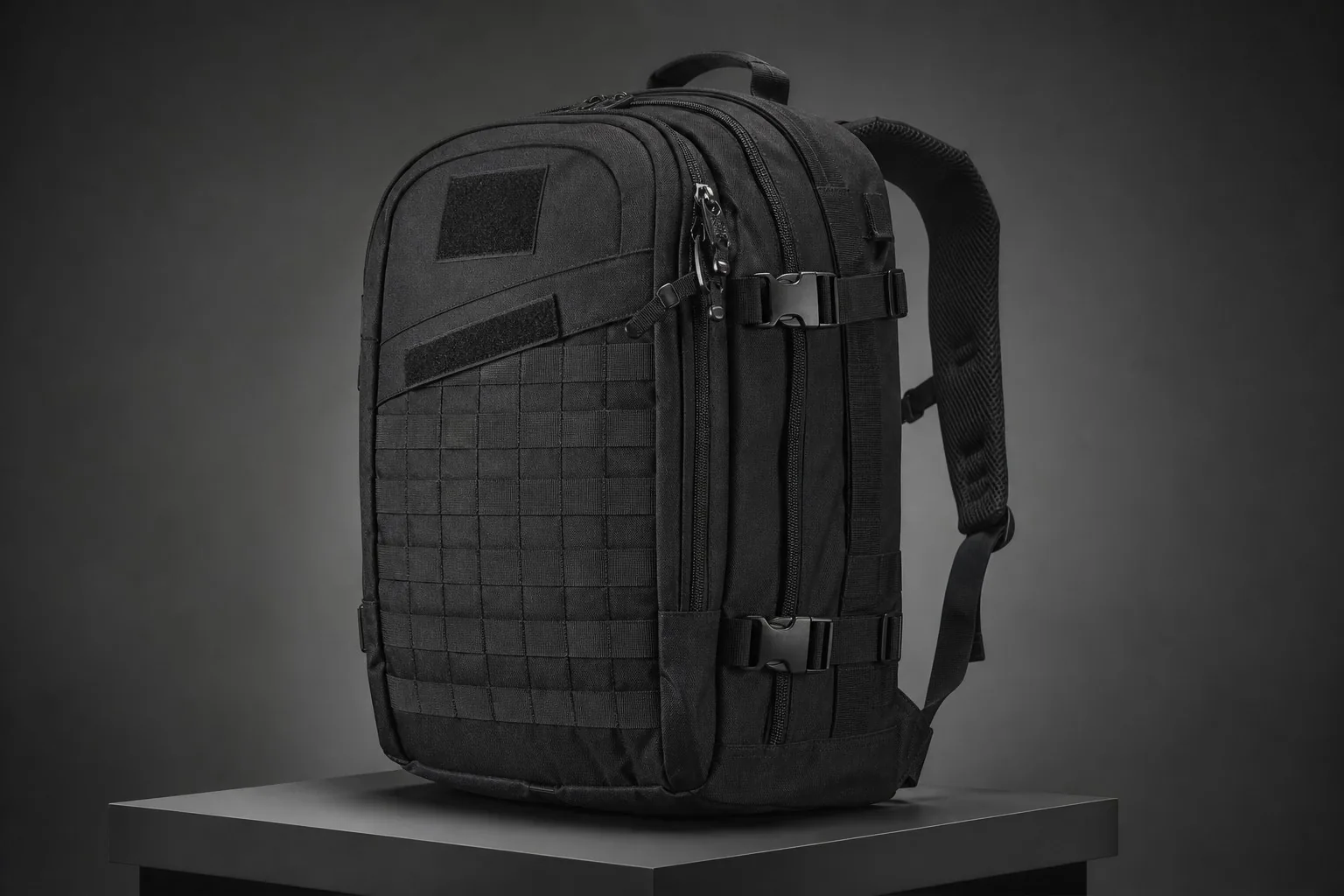
The defining feature of the modern tactical pack is the MOLLE system — the grid of webbing loops that lets users attach pouches, holsters, and accessories in endless configurations. MOLLE transformed tactical gear from fixed designs into modular platforms, and it created a whole manufacturing discipline around webbing placement, bar-tack reinforcement, and dimensional precision.
This guide explains tactical backpack manufacturing from the factory floor: the materials that take the abuse, the MOLLE webbing system and how it is built, the specialized sewing and reinforcement techniques, the hardware and zipper standards, the testing that separates tactical gear from ordinary packs, and what it takes to produce this category profitably.
- What Defines a Tactical Backpack
- The Materials That Take the Abuse
- The MOLLE System: The Heart of Tactical Design
- Sewing Tactical Gear: The Hard Part
- Hardware and Zippers: Where Tactical Packs Fail First
- Manufacturing the MOLLE Panel: A Step-by-Step View
- Design Decisions That Drive Manufacturing Cost
- Testing: Proving the Gear
- Production Line Differences vs Standard Backpack Lines
- Sourcing Tactical Packs: A B2B View
- The Cost Structure of Tactical Packs
- Weather Resistance and Field-Specific Features
- Quality Control on the Tactical Line
- Market Trends Shaping Tactical Manufacturing
- FAQ
- Conclusion
What Defines a Tactical Backpack
Tactical backpacks serve military, law enforcement, outdoor professionals, and a growing civilian market (hunters, preppers, EDC enthusiasts). The category is defined by requirements, not fashion:
| Requirement | What it means |
|---|---|
| Extreme durability | Survives field abuse, dragging, and heavy loads |
| Load-bearing capacity | Carries 20–40 kg without structural failure |
| Modularity | MOLLE/PALS webbing for attachments |
| Weather resistance | Sheds rain, resists mud and moisture |
| Functional organization | Purpose-built compartments, admin panels, hydration slots |
| Quick access | Rapid-open main compartments, dedicated pockets |
The Market Segments
| Segment | User | Key requirements |
|---|---|---|
| Military | Active-duty forces | Spec compliance, extreme durability, field serviceability |
| Law enforcement | Police, security | Rapid access, armor compatibility, discreet options |
| Outdoor professionals | Hunters, guides, SAR | Weather resistance, comfort, organization |
| Civilian/EDC | Enthusiasts, preppers | Durability, style, modularity |
| Airsoft/competition | Sports users | Authentic look, affordability |
Manufacturer’s note: The civilian tactical market is now larger than the military one in volume. But the manufacturing bar is set by the military customer: a factory that can hold mil-spec tolerances can easily serve the civilian market; the reverse is not true. Positioning for the hardest customer keeps the whole line honest.
The Materials That Take the Abuse
Tactical packs live or die by materials. Every component is chosen for the worst case, not the average case.
The Shell Fabrics
| Fabric | Denier | Typical use | Character |
|---|---|---|---|
| Standard nylon | 500D | Light tactical, urban packs | Lighter, less abrasion-resistant |
| Heavy nylon | 1000D | Mainstream tactical shells | Excellent abrasion, stiff |
| Cordura-branded | 500D/1000D | Premium tactical gear | Consistent spec, brand value |
| Ballistic nylon | 1050D/1680D | High-end panels, armor-adjacent | Maximum abrasion resistance |
| Ripstop variants | 500D–1000D | Weight-reduced builds | Tear resistance, lighter weight |
| Multicam/camo prints | — | Tactical aesthetic | Pattern accuracy matters |
Why Denier Matters
Denier measures yarn thickness. Higher denier means thicker yarn, tougher fabric, and more weight and stiffness:
- 500D — a good balance for urban and lighter tactical packs; easier to sew.
- 1000D — the workhorse of tactical shells; significantly tougher, heavier, harder to sew.
- 1680D ballistic — the extreme end; used where maximum cut and abrasion resistance is needed.
The Supporting Cast
| Component | Material standard | Why it matters |
|---|---|---|
| Webbing (MOLLE straps) | Nylon, typically 38–50 mm, high tensile | The load-bearing grid itself |
| Thread | Bonded nylon, heavier tex than standard | Seams must outlast the fabric |
| Zippers | #8/#10, often YKK with weather treatment | Heavy zippers fail less under load |
| Buckles | ITW/Woojin-style side-release, mil-spec nylon | Hardware is the most common failure point |
| Hook-and-loop | Mil-spec Velcro with strong adhesive | Patch panels and closures |
| Foam | Closed-cell or high-density EVA | Structure, comfort, and durability |
| Coating | PU or TPU on shell interior | Weather resistance without weight |
Manufacturer’s note: The two most common tactical gear failures are zippers and webbing attachments — not the shell fabric. Buyers obsessed with denier but indifferent to zipper quality and bar-tack placement are buying the wrong priorities. The seams and the hardware carry the load; the fabric is only the canvas.
The MOLLE System: The Heart of Tactical Design
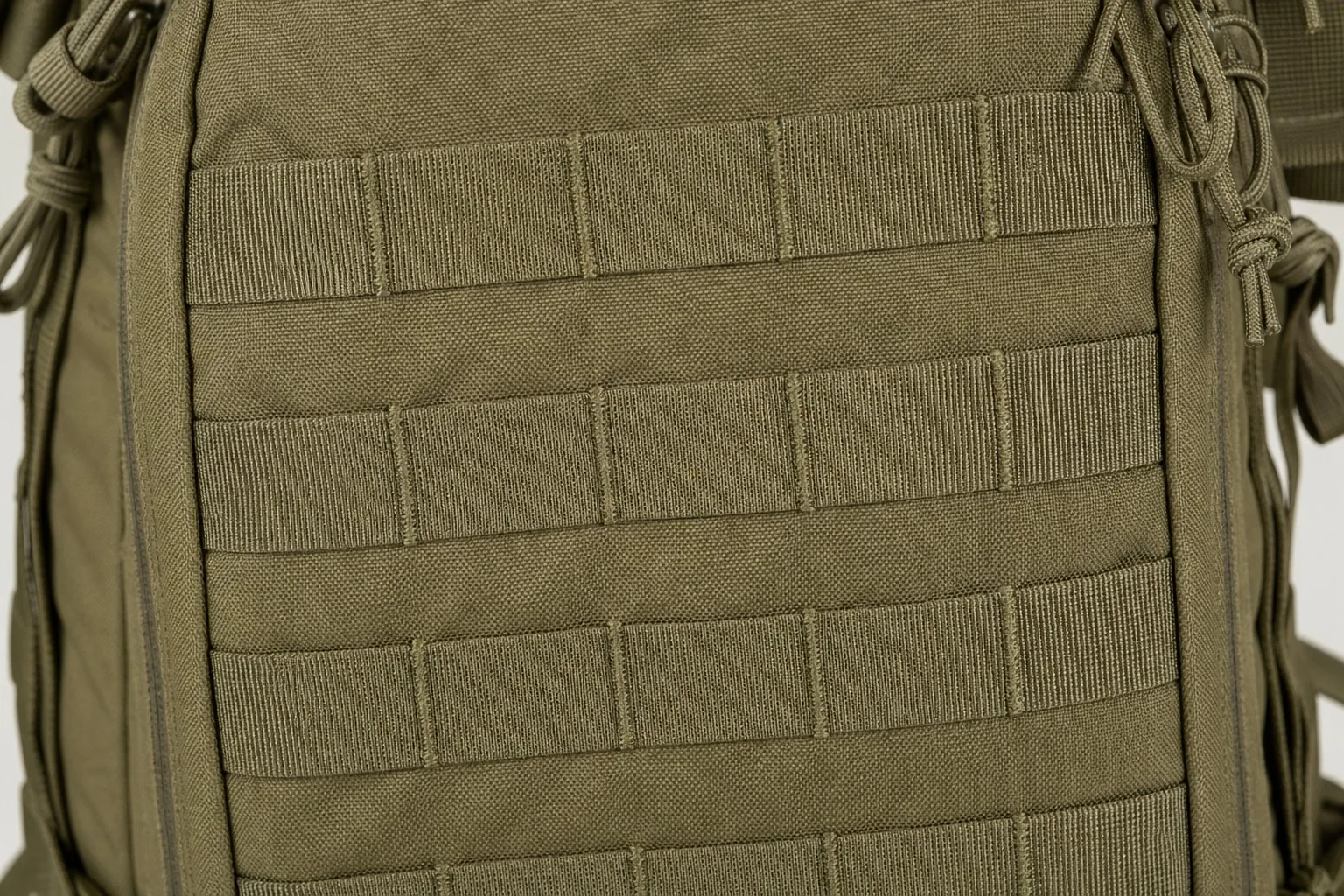
MOLLE (Modular Lightweight Load-carrying Equipment) originated with the U.S. military as a replacement for the ALICE system. Its core is PALS (Pouch Attachment Ladder System) webbing: horizontal rows of webbing loops stitched to the pack, through which accessory pouches weave their own straps.
The MOLLE Grid Standards
| Parameter | Standard dimension |
|---|---|
| Webbing width | 25 mm (1 inch) nominal |
| Loop spacing | 25 mm between loop centers |
| Row spacing | 38 mm between rows (1.5 inches) |
| Loop width | ~25 mm visible loop |
| Attachment method | Weave-through straps on accessory |
| Common layouts | 3–8 columns × 3–6 rows per panel |
Why Precision Matters
The entire point of MOLLE is interoperability: a pouch made by any brand must fit any pack with the same grid. That requires dimensional discipline:
- Consistent loop width — loops must be uniform so straps weave through smoothly.
- Consistent row spacing — 38 mm center-to-center; deviations of a few millimeters make attachments impossible or sloppy.
- Straight lines — curved or twisted webbing rows break the grid.
- Correct bar-tacks — each loop end must be reinforced so it does not tear out under load.
The Webbing Manufacturing Process
- Webbing sourcing — nylon webbing is cut to length; ends are heat-sealed to prevent fraying.
- Layout — rows are positioned on the panel using jigs and templates; spacing is verified against a gauge.
- Tacking — loops are formed and bar-tacked at each end; the stitch pattern determines tear-out strength.
- Inspection — every row is checked for spacing, straightness, and stitch integrity before the panel moves on.
Sewing Tactical Gear: The Hard Part
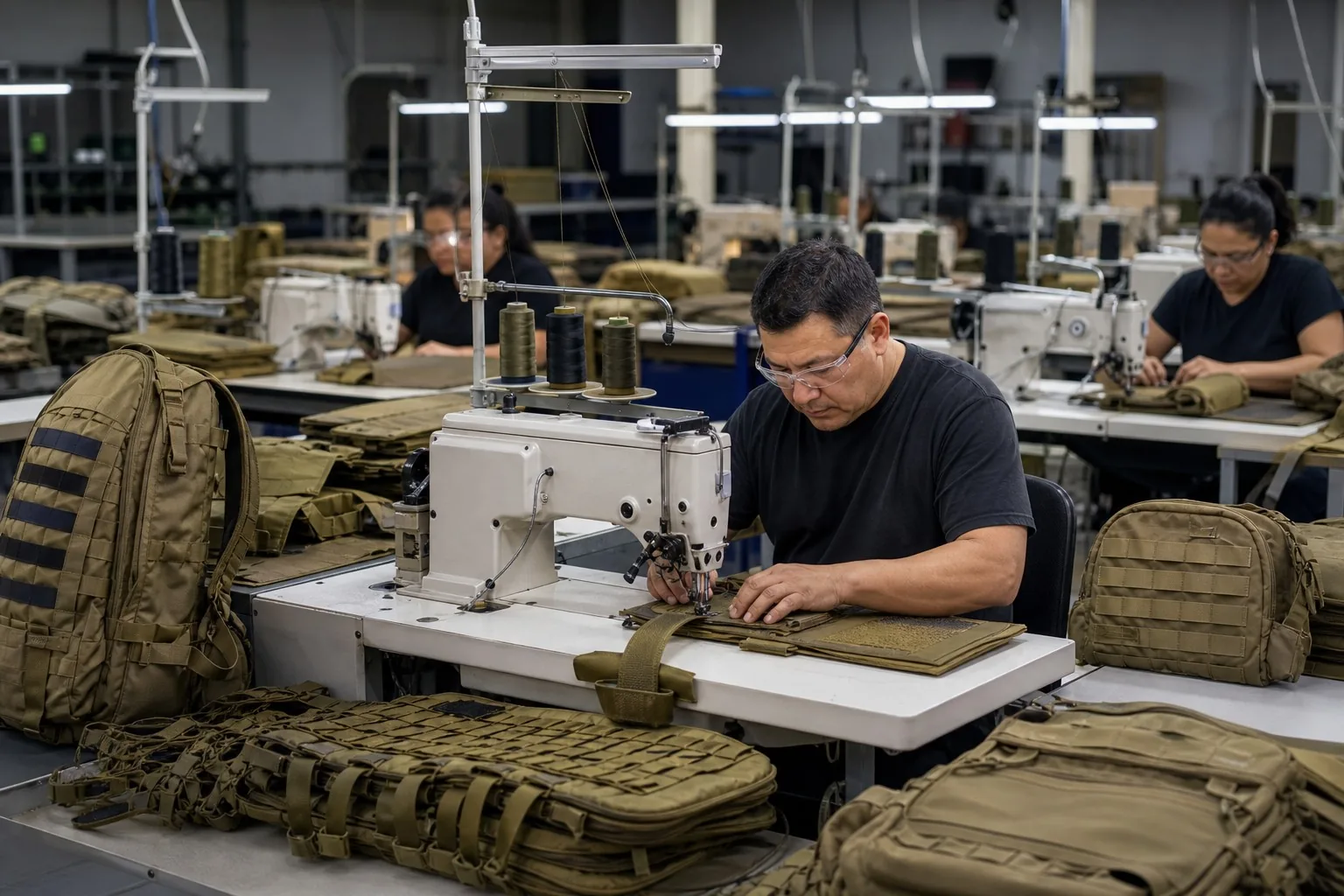
Sewing heavy fabrics with multiple layers is where tactical manufacturing separates from standard bag production. The machines, the needles, and the techniques are different.
The Machine Requirements
| Machine type | Role in tactical line | Why |
|---|---|---|
| Walking-foot machine | Main assembly sewing | Feeds thick multi-layer seams evenly |
| Compound feed (triple feed) | Heavy seams, webbing attachment | Maximum feeding power |
| Bar-tack machine | Reinforcements at stress points | Fast, precise reinforcement stitches |
| Double-needle | Zipper and binding seams | Parallel stitching for strength |
| Binding machine | Edge finishing | Clean, durable edge treatment |
| Heavy-duty single needle | Standard seams | Versatile workhorse |
The Sewing Techniques
- Bar-tacks — dense zigzag reinforcement stitches at stress points: webbing ends, zipper stops, handle bases, MOLLE loop ends.
- Box-X stitching — the classic reinforcement pattern for webbing and strap attachments: a rectangle with an X through it, locking the strap in four directions.
- Triple stitching — critical seams sewn three times for redundancy; if one line fails, the others hold.
- Reinforced seam allowances — folded and bound seams prevent edge fraying on heavy fabrics.
- Stitch density — tactical gear typically uses 4–6 stitches per inch (SPI) on heavy fabrics; fewer, larger stitches penetrate the material better than fine ones.
| Technique | Used for | Failure mode if skipped |
|---|---|---|
| Bar-tack | Webbing ends, zipper stops, handle bases | Tear-out under load |
| Box-X | Strap and webbing attachments | Strap detachment |
| Triple stitch | Main load seams | Progressive seam failure |
| Bound edges | Panel edges, pocket openings | Fraying, reduced durability |
Manufacturer’s note: The most telling quality signal in a tactical pack is not the fabric brand — it is the bar-tack count. Count the reinforcements at stress points and compare packs side by side. The pack with more, heavier, correctly placed bar-tacks will outlast the one with fewer, regardless of the label on the fabric.
The Multi-Layer Problem
Tactical packs routinely join 4–6 layers: shell fabric, foam, lining, webbing, binding, and reinforcement patches. Each additional layer raises the difficulty:
- Needle size — must match the total thickness; too small = skipped stitches and breakage, too large = weakened fabric.
- Tension — must be tuned for thick seams; wrong tension = loose threads or puckering.
- Speed — slower speeds prevent needle deflection on dense layers.
- Thread — bonded nylon in heavier tex (e.g., T-70 to T-90) is standard; polyester threads can fail under tactical load cycles.
Hardware and Zippers: Where Tactical Packs Fail First
Field data from repair shops is consistent: hardware fails before fabric. The factory’s hardware spec is therefore as important as the fabric spec.
Zipper Standards for Tactical Gear
| Zipper element | Standard gear spec | Tactical spec |
|---|---|---|
| Size | #5 | #8 or #10 |
| Type | Coil | Coil with heavy tape, or molded tooth |
| Slider | Standard | Locking sliders, larger pulls |
| Weather | Optional | Taped or coated where waterproofing is claimed |
| Brand | Any | Often YKK or equivalent quality |
Buckles and Clasps
| Buckle type | Typical use | Mil-spec considerations |
|---|---|---|
| Side-release (35–50 mm) | Main closures | Cold-crack resistance, tensile strength |
| Cam buckles | Compression straps | Grip strength under load |
| Quick-release | Shoulder straps | Emergency release reliability |
| D-rings / tri-glides | Lash points | Tensile strength, no sharp edges |
The Hardware Testing
- Tensile testing — buckles tested to rated loads (often 100–200 kg for main buckles).
- Cold-crack testing — buckles must not shatter at low temperatures (mil-specs test to -40 °C or below).
- Cycle testing — zippers cycled thousands of times; sliders must not fail.
- Corrosion — hardware finishes tested against salt and humidity.
Manufacturing the MOLLE Panel: A Step-by-Step View
To show how precision and strength come together, here is the production sequence for a typical front MOLLE panel:
| Step | Operation | Quality checkpoint |
|---|---|---|
| 1 | Cut shell panel to pattern | Panel dimensions, grain direction |
| 2 | Mark webbing row positions with template | Row spacing on gauge |
| 3 | Cut and heat-seal webbing strips | Strip length, sealed ends |
| 4 | Lay webbing rows on panel | Alignment, no twists |
| 5 | Tack each loop end (bar-tack) | Stitch density, placement |
| 6 | Attach backing (foam/lining) | No puckering |
| 7 | Edge-bind the panel | Clean edges, uniform binding |
| 8 | Final seam the panel into the pack | Seam integrity |
| 9 | Test attachment with standard pouch | Interoperability check |
The final step is the one most factories perform and few advertise: the finished panel must accept a standard MOLLE pouch. If a standard pouch does not weave through cleanly, the grid is off-spec and the pack is a failure for its core purpose.
Design Decisions That Drive Manufacturing Cost
Tactical design choices have outsized manufacturing cost effects. Understanding them helps buyers budget and factories quote accurately.
The Cost Drivers
| Design choice | Cost impact | Notes |
|---|---|---|
| Fabric denier (500→1000D) | +10–25% material | Also slower sewing |
| MOLLE panel area | +per row: webbing, labor, tacking | Full-front grids add real cost |
| Zipper size (#5→#10) | +15–40% per zipper | Bigger hardware, heavier tape |
| Bar-tack density | Labor cost per pack | The invisible quality spend |
| Number of compartments | +cutting, +sewing time | Each pocket adds labor |
| Coating (PU/TPU) | +material cost | Weather resistance |
| Hook-and-loop area | +material, +applique labor | Patch fields are expensive |
| Custom camo prints | +fabric MOQ, +lead time | Pattern registration matters |
The Balance
| Priority | Push | Pull |
|---|---|---|
| Price point | Simplify panels, standard fabrics | Fewer rows, 500D |
| Durability | 1000D, full bar-tacks, #10 zippers | Higher cost, heavier pack |
| Modularity | More MOLLE rows, more attachment points | Labor and webbing cost |
| Weight | Ripstop, 500D, minimal padding | Less protection |
Manufacturer’s note: The classic tactical pricing trap is “add one more row of webbing.” Each row adds webbing material, cutting, layout, tacking, and inspection time. By the time a design has full-front and full-back MOLLE grids, the labor cost per pack has risen 20–30% over a plain panel. Designers should place every row with intent.
Testing: Proving the Gear
Tactical products are tested harder than any other backpack category. The test regime is part of the spec.
The Standard Test Battery
| Test | Method | Pass criteria (typical) |
|---|---|---|
| Abrasion | Taber test on fabric | 1000D: 2,000+ cycles |
| Tear strength | Tongue tear test | 1000D: 30+ kgf warp/weft |
| Seam strength | Load test on sewn seams | 100–200 kg before failure |
| Strap pull-out | Pull-test on webbing attachments | Per spec (often 50–100 kg) |
| Zipper cycle | Repeated open/close | 5,000–10,000 cycles |
| Buckle tensile | Machine pull | Main buckles 100–200 kg |
| Buckle cold-crack | Low-temperature impact | No fracture at rated temp |
| Load carry | Weighted pack test | 20–40 kg, no structural failure |
| Water resistance | Spray/immersion per spec | Coated: meets rated level |
Load Testing in Practice
The load test is the closest thing to real-world validation:
- Pack loaded to the rated capacity (often 25–40 kg).
- Straps, handles, and MOLLE attachments exercised.
- Pack lifted, carried, dropped, and dragged.
- Seams and attachments inspected for failure.
- Test recorded with photos for the buyer’s file.
Production Line Differences vs Standard Backpack Lines
Running a tactical line next to a standard line reveals how different the categories are:
| Aspect | Standard backpack line | Tactical line |
|---|---|---|
| Fabric weight | 300–600D typical | 500–1680D |
| Machine mix | Standard single/double needle | Walking-foot, compound feed, bar-tack |
| Operator skill | Moderate | High (heavy, multi-layer work) |
| Stitch density | 8–12 SPI fine thread | 4–6 SPI heavy thread |
| QC intensity | Standard AQL | Tighter, with functional testing |
| Production speed | Faster | Slower (30–50% more labor) |
| Cost structure | Material-dominant | Labor-dominant |
Staffing Implications
- Operators on tactical lines need more training and experience — heavy multi-layer sewing has a learning curve.
- Bar-tack operators are specialists; their skill directly controls quality.
- QC staff need to understand MOLLE grid tolerances and test procedures.
- Rework on heavy fabric is harder: mistakes are visible, unpicking is slow, and holes are permanent.
Sourcing Tactical Packs: A B2B View
For brands importing tactical packs, the factory selection criteria differ from standard bags.
What to Look For in a Tactical Factory
- Proven tactical production — ask for production references, not just samples.
- Machine capability — verify walking-foot, compound feed, and bar-tack machines exist and are used.
- MOLLE precision tooling — jigs, templates, and gauges for grid placement.
- Testing capability — in-house or partnered testing for load, seams, and hardware.
- Material sourcing — access to 1000D, mil-spec webbing, and quality zippers.
The Questions to Ask
- Which tactical products have you produced, and for which markets?
- Can you show me your MOLLE spacing gauges and inspection records?
- What bar-tack pattern do you use at webbing ends, and why?
- What zipper and buckle brands do you install by default?
- Can you run the full test battery, and at what cost?
- What is your rework rate on tactical orders?
The Compliance Angle
Tactical gear faces export and compliance scrutiny that other bags do not:
| Compliance area | What to verify |
|---|---|
| Export controls | Dual-use and military-end-use restrictions by market |
| Materials compliance | REACH, Prop 65 for coatings and hardware |
| Labeling | Country of origin, care, fiber content |
| Consumer safety (civilian) | Small-parts, flammability where applicable |
| Customs classification | Correct HS codes for tactical gear |
Manufacturer’s note: Tactical gear is one of the few product categories where the paperwork can stop a shipment even when the product is perfect. Buyers should confirm the compliance picture with the factory and their customs broker before production, not after — the same pack that sails through one market’s customs may require a license in another.
The Cost Structure of Tactical Packs
Tactical packs sit at the premium end of backpack pricing for a reason:
| Cost component | Share of factory cost (typical) | Why |
|---|---|---|
| Materials | 40–55% | Heavy fabrics, mil-spec hardware, webbing |
| Labor | 30–45% | Slow, skilled, multi-layer sewing |
| Overhead | 10–15% | Specialized machines, QC, testing |
| Profit margin | 10–20% (on top) | Specialist positioning |
Compared with a standard 600D pack of similar size, a tactical pack typically costs 60–120% more at the factory — and the difference is not branding, it is material weight, hardware, reinforcement labor, and testing.
Where the Value Is
- A buyer who pays for 1000D but skips the bar-tacks gets a pack that fails where it matters.
- A buyer who pays for full reinforcement and standard fabrics gets durability that beats a thin premium-shell pack.
- The value is in the whole system: fabric + hardware + stitching + testing. Skimping on one component undermines the rest.
Weather Resistance and Field-Specific Features
Tactical gear is used outdoors, in all weather, often in conditions that would end a normal pack’s life. Weather resistance is engineered, not optional.
The Weather-Proofing Toolkit
| Feature | What it does | Manufacturing implication |
|---|---|---|
| PU/TPU-coated shell interior | Blocks water ingress through fabric | Coating applied at mill; handling care in cutting |
| Taped or sealed seams | Prevents seam leakage | Tape application adds labor, needs heat press |
| Weather-treated zippers | Slows water entry at closures | Premium zipper spec, higher cost |
| Zipper storm flaps | Physical barrier over zipper | Extra pattern piece and sewing step |
| Drain grommets | Lets water escape if flooded | Hole punch + grommet setting operation |
| Covered hardware | Protects buckles and webbing ends | Design complexity, extra panels |
| DWR on outer face | Beads light rain | Applied at mill or by finishing treatment |
The Hydration Compatibility Question
Most tactical packs now support hydration bladders:
- Bladder sleeve — a dedicated compartment with a hanging hook and hose port.
- Hose port — a grommet or routed opening for the drinking tube.
- Tube routing — webbing loops on the shoulder straps to secure the hose.
- The manufacturing detail — the hose port must not compromise the pack’s weather resistance; the port area needs reinforcement and often a flap.
Field-Serviceability Design
Tactical users expect to repair gear in the field:
- Replacement-friendly hardware — buckles and sliders that can be swapped without tearing the pack open.
- Exposed attachment points — webbing ends accessible for re-stitching.
- Reinforced repair zones — common damage areas (corners, strap bases) get extra layers so field repairs hold.
- Documented construction — some brands provide repair guidance; the factory’s QC file supports it.
Manufacturer’s note: A pack designed for field serviceability is cheaper to repair and more likely to be repaired than replaced — which matters for military and professional users who cannot simply buy a new pack. The factory work is small (accessible attachments, reinforced zones); the customer value is large.
Quality Control on the Tactical Line
Tactical quality control is stricter than standard bag QC because the stakes are higher: gear failure can mean mission failure, not just a returned product.
The QC Gates
| Gate | What is checked | Tactical-specific checks |
|---|---|---|
| Incoming materials | Fabric, webbing, zippers, buckles vs spec | Denier verification, webbing tensile, zipper brand |
| Cutting QC | Panel dimensions, grain, pattern alignment | MOLLE panel dimension accuracy |
| In-line QC | Sewing quality per operation | Bar-tack placement, stitch density, seam integrity |
| Sub-assembly QC | Pockets, panels, MOLLE grids before assembly | Grid spacing on gauge, attachment test |
| Final assembly QC | Complete pack before packing | Function test, hardware check, load test |
| Pre-shipment inspection | AQL sampling of finished goods | Full functional test battery on sample |
The MOLLE-Specific QC
MOLLE grids get dedicated checks because precision is the product:
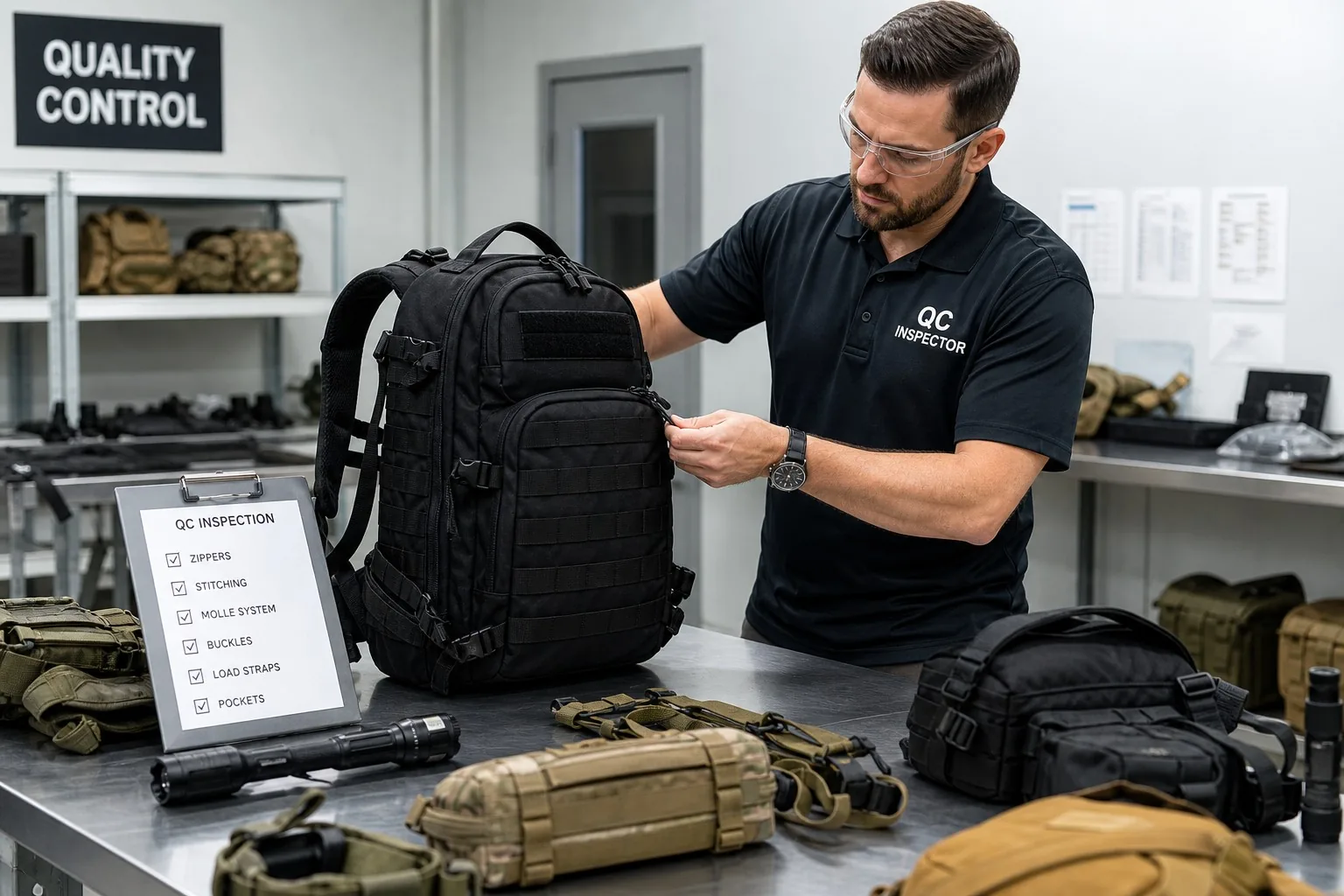
- Spacing gauge — a physical gauge verifies row spacing and loop width on every panel.
- Pouch fit test — a standard MOLLE pouch must weave through cleanly.
- Bar-tack inspection — every loop end verified for stitch coverage and placement.
- Pull test — sample loops loaded to rated force; no tear-out.
The Functional Test Battery on Finished Packs
- Load the pack to rated capacity and exercise straps and attachments.
- Cycle every zipper a defined number of times.
- Test every buckle closure.
- Spray test for weather resistance where claimed.
- Check all pockets, ports, and compartments for function.
- Verify labels, branding, and compliance marks.
The QC Documentation
Every tactical order should produce a QC file:
- Material test certificates (fabric, webbing, hardware)
- In-line inspection records
- Final inspection report with photos
- Load and function test results
- Rework and defect statistics
This file is the buyer’s evidence that the gear meets spec — and the factory’s record of how the product was made.
Market Trends Shaping Tactical Manufacturing
The tactical market is evolving, and the trends are changing what factories are asked to build.
The Trends to Watch
- Civilianization — the largest growth is in civilian use: EDC, hunting, travel, and work gear. Design priorities are shifting from pure field function toward daily carry ergonomics and style.
- Weight reduction — users want tactical durability without the weight. Ripstop shells, lighter hardware, and minimalist construction are rising — which changes fabric and machine choices.
- Laser-cut MOLLE — laser-cut laminate panels replace woven webbing on some premium packs: lighter, cleaner, and faster to produce, though less field-repairable. Factories need laser-cutting capability to offer it.
- Low-profile designs — urban and commuter tactical gear favors concealed or muted attachment systems over full webbing grids.
- Sustainable materials — recycled nylon and bluesign-certified fabrics are entering tactical gear, especially for the civilian segment.
- E-commerce direct — more tactical brands sell direct to consumer, which raises the demand for consistent QC and reliable reorders.
The Manufacturing Response
| Trend | Factory implication |
|---|---|
| Civilianization | More colorways, lighter fabrics, faster reorders |
| Weight reduction | Ripstop sourcing, hardware downsizing |
| Laser-cut MOLLE | New machinery investment, laminate materials |
| Low-profile designs | Simplified panels, hidden attachment points |
| Sustainability | Certified material sourcing, documentation |
| DTC brands | Consistent QC, shorter lead times, flexible batches |
Manufacturer’s note: The tactical factories that thrive are those that serve both worlds: the mil-spec discipline that built the category, and the civilian market’s demand for lighter, cleaner, more livable gear. The manufacturing fundamentals — heavy-sew capability, MOLLE precision, test rigor — transfer across both.
FAQ
What does MOLLE stand for, and how does it work?
MOLLE stands for Modular Lightweight Load-carrying Equipment. The MOLLE/PALS system uses horizontal rows of 25 mm nylon webbing loops sewn to the pack, with 38 mm spacing between rows. Accessory pouches weave their straps through the loops and snap them back, creating a customizable attachment grid.
What is the difference between 500D and 1000D tactical fabric?
1000D uses thicker yarns: roughly double the abrasion resistance and significantly more weight and stiffness than 500D. 500D suits urban and lighter tactical use; 1000D is the standard for hard-use shells. Sewing 1000D is slower and harder, adding labor cost.
What makes a tactical backpack more expensive than a normal backpack?
Heavier fabrics, mil-spec zippers and buckles, extensive bar-tack reinforcement, MOLLE webbing and its precision labor, slower skilled sewing, and a full test battery. A comparable tactical pack typically costs 60–120% more at the factory than a standard 600D pack.
What are the most common failure points in tactical backpacks?
Zippers and webbing attachments fail first in field use — not the shell fabric. The second tier is buckle breakage (especially in cold weather) and seam failure at stress points. Choosing quality hardware and bar-tack reinforcement matters more than fabric denier alone.
Can a normal backpack factory produce tactical gear?
Only with the right machines, operators, and tooling. Tactical sewing needs walking-foot and compound-feed machines, heavy thread, bar-tack capability, and MOLLE spacing precision. A standard factory can learn, but the first tactical orders carry real quality risk without experienced staff.
What MOLLE spacing is standard, and why does it matter?
Standard PALS: 25 mm webbing with 25 mm loop spacing, 38 mm between rows. The grid must be consistent so any standard pouch fits any pack. Deviations of even a few millimeters make attachments sloppy or impossible — precision is the whole point of the system.
Do tactical backpacks need export licenses?
It depends on the market, the design, and the end user. Some countries apply export controls to tactical and military-style gear, especially for military end-use. Verify compliance requirements with the factory and your customs broker before production.
The Buyer’s Quick Assessment
When evaluating a tactical pack or a factory, run this mental checklist:
- [ ] Fabric spec defined (denier, brand, coating) and verified against test certificates
- [ ] Hardware spec confirmed (zipper size/brand, buckle tensile, cold-crack rating)
- [ ] Bar-tack count and placement inspected at every stress point
- [ ] MOLLE grid measured against the standard gauge, and a standard pouch fit-tested
- [ ] Seam and stitch density verified (SPI, thread type)
- [ ] Full test battery available (load, zipper cycle, abrasion, tear, buckle)
- [ ] Weather features matched to the claimed rating (coating, taped seams, storm flaps)
- [ ] Compliance picture confirmed for the target market
- [ ] QC documentation expected and received with the order
A pack that passes this checklist is gear. A pack that fails it is a bag with a tactical look — and the market, especially the professional market, can tell the difference at first use.
Conclusion
Tactical backpacks are a distinct manufacturing discipline: heavier materials, specialized machines, precision MOLLE grids, dense reinforcement, and a test regime that ordinary bags never face. The category rewards factories that invest in capability and buyers who understand where the value actually sits — in the hardware, the bar-tacks, and the dimensional precision of the webbing, not just in the denier number on the fabric.
For brands entering the tactical market, the path is clear: define the real use case, spec the whole system (fabric, hardware, reinforcement, testing), select a factory with proven tactical production, and verify with load tests and inspection — then let the product prove itself in the field.
If you are planning a tactical pack line, our factory can walk you through material and hardware specifications, show you our MOLLE precision tooling and bar-tack standards, and run the full test battery on a prototype — so you launch with gear that earns its place on the field.