
Quality Control Checklist for Backpack Factories: What Buyers Should Audit
A backpack order is a promise: the pack will carry the load, open and close smoothly, survive the weather, and last as long as the customer expects. Between that promise and the customer’s hands stand the factory’s quality control system — and the buyer’s own inspection discipline. The factories that deliver consistent quality are not necessarily the ones with the fanciest machines; they are the ones with the most complete checkpoints, and the buyers who avoid disasters are the ones who verify, not assume.
Every season, importers discover the same lessons the hard way: seams that pop under normal loads, zippers that jam after a month, colors that bleed in the first wash, handles that tear out at the worst moment. Nearly all of these failures are detectable before shipment — if the right checks happen at the right stage.
This guide is a practical quality control checklist for backpack buyers and importers, written from the factory perspective. It covers the factory audit (who you are really dealing with), the inspection stages (incoming, in-line, pre-shipment), the critical QC items that matter most (stitch density, zipper smoothness, load testing, water testing, color fastness, hardware), the AQL sampling system that makes inspections statistically meaningful, and the arrival inspection that closes the loop.
- Why Quality Control Pays for Itself
- Stage 1: The Factory Audit
- Stage 2: Incoming Material Inspection
- Stage 3: In-Line (During-Production) Inspection
- Stage 4: The Critical QC Items — What Actually Matters
- Stage 5: Pre-Shipment Inspection and AQL
- The Defect Classification Framework
- The Buyer’s Own Arrival Inspection
- Building the QC Plan Into Your Purchase Order
- The Defect Anatomy: Common Backpack Defects and Their Root Causes
- Laboratory Testing: The Standards Behind the Checks
- Working with Third-Party Inspection Companies
- The Golden Rules of Backpack QC
- Sealed Samples and Record Management
- The Buyer’s Quick Audit Checklist
- FAQ
- Conclusion
Why Quality Control Pays for Itself
Quality control is often treated as a cost to be minimized. In backpack sourcing, it is an investment with a measurable return:
| Cost of QC failure | Typical impact |
|---|---|
| Customer returns | 10–30% of order value in returns, freight, and restocking |
| Refunds and claims | Full or partial refunds plus chargebacks |
| Brand reputation | Reviews and word-of-mouth damage that outlasts the fix |
| Compliance penalties | Failed safety tests can block sales entirely |
| Reorder loss | One bad batch kills the reorder stream |
| Cost of QC | Typical investment |
|---|---|
| Factory audit | A few hundred dollars and one day |
| Pre-shipment inspection | 0.2–0.5% of order value |
| Testing | Small fraction of the product price |
| Comparison | QC costs pennies per unit; failure costs dollars per unit |
Manufacturer’s note: From inside the factory, we see the same pattern every year: the buyers who invest in inspection get better product at the same price, because the factory knows the order will be checked. Inspection is not just catching defects — it is changing factory behavior before defects happen.
Stage 1: The Factory Audit
The first line of defense is knowing who you are buying from. A factory audit is an on-site examination of the factory’s systems, capabilities, and honesty — before you commit production.
The Audit Document Check
| Document | What it proves | Red flags |
|---|---|---|
| Business license | Legal entity exists and is registered | Mismatched names between license and contract |
| Export license | Authorized to export | No license for a claimed exporter |
| ISO 9001 certificate | Quality management system in place | Expired certificate or vague scope |
| BSCI/SEDEX membership | Social compliance framework | Membership number that does not verify |
| Test certificates | Materials and products meet standards | Certificates not tied to your materials |
| Previous audit reports | Past performance | Refusal to share |
The Factory Floor Walkthrough
| What to observe | What it tells you |
|---|---|
| Housekeeping (5S) | Orderly floors correlate with orderly production |
| Machine condition | Maintained machines produce consistent quality |
| Operator behavior | Trained operators work with confidence and care |
| Material storage | Properly stored materials keep their properties |
| QC stations | Dedicated QC points show process discipline |
| Fire and safety equipment | Basic compliance signals overall management quality |
| Employee atmosphere | High turnover and unhappy staff predict quality drift |
The Questions That Reveal the Most
- “Show me your QC records from the last order.” — real factories have them.
- “What was the defect rate on your last three orders?” — honest answers include a number.
- “What do you do with defective finished goods?” — the answer reveals the QC loop.
- “Who inspects the inspectors?” — layered QC is a sign of maturity.
- “Can you show me the first-piece inspection sheet for today’s run?” — specificity beats claims.
Manufacturer’s note: The single most revealing audit question is the QC records request. A factory with a working system produces records without hesitation — inspection sheets, defect tallies, rework logs. A factory without a system produces excuses. Records are the difference between a process and a promise.

Stage 2: Incoming Material Inspection
Quality starts at the material gate. Everything downstream inherits the quality of what comes in.
What to Check on Incoming Materials
| Material | Check items |
|---|---|
| Fabric | Denier, weight, color vs approved sample, coating uniformity, defects |
| Webbing | Width, tensile strength, edge finish, color |
| Zippers | Size, slider action, tape quality, brand verification |
| Buckles/hardware | Material, tensile rating, finish, no sharp edges |
| Foam | Density, thickness, resilience |
| Thread | Type, tex, color, strength |
| Labels | Content, artwork, compliance text |
The Verification Rules
- Compare against the approved sample — not against the purchase order description; the sample is the truth.
- Check the batch — verify certificates for this shipment, not the factory’s general claims.
- Sample across the delivery — take samples from different rolls/boxes, not the top layer.
- Document with photos — the material check becomes the reference for later stages.
Stage 3: In-Line (During-Production) Inspection
In-line inspection is the most cost-effective QC point: catching problems while they can still be fixed cheaply. Waiting until finished goods means rework or scrap.
The In-Line Checkpoints
| Checkpoint | What is checked | When |
|---|---|---|
| First-piece inspection | First unit of each operation vs approved sample | Start of each operation |
| Cutting QC | Panel dimensions, grain direction, defect avoidance | During cutting |
| Sewing QC | Stitch density, tension, seam alignment | During sewing |
| Sub-assembly QC | Pockets, panels, zippers before final assembly | During assembly |
| Final assembly QC | Complete pack function before packing | Before packing |
The First-Piece Rule
The first piece of every operation sets the standard for the run:
- Compare the first piece against the approved sample.
- Measure critical dimensions.
- Check stitch density and tension.
- Test function (zippers, buckles, straps).
- Approve or correct before the run continues.
Manufacturer’s note: First-piece inspection is the highest-leverage moment in production. A factory that checks the first piece of every operation and corrects deviations immediately produces consistent runs. A factory that skips first-piece checks discovers problems at final inspection — when everything is more expensive to fix.
Stage 4: The Critical QC Items — What Actually Matters
These are the checks that separate good backpacks from bad ones. Each one is a known failure mode in the field.
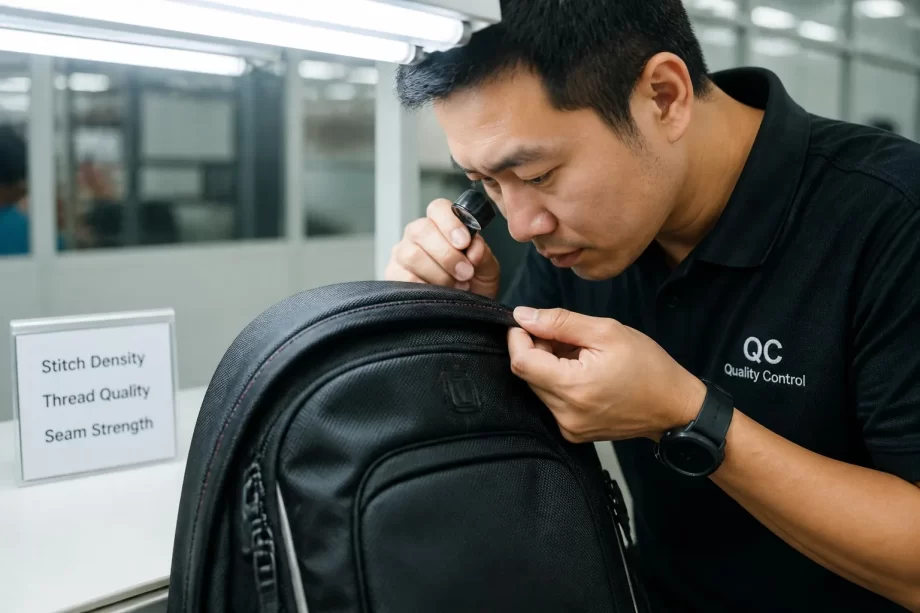
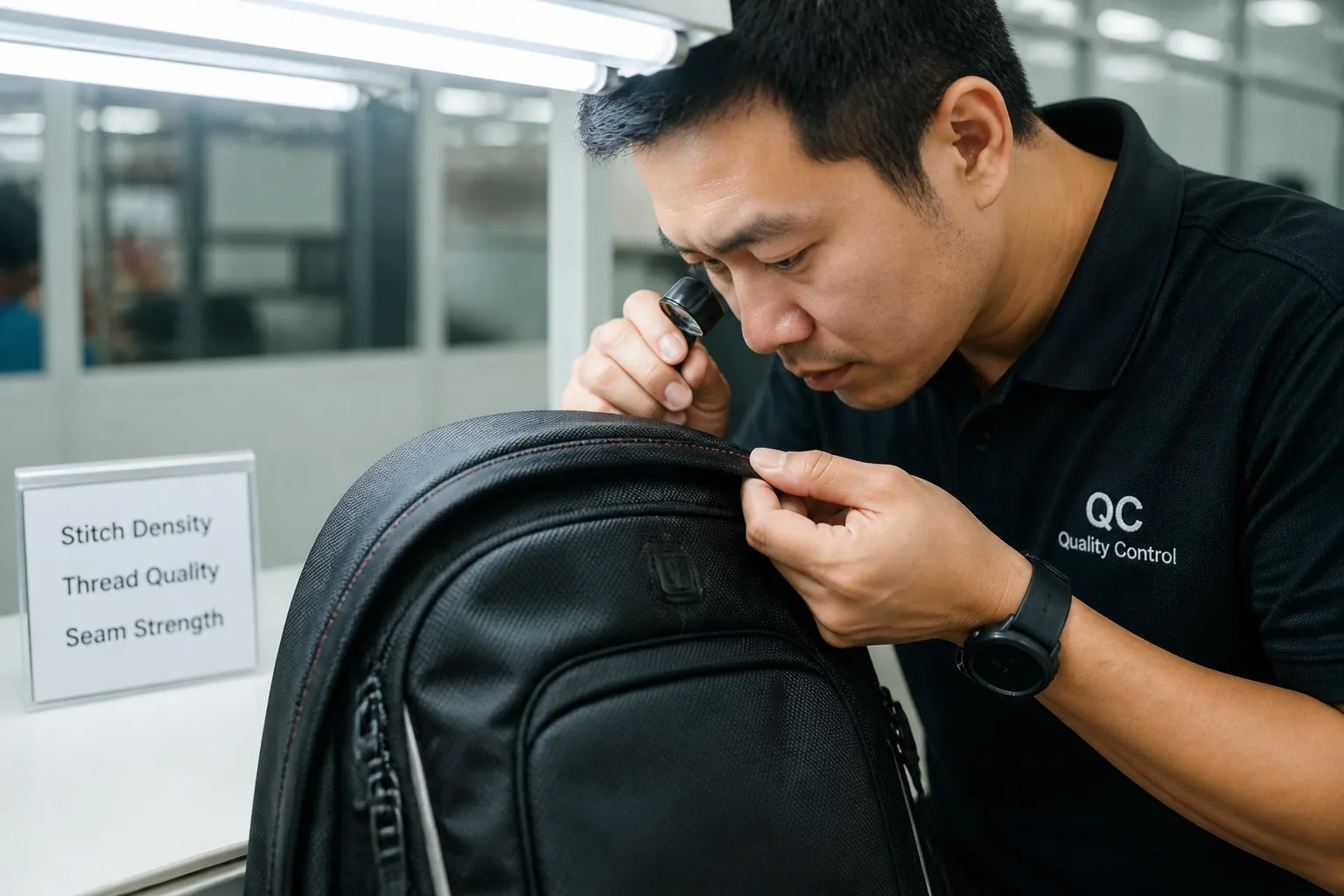
1. Stitch Density and Seam Quality
| Check | Standard (typical) | Failure symptom |
|---|---|---|
| Stitch density | 8–12 stitches per inch (SPI) on standard fabric | Loose seams, early unraveling |
| Stitch tension | Balanced — no loops or puckering | Weak seams, fabric distortion |
| Seam allowance | 8–12 mm typical | Edge fraying, seam failure |
| Bar-tacks | Present at stress points (handles, straps, zipper ends) | Tear-out under load |
| Thread type/lock | Bonded nylon, secure lock stitches | Seam unraveling |
2. Zipper Smoothness
The most common functional complaint in backpacks:
| Test | Method | Pass criteria |
|---|---|---|
| Slider action | Open/close repeatedly | Smooth, no jamming or sticking |
| Zipper cycle | Machine or manual cycling | 5,000+ cycles without failure (spec-dependent) |
| Tape strength | Check tape for tears near sliders | No damage |
| Alignment | Both sides meet cleanly | No gap, no waviness |
| Stop security | Zipper stops hold | No slider running off track |
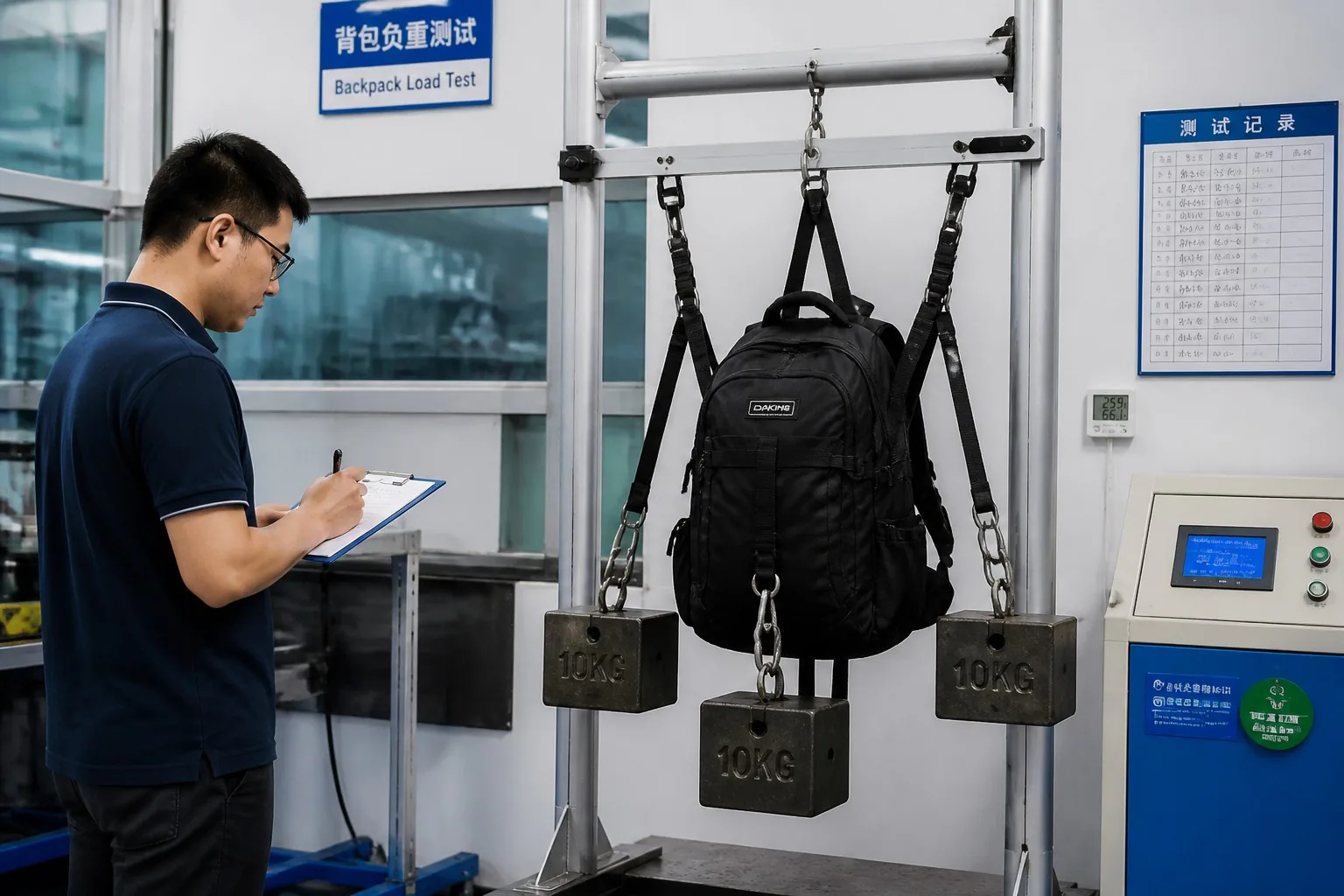
3. Load Testing (Weight-Bearing)
The pack must carry its rated load without structural failure:
| Test | Method | Pass criteria |
|---|---|---|
| Static load | Pack loaded to rated capacity, suspended | No seam or strap failure |
| Handle pull test | Handle loaded to rated force | No tear-out |
| Strap pull test | Shoulder straps loaded | No detachment |
| Bottom test | Loaded pack dropped/set down repeatedly | No bottom failure |
| Buckle test | Buckles loaded to rated force | No breakage |
4. Water and Weather Testing
| Test | Method | Pass criteria |
|---|---|---|
| Spray test | Water spray on surface | Beading, no penetration (per spec) |
| Hydrostatic head | Water column pressure | Meets rated mm (coated fabrics) |
| Seam leak test | Water applied to seams | No seam leakage (waterproof claims) |
| Drying | Wet pack dries reasonably fast | No trapped water pockets |
5. Color Fastness
Color issues drive many returns and are costly to discover late:
| Test | Method | Pass criteria |
|---|---|---|
| Wash fastness | Wash test | No bleeding or fading beyond rating |
| Crocking (dry/wet) | Rubbing test | No transfer beyond rating |
| Light fastness | Exposure test | No significant fading |
| Perspiration fastness | Simulated sweat test | No color change |
6. Hardware and Component Checks
| Component | Check | Pass criteria |
|---|---|---|
| Buckles | Snap, release, tensile | Secure closure, rated strength |
| Sliders and adjusters | Slide and lock | Smooth, hold position |
| Hook-and-loop | Adhesion strength | Holds, does not snag |
| Rivets/grommets | Setting, sharp edges | Secure, no sharp edges |
| Webbing ends | Heat-sealed or finished | No fraying |
Stage 5: Pre-Shipment Inspection and AQL
The pre-shipment inspection (PSI) is the final gate before the container ships. It uses AQL (Acceptable Quality Limit) sampling to make a statistically meaningful judgment on the whole lot.
The AQL System
AQL defines the maximum acceptable defect rate. Standard consumer-goods levels:
| Defect class | Typical AQL | What it covers |
|---|---|---|
| Critical | 0 | Safety hazards, regulatory failures |
| Major | 1.5–2.5 | Function failures, wrong materials, big visual defects |
| Minor | 4.0 | Small cosmetic issues |
How Sampling Works
| Lot size | Sample size (AQL 2.5, level II) | Critical | Major | Minor |
|---|---|---|---|---|
| 501–1,200 | 80 | 0 | 5 | 7 |
| 1,201–3,200 | 125 | 0 | 7 | 10 |
| 3,201–10,000 | 200 | 0 | 10 | 14 |
The inspection counts defects per class; if any class exceeds its limit, the lot is rejected (or re-inspected after sorting).
The PSI Protocol
- Confirm quantity — count against the packing list.
- Select samples — random across cartons, per AQL table.
- Check appearance — against the approved sample and spec.
- Check construction — seams, stitches, attachments.
- Test function — zippers, buckles, straps on every sample.
- Check labeling/packaging — marks, polybags, carton quality.
- Document — photos, defect counts, pass/fail per class.
Manufacturer’s note: A good pre-shipment inspection report is a mirror of the production quality — defect counts by class, photos of each defect type, and a clear pass/fail. Buyers should read the report’s detail, not just the verdict. The verdict tells you what to do with this shipment; the details tell you what to fix for the next one.
The Defect Classification Framework
Knowing how defects are classified helps buyers specify what they will accept:
| Defect class | Definition | Backpack examples |
|---|---|---|
| Critical | Safety or regulatory risk | Sharp hardware edges, failed safety test, wrong compliance labels |
| Major | Function or significant appearance failure | Broken zipper, popped seam, wrong color, failed load test |
| Minor | Small cosmetic imperfection | Loose thread end, slight misalignment, minor shade difference |
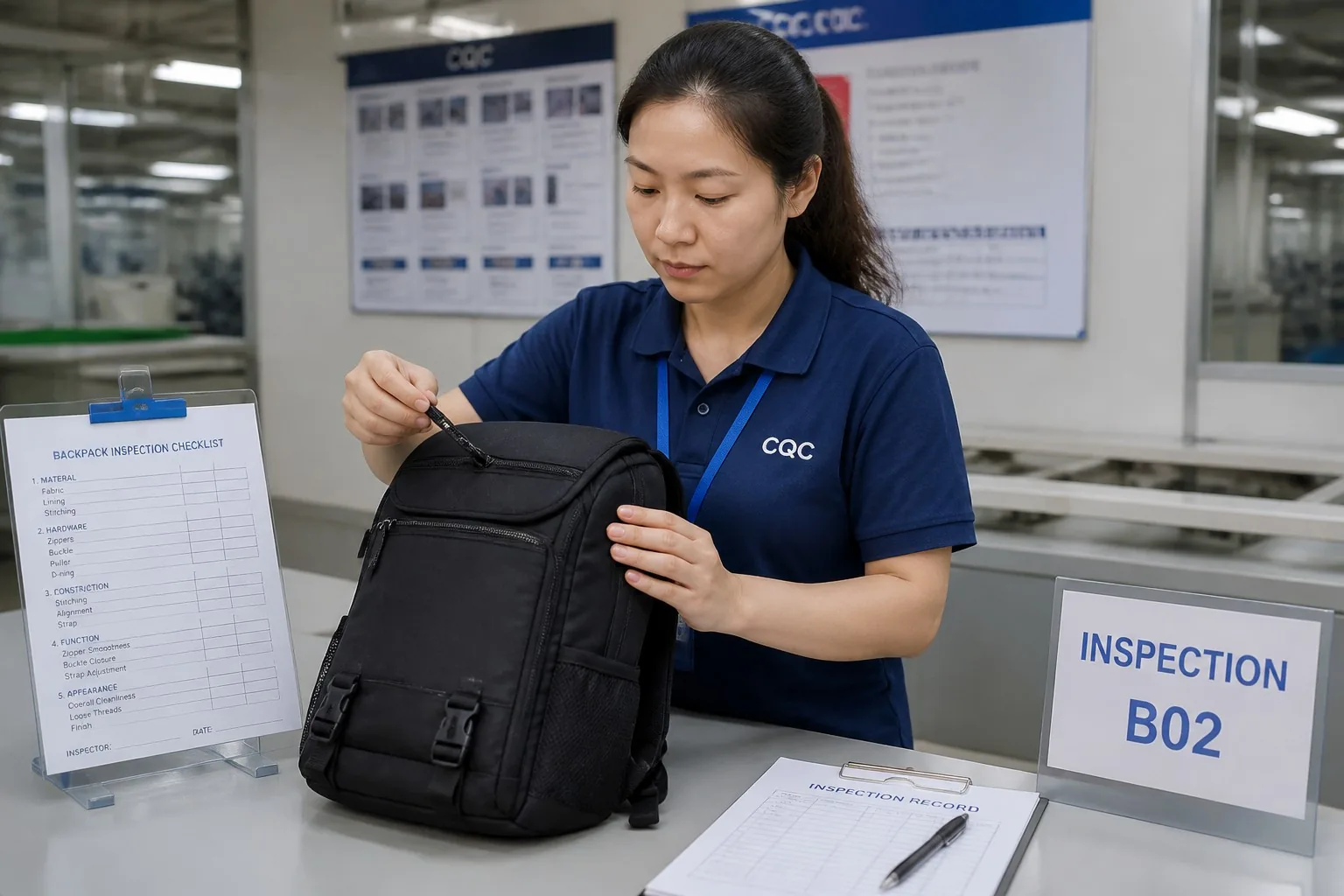
The 4-Point Check for Visual Inspection
- Size — does it match the spec within tolerance?
- Color — does it match the approved sample under standard light?
- Shape — does the silhouette match? No distortion?
- Finish — are edges, seams, and hardware clean?
The Buyer’s Own Arrival Inspection
The quality loop closes at your warehouse. Even with a clean PSI, arrival inspection is the last line of defense:
The Arrival Checklist
| Check | What to verify |
|---|---|
| Carton condition | Damage, moisture, crushing |
| Quantity | Count against packing list and invoice |
| Sample open | Compare to approved sample |
| Function test | Zippers, buckles, straps on sampled units |
| Labeling | Compliance marks, care labels, branding |
| Documentation | Packing list, inspection report, certificates |
When You Find Defects
- Document everything with photos and counts.
- Quantify against the AQL levels from the PSI.
- Notify the factory immediately with evidence.
- Agree on remedy: repair, replacement, discount, or refund.
- Feed the data back into the next order’s spec and QC plan.
Building the QC Plan Into Your Purchase Order
The most effective buyers make QC part of the contract, not an afterthought:
| PO element | What to include |
|---|---|
| Approved sample reference | Sample ID and date |
| Material specs | Fabric, hardware, thread with test certificates |
| AQL levels | Critical 0, Major 1.5–2.5, Minor 4.0 |
| Test requirements | Which tests, which standards, who pays |
| Inspection points | Incoming, in-line, pre-shipment |
| Inspection authority | Third-party or buyer’s inspector |
| Remedy terms | What happens if the lot fails |
The Inspection Schedule
| Order type | Recommended inspection |
|---|---|
| First order (new factory) | Factory audit + incoming + in-line + PSI |
| Repeat order (proven factory) | PSI at minimum |
| New product (proven factory) | First-piece + PSI |
| High-value order | Full coverage regardless of history |
The Defect Anatomy: Common Backpack Defects and Their Root Causes
Understanding why defects happen makes inspection more effective — the inspector who knows the root cause knows where to look next. This is the defect map we see in factories every season.
The Defect Categories
| Defect | Where it appears | Root cause | Prevention |
|---|---|---|---|
| Skipped stitches | Seams, zipper tapes | Wrong needle size, dull needle, tension drift | Machine maintenance, first-piece checks |
| Puckered seams | Panel joins, curved seams | Tension mismatch, material stretch | Tension calibration per material |
| Thread breakage | High-stress seams | Wrong thread type/tex, machine timing | Thread spec per operation |
| Bar-tack failure | Strap bases, webbing ends | Too few stitches, wrong pattern | Bar-tack pattern spec + QC gate |
| Zipper jamming | Main closures | Misaligned tape, debris, slider damage | Sub-assembly QC, function test |
| Zipper tape tear | Near sliders | Oversized sliders, sharp tape edges | Hardware spec verification |
| Handle tear-out | Handle bases | Insufficient reinforcement | Box-X stitching, foam core |
| Strap detachment | Shoulder straps | Weak attachment, no bar-tack | Reinforcement spec |
| Buckle breakage | Main buckles | Substandard material, cold-crack | Mil-spec sourcing, tensile test |
| Fabric snagging | Shell surfaces | Low-denier fabric, loose threads inside | Lining quality, snag test |
| Color bleeding | Washed packs | Poor dye fastness | Wash fastness test before bulk |
| Coating peeling | Coated fabrics | Low-grade coating, age | Coating quality spec |
| Misaligned panels | Assembly | Poor pattern/assembly discipline | Jigs, first-piece inspection |
| Frayed edges | Pocket openings | Unfinished edges | Edge binding, seam finishing |
The Three Root-Cause Families
- Material family — defects born in the fabric, thread, or hardware: dye failures, weak buckles, low-denier fabric. Caught at incoming inspection.
- Machine family — defects from machines: skipped stitches, tension problems, uneven feeding. Caught at first-piece and in-line checks.
- Human family — defects from operators: misalignment, wrong panels, rushed work. Caught by process discipline and training.
Manufacturer’s note: When the same defect appears across multiple orders, it is a system problem, not an accident. The fix is never “inspect harder” — it is finding which of the three families the defect belongs to and correcting the source. Inspection data without root-cause analysis is just counting casualties.
Laboratory Testing: The Standards Behind the Checks
Beyond the factory-floor checks, laboratory testing provides objective, standardized evidence. These are the tests and standards that matter for backpacks.
The Core Test Standards
| Test | Standard (common) | What it measures |
|---|---|---|
| Abrasion resistance | ASTM D4966 (Martindale), Taber | Fabric wear resistance |
| Tear strength | ASTM D2261, ISO 13937 (Elmendorf) | Resistance to tear propagation |
| Tensile strength | ISO 13934 (grab test) | Fabric breaking strength |
| Seam strength | ISO 13935 | Seam load capacity |
| Color fastness to washing | ISO 105-C06 | Dye stability in wash |
| Color fastness to crocking | ISO 105-X12 | Dye transfer on rubbing |
| Color fastness to light | ISO 105-B02 | Fading under light |
| Hydrostatic head | ISO 811 | Water penetration resistance |
| Water repellency | ISO 4920 (spray test) | Surface water beading |
| Zipper performance | ASTM D2061, BS 3084 | Slider force, strength, durability |
How to Read a Test Report
| Report element | What to verify |
|---|---|
| Sample description | Matches your material/spec |
| Test methods | Standards match your requirement |
| Conditions | Temperature/humidity noted |
| Results | Values meet your pass criteria |
| Lab accreditation | ISO 17025 accredited lab |
| Date | Current — not a recycled old report |
The Testing Strategy
| Stage | Testing |
|---|---|
| Pre-production | Material certification on proposed fabrics/hardware |
| Prototype | Full test battery on the approved sample |
| Production | Batch tests on production materials |
| Ongoing | Periodic re-testing on reorders |

Working with Third-Party Inspection Companies
Most importers use third-party inspection companies (SGS, Bureau Veritas, Intertek, TÜV) for pre-shipment inspection. Here is how to get the most from them.
The Booking Process
- Book in advance — inspectors are busy in peak season; book 5–10 days ahead.
- Specify the standard — AQL levels, sample size, test requirements in the booking.
- Share the approved sample — the inspector compares against it.
- Provide the spec — materials, dimensions, defect definitions.
- Receive the report — usually 1–3 days after inspection.
What the Report Should Include
| Section | Content |
|---|---|
| General info | Order, product, quantity, inspection date |
| Sampling | Sample size and method |
| Quantity check | Actual count vs packing list |
| Appearance | Against approved sample, per defect class |
| Construction | Stitches, seams, attachments |
| Function | Zippers, buckles, straps |
| Labeling/packing | Marks, polybags, cartons |
| Defect summary | Counts per class, pass/fail |
| Photos | Representative defects and general views |
Choosing Between Third-Party and Buyer Inspection
| Factor | Third-party | Buyer/agent |
|---|---|---|
| Objectivity | High — independent | Depends on relationship |
| Cost | Fixed fee per man-day | Travel + time |
| Depth | Standard protocols | Custom depth possible |
| Relationship knowledge | None | Knows history |
| Best for | Standard PSI, disputes | New products, complex specs |
Manufacturer’s note: A well-written third-party inspection report is the most useful document in the import process — but only if the buyer gives the inspector the right tools: the approved sample, a complete spec, and clear defect definitions. The report is only as good as the briefing.
The Golden Rules of Backpack QC
Distilled from years of factory and buyer experience — the rules that separate effective quality programs from token ones:
- The approved sample is the law — every judgment, from material to finish, compares against it.
- Inspect at the right stage — in-line checks catch problems cheaply; waiting for PSI is waiting too long.
- Define defects before production — clear defect classes and AQL levels prevent arguments later.
- Test what you claim — if you sell “waterproof,” test waterproofing; if you sell “20 kg capacity,” test 20 kg.
- Document everything — photos and records are the currency of dispute resolution.
- Feed data forward — every inspection informs the next order; quality improves in cycles, not leaps.
- Inspect the inspector — verify third-party reports against spot checks; verify factory records against finished goods.
Sealed Samples and Record Management
The backbone of any quality program is traceability — the ability to prove what was approved, what was produced, and what was shipped. Two practices make this possible: sealed samples and complete records.
The Sealed Sample System
| Sample type | Role | Management |
|---|---|---|
| Development sample | Design reference | Held by both factory and buyer |
| Approval sample | The quality law | Signed and dated by both parties |
| Production reference | Line comparison | Kept at the production line |
| Shipment reference | Arrival comparison | Stored with the order file |
| Archive sample | Dispute resolution | Retained for the season |
The Sealing Rules
- Sign and date — both parties sign the approved sample; the signature makes it binding.
- Duplicate copies — factory, buyer, and inspector each hold a copy.
- Protect the sample — sealed samples are reference objects, not display items.
- Replace when worn — a damaged reference sample must be replaced with a new signed one.
The Records That Matter
| Record | Purpose | Retention |
|---|---|---|
| Approved sample log | What was approved, when, by whom | Season or longer |
| Incoming inspection reports | Material quality evidence | Per order |
| First-piece sheets | Line setup verification | Per order |
| In-line QC logs | Process consistency | Per order |
| Test reports | Standards compliance | Per order |
| PSI reports | Shipment quality verdict | Per order |
| Arrival inspection records | Buyer-side evidence | Per order |
Manufacturer’s note: When a dispute arises — and in importing, disputes will arise — the winner is the side with the records. A buyer who signs approved samples, keeps test reports, and files PSI results can resolve claims in days. A buyer without records argues from memory, and memory loses.
The Reorder Quality Loop
The real payoff of records is the reorder:
- Field complaints from the previous season feed the new spec.
- Defect data from PSI reports sets the new inspection priorities.
- The improved spec and inspection plan are written into the new purchase order.
- Each season’s quality should measurably beat the last.
Quality in backpack sourcing is not a destination — it is a loop, and the loop runs on records.
The Buyer’s Quick Audit Checklist
A condensed version of everything in this guide — print it, use it, and let it structure your quality program:
- [ ] Factory audit completed (licenses, QC records, floor walkthrough)
- [ ] Approved sample signed and sealed by both parties
- [ ] Material specs and test certificates collected
- [ ] Defect classes and AQL levels written into the purchase order
- [ ] Incoming material inspection scheduled
- [ ] First-piece and in-line checkpoints agreed with the factory
- [ ] Critical item tests specified (stitches, zippers, load, water, color, hardware)
- [ ] Laboratory tests booked where required by the spec
- [ ] Pre-shipment inspection booked and briefed with sample + spec
- [ ] Arrival inspection planned at the destination
- [ ] Records filed for every stage
A buyer who works this checklist on every order gets predictable quality — and predictable quality is the cheapest thing a buyer can buy.
The Quality Mindset
Beyond checklists and standards, effective QC rests on a mindset shared by the best buyers and the best factories:
- Quality is designed in, not inspected in — a well-specified product with clean materials needs less inspection than a loosely specified one with marginal materials.
- Every inspection is communication — the factory learns what you value from what you check; check what matters and the factory will prioritize it.
- Consistency beats intensity — inspecting every order at the agreed level beats a dramatic crackdown on one order.
- Relationships compound quality — factories that know your standards deliver them without being told; that knowledge is built over seasons of consistent inspection.
The factories and buyers who treat quality as a shared system rather than an adversarial checkpoint ship better product, season after season.
FAQ
What are the most important QC checks for backpacks?
In order of real-world impact: stitch density and bar-tacks (seams fail first), zipper smoothness (most common complaint), load testing (structural integrity), water resistance (where claimed), color fastness (bleeding drives returns), and hardware function (buckles and sliders).
What is AQL and how does pre-shipment inspection work?
AQL (Acceptable Quality Limit) is a sampling system: the inspector selects a random sample based on lot size, counts defects by class (critical/major/minor), and compares against limits (e.g., major 2.5). If any class exceeds its limit, the lot is rejected or sorted before shipping.
Should I do a factory audit before my first order?
Yes — especially with a new factory. A one-day audit verifies licenses, QC records, floor conditions, and honesty before you commit. It costs little compared with the cost of discovering a weak factory after production starts.
What stitch density should a quality backpack have?
Typically 8–12 stitches per inch on standard fabrics, with balanced tension and secure lock stitches. Heavy-duty or tactical fabrics may use fewer, larger stitches. The bar-tacks at stress points (handles, straps, zipper ends) matter as much as the main seam density.
How do I test whether a backpack can carry its rated load?
Load the pack to the rated capacity, suspend or carry it, and check seams and straps for failure. Test handles and shoulder straps with pull tests at rated force, and check buckles under load. A load test should be part of every pre-shipment inspection.
Who pays for inspections and testing?
Typically the buyer pays for third-party inspection fees and lab tests, though terms vary. Many factories cover in-house first-piece and in-line checks as part of their process. Agree on the split in the purchase order before production starts.
What should I do if a shipment fails inspection?
Document with photos, quantify against AQL, notify the factory immediately, and agree on a remedy (repair, replacement, discount, or refund) per your contract terms. Then feed the defect data into the next order’s spec and QC plan — the second order should be better than the first.
Conclusion
Backpack quality is not mysterious. It is the product of a complete chain of checkpoints — a factory audit that confirms the partner, an incoming inspection that protects the materials, in-line checks that catch problems while they are cheap to fix, critical item testing (stitches, zippers, loads, water, color, hardware), a pre-shipment inspection that judges the lot with statistical rigor, and an arrival inspection that closes the loop.
The buyers who ship clean product year after year are not lucky — they are systematic. They put the QC plan into the purchase order, they inspect at the right stages, they read the inspection reports in detail, and they feed the data back into the next order.
If you are sourcing backpacks, our factory maintains full QC documentation on every order — first-piece sheets, in-line records, test results, and final inspection reports — and we welcome buyer audits and third-party inspections. A factory that invites inspection is a factory that has nothing to hide — and that is the first quality signal worth checking.