
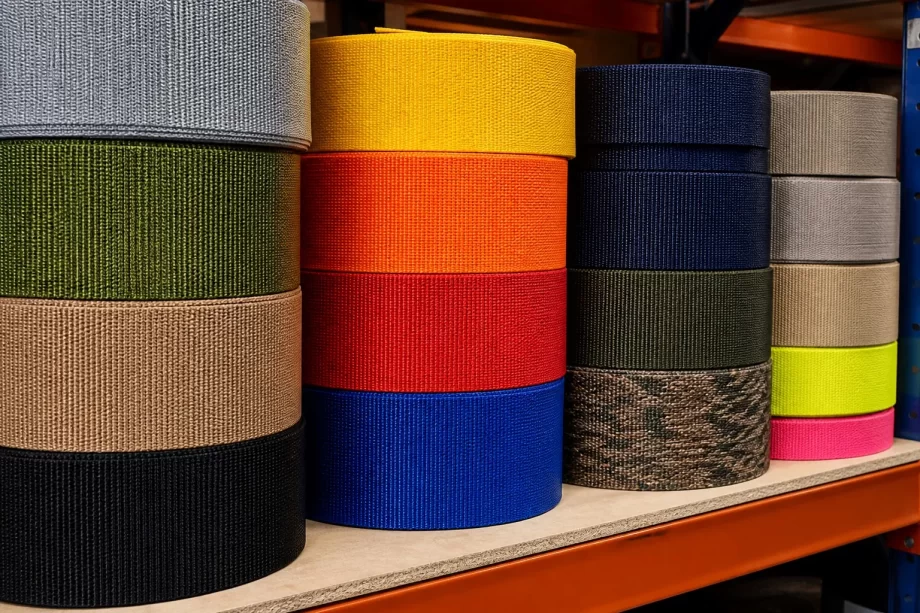
Backpack Webbing and Straps: Specs and Manufacturing
The shoulder straps hold the weight. The webbing carries the load to the frame. Yet in most tech packs, webbing gets one vague line: “25mm nylon webbing.” That is not a spec — it is a guess.
Webbing quality decides whether a backpack survives daily use or fails at the first heavy load. Break strength, weave density, edge finish, and color fastness all matter. Each is measurable, and each belongs on the specification sheet.
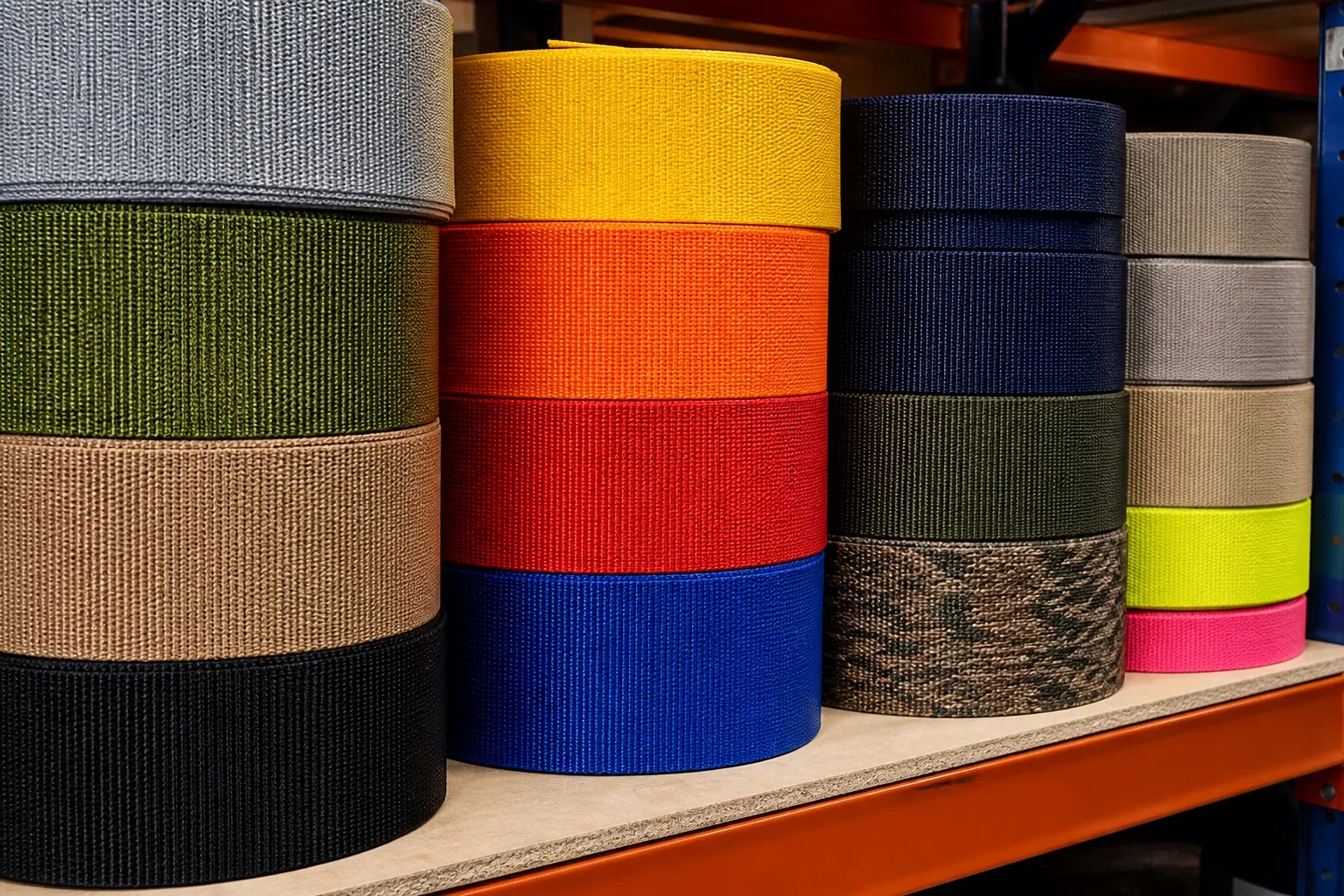
This guide covers webbing and strap specification from the manufacturer’s perspective: materials, dimensions, construction, production, testing, and the common mistakes buyers make.
- Why Webbing Deserves Its Own Spec
- Webbing Materials Compared
- The Webbing Spec: Width, Thickness, Strength
- How Webbing Is Made
- Webbing Construction Types
- Shoulder Straps: From Webbing to Comfort
- Manufacturing and Attachment
- Testing Webbing and Straps
- Specifying Webbing: The Buyer’s Checklist
- Webbing Grades and Quality Signals
- Handle Webbing and Lash Points
- Strap Hardware Systems
- Webbing Cost Factors
- Sustainable Webbing Options
- The Strap Assembly Process
- Webbing Care and Durability
- Common Strap Failures and Prevention
- Working with Your Factory on Straps
- Strap Systems by Pack Type
- Writing Webbing into the Tech Pack
- Weave Patterns and Edge Treatments
- FAQ
- Conclusion
Why Webbing Deserves Its Own Spec
Webbing is structural. It connects the pack to the person carrying it.
The Load Path
Every strap carries weight through the webbing. A 15 kg pack puts roughly 7–8 kg on each shoulder strap.
The webbing must hold that load repeatedly — not once, but for years of daily use. A weak strap is a product failure waiting for a heavy day.
What Vague Specs Cost
| Vague request | What arrives | Result |
|---|---|---|
| “Nylon webbing” | Any grade, any weave | Unknown strength |
| “25mm webbing” | ±1mm tolerance | Loose hardware fit |
| “Black webbing” | Wrong shade | Color mismatch |
| “Strong webbing” | Unmeasured | No proof of quality |
Precise specs protect both sides. The factory knows what to source; the buyer knows what to expect.
Webbing Materials Compared
Webbing comes in three main polymer families. Each behaves differently under load, weather, and sun.
Nylon Webbing
Nylon is the workhorse of bag webbing. It has the best strength-to-weight ratio and absorbs shock well.
It stretches slightly under load, which helps straps feel forgiving. Nylon also dyes deeply and takes abrasion well.
The weakness: nylon absorbs water and weakens when wet. It also degrades slowly under strong sunlight.
Polyester Webbing
Polyester resists water, UV, and abrasion better than nylon. It holds color longer outdoors.
It is slightly weaker per denier than nylon and has less stretch. Polyester suits outdoor gear where sun and rain dominate.
Polypropylene Webbing
Polypropylene is light and floats. It resists water completely but has low strength and melts under heat.
It suits cheap straps, lanyards, and light duty. It has no place on a load-bearing backpack strap.
The Material Comparison
| Property | Nylon | Polyester | Polypropylene |
|---|---|---|---|
| Break strength | Highest | High | Low |
| UV resistance | Moderate | High | Moderate |
| Water resistance | Low | High | Highest |
| Abrasion resistance | High | High | Moderate |
| Stretch | Some | Little | Some |
| Cost | Moderate | Moderate | Lowest |
Manufacturer’s note: Most quality backpacks use nylon webbing on load-bearing straps and polyester where color and UV matter. Read the product’s use case before choosing.
The Webbing Spec: Width, Thickness, Strength
Three numbers define a webbing spec. Each is measured, not estimated.
Width Standards
Webbing width is measured in millimeters, with standard sizes across the industry.
| Width | Typical use |
|---|---|
| 15 mm | Lash points, small pulls |
| 20 mm | Light straps, daisy chains |
| 25 mm | Standard shoulder straps |
| 38 mm | Load-bearing straps, luggage |
| 50 mm | Heavy hauling, handles |
Tolerance matters. A 25 mm spec with ±1 mm tolerance fits standard sliders. A loose tolerance means rattling hardware.
Thickness and Density
Thickness affects feel and hardware fit. Most nylon webbing runs 1.2–2.0 mm thick.
Density shows as grams per meter. Heavier webbing carries more fiber and more strength.
| Webbing density | Typical strength |
|---|---|
| Light (~10 g/m, 25mm) | 500–800 kg |
| Standard (~14 g/m, 25mm) | 800–1,200 kg |
| Heavy (~20 g/m, 25mm) | 1,200–1,800 kg |
Break Strength Standards
Break strength is the number that matters. Ask for it, and ask for the test method.
| Strap type | Minimum break strength |
|---|---|
| Shoulder strap webbing | 1,000 kg+ |
| Side compression straps | 300–500 kg |
| Handle webbing | 500 kg+ |
| Lash points | 200–300 kg |
How Webbing Is Made
Webbing production explains why cheap webbing fails and quality webbing lasts.
Weaving the Tape
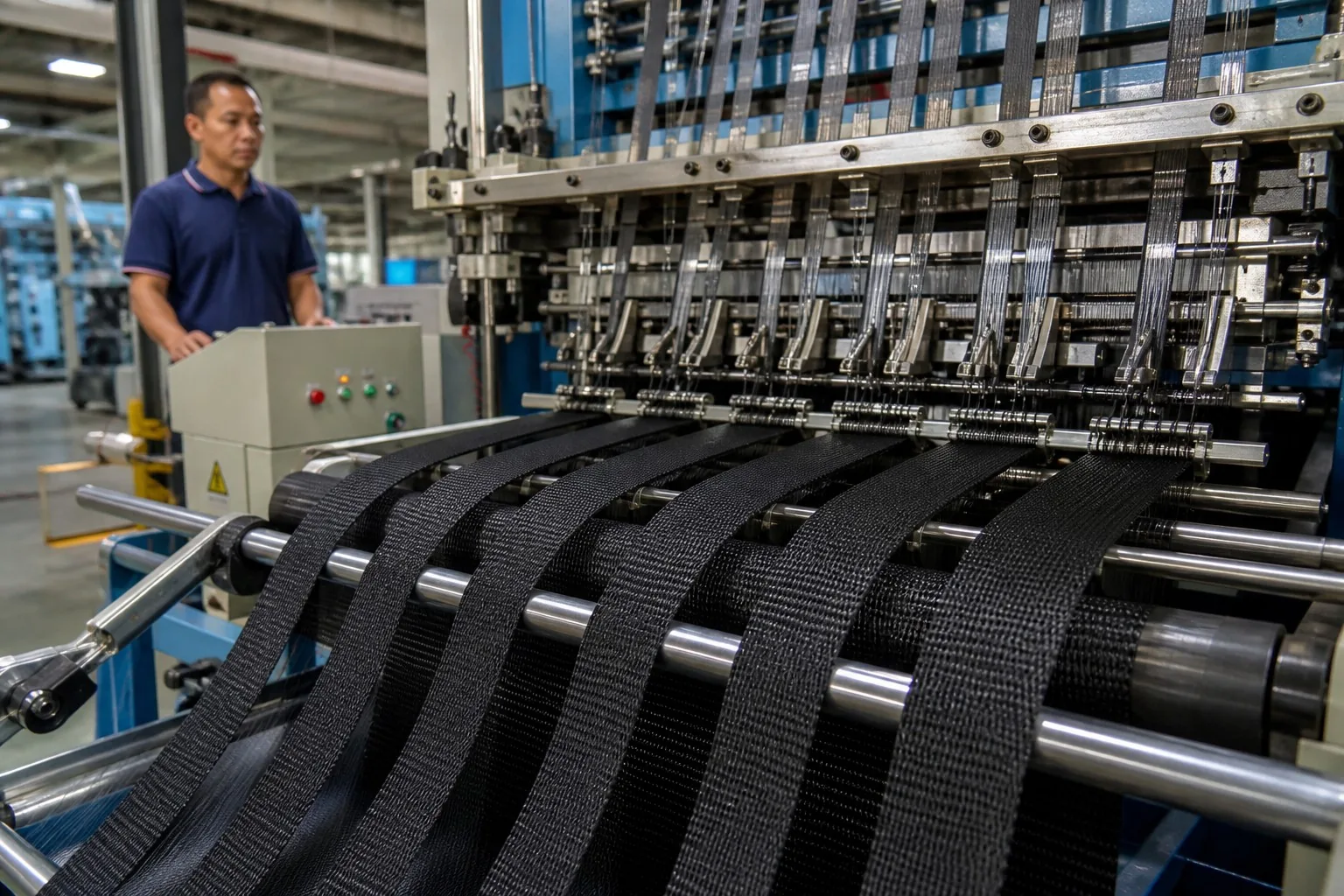
Webbing is woven on narrow looms. Warp yarns run the length; weft yarns lock them together.
Tight weaves pack more yarn into each centimeter. Density translates directly into strength and abrasion resistance.
Dyeing and Finishing
| Process | Purpose |
|---|---|
| Solution dyeing | Color in the yarn itself |
| Piece dyeing | Color after weaving |
| Heat setting | Stabilize width and stretch |
| Coating | Water repellency or grip |
Solution-dyed webbing keeps color far longer than piece-dyed. It costs more and is worth it on outdoor products.
Webbing Construction Types
Construction changes what the webbing can do.
Flat Webbing
Flat webbing is the standard tape used for straps and attachments. It sews cleanly and takes hardware well.
Tubular Webbing
Tubular webbing is woven as a tube, then flattened. It is softer, thicker, and used for climbing-style slings.
Backpacks use tubular webbing for comfort edges and premium handles.
Jacquard Webbing
Jacquard looms weave patterns and logos directly into the tape. The logo is part of the webbing, not printed on it.
| Webbing type | Best for | Cost level |
|---|---|---|
| Flat | Standard straps | Low |
| Tubular | Comfort slings | Moderate |
| Jacquard | Branded straps | Higher |
Shoulder Straps: From Webbing to Comfort
The strap is a sandwich. Webbing is one layer of several.
The Strap Layers
| Layer | Role |
|---|---|
| Outer fabric | Abrasion and appearance |
| Foam padding | Comfort and load spread |
| Webbing core | Strength |
| Lining | Interior finish and slip |
The webbing carries the load; the foam spreads it; the fabric protects both.
The Adjustment System
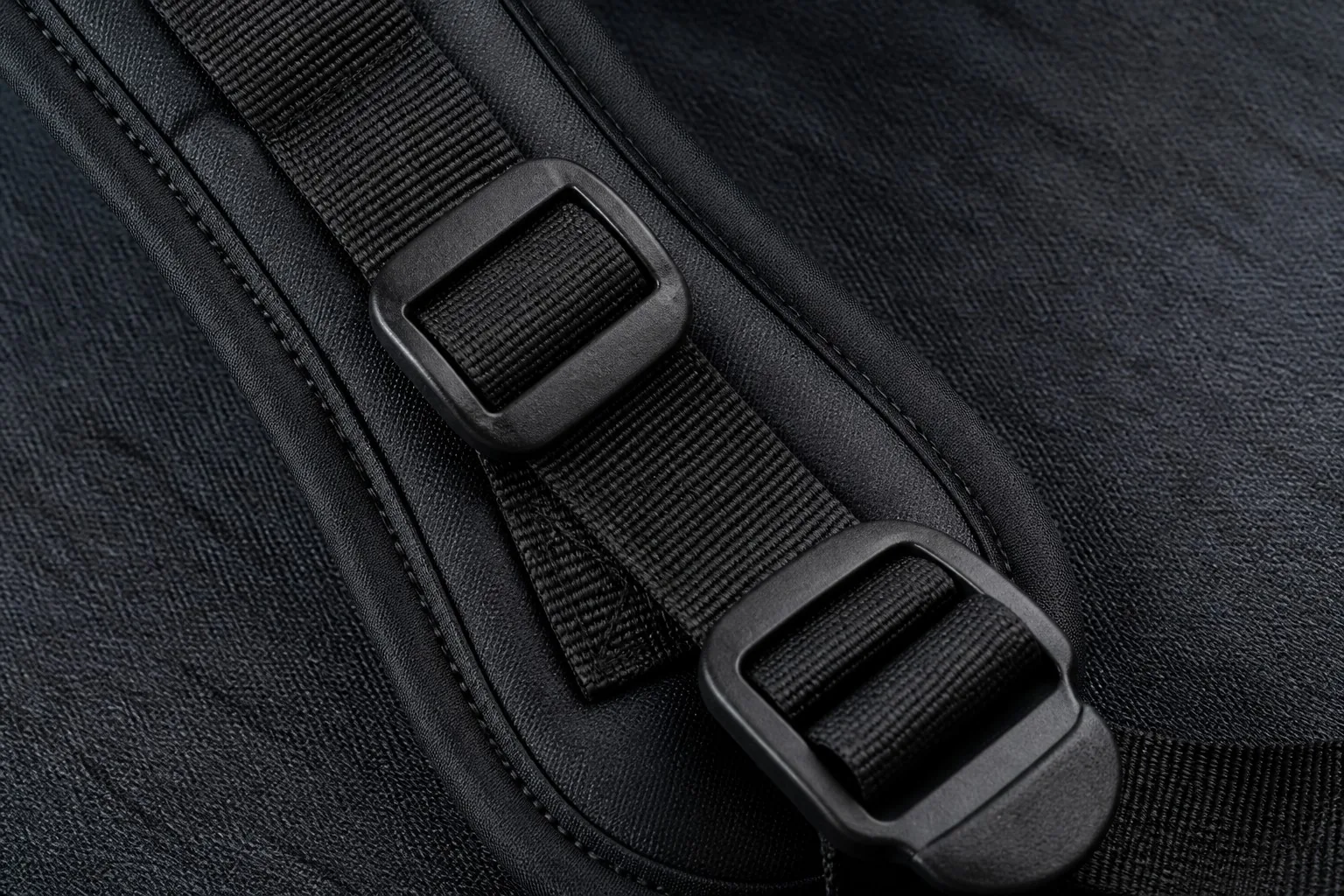
Sliders and buckles ride on the webbing. Hardware fit depends on webbing width tolerance.
A well-made strap adjusts smoothly, stays put under load, and releases cleanly. Poor webbing makes hardware slip or jam.
Strap Shape
S-shaped straps follow the shoulders. Straight straps suit light packs.
The shape is cut in foam and fabric, then the webbing is sewn along the length. Strap engineering is where comfort is won or lost.
Manufacturing and Attachment
Production quality decides how long the strap survives its first heavy month.
Cutting the Webbing
Webbing is cut to length, then end-sealed. Heat cutting melts the ends cleanly; cheaper methods fray.
| Cut type | Edge result |
|---|---|
| Heat cut | Clean, sealed |
| Ultrasonic cut | Precision, sealed |
| Scissor cut | Fray risk |
Attaching the Webbing
Attachments concentrate stress at the seams. Reinforcement patterns exist for this reason.
| Attachment point | Reinforcement |
|---|---|
| Strap top to pack | Box-X stitch |
| Handle ends | Bar tack |
| Webbing loops | Double stitch + tack |
| Buckle anchors | Folded and boxed |
Box-X stitches lock the webbing in place and spread the load over more thread. Skimping here is the fastest route to a returned product.
Hardware Fit
Buckles, sliders, and tri-glides must match the webbing width exactly. A 25 mm slider on 24.5 mm webbing rattles; on 25.5 mm it jams.
Quality factories test hardware fit on every new webbing lot. Webbing shrinks or stretches after dyeing, so tolerance checks repeat.
Testing Webbing and Straps
Testing turns claims into numbers. The tests below matter most.
Tensile Testing
A tensile tester pulls the webbing until it breaks. The result is the break strength in kilograms or newtons.
| Test | What it verifies |
|---|---|
| Webbing break strength | Raw material quality |
| Seam strength | Attachment quality |
| Buckle pull test | Hardware hold |
| Strap assembly test | Whole-system strength |
Abrasion and UV Testing
| Test | Method | Pass level |
|---|---|---|
| Abrasion | Martindale or similar | 20,000+ cycles |
| UV exposure | Xenon arc | No severe fading |
| Water exposure | Soak and dry cycles | Strength retention |
The Practical Test
The laboratory tells part of the story. The factory floor tells the rest.
Fill a finished pack to 15 kg. Lift it by the handle. Swing it by one shoulder strap. Repeat 50 times. Weak webbing, seams, or hardware will show themselves within minutes.

Specifying Webbing: The Buyer’s Checklist
Writing a usable webbing spec is straightforward once the elements are clear.
The Complete Webbing Spec
| Spec element | Example |
|---|---|
| Material | Nylon 6.6 |
| Width | 25 mm ± 1 mm |
| Construction | Flat weave, 2.0 mm thick |
| Break strength | 1,000 kg minimum |
| Color | Pantone 19-4005, solution dyed |
| Edge finish | Heat sealed |
| Hardware match | Standard 25 mm sliders |
| Test certificate | Break strength report |
Common Specification Errors
| Error | Fix |
|---|---|
| No width tolerance | Add ±1 mm |
| No break strength | Add minimum kg |
| No color reference | Add Pantone number |
| No test requirement | Add certificate request |
| No edge finish | Specify heat sealed |
Manufacturer’s note: Send the full spec with the RFQ. We quote accurately when we know exactly what you need — and we can prove it with test reports before production starts.
Webbing Grades and Quality Signals
Two rolls of “nylon webbing” can differ threefold in price. The grade differences are visible to trained eyes.
Why Prices Differ
| Factor | Economy grade | Quality grade |
|---|---|---|
| Yarn source | Mixed, recycled scrap | Virgin or certified |
| Weave density | Loose | Tight, even |
| Width control | Poor tolerance | ±1 mm or better |
| Edge finish | Raw, fraying | Clean, sealed |
| Color fastness | Fades fast | Solution dyed |
| Break strength | Unverified | Tested, documented |
Field Checks Without Equipment
| Check | Method | Red flag |
|---|---|---|
| Bend the webbing | Fold sharply | White crease = weak yarn |
| Rub the surface | Finger rub | Pilling or fuzz |
| Look at edges | Close view | Loose yarns, uneven weave |
| Pull by hand | Two-hand tug | Visible stretch beyond normal |
| Wet a corner | Water drop | Fast soak = poor coating |
The Lot Certificate
Ask for the webbing lot’s test certificate with every delivery.
The certificate lists break strength, width, and weight per meter. Compare the numbers to the spec. A certificate that matches the spec is the cheapest quality insurance available.
Handle Webbing and Lash Points
Shoulder straps get the attention, but handles and lash points carry their own loads.
Handle Construction
A top handle lifts the full pack weight, often with one hand.
| Handle spec | Recommended |
|---|---|
| Width | 25–38 mm |
| Padding | Optional, 5–10 mm foam |
| Break strength | 500 kg minimum |
| Attachment | Boxed ends, double sewn |
Handles take jerking loads when packs are lifted and set down. The seam between handle and pack is the failure point to reinforce.
Lash Points and Daisy Chains
Lash points attach gear to the outside of the pack. Daisy chains run webbing loops in a line.
| Element | Spec |
|---|---|
| Loop width | 15–25 mm |
| Loop spacing | 25–50 mm |
| Attachment | Bar tacked both ends |
| Strength | 200–300 kg per loop |
The Zipper Pull Detail
Even zipper pulls use small webbing or cord loops. These tiny straps take constant tugging.
Quality pulls are bar-tacked or knotted, not glued. A pull that detaches on day one signals weak details throughout.
Strap Hardware Systems
Webbing works with hardware. The system is only as good as its weakest part.
The Adjustment Hardware
| Hardware | Function | Webbing match |
|---|---|---|
| Slider | Length adjustment | Exact width |
| Tri-glide | Three-way control | Exact width |
| Side-release buckle | Quick release | 20–50 mm |
| Cam buckle | Strong hold | Heavy duty |
| Ladderlock | Strap end control | Exact width |
The Chest and Hip Straps
Chest straps stabilize the pack on the shoulders. Hip straps transfer load to the hips.
| Strap | Width | Hardware |
|---|---|---|
| Chest strap | 15–25 mm | Quick-release buckle |
| Hip strap | 25–50 mm | Heavy buckle, adjuster |
| Load lifters | 20–25 mm | Sliders |
Hardware Quality Checks
Test buckles for cold-crack resistance and repeated cycling. A buckle that snaps in winter is a return waiting to happen.
Webbing Cost Factors
Pricing webbing is transparent once the variables are clear.
What Drives Webbing Cost
| Factor | Effect on price |
|---|---|
| Material grade | Virgin > recycled > scrap |
| Width and weight | More fiber, more cost |
| Weave density | Tighter, higher cost |
| Dyeing method | Solution dye premium |
| Pattern/logo | Jacquard adds cost |
| Quantity | Volume discounts apply |
| Finishing | Coatings add cost |
Cost-Saving That Keeps Quality
| Saving method | Effect |
|---|---|
| Standard widths | Mill runs are efficient |
| Fewer colors | Dye lot economy |
| Volume orders | Better per-meter price |
| Specs that match stock | No custom setup |
| Long-term contracts | Stable pricing |
The False Savings
Cutting the webbing grade saves cents per pack and risks the core function of the product. The strap is where the pack meets the person — grade cuts show up as failures, not savings.
Sustainable Webbing Options
Environmental requirements now reach the webbing reel.
Recycled Nylon Webbing
Recycled nylon webbing (GRS-certified) reuses industrial and consumer waste. Modern recycled yarns approach virgin strength.
The premium is modest and falling. Brands with sustainability claims should specify GRS webbing and ask for the certificate chain.
Solution-Dyed Benefits
Solution dyeing reduces water use compared to piece dyeing. It also produces the most colorfast webbing.
The double benefit — environment and durability — makes solution dyeing the recommended choice for outdoor lines.
The Certificate Chain
| Claim | Certificate |
|---|---|
| Recycled content | GRS |
| No harmful substances | OEKO-TEX Standard 100 |
| Safe chemicals | bluesign or ZDHC |
The Strap Assembly Process
A finished shoulder strap passes through a series of steps. Each step adds cost and quality — or risk.
The Assembly Steps
| Step | Operation | Quality control |
|---|---|---|
| 1 | Cut webbing and foam to length | Length check |
| 2 | Cut and prepare outer fabric | Pattern check |
| 3 | Laminate foam to fabric | Adhesion check |
| 4 | Insert webbing core | Position check |
| 5 | Fold and sew the strap tube | Stitch density check |
| 6 | Attach hardware | Fit and function test |
| 7 | Sew the strap to the pack | Box-X reinforcement |
| 8 | Final inspection | Pull test on assembly |
The Quilting Question
Straps may be quilted through the foam to stop shifting. Quilting adds time and cost.
| Strap type | Quilting |
|---|---|
| Simple flat strap | No |
| Padded strap | Optional |
| Curved ergonomic strap | Yes, for shape retention |
Curved Strap Construction
Curved straps follow the shoulder contour. They require pre-shaped foam and careful sewing.
The curve is cut, then the strap is sewn with eased edges. Poor construction produces puckers that dig into shoulders.
Webbing Care and Durability
Webbing lasts years with basic care. Neglect shortens its life quickly.
The Care Rules
| Care point | Why |
|---|---|
| Rinse after saltwater use | Salt crystals cut fibers |
| Dry away from direct sun | UV degrades nylon |
| Avoid bleach | Breaks polymer chains |
| Store dry | Mildew weakens fibers |
| Check seams before trips | Catch wear early |
Aging Signals
| Signal | Meaning |
|---|---|
| Fuzz on the surface | Fiber wear beginning |
| White creases that stay | Yarn damage |
| Color fading unevenly | Piece-dyed, UV exposure |
| Edge fraying | Coating or finish worn |
| Hardware slipping | Webbing width change |
When to Replace
Replace straps when fraying reaches the load-bearing seams or when hardware no longer holds.
A strap that fails in the field fails at the worst moment. Replacement is cheaper than the incident it prevents.
Common Strap Failures and Prevention
Most strap failures follow predictable patterns. Each has a root cause and a fix.
The Failure Map
| Failure | Root cause | Prevention |
|---|---|---|
| Strap tears from pack | Weak seam, no box-X | Reinforced attachment |
| Webbing snaps | Low grade yarn | Spec break strength |
| Slider slips | Width tolerance wide | Match hardware to webbing |
| Foam collapses | Low density foam | Spec foam density |
| Buckle cracks in cold | Cheap plastic | Cold-crack tested hardware |
| Strap puckers | Poor easing | Trained sewing, curved jigs |
| Color bleeds | Poor dye fastness | Solution dye or test |
The Design-Side Causes
| Design issue | Result |
|---|---|
| Strap too narrow for weight | Shoulder pressure, early failure |
| Hardware too small | Jammed adjustment |
| Sharp edges on frames | Webbing abrasion |
| Top-loading pressure points | Strap seam stress |
The Inspection Point
Final inspection should include a loaded pull test on every strap attachment. The test takes seconds and catches the failures that matter.
Working with Your Factory on Straps
Good straps come from collaboration, not just specifications.
The Sample Confirmation
| Sample check | What to verify |
|---|---|
| Feel and padding | Comfort in hand |
| Hardware operation | Smooth adjustment |
| Width and length | Match the spec |
| Color | Match the reference |
| Stitch quality | Even, dense, clean |
| Load test | Hang and pull |
The First-Article Check
The first production strap assembly deserves a full check before the line runs.
Compare the first article to the approved sample. Measure, pull, and inspect every element. Corrections at this stage cost minutes; corrections after production cost days.
The Ongoing Relationship
Share field feedback with the factory. When customers report strap issues, the pattern belongs in the next design review.
Factories that receive honest feedback build better straps over time. The best partnerships treat every season as a learning cycle.
Strap Systems by Pack Type
Different packs demand different strap engineering. The spec should follow the use case.
The Category Guide
| Pack type | Strap width | Padding | Hardware | Special notes |
|---|---|---|---|---|
| School pack | 20–25 mm | Medium | Standard buckles | Durability first |
| Commuter pack | 25 mm | Medium | Quick release | Comfort, sternum strap |
| Laptop pack | 25–38 mm | Firm | Sturdy sliders | Weight distribution |
| Travel pack | 38 mm+ | Thick | Load-lifter, hip belt | Long-carry comfort |
| Hiking pack | 25–38 mm | Firm, ventilated | Hip belt, load lifters | Stability and airflow |
| Tactical pack | 25–38 mm | Heavy | Heavy buckles | MOLLE integration |
| Leather pack | 20–25 mm | Thin-medium | Matching metal | Aesthetic hardware |
The Weight Rule
| Pack weight (empty) | Strap recommendation |
|---|---|
| Under 500 g | 20 mm, light padding |
| 500 g – 1 kg | 25 mm, medium padding |
| 1 – 1.5 kg | 25–38 mm, firm padding |
| Over 1.5 kg | 38 mm+, hip belt |
The Comfort Equation
Comfort comes from spreading pressure. Wider straps, denser foam, and curved shapes all reduce pressure per square centimeter.
The measurements matter: a 15 kg pack carried for an hour generates measurable pressure on each shoulder. Quality strap systems keep that pressure under roughly 0.4 kg per square centimeter. Anything higher fatigues the carrier quickly.
Ventilation adds another layer. Breathable strap backing and ventilated back panels reduce sweating, which customers read as comfort. The best factories test strap pressure with load cells during development — and buyers should ask for the test data.
A 15 kg load on a 25 mm strap presses harder than the same load on a 38 mm strap. Weight distribution is engineering, not luxury.
Writing Webbing into the Tech Pack
The specification belongs in the tech pack, in a place the factory cannot miss.
The Webbing Page
| Tech pack section | Content |
|---|---|
| Materials page | Webbing spec table |
| Construction page | Strap assembly drawing |
| Hardware page | Buckle and slider references |
| QC page | Test requirements |
| BOM | Webbing lengths per size |
The Drawing Requirement
Every strap needs a dimensioned drawing: length, width, fold points, and seam positions.
A drawing eliminates the guesswork that vague words create. The factory’s pattern maker turns the drawing into a cutting template directly.
The Approved Sample
The approved physical sample is the final authority. The spec and drawing describe it; the sample defines it.
Keep one sealed sample for production reference and one for inspection comparison. Every strap in the shipment should match the sealed sample — that is the standard.
The QC Integration
| QC stage | Webbing check |
|---|---|
| Incoming material | Width, color, certificate |
| Cutting | Length accuracy |
| Sewing | Stitch density, reinforcement |
| Assembly | Pull test, hardware fit |
| Final | Loaded test, appearance |
Weave Patterns and Edge Treatments
Beyond the basics, weave structure and edge finish decide how webbing feels and lasts.
The Weave Structures
| Weave | Character | Strap use |
|---|---|---|
| Plain weave | Simple, firm | Standard straps |
| Twill weave | Softer hand, diagonal line | Comfort straps |
| Herringbone | Decorative diagonal | Visible accents |
| Grip weave | Textured surface | Anti-slip points |
| Tubular weave | Hollow, soft | Slings, comfort edges |
The Edge Treatments
| Edge type | Appearance | Durability |
|---|---|---|
| Selvedge | Woven edge | Best |
| Heat-sealed | Melted edge | Good |
| Stitched edge | Sewn binding | Good |
| Raw edge | Cut only | Poor |
The Feel Factor
Hand feel is a real spec. Buyers should specify softness or stiffness when it matters.
Softer webbing is comfortable but may carry less load. Stiffer webbing holds shape and hardware better. The balance depends on the strap’s role.
Matching Webbing to Hardware
Hardware brands and grades interact with webbing surface.
Smooth webbing lets sliders move freely. Textured webbing holds adjustments but may wear sliders faster. Test the pair before production — the interaction is visible only in use.
FAQ
What is the best webbing material for backpack straps?
Nylon webbing is the standard for load-bearing straps because it combines the highest strength with good abrasion resistance. Use polyester where UV and water resistance matter more, such as outdoor packs. Polypropylene suits only light duty.
How strong should backpack strap webbing be?
Quality shoulder-strap webbing tests at 1,000 kg or more break strength. The working load is far lower, but the margin protects against wear, stitching, and dynamic loading. Always ask for the test report, not a verbal claim.
What width webbing should a backpack spec use?
25 mm is the standard for shoulder straps, 20 mm for lighter straps, and 38 mm for load-bearing or premium straps. Match the width to the pack weight: heavier packs need wider webbing and matching hardware.
Why does my strap webbing fray at the edges?
Fraying usually means the ends were cut rather than heat-sealed, or the weave is too loose for the application. Specify heat-sealed or ultrasonic-cut ends and a minimum weave density to prevent fraying.
What does box-X stitching do on a strap?
Box-X reinforcement locks the webbing to the pack at stress points. It spreads the load across more stitches and prevents tear-out where straps attach. Skimping on reinforcement is the most common cause of strap failure.
How do I specify webbing color correctly?
Reference a Pantone or other color system number, and state whether the webbing must be solution-dyed or piece-dyed. Solution-dyed webbing keeps color far longer and is worth the premium on products exposed to sun and washing.
Do I need to test webbing on every order?
Test when the supplier, material grade, or weaver changes, and on every order from a new source. For established suppliers, verify the certificate with each lot and run a spot check on arrival. Testing is cheaper than a failed product.
Identifying Webbing Materials on Arrival
A quick burn test separates the polymer families. Use it when certificates are missing.
| Material | Burn behavior | Residue |
|---|---|---|
| Nylon | Melts, blue-based flame | Hard bead |
| Polyester | Melts, sooty smoke | Hard black bead |
| Polypropylene | Melts, drips | Soft bead, floats |
| Cotton | Burns to ash | Soft ash |
Safety first: run burn tests in a ventilated area with water nearby. The test takes seconds and answers the material question permanently.
The Ten-Point Webbing Spec Template
Copy this template into your next tech pack and fill in the blanks:
- Material: nylon 6.6 / polyester / other, with yarn source
- Width: 25 mm ± 1 mm
- Thickness and weight per meter
- Weave structure and density
- Edge finish: selvedge or heat-sealed
- Break strength: minimum kg, test method
- Color reference: Pantone, dye method
- UV and water resistance requirements
- Hardware match: slider and buckle size
- Test certificate: required with each lot
A complete template takes ten minutes to fill and prevents ten problems per order. The strap that carries the load deserves a spec that carries the intent.
The Webbing Inspection Routine
Add these steps to incoming inspection for every webbing delivery.
| Step | Action |
|---|---|
| 1 | Measure width at three points |
| 2 | Check color against the reference |
| 3 | Feel the edge finish |
| 4 | Bend and look for creasing |
| 5 | Compare the certificate to the spec |
| 6 | Test hardware fit with the actual parts |
The Final Word on Straps
Straps are the most-tested component of a backpack that nobody tests.
The user pulls them daily, hangs the pack by them, and trusts them with the full load. When a strap fails, the pack fails — regardless of how good the fabric was.
Specify webbing with numbers, verify with certificates, and inspect the attachments. That discipline turns a roll of tape into the backbone of a product customers trust.
The Buyer’s Rapid Strap Audit
A thirty-second audit of any finished pack reveals its strap quality instantly.
| Check | What to look for |
|---|---|
| Pull the straps | No visible stretch or creaking |
| Squeeze the padding | Dense, full recovery |
| Run the sliders | Smooth, no jamming or rattling |
| Tug the attachments | No movement at the seams |
| Inspect the edges | Clean, sealed, no fraying |
| Check the stitching | Even, dense, straight |
Run the same audit on samples from every new factory. The strap is the component users feel first and break first — it deserves the first look.
Conclusion
Webbing is the quiet backbone of every backpack. It carries the load, holds the hardware, and takes the abuse that the shell never sees.
A proper spec is short — a dozen lines of material, width, strength, color, and finish. Those lines separate a pack that lasts from a pack that fails, and they cost nothing to write.
For buyers, the takeaway is simple. Specify webbing precisely, ask for test reports, and inspect the attachment points. The factories that meet those standards are the factories that build packs worth carrying.
We run webbing and strap production with measured specs and test reports on every lot. Send us your strap design and we will show you the numbers behind it.