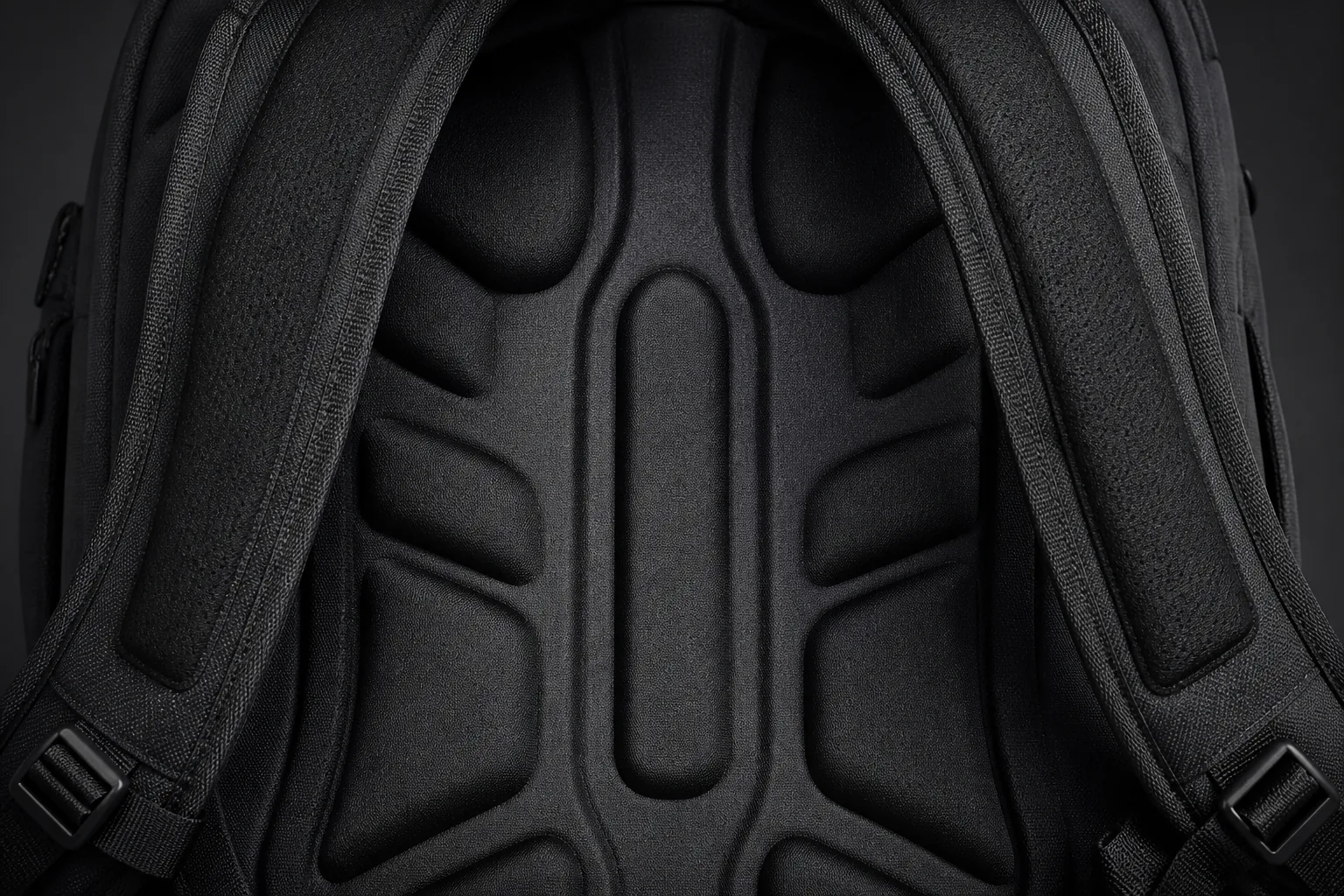
Foam is the component that decides whether a backpack feels protective, comfortable, or cheap, and it is usually the last material specified and the first one substituted. It carries the load on the shoulders, absorbs the impact around a laptop, and holds the shape of a back panel for years.
For a bag manufacturer, foam specification is also a commercial decision. Two paddings that look identical in a sample can differ by a factor of two in cost, by several hundred grams in weight, and by years in how long they keep their shape.
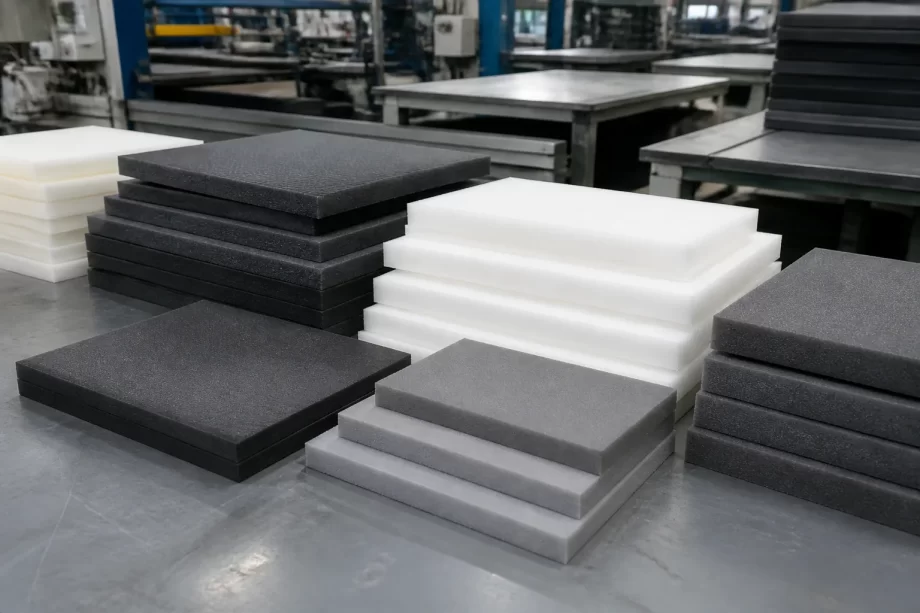
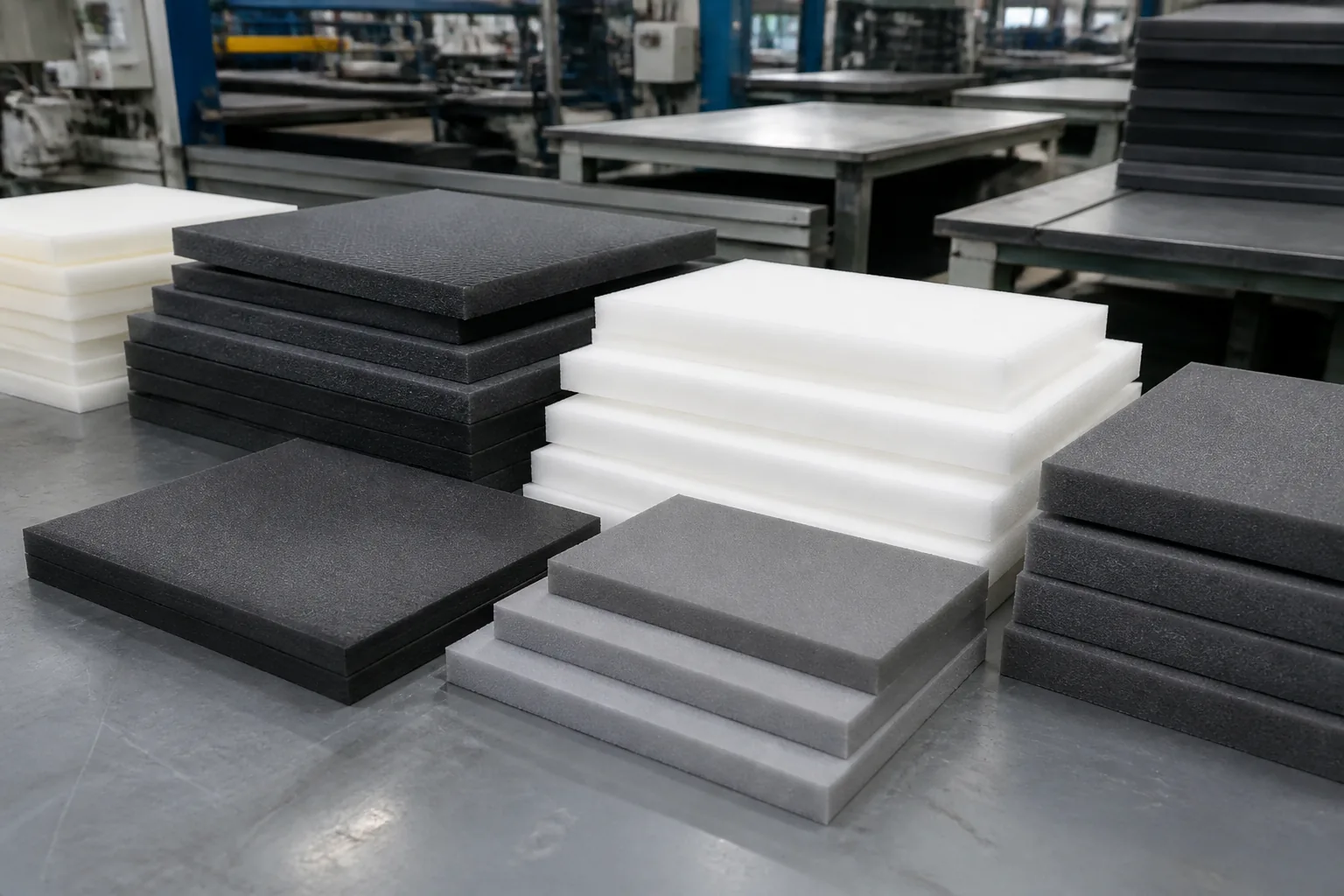
Foam sheet samples in several thicknesses and densities on a factory workbench
This guide covers foam and padding specification from a manufacturing perspective: what each padding area has to do, how the main foam types compare, which measurable properties matter, how foam is specified in a tech pack, how it behaves in cutting and assembly, and the testing that verifies it survives real use.
Padding is not a single material choice. Each padded area solves a different problem, and the specification should follow the function.
The Padded Areas
Area
Function
Shoulder straps
Load distribution and pressure relief
Back panel
Contact comfort and ventilation
Laptop compartment
Impact protection
Base panel
Shape retention and abrasion
Handle
Grip comfort
Hip belt
Load transfer
Structured walls
Shape and rigidity
The Function Table
Function
Property that delivers it
Comfort
Compression behaviour
Protection
Energy absorption
Shape retention
Resilience
Weight control
Density and thickness
Durability
Compression set
Breathability
Open structure and channels
Cost control
Appropriate specification
The Area Priority Table
Area
Priority
Laptop compartment
Protection
Shoulder straps
Comfort and durability
Back panel
Comfort and ventilation
Base panel
Shape retention
Handle
Comfort
Hip belt
Load transfer
The Failure Table
Failure
Cause
Flattened straps after a season
Compression set
Visible dents in back panel
Low resilience
Laptop damage from a drop
Insufficient thickness
Bottom sagging
Inadequate base support
Excessive pack weight
Over-specified density
Foam dust in the bag
Low quality foam or poor cutting
The Cost Drivers Table
Driver
Influence
Density
Material cost per volume
Thickness
Volume consumed
Foam type
Base material price
Sheet size and yield
Waste
Cutting method
Labour and tooling
Lamination
Additional materials
Factory note: Over-specifying foam is a common and invisible cost. A density increase from 25 to 35 kilograms per cubic metre across a full harness can add over a hundred grams to the pack and a meaningful amount to the unit cost, without the user noticing any difference. Matching the specification to the function is what keeps both weight and cost under control.
Foam Types and How They Compare
Bag manufacturing uses a small number of foam families. Each has a characteristic balance of cost, weight, resilience, and behaviour under cutting.
The Foam Types
Type
Character
PE foam
Low cost, firm, poor recovery
EVA foam
Light, resilient, easy to cut
PU foam
Soft, comfortable, variable durability
Memory foam
High comfort, slow recovery
Cross-linked PE
Fine cell, good resilience
Molded foam
Complex shapes, higher tooling
The Comparison Table
Type
Density range
Resilience
Cost
PE
25 to 45
Low
Lowest
EVA
45 to 90
Good
Low to moderate
PU
20 to 40
Moderate
Moderate
Memory
40 to 80
Slow recovery
Higher
Cross-linked PE
30 to 60
Good
Moderate
Molded
Varies
Good to high
Highest
The Selection Table
Application
Suitable type
Laptop sleeve padding
EVA or cross-linked PE
Shoulder strap core
EVA or PU
Back panel
Molded or laminated EVA
Base stiffener
PE sheet
Handle grip
PU or memory foam
Hip belt
EVA
The Property Table
Property
Meaning
Density
Mass per unit volume
Thickness
Specified dimension
Hardness
Resistance to compression
Resilience
Recovery after compression
Compression set
Permanent deformation
Tensile strength
Resistance to tearing
Cell structure
Open or closed
The Weight Table
Specification
Relative weight
5 mm at 25 density
Lightest
10 mm at 25 density
Light
10 mm at 45 density
Moderate
15 mm at 45 density
Heavier
Laminated multi-layer
Heaviest
The Substitution Table
Original
Common substitute
EVA
Cross-linked PE
PU
EVA of matched hardness
PE sheet
Rigid board of equal stiffness
Memory foam
Soft PU
The Substitution Risk Table
Risk
Consequence
Different density
Weight and feel change
Different hardness
Pressure points
Different resilience
Faster flattening
Different cell structure
Cutting and lamination issues
Unstated tolerance
Variable product
Specifying Foam in the Tech Pack
A foam specification must define measurable properties and a test method. Naming a colour and a thickness is not a specification.
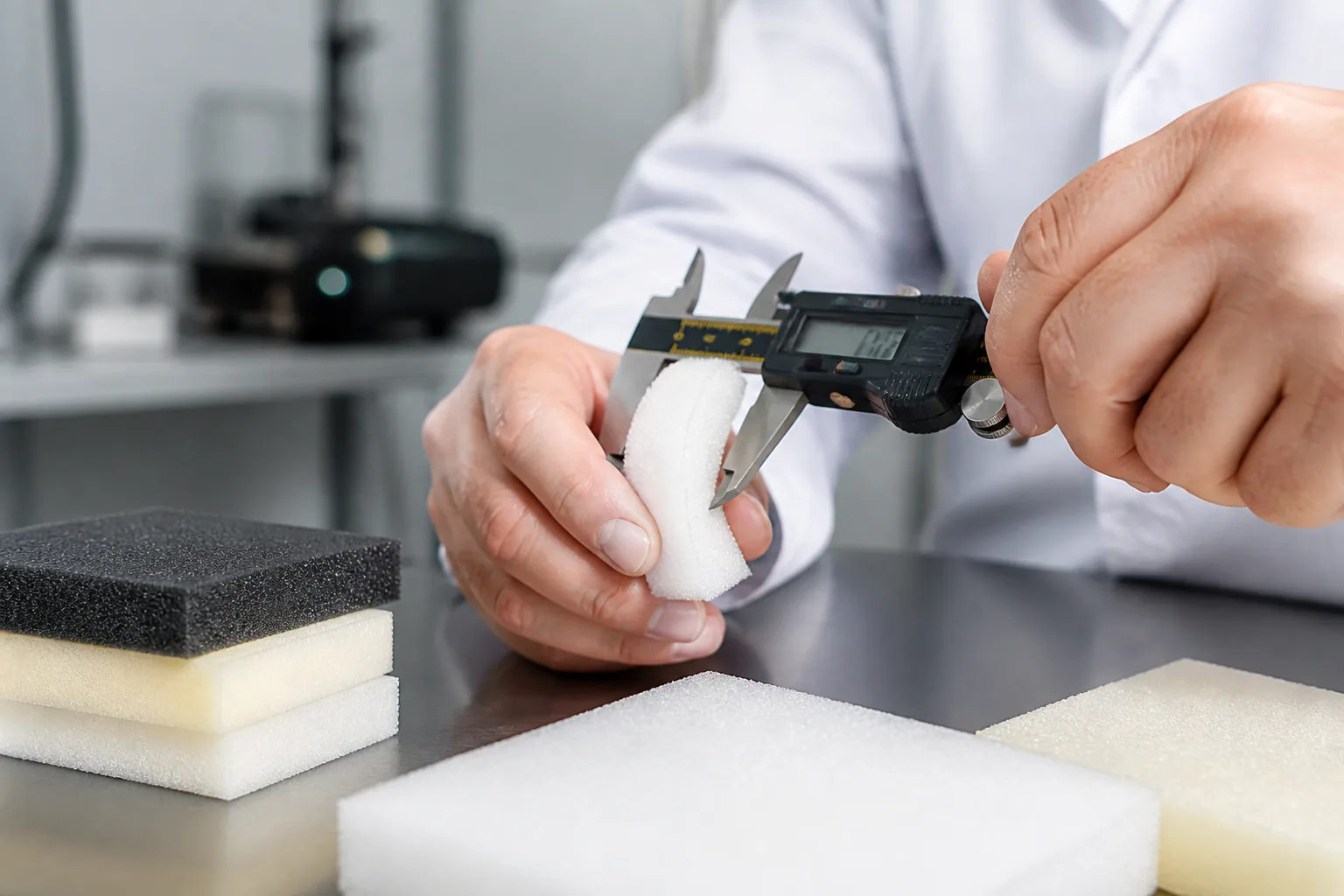
Technician measuring foam padding thickness with a digital caliper
The Required Specifications
Field
Example
Type
EVA
Density
45 kilograms per cubic metre
Thickness
10 millimetres
Hardness
25 degrees Shore A
Resilience
Stated recovery value
Colour
Reference
Sheet size
1000 by 2000 millimetres
Tolerance
Plus or minus 1 millimetre
The Specification Quality Table
Weak specification
Strong specification
Soft foam
25 Shore A hardness
Medium density
45 kilograms per cubic metre
About 10 mm
10 mm plus or minus 1 mm
Grey
Reference number 4
Good quality
Resilience above stated value
The Tolerance Table
Property
Typical tolerance
Thickness
Plus or minus 1 millimetre
Density
Plus or minus 3 kilograms per cubic metre
Hardness
Plus or minus 3 Shore A
Sheet dimension
Plus or minus 5 millimetres
Colour
Visual standard
The Lamination Table
Construction
Use
Single layer
Simple padding
Foam to fabric
Lining attachment
Foam to mesh
Breathable contact surface
Multi-layer foam
Graded hardness
Foam to stiffener
Structural panel
The Layer Stack Table
Layer
Function
Outer fabric
Durability
Thin foam
Cushioning
Dense foam
Support
Mesh spacer
Ventilation
Lining fabric
Finish
The Documentation Table
Document
Content
Material specification sheet
All properties
Supplier test report
Measured values
Colour standard
Physical reference
Sheet size confirmation
Purchasing data
Compliance declaration
Restricted substances
Cutting and Processing Foam
Foam behaviour during cutting and assembly determines whether the specified properties survive into the finished bag.
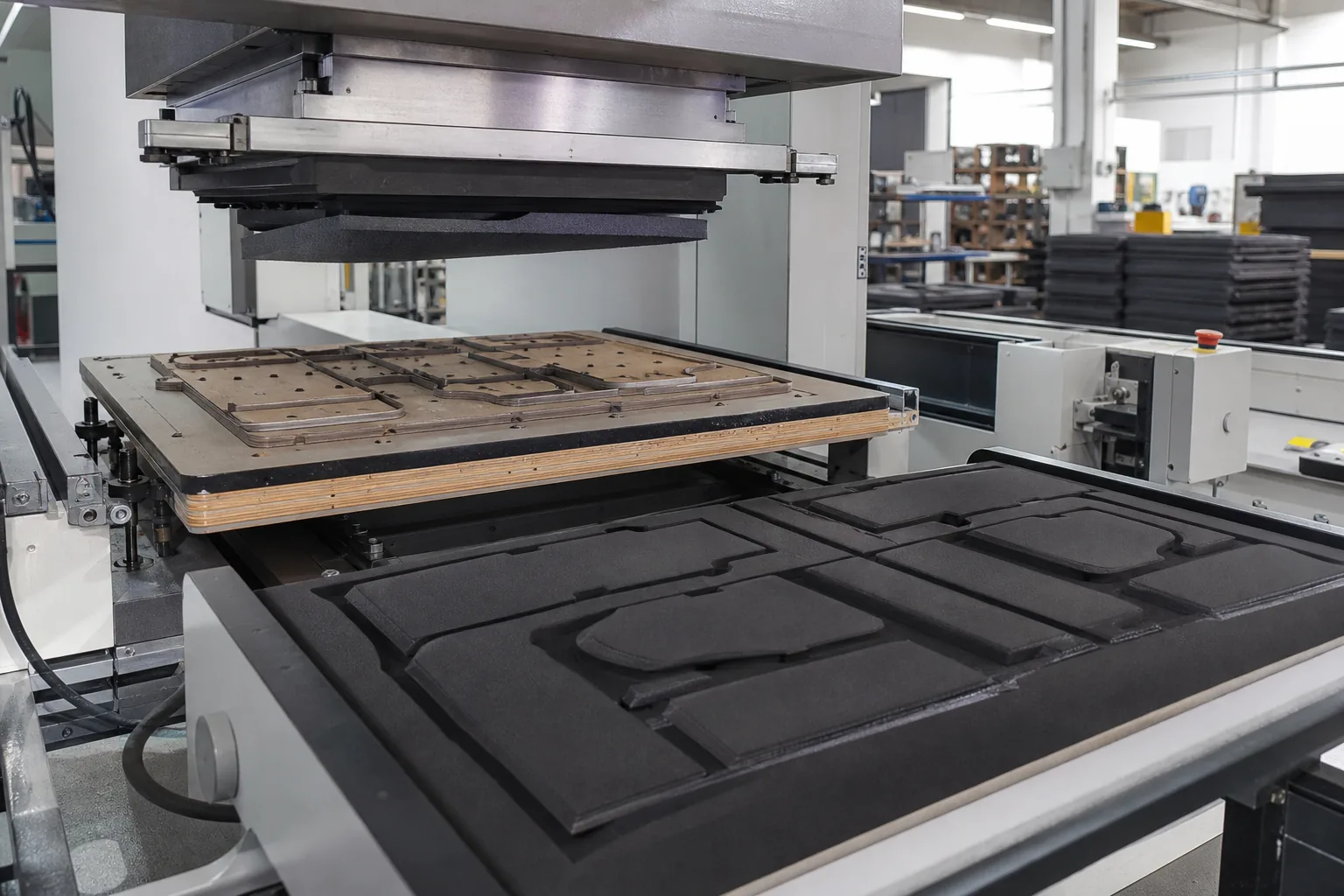
Die cutting press cutting foam padding panels for backpack manufacturing
The Cutting Methods
Method
Character
Die cutting
Fast, consistent shapes
Hot wire cutting
Sealed edges, simple profiles
CNC contour cutting
Complex shapes
Vertical band knife
Block splitting
Waterjet cutting
Clean edges, wet process
Manual cutting
Prototypes only
The Cutting Comparison Table
Method
Edge quality
Tooling
Die cutting
Good
Cutting die required
Hot wire
Sealed
Simple fixture
CNC contour
Very good
Program only
Band knife
Good
Machine
Waterjet
Excellent
Machine
The Cutting Effect Table
Effect
Cause
Tapered edges
Poor die or excessive pressure
Crushed cell structure
Blunt die
Dimensional drift
Material compression
Foam dust
Tearing cut
Delamination
Laminated sheet cut cold
The Nesting Table
Practice
Effect
Efficient layout on the sheet
Less waste
Consistent orientation
Predictable behaviour
Edge margin allowance
Avoid crushed edges
Batch cutting by thickness
Reduced handling
The Assembly Methods
Method
Use
Sewn in
Straightforward, repositioning risk
Laminated to fabric
Stable, needs heat or adhesive
Inserted in a pocket
Replaceable, buries edges
Quilted
Decorative and stable
Molded in place
Complex shapes
Tacked at intervals
Light control
The Assembly Comparison Table
Method
Behaviour over time
Loose inside a pocket
Can shift and bunch
Sewn through foam
Compresses at the stitch line
Laminated
Most stable
Quilted
Stable with stitch dimples
Molded
Shape-retaining
The Stitching Effect Table
Effect
Consequence
Stitch line compression
Harder line, pressure point
Needle heat on foam
Melted cell structure
Dense stitch rows
Reduced resilience
Bar-tacks through foam
Local collapse
The Quality Checks Table
Check
Method
Thickness
Caliper measurement
Dimensions
Template check
Edge condition
Visual
Lamination bond
Peel check
Position within panel
Measurement
Padding Design in Practice
Padding design combines thickness, density, and geometry. Geometry is often the most cost-effective variable.
The Strap Design Table
Element
Specification
Core thickness
8 to 12 millimetres
Core density
45 to 60 kilograms per cubic metre
Width
60 to 80 millimetres
Edge treatment
Tapered or bound
Contact surface
Mesh or spacer fabric
The Back Panel Table
Element
Specification
Foam thickness
8 to 15 millimetres
Channel pattern
Vertical or horizontal
Lumbar pad
Localised thicker section
Contact surface
Air mesh
Frame sheet
Optional stiffener
The Laptop Compartment Table
Element
Specification
Base foam
10 to 15 millimetres
Face foam
8 to 12 millimetres
Base clearance
Raised above the pack base
Edge protection
Wrapped padding
Sleeve fit
Snug to device
The Volume Table
Application
Typical thickness
Handle grip
3 to 5 millimetres
Shoulder strap
8 to 12 millimetres
Back panel
8 to 15 millimetres
Laptop sleeve
8 to 15 millimetres
Hip belt
10 to 20 millimetres
Base reinforcement
2 to 5 millimetres
The Geometry Table
Feature
Effect
Tapered edges
Reduces pressure lines
Perforation
Reduces weight and adds ventilation
Channels
Ventilation and flexibility
Contoured cut
Follows body shape
Zoned density
Support where needed
The Weight Optimisation Table
Action
Effect
Perforate non-contact areas
Weight reduction
Reduce thickness where not loaded
Weight reduction
Use zoned density
Weight with support retained
Trim excess material
Lower consumption
Choose closed cell where suitable
Less moisture uptake
The Comfort Factors Table
Factor
Influence
Contact area
Pressure distribution
Foam hardness
Comfort under load
Ventilation
Heat and moisture
Edge softness
Chafing
Load transfer
Shoulder pressure
Testing and Verification
Foam performance claims need measurement. The tests are simple and can be run on incoming material and on finished components.
The Test Methods
Test
Measures
Thickness measurement
Specified dimension
Density verification
Mass per unit volume
Hardness test
Compression resistance
Compression set
Permanent deformation
Resilience test
Recovery after compression
Tensile test
Strength
Peel test
Lamination bond
The Acceptance Table
Property
Verification method
Thickness
Caliper on incoming sheet
Density
Weigh a measured volume
Hardness
Durometer reading
Resilience
Drop and measure recovery
Lamination
Peel test per batch
Compression set
Held compression test
The Test Frequency Table
Test
Frequency
Thickness
Every batch
Density
Every batch
Hardness
Every batch
Compression set
Per supplier qualification
Resilience
Per material change
Peel strength
Per lamination batch
The Incoming Inspection Table
Check
Done
Thickness within tolerance
☐
Density confirmed
☐
Colour matches standard
☐
Sheet size as ordered
☐
No contamination or damage
☐
Test report on file
☐
The Failure Analysis Table
Field failure
Likely cause
Flattened padding
Compression set exceeded
Crumpled lining
Foam shifting inside the pocket
Visible dent
Low resilience
Tearing at the stitch line
Needle heat or weak material
Lamination separation
Poor bonding process
Excessive weight
Over-specified density
The Lifecycle Table
Factor
Effect on lifespan
Density
Higher density resists set
Resilience
Determines recovery
Moisture exposure
Degrades some foams
UV exposure
Degrades open cell foams
Load duration
Continuous compression
Cleaning method
Aggressive washing damages foam
Factory note: Compression set is the property that decides how a backpack feels after a year of use, and it is the property most often left out of the specification. A foam that recovers well from compression keeps its shape and comfort; a cheaper foam with the same initial thickness and density may look identical in a sample and flatten permanently within a season.
Cost, Sourcing and Supply
Foam is a commodity material with volatile input costs. Sourcing discipline protects both the specification and the price.
Back panel with molded foam padding and channel structure
The Cost Structure
Element
Character
Raw material
Largest share
Cutting
Labour and tooling
Lamination
Adhesive and process
Waste
Yield loss
Freight
Low density, volume-heavy
The Cost Comparison Table
Specification
Relative cost
5 mm PE
Lowest
10 mm PE
Low
10 mm EVA at 45 density
Moderate
15 mm EVA at 60 density
Higher
Molded foam component
Highest
The Yield Table
Issue
Effect on cost
Poor nesting
Material waste
Small sheet sizes
More handling
Tight tolerances
Higher rejection
Non-standard thickness
Special order
Low minimum order
Price penalty
The Sourcing Table
Consideration
Practice
Supplier qualification
Test the first batches
Consistency of density
Verify each delivery
Lead time
Plan around mill schedules
Minimum order quantity
Consolidate across styles
Price volatility
Review periodically
Storage
Keep flat and dry
The Storage Table
Condition
Requirement
Flat storage
Prevents permanent set
Dry environment
Limits moisture uptake
Away from sunlight
Limits degradation
Away from heat
Prevents distortion
Stacked height limited
Avoids compression
The Substitution Control Table
Situation
Requirement
Supplier out of stock
Written approval before use
Price increase
Review specification, not just price
New supplier
Test properties first
Colour change
Reference approval
Thickness change
Re-verify fit and weight
The Supplier Evaluation Table
Criterion
Check
Density consistency
Batch measurements
Thickness consistency
Caliper records
Colour consistency
Against reference
Sheet size accuracy
Against order
Documentation
Test reports supplied
Lead time reliability
Delivery history
The Lead Time Table
Material
Typical planning window
Standard PE sheet
Short
Standard EVA sheet
Short to moderate
Coloured foam
Moderate
Custom density
Longer
Laminated sheet
Moderate
Molded component
Longest
The Order Quantity Table
Factor
Effect
Minimum order quantity
Price step
Sheet size
Yield and waste
Colour range
Complexity
Combined styles
Consolidation benefit
Storage capacity
Order planning
The Price Review Table
Trigger
Action
Raw material movement
Re-quote
Supplier change
Re-verify properties
Specification change
Re-cost the unit
Volume change
Review price step
Annual review
Benchmark against alternatives
Working with Fabric and Structure
Foam never functions alone. Its performance depends on how it is combined with fabric, stiffeners, and the shape of the panel.
The Fabric Pairing Table
Contact surface
Purpose
Air mesh
Ventilation at the back panel
Spacer fabric
Cushioning and airflow
Brushed lining
Soft contact inside a sleeve
Ripstop nylon
Durability in a strap
Coated fabric
Moisture resistance
The Stiffener Table
Stiffener
Use
PE board
Semi-rigid back panel
HDPE sheet
Rigid frame
Cardboard
Low-cost prototypes
Composite sheet
Lightweight rigidity
The Combination Table
Requirement
Combination
Maximum protection
Dense foam plus rigid stiffener
Minimum weight
Thin foam plus perforation
Maximum ventilation
Channel geometry plus mesh
Maximum comfort
Graded density plus contoured shape
The Interaction Table
Interaction
Effect
Foam against stiffener
Load spreading
Foam against mesh
Ventilation retained
Foam against coated fabric
Moisture barrier
Foam against lining
Slick surface, possible shifting
Foam against zipper
Abrasion at the tape
The Design Rules Table
Rule
Reason
Specify density, not just thickness
Determines behaviour
Match thickness to the function
Avoids waste
Taper strap edges
Prevents pressure lines
Localise stiffness
Support without mass
Keep the base raised
Protects the device
Test compression set
Predicts lifespan
Common Problems and Troubleshooting
Padding problems surface either in the sample room or after months of use. Both are traceable to the specification or to the process.
The Problem Matrix
Symptom
Likely cause
Corrective action
Straps flatten quickly
Low resilience foam
Increase density or change type
Back panel dents visible
Compression set
Specify compression set limit
Foam bunches inside the panel
Not laminated or tacked
Specify lamination or tacking
Sagging base
Insufficient stiffener
Add or upgrade the stiffener
Excess pack weight
Over-specified density
Review density by area
Foam dust in the bag
Poor edge cutting
Improve the die or cutting method
Laptop unprotected in a drop
Thin or soft padding
Increase thickness or density
Sore shoulders under load
Insufficient contact area
Widen straps or reshape
Heat build-up on the back
No ventilation path
Add channels and mesh
Stitch line hardening
Compression at the seam
Change the assembly method
The Diagnosis Order
Step
Check
1
Confirm the foam delivered matches the specification
2
Verify thickness and density on incoming sheets
3
Check the cutting method and edge condition
4
Review the assembly method for compression points
5
Re-test compression set and resilience
6
Confirm the storage conditions at the factory
7
Compare against a retained reference sample
The Sample Room Table
Issue found in sampling
Action
Foam too soft
Revise hardness or density
Foam too heavy
Reduce thickness or density
Shape does not hold
Add stiffener or change type
Visible seams through padding
Adjust assembly
The Prevention Table
Control
Effect
Incoming inspection
Catches supply variation
Retained sample
Reference for disputes
Documented specification
Removes interpretation
Supplier qualification
Consistent supply
Process instruction
Consistent assembly
The Specification Checklist
Item
Done
Type stated
☐
Density stated with tolerance
☐
Thickness stated with tolerance
☐
Hardness stated
☐
Resilience or compression set stated
☐
Colour reference provided
☐
Sheet size stated
☐
Lamination method stated
☐
Assembly method stated
☐
Test method and frequency stated
☐
Factory note: Where a padding failure appears after the warranty period, the cause is almost always a compression set or resilience value that was never specified. Adding those two figures to the tech pack costs nothing, gives the factory a measurable acceptance criterion, and removes the most common source of disputes about comfort and shape retention.
Selecting Foam by Product Type
The right specification depends on how the pack will be used. The same harness component can be correctly specified at two very different densities for two different products.
The Product Profiles
Product type
Load character
Commuter daypack
Light, daily, short duration
School pack
Moderate, frequent, book loads
Travel pack
Heavy, long duration, carried far
Hiking pack
Heavy, sustained, load transfer critical
Camera pack
Protected contents, moderate load
Hydration pack
Light, active, ventilation critical
The Commuter Table
Area
Specification
Shoulder strap core
8 to 10 millimetres at 45 density
Back panel
8 millimetres with channels
Laptop sleeve
10 to 15 millimetres both faces
Handle
4 millimetres
The Travel and Hiking Table
Area
Specification
Shoulder strap core
10 to 12 millimetres at 55 to 60 density
Back panel
12 to 15 millimetres, contoured
Hip belt
15 to 20 millimetres
Frame sheet
Rigid or semi-rigid
Lumbar pad
Localised thicker section
The Camera and Device Table
Area
Specification
Main compartment padding
15 to 20 millimetres
Dividers
10 to 15 millimetres laminated
Base
20 millimetres plus stiffener
Access panel
10 millimetres
The Hydration Table
Area
Specification
Back panel
Minimal thickness, maximum channel area
Contact surface
Spacer mesh
Shoulder strap
5 to 8 millimetres, perforated
Waist
Light padding only
The Selection Matrix
Requirement
Specification direction
Maximum comfort
Higher density with contoured geometry
Minimum weight
Lower density with perforation
Maximum protection
Thicker foam plus stiffener
Maximum ventilation
Thin foam plus channels and mesh
Maximum durability
Higher density with laminated construction
The Weight Comparison Table
Product type
Typical padding share of total weight
Commuter daypack
Moderate
Travel pack
Lower share, higher absolute
Hiking pack
Moderate
Camera pack
Higher share
Hydration pack
Lower share
The Testing Emphasis Table
Product type
Priority test
Commuter
Compression set
Travel
Load retention over time
Hiking
Comfort under sustained load
Camera
Impact protection
Hydration
Ventilation performance
Sustainability in Foam Selection
Foam is a significant contributor to a pack’s material footprint and to its weight. Both pressures point towards using less material and specifying it more precisely.
The Sustainability Levers
Lever
Effect
Right-sizing density
Lower material and weight
Perforating non-contact areas
Material reduction
Reducing over-thickness
Material reduction
Improving cutting yield
Less waste
Recycled content foam
Lower footprint
Recycling offcuts
Waste diversion
The Recycled Content Table
Option
Consideration
Recycled PE foam
Broadly available
Recycled EVA
Availability varies
Bio-based foam
Cost and performance
Bonded offcut foam
Density consistency
Recycled content claim
Requires verification
The Waste Table
Waste source
Reduction
Cutting offcuts
Better nesting
Rejected laminated sheets
Process control
Oversized parts
Tighter specification
Obsolete stock
Production planning
The Verification Table
Claim
Evidence
Recycled content percentage
Supplier declaration and certificate
Bio-based content
Material documentation
Waste diversion rate
Disposal records
Weight reduction
Measured comparison
The Trade-off Table
Decision
Trade-off
Lower density
Less weight but lower resilience
Thinner foam
Less material but less protection
Recycled content
Lower footprint, possible property variation
Bio-based material
Cost premium
Perforation
Weight saving, more processing
The Design-Stage Table
Decision point
Sustainability effect
Padding area definition
Determines material volume
Thickness choice
Direct material impact
Geometry
Comfort without extra material
Assembly method
Waste and rework
Specification precision
Rejection rate
The Foam Specification Checklist
Before Development
Item
Done
Padded areas identified on the drawing
☐
Function defined for each area
☐
Target pack weight established
☐
Target cost established
☐
Test requirements agreed
☐
Specification
Item
Done
Foam type stated per area
☐
Density stated with tolerance
☐
Thickness stated with tolerance
☐
Hardness stated
☐
Resilience or compression set stated
☐
Colour reference provided
☐
Sheet size stated
☐
Lamination method stated
☐
Assembly method stated
☐
Production
Item
Done
Cutting method specified
☐
Nesting efficiency reviewed
☐
Incoming inspection defined
☐
Storage conditions specified
☐
Retained reference sample agreed
☐
Test frequency defined
☐
The Seven Rules
Rule
Reason
Specify density and hardness, not just thickness
Determines behaviour
State compression set for any load-bearing padding
Predicts lifespan
Match thickness to the function of each area
Avoids wasted material
Define the assembly method
Prevents shifting and compression
Verify every incoming batch
Supply varies
Keep foam flat and dry in storage
Prevents permanent set
Retain a reference sample
Settles disputes
FAQ
What density foam should a backpack shoulder strap use?
Between 45 and 60 kilograms per cubic metre for a standard daypack, with a thickness typically between 8 and 12 millimetres. Travel and hiking packs that carry heavier loads benefit from the upper end of that range, while lightweight commuter packs can use the lower end. Density is the property that determines how the strap behaves after months of use, so it should always be stated with a tolerance.
Is thicker foam always better for laptop protection?
No. Protection comes from the combination of thickness, density, and how the sleeve is positioned. A 10 millimetre sleeve of suitable density that is raised above the pack base protects a laptop better than a 15 millimetre sleeve sitting directly on the base, because base impact is the most common damage mechanism. Thickness without correct positioning and density simply adds weight.
What is compression set and why does it matter?
Compression set is the permanent deformation that remains after a foam has been compressed for a period and then released. It determines whether a strap or back panel returns to its original thickness after use. A foam with a high compression set flattens within a season and never recovers, which changes the fit and comfort of the pack. Because it does not show up in a new sample, it must be specified and tested rather than assumed.
Why does foam need a hardness specification as well as a density?
Density measures mass per unit volume and hardness measures resistance to compression. Two foams of identical density can have different hardness depending on their formulation and cell structure, and hardness is what the user feels. Specifying both removes the ambiguity and ensures that a substitute material does not change the comfort characteristics of the product.
What is the best way to attach foam inside a panel?
Lamination to the fabric is the most stable method, because it prevents the foam from shifting or bunching inside the panel. Inserting foam into a pocket is simpler and makes replacement possible, but it allows movement unless the foam is tacked at intervals. Quilting stabilises the foam but introduces stitch dimples that compress the material at each line. The choice should be stated in the tech pack rather than left to the line.
Does sewing through foam reduce its performance?
Yes, locally. A stitch line through a foam panel compresses the material along that line and creates a harder ridge, which can become a pressure point on a strap. Dense stitch rows over a large area reduce the resilience of the panel overall. Where stitching through foam is unavoidable, the pattern should keep stitch lines away from the highest-pressure contact areas, and the needle should be chosen to avoid heat build-up.
How should foam be stored in a factory?
Flat, dry, and away from sunlight and heat sources. Foam stored on its edge or under stacked weight develops permanent deformation, and foam exposed to heat or direct sunlight degrades over time. The stacking height should be limited so that the lower sheets are not compressed beyond their recovery capacity. These conditions should be stated as part of the material handling instruction rather than left to the warehouse.
Can a cheaper foam be substituted without affecting the product?
Only if the measurable properties match. A substitution that keeps the type but changes the density, hardness, or resilience will change the weight, the feel, and how long the padding holds its shape. Any substitution should be approved in writing after the replacement material has been tested against the original performance requirements, and the thickness should be re-verified because a different foam may compress differently during cutting.
How can padding weight be reduced without losing comfort?
By specifying geometry rather than volume. Perforating areas that do not contact the body, tapering strap edges, using zoned density so that support sits only where load is transferred, and cutting channels for ventilation all reduce weight while preserving the feel of the product. Reducing thickness across an entire panel is the crudest method and the most likely to compromise protection.
Conclusion
Foam is a small share of a backpack by weight and a large share of how it feels. It carries the load, protects the contents, and determines whether the pack still looks and fits the same way after a year of daily use.
The discipline is to specify it the way any other performance material is specified. Define what each padded area has to do before choosing a material, and compare the foam families on the properties that matter rather than on price alone.
State density, thickness, hardness, and compression set as measurable values with tolerances. Name the assembly method so that the foam cannot shift or be compressed at the stitch line. Verify every incoming batch, store the material flat and dry, and retain a reference sample for the life of the program.
For factories, a precise foam specification is a competitive advantage in both directions. It prevents returns caused by flattened padding, which are expensive and difficult to argue, and it prevents over-specification, which silently adds weight and cost to every unit.
For buyers, the two figures worth adding to the tech pack today are a density tolerance and a compression set limit. Neither costs anything to write, both give the factory a measurable acceptance criterion, and together they resolve the majority of padding complaints before they reach a customer.