A tech pack is the document that decides whether a backpack program runs smoothly or consumes months in sample corrections. It is the complete, unambiguous instruction set a factory needs to build the product exactly as the brand intends, and its quality determines the cost, timeline, and consistency of everything that follows.
Most problems that surface during sampling are not manufacturing problems. They are documentation problems: a dimension that was never specified, a material that was described rather than identified, a construction detail that was left to interpretation.
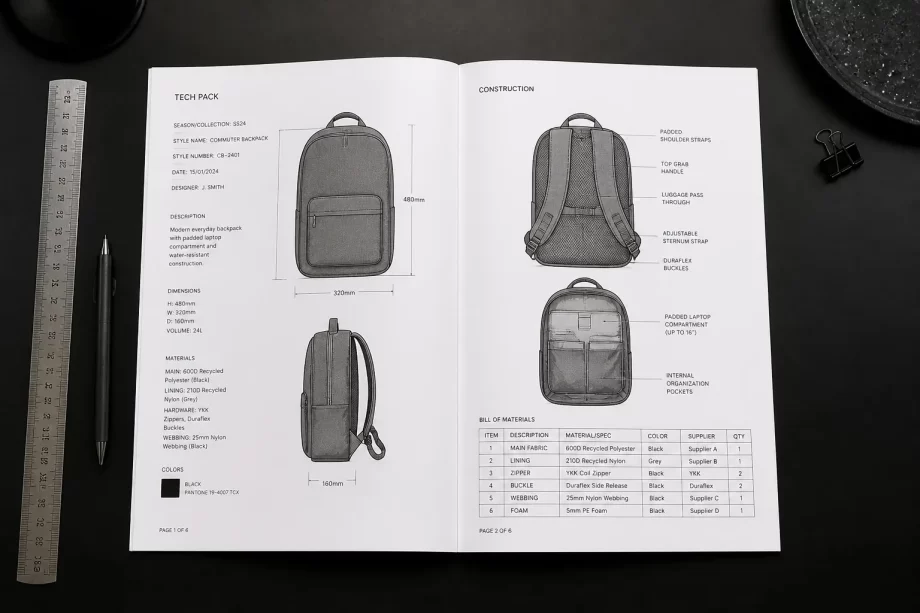
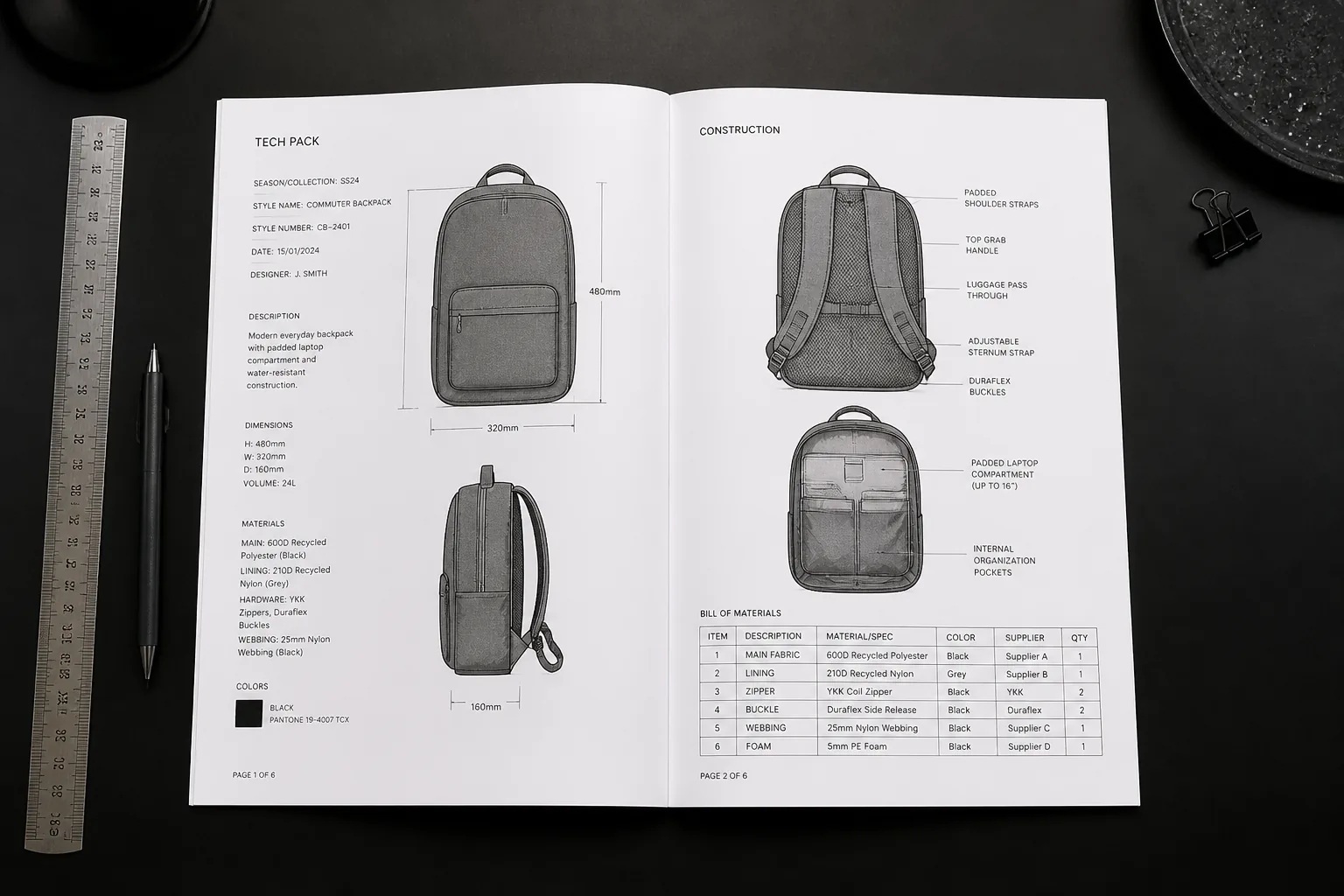
Open tech pack with backpack technical drawings and measurements
This guide covers tech pack development from a manufacturing perspective: what the document must contain, how each section is built, how tolerances and construction details are specified, how the pack moves through sampling and revision control, and the mistakes that cost the most time and money.
What a Tech Pack Is and Why It Decides the Program
A tech pack is not a design sketch with notes. It is a technical specification that a factory can cost, sample, produce, and inspect without asking interpretive questions.
The Function of a Tech Pack
Function
Output
Communicates design intent
Factory understands the product
Defines materials
Sourcing can be planned
Specifies construction
Samples are reproducible
Sets dimensions and tolerances
Inspection has criteria
Enables costing
Quotation is comparable
Records changes
Revision control
Supports compliance
Labelling and testing defined
The Document Comparison Table
Document
Purpose
Audience
Design sketch
Visual concept
Internal design
Tech pack
Full production specification
Factory
Bill of materials
Component list
Sourcing and purchasing
Specification sheet
Material standards
Quality and suppliers
Inspection standard
Acceptance criteria
Quality control
Costing sheet
Price build-up
Commercial
The Cost of a Poor Tech Pack
Weakness
Consequence
Missing dimensions
Sample rejected on arrival
Vague material description
Wrong material sourced
Undefined construction
Inconsistent samples
No tolerance
Disputes at inspection
No revision control
Old specification produced
Unstated compliance
Late relabelling
The Quality Indicators Table
Indicator
Strong tech pack
Material identification
Supplier and code
Dimensions
Numeric with tolerance
Construction
Step sequence with drawings
Hardware
Part numbers
Labelling
Full content and position
Revision record
Dated and approved
The Program Timeline Table
Stage
Tech pack quality effect
Quotation
Comparable pricing
Sampling
Fewer rounds
Approval
Clear criteria
Production
Consistent output
Inspection
Objective decisions
Repeat order
Reproducible
The Roles Table
Role
Responsibility
Brand designer
Design intent and visuals
Brand product developer
Specification accuracy
Factory engineer
Feasibility and construction feedback
Sourcing
Material availability
Quality
Inspection criteria
Commercial
Costing inputs
Factory note: The single cheapest improvement to any backpack program is a complete tech pack. Every hour spent specifying dimensions, materials, and construction before sampling saves several hours in sample corrections, and the savings repeat on every order placed against that specification.
The Anatomy of a Backpack Tech Pack
A complete tech pack has a predictable structure. Missing sections are the most common cause of sampling delay.
The Core Sections
Section
Content
Cover sheet
Product identity and revision
Concept and style
Design intent and references
Technical drawings
Front, back, side, top, base, details
Bills of materials
Fabric, lining, hardware, trim
Construction details
Sequence and method per area
Measurement chart
Dimensions with tolerances
Labelling
Branding, care, and compliance
Packaging
Polybag, carton, and markings
Testing requirements
Standards and acceptance
Approval and revision
Sign-off record
The Section Priority Table
Section
Priority
Technical drawings
Essential
Bills of materials
Essential
Measurement chart
Essential
Construction details
Essential
Labelling
Essential for retail
Testing requirements
Essential for regulated markets
Packaging
Essential for shipping
Concept references
Supporting
The Cover Sheet Fields
Field
Example
Product name
Urban Commuter 22L
Style number
UC-22-2026
Revision
Rev 3
Date issued
2026-09-26
Season
Spring 2027
Market
European Union
Prepared by
Product development
Approved by
Head of product
The Drawing Set Table
Drawing
Content
Front view
Outline with feature callouts
Back view
Harness and back panel
Side view
Profile and depth
Top view
Opening and handle
Base view
Base panel and feet
Detail views
Zipper, pocket, strap anchor
Section views
Layer order at key joints
Exploded view
Assembly sequence
The Drawing Standards Table
Standard
Requirement
Scale
Stated on every drawing
Units
Millimetres, stated once
Line types
Consistent convention
Callouts
Numbered with a legend
Dimensions
With tolerance
Revision
Marked on every sheet
The Bill of Materials Structure
Block
Content
Shell fabric
Supplier, code, colour, weight
Lining
Supplier, code, colour
Reinforcement
Material and position
Foam and padding
Type, density, thickness
Hardware
Part number, finish, size
Thread
Type and size
Zippers
Type, length, pull
Labels
Type, content, position
The BOM Discipline Table
Practice
Reason
One row per component
Traceability
Supplier and code both stated
Identifiable material
Colour reference stated
No colour disputes
Consumption per unit
Costing and purchasing
Approved alternative listed
Supply continuity
Specifying Materials and Components
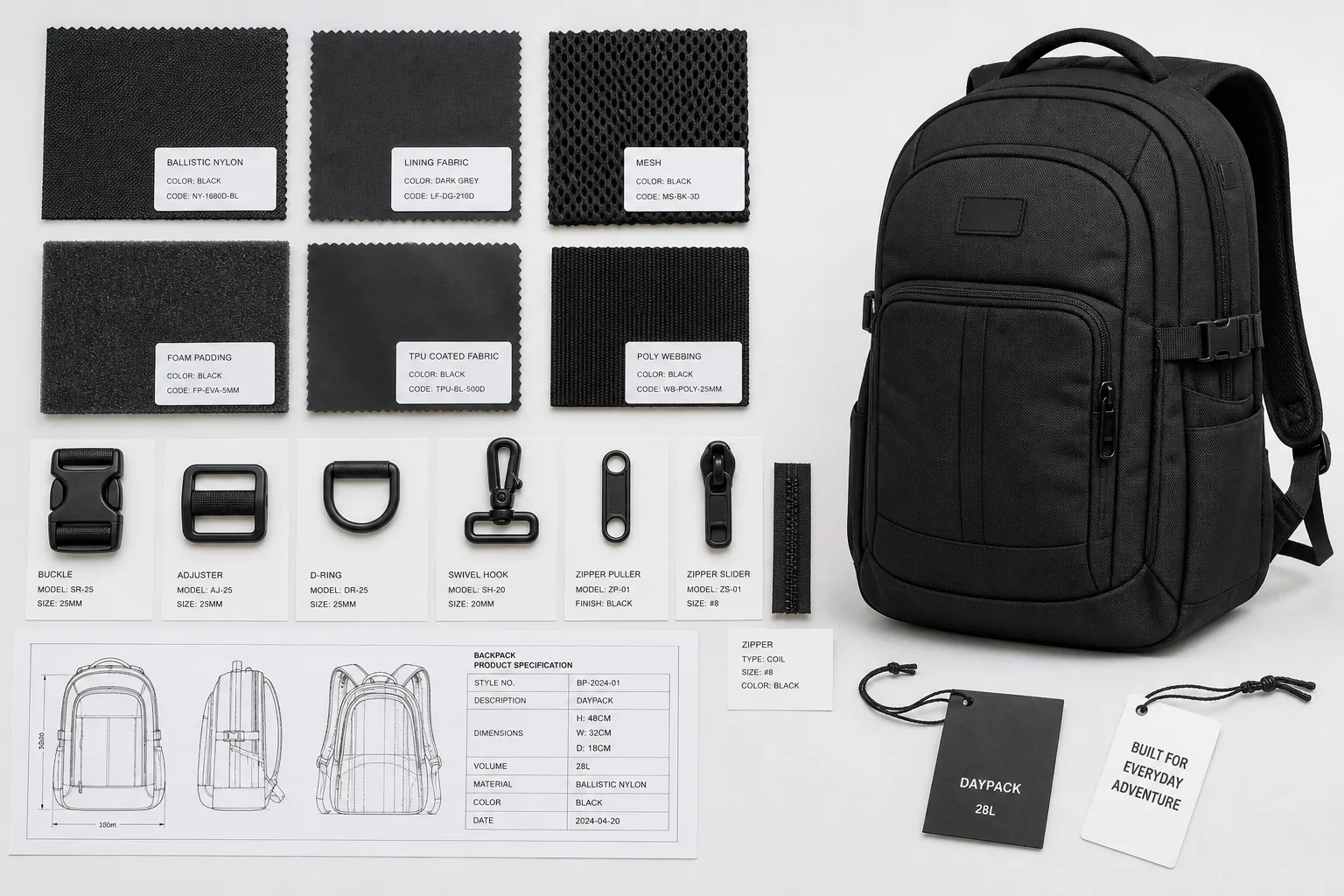
Material specifications must identify a material, not describe one. A description invites substitution; an identification prevents it.
Material swatches and hardware components with identification cards
The Fabric Specification Table
Attribute
Requirement
Composition
Fibre content by percentage
Weight
Grams per square metre
Construction
Weave or knit type
Coating
Type and application
Finish
Water repellent or other
Colour
Reference and standard
Performance
Abrasion, tear, water resistance
The Coating Specification Table
Attribute
Requirement
Type
PU, PVC, TPU, or other
Application
Coated, laminated, or both
Thickness
Microns
Water resistance
Hydrostatic head
Heat limit
Maximum pressing temperature
Weldability
Weldable or not
The Foam Specification Table
Attribute
Requirement
Type
PE, EVA, PU, or other
Density
Kilograms per cubic metre
Thickness
Millimetres
Hardness
Compression value
Resilience
Recovery test result
The Hardware Specification Table
Attribute
Requirement
Part number
Supplier catalogue reference
Material
Metal, polymer, or composite
Finish
Plating or coating
Size
Nominal and actual
Load rating
Tested capacity
Colour
Reference
The Zipper Specification Table
Attribute
Requirement
Type
Coil, vislon, or metal
Size
Number designation
Length
Cut length
Slider type
Auto-lock or non-lock
Pull style
Type and finish
Finish
Tape and teeth colour
The Thread Specification Table
Attribute
Requirement
Material
Bonded nylon or polyester
Size
Ticket or denier
Colour
Reference
Use
Structural or decorative
The Material Substitution Rules
Situation
Rule
Supplier discontinues a material
Brand approval required
Mill offers an equivalent
Comparative test required
Price pressure
No substitution without approval
Availability issue
Nominated alternative used
Colour variance
Within the approved standard
The Specification Documentation Table
Document
Content
Material specification sheet
Full attributes
Test report
Supplier performance data
Colour standard
Physical or numeric reference
Certificate of conformity
Compliance evidence
Care and use data
Consumer requirements
Factory note: A material named only by description, such as “600 denier polyester with PU coating”, can be satisfied by dozens of different fabrics with very different costs and performance. Naming a supplier and a code removes the ambiguity, and it also makes the quotation comparable, because every factory is pricing the same input.
Construction Details and Drawings
Construction specification is where most sampling errors originate. Every operation that a reasonable person could perform two different ways must be specified one way.
The Construction Elements to Specify
Element
Specification
Seam type
Plain, flat-felled, bound
Stitch type
Lock stitch, bar-tack, zigzag
Stitch density
Stitches per centimetre
Seam allowance
Millimetres
Reinforcement
Material, position, size
Edge finish
Binding, folding, binding tape
Layer order
Sequence at the joint
Assembly sequence
Order of operations
The Seam Specification Table
Area
Seam
Finish
Main body
Flat-felled
Double stitched
Base
Flat-felled
Reinforced
Front pocket
Plain
Bound
Lining
Plain
Overlocked
Zipper opening
Plain
Faced
Strap anchor
Reinforced
Bar-tacked
The Stitch Density Guide
Application
Stitches per centimetre
Lightweight fabric
4 to 5
Standard fabric
3.5 to 4
Heavy fabric
2.5 to 3
Leather and coated
2.5 to 3
Reinforcement
Per specification
The Reinforcement Table
Location
Reinforcement
Strap anchor
Patch plus bar-tack
Handle attachment
Patch plus box stitch
Zipper ends
Bar-tack
Pocket corners
Bar-tack
Base corners
Patch or binding
Strap adjuster
Box stitch
The Assembly Sequence Table
Step
Operation
1
Cut panels to pattern
2
Apply reinforcement and interfacing
3
Attach logos and transfers
4
Assemble front panel and pockets
5
Assemble back panel and harness
6
Join body seams
7
Attach base
8
Install zippers
9
Attach hardware
10
Seal seams where specified
11
Assemble lining
12
Join lining to shell
13
Final trim and inspection
The Detail Drawing Requirements
Detail
What must be shown
Strap anchor
Reinforcement size and stitch pattern
Zipper end
Bar-tack position and length
Pocket construction
Layer order and seam allowance
Base join
Corner treatment
Handle
Stitch pattern and reinforcement
Adjuster
Threading path
The Drawing Convention Table
Convention
Use
Solid line
Visible outline
Dashed line
Hidden or internal
Dash-dot line
Centre line or fold
Break line
Shortened view
Section marker
Cut position and direction
Callout bubble
Feature reference number
The Callout Legend Table
Number
Feature
1
Main zipper
2
Front pocket zipper
3
Laptop sleeve
4
Strap anchor reinforcement
5
Base reinforcement
6
Handle
Measuring and Specifying Tolerances
Tolerances decide whether an inspection passes or fails. Without them, every measurement becomes a negotiation.
The Dimension Groups
Group
Examples
Overall
Height, width, depth
Compartment
Laptop sleeve, pocket sizes
Strap
Length, width, pad size
Hardware
Position, spacing
Detail
Stitch length, reinforcement size
The Measurement Method Table
Dimension
Method
Height
Base to the highest point
Width
Widest point, laid flat
Depth
Side seam measurement
Sleeve
Internal width and height
Strap
Full length, relaxed
Position
From a stated datum
The Datum Table
Datum
Use
Base seam
Vertical measurements
Side seam
Horizontal measurements
Centre front
Symmetrical positioning
Zipper end
Detail positioning
The Tolerance Table
Dimension type
Typical tolerance
Overall height and width
Plus or minus 10 millimetres
Depth
Plus or minus 5 millimetres
Internal compartment
Plus or minus 5 millimetres
Hardware position
Plus or minus 3 millimetres
Strap length
Plus or minus 15 millimetres
Stitch density
Plus or minus 0.5 per centimetre
The Tolerance Rationale Table
Factor
Effect on tolerance
Soft material
Wider tolerance
Multiple panels
Cumulative variation
Structural fit
Tighter tolerance
Aesthetic alignment
Tighter tolerance
Cost sensitivity
Wider tolerance
The Measurement Chart Format
Point
Description
Spec
Tolerance
A
Overall height
470 mm
Plus or minus 10
B
Overall width
310 mm
Plus or minus 10
C
Depth
160 mm
Plus or minus 5
D
Laptop sleeve width
360 mm
Plus or minus 5
E
Laptop sleeve height
270 mm
Plus or minus 5
The Measurement Precautions Table
Precaution
Reason
State the filled or empty condition
Affects dimensions
State the closure state
Affects width
State flat or hung
Affects results
Condition before measuring
Relaxation
Same method for all sizes
Comparability
The Size Grading Table
Dimension
Grading rule
Height
Per size increment
Width
Per size increment
Depth
Often constant
Sleeve
Per laptop class
Strap
Adjustable range
The Inspection Alignment Table
Tech pack element
Inspection use
Measurement chart
Dimensional check
Tolerance
Accept or reject
Construction detail
Visual check
Material specification
Conformity check
Labelling
Content and position check
Labelling, Packaging and Compliance
Labelling and packaging are specified in the tech pack because they are production operations, not afterthoughts.
The Label Types
Label
Content
Brand label
Brand and logo
Care label
Washing and handling instructions
Composition label
Fibre content
Origin label
Country of manufacture
Warning label
Applicable hazards
Tracking label
Batch traceability
The Label Position Table
Label
Position
Brand label
Interior back panel or exterior tab
Care and composition
Interior seam or back panel
Origin
With care label or separately
Warning
Where specified by regulation
Tracking
Concealed interior position
The Care Instruction Table
Item
Content
Washing
Method and temperature
Drying
Method
Ironing
Permitted or not
Bleaching
Permitted or not
Professional care
If applicable
The Compliance Table
Market
Key requirement
European Union
Chemical restrictions and labelling
United States
Chemical and warning requirements
United Kingdom
Market-specific labelling
Other markets
Per destination regulation
The Testing Requirement Table
Test
Applicability
Fabric strength
Durable products
Abrasion
High-wear products
Water resistance
Outdoor products
Colour fastness
All coloured products
Chemical screening
All markets with restrictions
Zipper durability
All products
The Packaging Specification Table
Element
Requirement
Polybag
Size, thickness, recycled content
Warning printing
Applicable safety notice
Hangtag
Type and attachment
Carton
Size, strength, and count
Carton markings
Content and position
Barcode
Type and position
The Carton Marking Table
Field
Content
Style number
Product identity
Colour
Colour reference
Quantity
Units per carton
Size
Packed dimensions
Weight
Gross and net
Origin
Country of manufacture
Handling symbols
Per standard
The Compliance Documentation Table
Document
Purpose
Material declarations
Restricted substances
Test reports
Performance evidence
Certificates
Conformity proof
Care and use sheet
Consumer information
Labelling artwork
Print-ready file
Factory note: Labelling and packaging specifications are frequently left to the last minute and then become the reason a shipment is held. They belong in the tech pack from revision one, because artwork has lead times, carton sizes affect container loading, and compliance content must be verified before printing.
Building the Tech Pack: Process and Roles
A tech pack is developed in stages. Each stage resolves a different class of ambiguity before it can affect sampling.
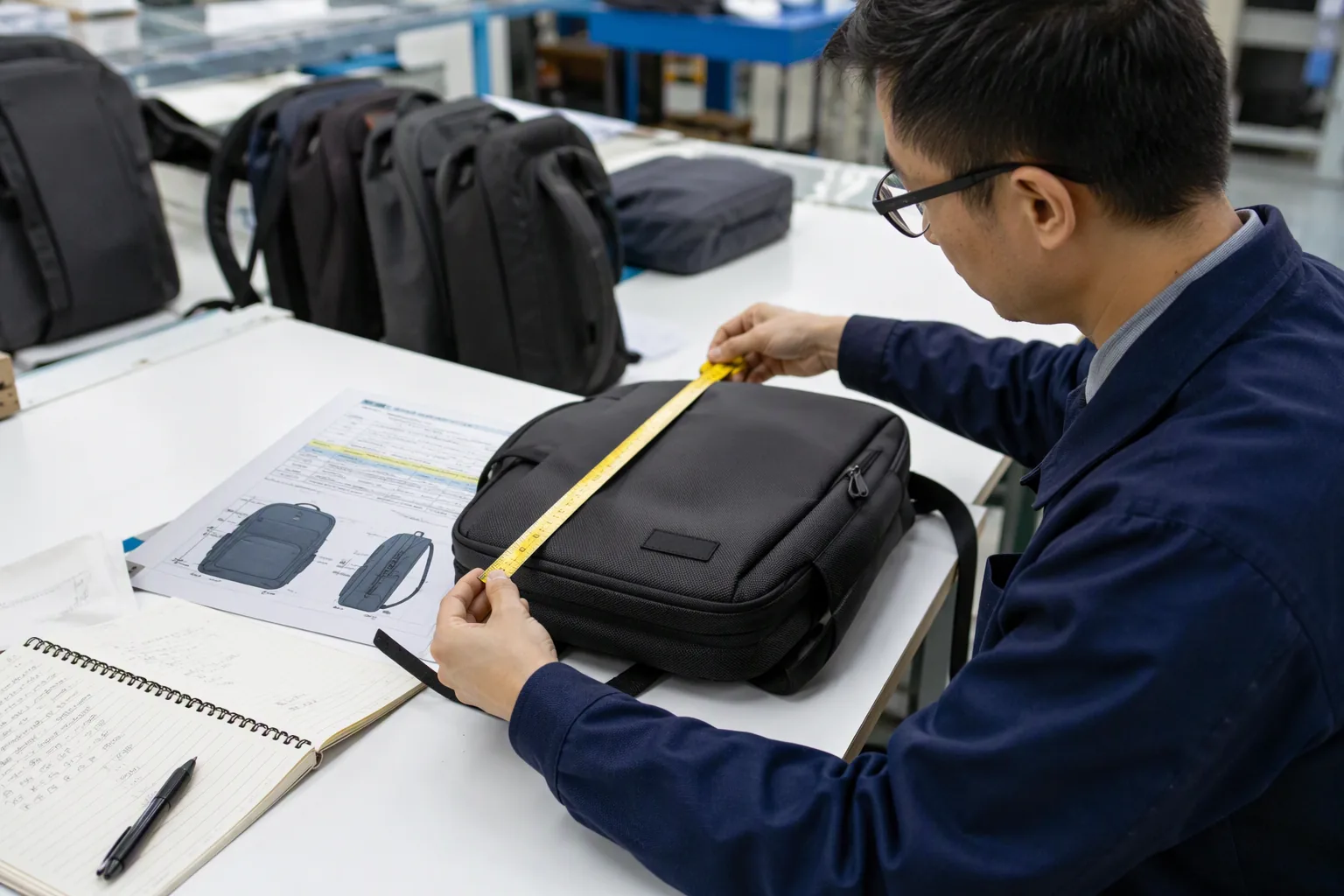
Engineer measuring a backpack sample against the specification
The Development Stages
Stage
Output
Concept
Design intent and references
Specification
Materials and dimensions drafted
Feasibility review
Factory feedback on construction
Costing draft
Price indication
First sample
Physical prototype
Correction rounds
Refined specification
Approval
Frozen revision
Production release
Final revision
The Stage Gate Table
Gate
Exit criteria
Concept approved
Design signed off
Specification complete
All sections populated
Feasibility confirmed
Factory accepts construction
Costing accepted
Target price met
Sample approved
Fit, function, and finish
Production release
Frozen revision issued
The Feedback Loop Table
Source
Feedback type
Factory engineer
Construction feasibility
Pattern maker
Panel geometry
Sourcing
Material availability
Costing
Price impact
Quality
Inspectability
Compliance
Labelling and testing
The Feasibility Questions Table
Question
Why it matters
Can this seam be sewn?
Access and machine limits
Can this be taped or welded?
Material compatibility
Is the reinforcement sufficient?
Load path
Is the pattern efficient?
Material yield
Is the hardware available?
Lead time
Can it be inspected?
Measurability
The First Sample Review Table
Review area
Check
Dimensions
Against the chart
Materials
Against the BOM
Construction
Against the details
Hardware
Correct parts and finish
Labelling
Content and position
Function
Usability and comfort
Appearance
Visual intent
The Correction Round Table
Round
Typical focus
First sample
Structure and dimensions
Second sample
Refinement and detail
Third sample
Production readiness
Pre-production sample
Line-equivalent build
The Approval Table
Approver
Scope
Designer
Appearance and intent
Product developer
Specification accuracy
Commercial
Cost
Compliance
Labelling and testing
Brand management
Final sign-off
Sampling and Revision Control
Revision control is what keeps a specification trustworthy across months of development and multiple production runs.
The Revision System
Element
Requirement
Revision number
Sequential
Date
Issue date
Author
Who changed it
Change description
What changed
Reason
Why it changed
Approval
Who authorised it
The Revision Record Table
Rev
Date
Change
Reason
0
Concept issue
Initial draft
Development start
1
First sample
Dimensions revised
Fit correction
2
Second sample
Hardware changed
Availability
3
Pre-production
Stitch density set
Strength
4
Production release
Frozen
Approval
The Change Control Table
Change type
Approval level
Cosmetic
Designer
Dimensional
Product development
Material
Product development and sourcing
Construction
Factory and product development
Compliance
Compliance owner
The Document Control Table
Control
Practice
Unique revision number
Prevent confusion
Date on every sheet
Traceability
Superseded mark
Prevent use
Distribution list
Controlled access
Archive
Retain all revisions
The Sample Tracking Table
Field
Content
Sample number
Unique
Revision built to
Which tech pack
Date received
Timeline
Review outcome
Result
Corrections listed
Action
Disposition
Approved, revised, or rejected
The Production Release Table
Requirement
Reason
Frozen revision
No ambiguity
Approved sample retained
Reference standard
Material approval
Sourcing confirmed
Labelling artwork final
Print lead time
Inspection criteria issued
Quality alignment
Tech Pack Mistakes and Their Costs
The most expensive mistakes are the ones that pass unnoticed until production.
The Common Mistakes
Mistake
Cost
Missing dimensions
Rejected samples
Vendor codes absent
Wrong material
Undefined seam type
Inconsistent construction
No tolerance
Inspection disputes
Mixed revisions
Wrong product built
Unstated packaging
Shipment delay
Compliance omitted
Relabelling and rework
Ambiguous units
Proportionate errors
The Cost of Each Round Table
Issue found at
Relative cost
Spec review
Lowest
First sample
Low
Pre-production
Moderate
During production
High
After shipment
Highest
The Ambiguity Table
Ambiguous phrase
Better specification
Strong reinforcement
40 millimetre patch, box stitch
Water resistant
5,000 millimetre hydrostatic head
Good quality zipper
Part number and size
Standard stitch
3.5 stitches per centimetre
Sturdy base
600 denier reinforcement panel
The Unit and Standard Table
Item
Standard to state
Dimensions
Millimetres
Fabric weight
Grams per square metre
Foam density
Kilograms per cubic metre
Stitch density
Stitches per centimetre
Tolerance
Plus or minus, stated in millimetres
The Prevention Table
Practice
Effect
Checklist before issue
Catches omissions
Factory feasibility review
Catches unbuildable details
Sample room sign-off
Builds correctly
Single revision authority
Prevents divergence
Retained reference sample
Resolves disputes
Costing Inputs from the Tech Pack
A complete tech pack is what makes a quotation comparable between factories. An incomplete one produces prices that cannot be compared.
The Costing Components
Component
Source in the tech pack
Material consumption
Pattern and material width
Material price
Supplier and code
Hardware count
BOM
Labour time
Construction detail
Packaging
Packaging specification
Testing
Testing requirement
Logistics
Packed volume and weight
The Consumption Table
Input
Basis
Fabric
Pattern area plus waste
Lining
Pattern area plus waste
Foam
Panel area
Hardware
Count per unit
Thread
Estimated metres
Packaging
Per unit
The Cost Variability Table
Factor
Effect on cost
Material specification
Direct
Number of panels
Labour and waste
Seam complexity
Labour
Hardware count
Material and labour
Testing scope
Fixed cost
Packaging level
Material and volume
The Quotation Comparability Table
Situation
Comparability
Full specification
High
Material named only
Low
Missing construction detail
Low
Missing packaging
Moderate
Complete with tolerances
Highest
The Cost Reduction Table
Lever
Mechanism
Panel simplification
Less labour and waste
Material substitution
Approved equivalent
Hardware standardisation
Volume pricing
Packaging optimisation
Freight saving
Size grading efficiency
Yield improvement
Factory note: When three factories quote very different prices for the same brief, the brief is almost always incomplete. The factories have each filled the gaps with their own assumptions about materials, construction, and packaging. Completing the tech pack is what turns three incomparable numbers into a real sourcing decision.
Handing Over to Production
The handover stage converts an approved development into a repeatable production process.
The Handover Package
Item
Content
Frozen tech pack
Final revision
Approved sample
Physical standard
Bill of materials
Final version
Inspection standard
Acceptance criteria
Labelling artwork
Print-ready files
Packaging specification
Full detail
Testing record
Completed results
The Handover Meeting Table
Topic
Owner
Specification walkthrough
Product development
Construction questions
Factory engineer
Material confirmation
Sourcing
Inspection criteria
Quality
Timeline
Production planning
Open items
All parties
The Production Readiness Table
Check
Status requirement
Materials in house
Confirmed
Patterns issued
Confirmed
Work instruction written
Confirmed
Operators trained
Confirmed
Inspection criteria issued
Confirmed
Labelling available
Confirmed
The First Production Check Table
Check
Purpose
First-off approval
Confirms setup
In-line inspection
Catches drift
Final inspection
Acceptance
Sample retention
Future reference
Factory note: A retained production sample, built to the frozen revision and kept alongside the tech pack, settles most future disputes in minutes. When a repeat order arrives a year later, the physical sample resolves questions that no document can, and it reveals whether the specification or the production drifted.
The Tech Pack Checklist
A pre-issue checklist catches the omissions that would otherwise be discovered by the sample room, which is the most expensive place to find them.
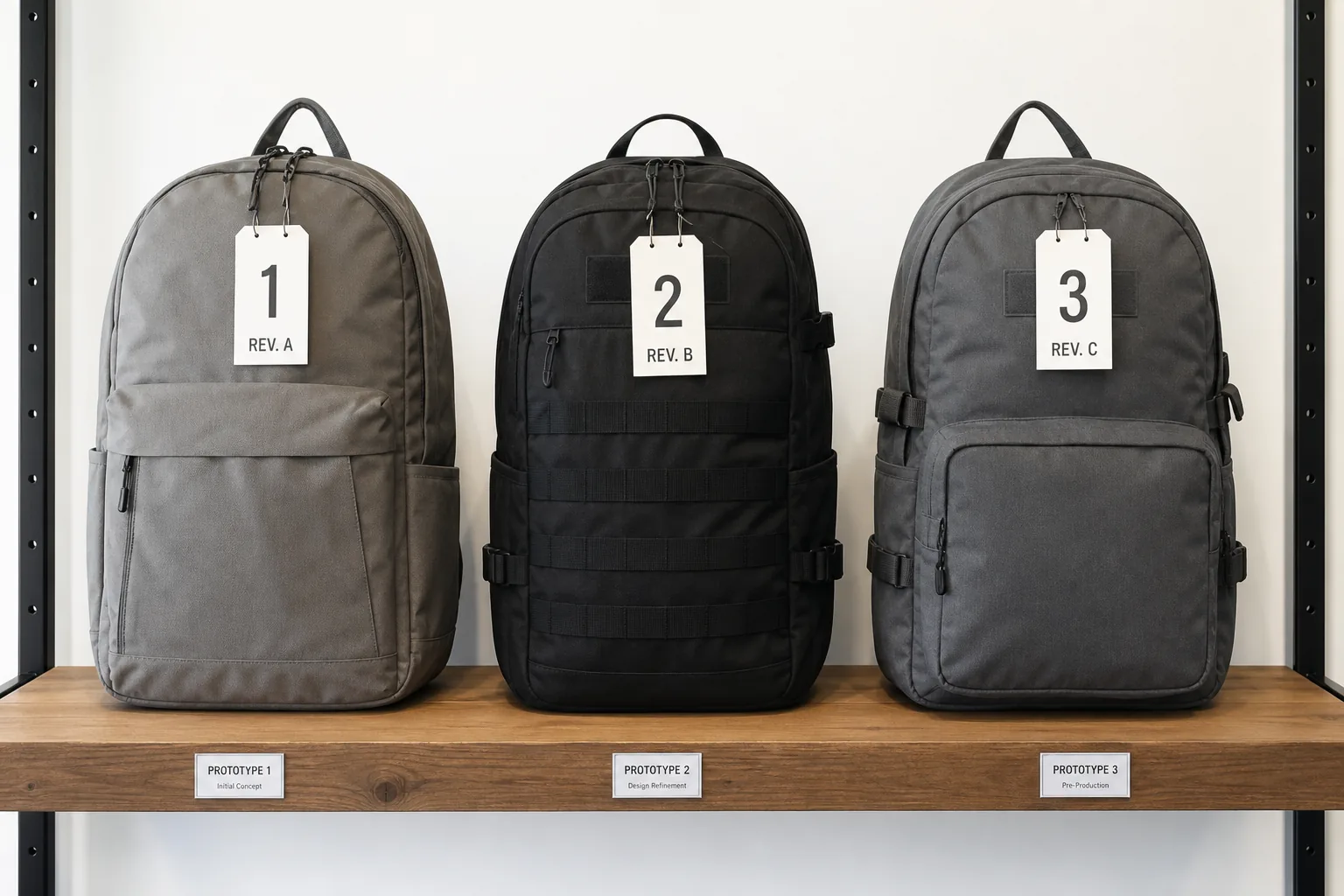
Numbered backpack prototypes on a sample room shelf
Document Completeness
Item
Done
Cover sheet with style number and revision
☐
Concept reference sheet
☐
Complete drawing set
☐
Bill of materials with supplier codes
☐
Construction detail sheets
☐
Measurement chart with tolerances
☐
Labelling specification
☐
Packaging specification
☐
Testing requirements
☐
Revision record
☐
Specification Quality
Item
Done
All dimensions numeric
☐
Tolerances stated for every key dimension
☐
Units stated once and used consistently
☐
Datum points defined
☐
Measurement condition stated
☐
Seam types named
☐
Stitch density specified
☐
Reinforcement sizes specified
☐
Layer order shown at each joint
☐
Assembly sequence listed
☐
Material and Component Quality
Item
Done
Fabric identified by supplier and code
☐
Colour reference established
☐
Coating type and thickness stated
☐
Foam type and density stated
☐
Hardware part numbers listed
☐
Zipper specification complete
☐
Thread type and size stated
☐
Consumption per unit provided
☐
Approved alternatives listed
☐
Commercial and Compliance
Item
Done
Target cost stated
☐
Order quantity indication
☐
Delivery window indication
☐
Destination markets named
☐
Applicable regulations identified
☐
Testing scope agreed
☐
Labelling content verified
☐
Packaging artwork available
☐
The Eight Rules
Rule
Reason
Identify materials, do not describe them
Prevents substitution
Give every dimension a tolerance
Makes inspection objective
Specify one way to build each detail
Removes interpretation
Review feasibility with the factory before sampling
Catches unbuildable details
Control revisions through a single owner
Prevents divergence
Keep a retained approved sample
Settles disputes
Specify labelling and packaging from revision one
Avoids late delays
Complete the pack before requesting quotations
Makes prices comparable
Working Across Markets and Size Ranges
A tech pack that serves one market and one size is a starting point. Extending it without losing control is a development task of its own.
The Market Variation Table
Market factor
Tech pack impact
Chemical restrictions
Material and testing requirements
Labelling rules
Label content and language
Measurement expectations
Sizing and tolerance
Packaging rules
Carton and marking requirements
Climate
Material performance requirements
The Multi-Market Approach Table
Approach
Trade-off
One pack per market
Most control, most maintenance
One pack with market annexes
Balanced
One pack with the strictest requirements
Simplest, may over-specify
Separate packs per regulation zone
Clear responsibility
The Size Range Table
Size
Grading impact
Small
Reduced capacity and strap length
Medium
Base size for development
Large
Increased capacity and strap length
One size
Fixed dimension set
The Grading Specification Table
Dimension
Grading approach
Body height
Increment per size
Body width
Increment per size
Depth
Often held constant
Laptop sleeve
By device class
Strap length
Adjustable, minimum length specified
Pad size
Increment or constant
The Variant Control Table
Variant
Documentation need
Colourway
Separate BOM colour rows
Material variant
Separate specification
Size variant
Grading chart
Market variant
Labelling and testing annex
Packaging variant
Carton and marking annex
The Maintenance Table
Activity
Frequency
Review the pack against actual production
Annually
Update supplier references
On change
Refresh the retained sample
Per production run
Archive superseded revisions
Immediately
Re-verify compliance content
On regulation change
Factory note: Variants multiply maintenance work. A product with four colourways, three sizes, and two market label sets carries twenty-four specification combinations, and each one can drift independently. Where variation is unavoidable, market annexes kept separate from the core pack prevent a change in one market from disturbing the others.
FAQ
What must a backpack tech pack contain at minimum?
Seven sections: technical drawings with detail views, a bill of materials identifying every component by supplier and code, construction details including seam type and stitch density, a measurement chart with tolerances, a labelling specification, a packaging specification, and the testing requirements. A cover sheet with the style number and revision number sits on top. Missing any one of these reliably produces a sampling delay.
Why is describing a material worse than naming it?
A description such as “600 denier polyester with PU coating” can be satisfied by dozens of different fabrics with different weights, coatings, and prices. Naming a supplier and a code makes the specification unambiguous, prevents substitution, and makes quotations from different factories genuinely comparable, because every factory is then pricing the same input.
What tolerances are normal for a backpack?
Overall height and width commonly carry plus or minus 10 millimetres, depth around plus or minus 5 millimetres, internal compartments around plus or minus 5 millimetres, hardware positions around plus or minus 3 millimetres, and strap length around plus or minus 15 millimetres. Soft materials justify wider tolerances; structural fit and aesthetic alignment justify tighter ones.
How many sample rounds should a backpack program need?
Three rounds is typical: the first sample resolves structure and dimensions, the second refines detail and materials, and the third confirms production readiness. Programs that need five or more rounds usually have a tech pack problem rather than a manufacturing problem, and the corrections tend to repeat issues that should have been specified in revision one.
Who owns the tech pack after development?
A single named owner should control revisions, even when many people contribute. Design, sourcing, compliance, and the factory all supply content, but one person issues revisions and maintains the record. When multiple parties edit the specification independently, the production line eventually builds a hybrid of two revisions, which is one of the most expensive failures in the process.
Should packaging be specified in the tech pack?
Yes, from the first revision. Polybag size and thickness, hangtags, carton dimensions and strength, carton markings, and barcodes all affect cost, freight, and shipment timing. Artwork has a lead time, and carton dimensions affect container loading, so a packaging specification added late delays shipments that are otherwise complete.
How does the tech pack affect the quotation?
It determines whether quotations are comparable. A complete pack with named materials, defined construction, and a specified packaging level produces prices that can be compared directly. An incomplete brief produces three different numbers reflecting three different sets of assumptions, and the comparison is therefore meaningless.
What is a datum point and why does it matter?
A datum is the reference from which measurements are taken, such as the base seam for vertical dimensions or the side seam for horizontal ones. Without a stated datum, two inspectors measuring the same bag can produce different numbers. Stating the datum and the measurement condition makes the result repeatable across factories, lots, and inspectors.
How should a tech pack be updated when a material is discontinued?
Through a formal revision with approval at the right level, in this case product development together with sourcing. The replacement material should be tested against the original performance requirements rather than accepted as equivalent on description, and the measurement and construction sections should be reviewed because a different material may behave differently in cutting, sewing, and finishing.
Conclusion
A tech pack is the instrument that converts design intent into reproducible production. Its value is not in how detailed it looks, but in how few questions it leaves open when it reaches the sample room.
The discipline is consistent across every section. Materials are identified by supplier and code rather than described, and every key dimension carries a stated tolerance and a stated datum.
Every construction detail that could be built two ways is specified one way. Labelling, packaging, and testing requirements are included from the first revision, because they carry lead times of their own. And revisions are controlled by a single owner with a dated record, so the factory never builds from a superseded document.
For factories, a well-built tech pack from a buyer is a signal of a professional program, and it allows the plant to quote accurately, sample quickly, and produce consistently. Reviewing the pack for feasibility before sampling is a service, not an obstacle, and the feedback improves the product.
For buyers, the investment is front-loaded and the return is compounding: fewer sample rounds, comparable quotations, objective inspection, and a specification that can be repeated on every order for as long as the product sells. A tech pack written in an afternoon becomes the reference for years of production. Writing it well is the highest-leverage hour in the entire program.