No factory inspects every backpack it ships. Full inspection doubles the cost of quality control and still misses defects, because human attention is not perfectly reliable at any speed. Instead, the industry inspects a statistically defined sample and accepts a defined number of defects.
That system is AQL — Acceptable Quality Limit. For a bag brand placing an order, AQL is the difference between a shipment that arrives clean and a container of backpacks that generates returns for six months. For a factory, it is the standard that defines whether a lot ships or is reworked.
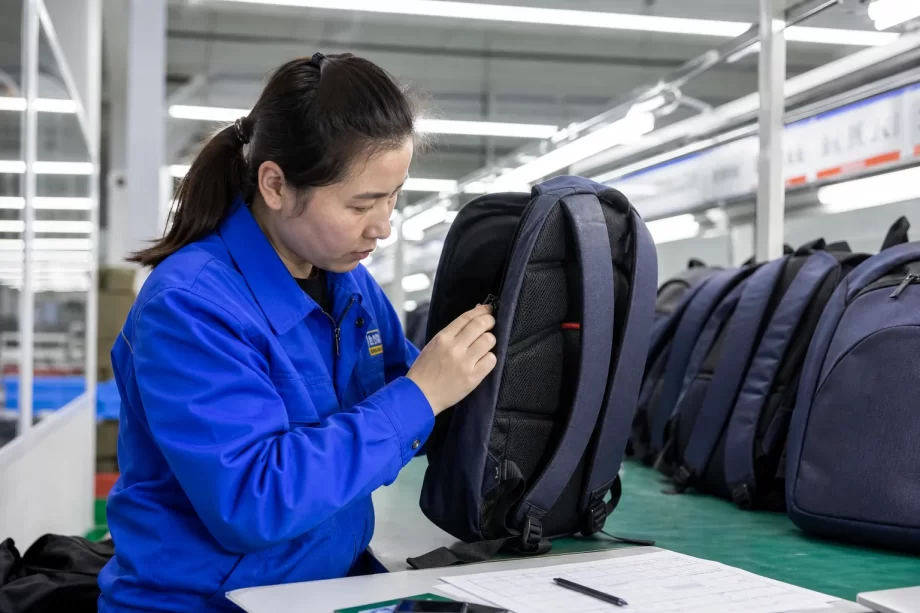
Quality inspector examining finished backpacks at an inspection table
This guide covers how AQL inspection works in backpack production: inspection levels, sample sizes, defect classification, inspection stages, execution, reporting, and how buyers and factories should agree the standard before production starts.
AQL is a compromise between two impossible alternatives: inspect nothing and accept whatever arrives, or inspect everything and pay for it twice.
The Inspection Economics
Approach
Cost
Coverage
No inspection
Lowest
None
Sample inspection
Moderate
Statistical
100% inspection
Highest
Full, if reliable
100% plus audit
Highest plus
Full plus verification
What AQL Protects
Party
Protection
Buyer
Defined defect limit before shipment
Factory
Defined acceptance criteria, no arbitrary rejection
Both
Shared language for quality disputes
End customer
Consistent product quality
The Cost of an Escaped Defect
Discovery point
Relative cost
At the factory before packing
1×
At a third-party inspection
2×
At the buyer’s warehouse
6×
At the retailer
20×
After the end customer
40× or more
The Perception Problem
Perception
Reality
AQL removes all defects
AQL defines an accepted level
AQL 0.0 is achievable
Very small samples may pass by chance
Higher AQL saves money
It shifts cost to returns
Inspection replaces process control
It verifies, it does not build
One inspection is enough
Stage-dependent quality needs multiple checks
The AQL Mindset
Wrong approach
Working approach
Inspect to catch failures
Build in quality, verify with AQL
Negotiate the standard after failure
Agree the standard before production
Treat AQL as a pass or fail
Treat it as a defined acceptance level
Argue about individual units
Apply the classification consistently
Factory note: The standard must be agreed before the first cut, not before shipment. A buyer who introduces a defect classification two days before loading leaves the factory no time to correct a process problem, and the resulting dispute usually costs more than the defects themselves.
The AQL Framework
AQL is built on three parameters that must be defined together. Changing one changes everything else.
The Three Parameters
Parameter
Meaning
Inspection level
How many units to check
AQL value
What defect rate is accepted
Defect class
What counts as critical, major, minor
The Standard Reference
Standard
Use
ISO 2859-1
Widely used sampling standard
ANSI/ASQ Z1.4
US equivalent
GB/T 2828.1
Chinese national equivalent
Buyer-specific protocol
Retail or brand requirement
The Relationship Between Parameters
Change
Effect
Tighter AQL
Larger sample or stricter acceptance
Higher inspection level
Larger sample
More critical class items
Higher rejection risk
Smaller lot
Smaller sample, less precision
Higher lot size
Larger sample
The Acceptance Logic
Result
Action
Defects at or below acceptance
Lot passes
Defects above acceptance
Lot rejected
Critical defect found
Immediate rejection, no compromise
Marginal case
Buyer and factory agree per contract
The Sampling Table Structure
Lot size
Sample letter
Sample size
151–280
G
32
281–500
H
50
501–1,200
J
80
1,201–3,200
K
125
3,201–10,000
L
200
10,001–35,000
M
315
The Single Sampling Plan Table
Sample size
AQL 2.5 accept
AQL 2.5 reject
32
2
3
50
3
4
80
5
6
125
7
8
200
10
11
315
14
15
The Acceptance Values at Common AQL Levels
Sample size
AQL 1.5
AQL 2.5
AQL 4.0
32
1
2
3
50
1
3
4
80
2
5
7
125
3
7
10
200
5
10
14
315
8
14
21
Reading the tables correctly matters more than memorising them. The numbers are acceptance counts: if the sample is 200 units at AQL 2.5, up to 10 major defects are accepted and 11 cause rejection. The same 200-unit sample at AQL 1.5 accepts only 5.
The Typical Backpack Standard
Defect class
Common AQL
Critical
0.0, zero tolerance
Major
1.5 or 2.5
Minor
4.0
Inspection Levels and Sampling Plans
The inspection level determines how many units enter the sample. It is a separate decision from the AQL value itself.
The General Inspection Levels
Level
Relative sample
Use
Special S1
Very small
Quick check
Special S2
Small
Simple check
Special S3
Small plus
Minimal verification
General I
Half of II
Low-risk product
General II
Standard
Default level
General III
Double of II
High-risk or first order
General Level II is the default for consumer goods including backpacks. A buyer raising the level to III deliberately doubles the sample size and increases the chance of detecting a marginal quality level.
The Level Comparison Table
Lot size
Level I
Level II
Level III
501–1,200
32
80
125
1,201–3,200
50
125
200
3,201–10,000
80
200
315
10,001–35,000
125
315
500
The Tightened and Reduced Plans
Plan
When used
Normal
Default
Tightened
Two consecutive lots rejected
Reduced
Several consecutive lots accepted
Skip-lot
Sustained strong performance
The Switch Rules
Trigger
Switch
Two of five lots rejected
Normal to tightened
Five consecutive lots accepted
Normal to reduced
Rejection under tightened
Back to normal
Sustained acceptance
Consider skip-lot
The Lot Definition
Factor
Requirement
Same style
One lot, one style
Same color
Separate lots if colors differ
Same production window
Avoid mixing weeks
Complete quantity
Partial lots inspected as partial
Identified clearly
Lot number recorded
The Sample Selection Rules
Rule
Reason
Random across the lot
Represent the whole
Include carton variety
Catch packing variation
Include shift variety
Catch shift patterns
Do not let the factory choose
Avoid biased samples
Pull from finished stock
Pre-shipment verification
The Two Sample Pitfalls
Pitfall
Consequence
Factory pre-selects units
Best units inspected
Sample taken early
Later production uninspected
Sample from one carton
Not representative
Sample after rework only
Hidden defect pattern
Factory note: The sample must be pulled by the inspector, not handed over by the factory. A pre-selected sample is the single most common way an inspection produces a misleading pass, and no amount of table precision compensates for a biased sample.
Defect Classification for Backpacks
Classification turns vague quality discussions into countable items. Every defect type must be assigned to a class before inspection begins.
The Three Classes
Class
Definition
Consequence
Critical
Safety risk or illegal
Reject the lot
Major
Function or sale failure
Counts against major AQL
Minor
Cosmetic, does not block sale
Counts against minor AQL
The Critical Defect List
Defect
Why critical
Broken or exposed needle fragment
Injury risk
Sharp metal protrusion
Injury risk
Excessive azo dye or restricted substances
Regulatory
Mold or mildew
Health
Structural anchor failure
Load failure
Child safety strap failure
Safety regulation
The Major Defect List
Defect
Impact
Zipper fails or jams
Function loss
Strap anchor not reinforced
Structural risk
Missing hardware
Function loss
Broken buckle
Function loss
Wrong size or dimension beyond tolerance
Fit failure
Seam skipped in load path
Structural risk
Hole or cut in shell fabric
Durability
Wrong color or material
Sale failure
Logo misplaced or wrong
Sale failure
Lining not attached at an opening
Function and appearance
The Minor Defect List
Defect
Impact
Loose thread over 10 mm
Appearance
Slight stitch irregularity
Appearance
Minor edge roughness
Appearance
Slight shade variation
Appearance
Small glue mark on lining
Appearance
Hardware surface scratch
Appearance
Slight asymmetry in trim
Appearance
The Classification Table
Attribute
Critical
Major
Minor
Safety
Yes
No
No
Function
Yes
Yes
No
Saleability
Yes
Yes
Marginal
Measurable
Yes
Yes
Yes
AQL applied
0.0
1.5–2.5
4.0
The Judgement Rules
Rule
Application
One unit, one defect
Count per unit
Same defect on one unit
Count once
Multiple defects on one unit
Highest class counts
Defect visible at 60 cm
Cosmetic rule
Defect under normal light
Standard conditions
Standard inspection distance
40–60 cm
The Measurement Tolerance Table
Dimension
Tolerance
Overall height
±10 mm
Overall width
±10 mm
Overall depth
±10 mm
Strap length
±15 mm
Zipper length
±10 mm
Hardware position
±5 mm
Pocket dimension
±8 mm
The Sample Defect Record
Unit
Critical
Major
Minor
Notes
1
0
0
1
Loose thread
2
0
1
0
Zipper drag
3
0
0
0
Pass
4
0
0
2
Stitch and trim
5
0
0
0
Pass
The Defect Distribution Analysis
Station
Defects found
Interpretation
Zipper insertion
Many major
Process problem
Topstitch
Many minor
Skill or setting
Hardware setting
Few
Stable process
Final assembly
Mixed
Upstream escapes
Packing
Very few
Clean stage
Factory note: Classify a defect by its effect on the user, not by how easy it is to fix. A zipper that jams because of a minor stitch adjustment is still a major defect, because the customer cannot use the bag. Misclassification in either direction destroys the value of AQL — one way it hides real problems, the other it rejects acceptable product.
Inspection Stages in Backpack Production
A single pre-shipment inspection catches problems too late to fix cheaply. Professional programs inspect at several stages.
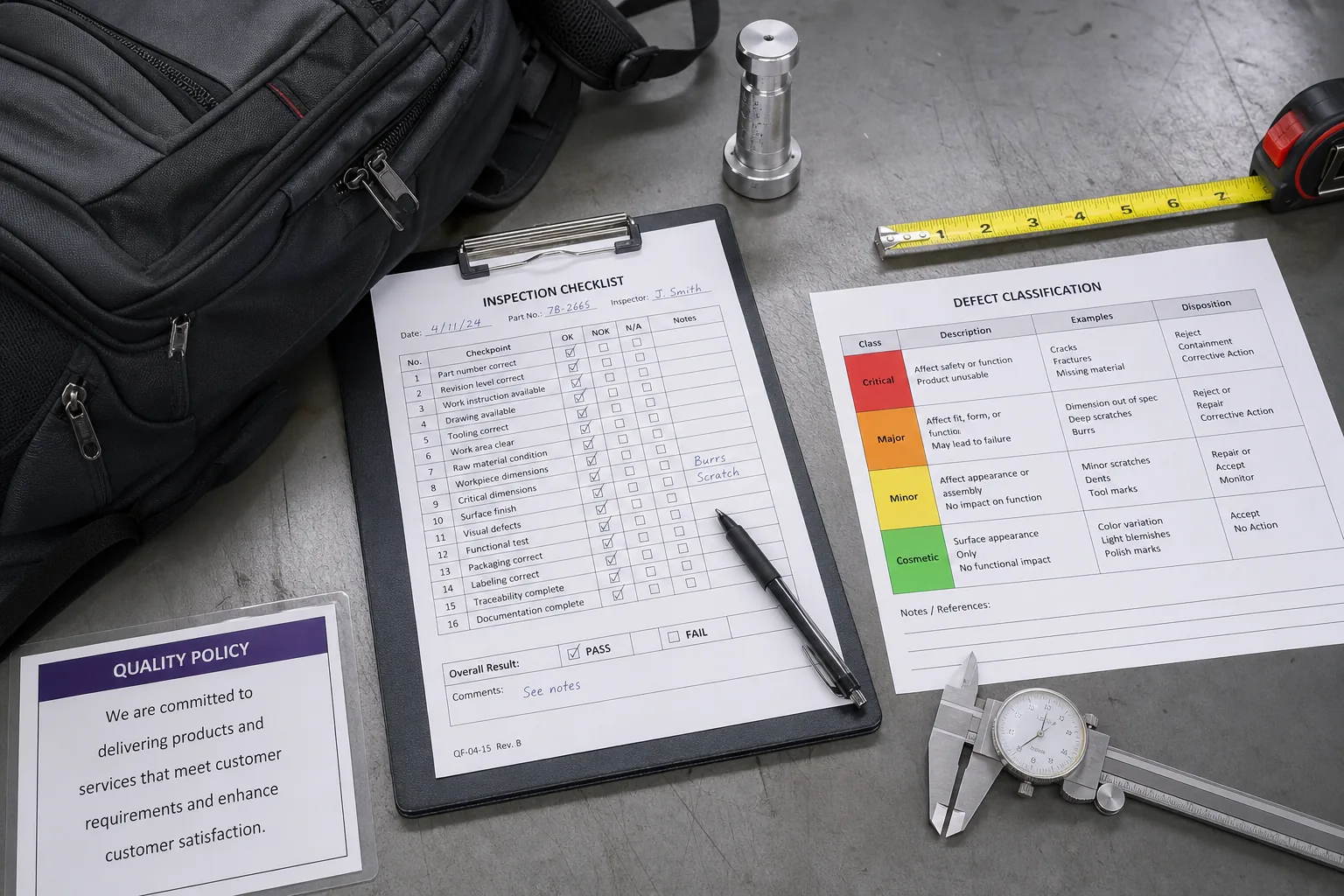
Inspection checklist and defect classification sheets at the QC table
The Inspection Stages
Stage
Timing
Purpose
Incoming material
Before cutting
Material conformity
First article
Line start
Method verification
In-line
During sewing
Early defect detection
End-of-line
After assembly
Function verification
Pre-shipment
Finished, packed
Final acceptance
Container loading
At loading
Quantity and condition
The Stage Comparison Table
Stage
Sample
Typical check
Incoming
Per fabric lot
Width, weight, shade, defects
First article
1–3 units
Full specification
In-line
Per station, hourly
Critical dimensions, stitching
End-of-line
100% or high sample
Function, hardware
Pre-shipment
AQL per level II
Full classification
Loading
Observation
Quantity, cartons, seals
The Incoming Material Checks
Material
Checks
Fabric
Shade, width, weight, defect grading
Webbing
Width, strength certificate
Zipper
Length, smoothness, brand
Foam
Density, thickness
Hardware
Dimensions, color, function
Lining
Shade, weight
The First Article Checks
Check
Requirement
Dimensions
All critical measurements
Construction
Method as specified
Materials
Correct components
Hardware
Correct type and color
Stitching
Density, alignment
Reinforcement
Present at all load points
Workmanship
Clean finish
The In-Line Check Frequency
Product stage
Frequency
Simple styles
Every 2 hours
Complex styles
Hourly
First production lot
Every 30 minutes
Resumed after a change
Immediately
The Pre-Shipment Focus
Focus area
Detail
Quantity
Cartons complete and correct
Assortment
Colors and sizes per order
Function
Zippers, straps, hardware
Workmanship
Stitching, edges, trim
Marking
Labels, tags, carton marks
Packing
Fold method, protection
The Stage Cost-Benefit Table
Stage
Cost
Defect detection value
Incoming
Low
Very high, cheap correction
First article
Very low
Very high, prevents whole-lot error
In-line
Low
High, catches drift
End-of-line
Moderate
Moderate, fixable
Pre-shipment
Moderate
Low, too late to fix
Customer
Highest
Worst possible
The economics are inverted from common practice. Detection is cheapest exactly where it is least often applied — at the material stage and the first article — and most expensive where inspection is most common.
The Inspection Plan Template
Item
Specification
Stage
Pre-shipment
Standard
ISO 2859-1
Level
General II
Critical AQL
0.0
Major AQL
2.5
Minor AQL
4.0
Lot size
Per style and color
Inspector
Third party, independent
Location
Factory finished goods area
Report deadline
24 hours after inspection
Executing an Inspection
Execution quality determines whether the AQL result means anything. An inspection can be technically correct and practically useless.
The Inspection Sequence
Step
Action
1
Confirm lot identity and quantity
2
Confirm order specification available
3
Pull a random sample
4
Inspect against the checklist
5
Measure critical dimensions
6
Test functions
7
Record defects by class
8
Photograph representative defects
9
Compare counts against acceptance
10
Issue the report
The Inspection Environment
Requirement
Standard
Lighting
Even, 500 lux minimum
Distance
40–60 cm viewing
Time per unit
Sufficient for full check
Table
Clean, adequate size
Tools
Tape, gauge, checklist
Interruption
None during counting
The Functional Tests
Test
Method
Zipper run
Open and close fully twice
Strap adjustment
Move through full range
Buckle engagement
Open, close, load
Handle load
Lift with rated weight
Anchor tug
Firm manual pull
Seam inspection
Visual plus tug at stress points
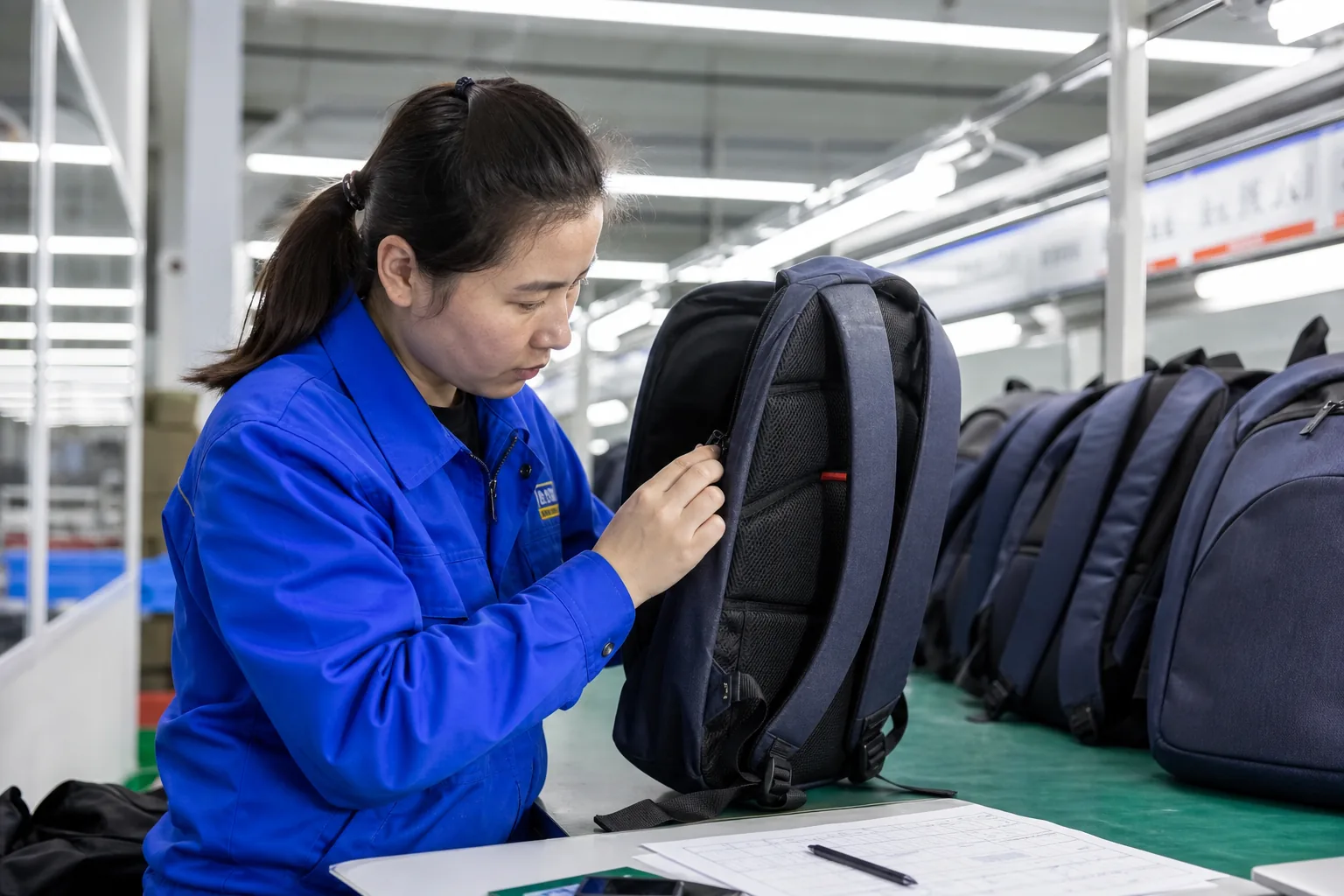
Close-up inspection of zipper and seam quality
The Common Execution Failures
Failure
Effect
Sample pre-selected
Biased result
Insufficient lighting
Undetected defects
Rushed timing
Missed checks
No specification on hand
Judgement drift
Defects not photographed
Disputes unresolvable
Counts recorded loosely
Unverifiable report
The Workmanship Standard Reference
Area
Standard
Stitch density
Per specification
Seam straightness
Visible deviation counted
Edge finish
No fraying over 3 mm
Thread ends
Trimmed under 10 mm
Symmetry
Within tolerance
Cleanliness
No marks or dust
The Measurement Discipline
Rule
Reason
Same method each time
Comparability
Measure flat and relaxed
Avoid distortion
Record actual values
Traceability
Note out-of-tolerance units
Dispute evidence
Keep the measuring tools calibrated
Reliability
The Inspector Independence Question
Option
Character
Factory QC
Fast, less independent
Buyer’s own QC
Good, requires presence
Third-party agency
Independent, adds cost
Retailer audit
Selling requirement
Hybrid
Factory QC plus third-party audit
Factory note: A pre-shipment inspection is a verification step, not a production control. When a lot fails at the pre-shipment stage, the cause was created days earlier and the correction cost is at its highest. Factories that inspect incoming materials and first articles reject far fewer lots at the end.
Handling Rejection and Corrective Action
A failed inspection is not the end of the process. It is the start of a defined corrective sequence.
The Rejection Outcomes
Result
Action
Pass
Ship as scheduled
Pass with observations
Ship, note minor items
Fail on minor
Discuss, may ship with concession
Fail on major
Rework and re-inspect
Fail on critical
Reject, no concession
The Concession Option
Aspect
Consideration
When allowed
Minor or cosmetic only
Price adjustment
Common for accepted deviation
Written record
Required
Customer notification
Required where relevant
Future prevention
Process correction still needed
The Corrective Action Sequence
Step
Action
1
Identify the defect class and quantity
2
Find the station or material source
3
Determine the root cause
4
Correct the process, not the units only
5
Train or adjust the method
6
Re-inspect the corrected lot
7
Record the change in the standard
8
Verify on the next lot
The Root Cause Table
Symptom
Likely cause
Zipper drag on many units
Zipper batch or setting
Skipped stitches
Needle or tension
Dimension drift
Pattern or cutting
Shade variation
Fabric lot mixing
Weak anchor
Missing reinforcement
Loose threads widespread
Trimming step skipped
The Rework Risk Table
Rework type
Risk
Re-stitching over a seam
Needle holes weaken fabric
Replacing a zipper
Panel damage possible
Replacing hardware
Hole enlargement
Trimming threads
Cutting fabric
Cleaning marks
Color damage
The Re-inspection Rules
Rule
Reason
Re-inspect the whole lot
Rework may affect all units
Same AQL and level
Comparability
Same inspector where possible
Consistency
Photograph rework
Evidence
Count rework hours
Cost accountability
The Prevention Table
Prevention
Effect
Material inspection
Removes incoming defects
First article approval
Prevents whole-lot error
In-line checks
Catches drift early
Visual standards displayed
Aligns judgement
Operator self-check
Immediate detection
Skill matrix and training
Reduces skill variance
Factory note: Correcting units without correcting the process guarantees the same failure on the next lot. A corrective action report should state what changed in the method, the material specification, or the training — and the next inspection is the proof that the change worked.
Reports and Documentation
An inspection without documentation cannot support a claim, a decision, or an improvement.
QC inspection report being completed at the packing station
The Report Contents
Section
Detail
Order reference
PO number and style
Lot identification
Style, color, quantity
Inspection details
Date, location, level, AQL
Sample size
Units inspected
Defect counts
By class
Acceptance values
From the tables
Result
Pass or fail
Photographs
Representative and worst cases
Measurements
Actual against tolerance
Remarks
Observations and risks
The Defect Count Table Format
Defect class
Found
Accept
Reject
Result
Critical
0
0
1
Pass
Major
4
7
8
Pass
Minor
9
10
11
Pass
The Photograph Standard
Requirement
Detail
Reference unit
One clean unit per lot
Defect detail
Close-up with scale
Full view
Overall condition
Carton condition
Where relevant
Packing method
Fold and protection
Labelling
Visible and legible
The Documentation Package
Document
Purpose
Inspection report
Acceptance evidence
Defect photo set
Visual record
Measurement sheet
Dimension evidence
Concession agreement
Accepted deviation
Corrective action report
Process improvement
Re-inspection record
Verification
The Retention Rules
Record
Retention
Inspection reports
12–24 months
Defect photographs
12 months
Approved samples
Program lifetime plus
Corrective actions
Program lifetime
Measurement sheets
12 months
The Access Question
Access level
Typical arrangement
Buyer sees full report
Standard
Factory sees the same report
Recommended
Inspector independent
Required for credibility
Retailer audit access
As required by contract
The Report Discipline Table
Practice
Why it matters
Issue within 24 hours
Supports decisions
Consistent format
Comparability
Include both passes and failures
Statistical value
State the acceptance basis
Dispute protection
Sign and timestamp
Accountability
Using AQL Data for Supplier Management
AQL inspection is most valuable as a trend instrument. Single results decide a shipment; trends decide a supplier relationship.
The Supplier Quality Metrics
Metric
Definition
Lot rejection rate
Rejected lots over lots inspected
Major defect rate
Major defects over units inspected
Critical defect count
Absolute, should be zero
Repeat defect rate
Same defect across lots
Corrective action closure
Closed over raised
Claim rate
Field claims over units shipped
The Performance Tiers
Tier
Lot rejection rate
Action
Preferred
Under 2%
Reduced inspection possible
Good
2–5%
Normal inspection
Watch
5–10%
Tightened inspection
Improvement required
Over 10%
Corrective action plan
At risk
Repeated critical
Sourcing review
The Trend Analysis Table
Period
Lots
Rejected
Rate
Trend
Q1
24
1
4.2%
Baseline
Q2
30
3
10.0%
Worsening
Q3
28
1
3.6%
Improved
Q4
32
0
0.0%
Stable
The Defect Pareto
Defect
Frequency
Share
Loose thread
42
34%
Zipper function
21
17%
Stitch irregularity
18
15%
Dimension drift
14
11%
Hardware
12
10%
Other
16
13%
The Improvement Priorities
Priority
Action
1
Address the top Pareto defect
2
Standardize the visual criteria
3
Train at the source station
4
Verify with the next two lots
5
Move to the next Pareto item
The Buyer-Factory Meeting Rhythm
Frequency
Content
Per lot
Inspection result and actions
Monthly
Defect trends and top causes
Quarterly
Performance review and targets
Annually
Standard review and level changes
The AQL Standard Review
Trigger
Review
Sustained strong performance
Consider reduced inspection
Repeated failures
Tighten and investigate
New style launched
Confirm classification
Market complaint
Revisit the defect list
Regulatory change
Update critical criteria
The Shared Improvement Table
Joint action
Benefit
Aligned defect standards
Fewer disputes
Shared photographs
Common reference
Joint corrective actions
Faster closure
Regular reviews
Earlier detection
Agreed targets
Clear direction
The Contract Clauses Worth Fixing Early
Clause
Why
Defect classification list
Prevents argument
AQL values by class
Defines acceptance
Inspection level
Defines sample size
Re-inspection cost responsibility
Motivates prevention
Rework deadline
Protects the schedule
Concession process
Handles minor deviation
Record retention
Supports claims
Factory note: Suppliers perform better when the standard is stable and the feedback is prompt. A classification list that changes with each order, or a defect report that arrives a month after shipment, removes any chance of learning — and the same defects reappear on the next order.
The AQL Checklist for Buyers
A short checklist that prevents most inspection disputes before they occur.
Before the Order
Item
Done
Defect classification list agreed
☐
AQL values set by class
☐
Inspection level confirmed
☐
Inspection stages agreed
☐
Inspector or agency appointed
☐
Re-inspection cost clause written
☐
Reporting deadline defined
☐
During Production
Item
Done
Incoming material report received
☐
First article approved in writing
☐
In-line check records shared
☐
Workmanship standard displayed
☐
Defect trends communicated
☐
Before Shipment
Item
Done
Quantity and assortment confirmed
☐
Random sample pulled by inspector
☐
Defects counted by class
☐
Acceptance values applied correctly
☐
Photographs included
☐
Report issued within 24 hours
☐
Corrective action raised if failed
☐
After Shipment
Item
Done
Inspection results logged
☐
Defect Pareto updated
☐
Supplier tier reviewed
☐
Standard revised if needed
☐
The Five Rules
Rule
Reason
Agree the standard before production
Removes argument
Inspect early stages
Correction is cheapest there
Control the sample
Bias destroys the data
Classify by user effect
Keeps the standard meaningful
Track trends, not just lots
Improvement requires history
FAQ
What AQL is normally used for backpack inspections?
Most backpack orders use critical 0.0, major 1.5 or 2.5, and minor 4.0 at General Inspection Level II. Critical defects have zero tolerance because they involve safety or legal compliance; major defects affect function or saleability; minor defects are cosmetic.
How many backpacks are inspected in an AQL check?
It depends on lot size and inspection level. At General Level II, a lot of 501–1,200 units uses a sample of 80, a lot of 1,201–3,200 uses 125, and a lot of 3,201–10,000 uses 200. Raising the level to III roughly doubles those sample sizes.
What is the difference between AQL 1.5 and AQL 2.5?
The AQL value sets the acceptance count. In a 200-unit sample, AQL 1.5 accepts up to 5 major defects and rejects at 6, while AQL 2.5 accepts up to 10 and rejects at 11. AQL 1.5 is stricter and produces more rejections at the same quality level.
Can a factory pass an AQL inspection with defects present?
Yes. AQL is an acceptance level, not a zero-defect requirement. A lot passes if the number of defects found in the sample is at or below the acceptance count for its class. This is why the classification list matters as much as the AQL number — it decides what gets counted.
Should a backpack order use 100% inspection instead of AQL?
Full inspection costs substantially more and still misses defects, because attention is not perfectly reliable. AQL inspection combined with in-line and first-article checks usually delivers better value. Full inspection is justified for very high-value styles, safety-critical products, or rebuilding trust after repeated failures.
When should a pre-shipment inspection be scheduled?
When the order is 100% packed and at least 80% of cartons are sealed, so the sample represents the finished goods. Inspecting before packing is complete leaves later production unverified, and moving finished goods after inspection weakens the verification.
Who should pay for a failed inspection and re-inspection?
The most common arrangement is that the buyer pays for the initial inspection and the factory bears the cost of re-inspection caused by a failure. This clause is worth writing into the purchase order, because it gives the factory a direct financial reason to prevent defects rather than to argue about them.
How is a defect classified as major rather than minor?
By its effect on the user. If the defect prevents normal use, breaks function, or makes the product unsellable, it is major — even when the physical cause looks small, such as a stitch adjustment that makes a zipper drag. Minor defects are cosmetic only and do not affect use or sale.
Conclusion
AQL turns quality from an argument into a measurement. It defines how many units to check, what counts as a defect, and how many defects are acceptable before a lot is rejected.
For buyers, the working rules are practical. Agree the defect classification, AQL values, and inspection level in writing before production. Inspect materials and the first article, where correction is cheapest, rather than relying on a pre-shipment check alone.
Require a randomly pulled sample rather than one selected by the factory. Read the acceptance counts correctly, and treat critical defects as absolute. Then use the results as a trend instrument — rejection rate, defect Pareto, corrective action closure — so the relationship improves instead of repeating the same failures.
For factories, the same facts build commercial advantage. A plant that inspects incoming materials, approves first articles, monitors in-line drift, and closes corrective actions with changes to the process will pass AQL inspections more often, ship on schedule, and earn the reduced-inspection tier that lowers cost for both sides.
Quality control that happens early is the cheapest cost in production; quality control that happens at the container door is the most expensive.