Recycled Fabrics for Backpacks: rPET, GRS and Performance
Recycled Fabrics for Backpacks: rPET, GRS and Performance
Recycled polyester has moved from a niche claim to a standard requirement. Retailers ask for it, tenders score it, and end customers increasingly check for it. For a backpack manufacturer, the question is no longer whether to offer recycled fabrics, but how to specify them so the claims hold up and the bag still performs.
The risk is not that recycled fabric fails. Well-made rPET performs close to virgin polyester in most backpack applications. The risk is unverified claims — a fabric described as recycled without the documentation to prove it, in a market where regulators now look closely at environmental marketing.
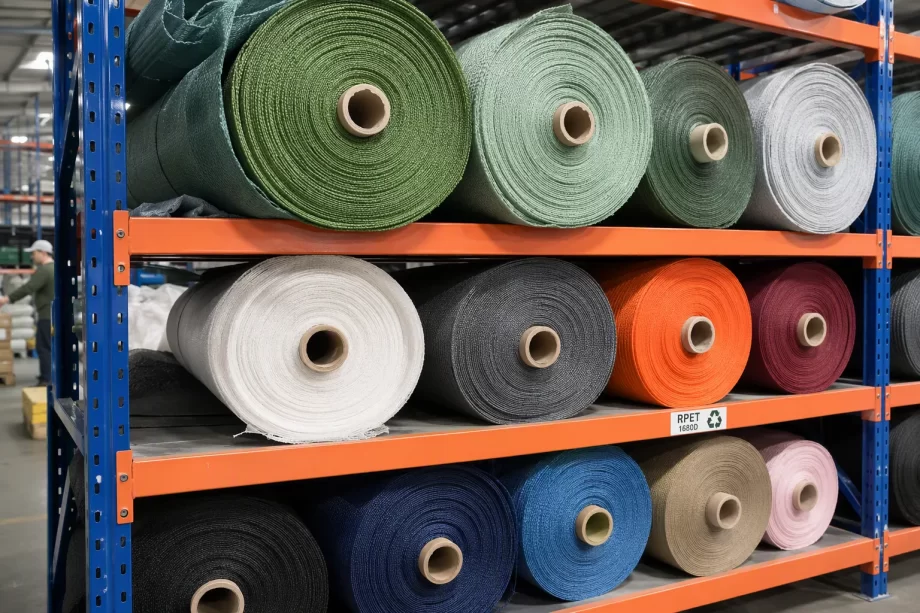
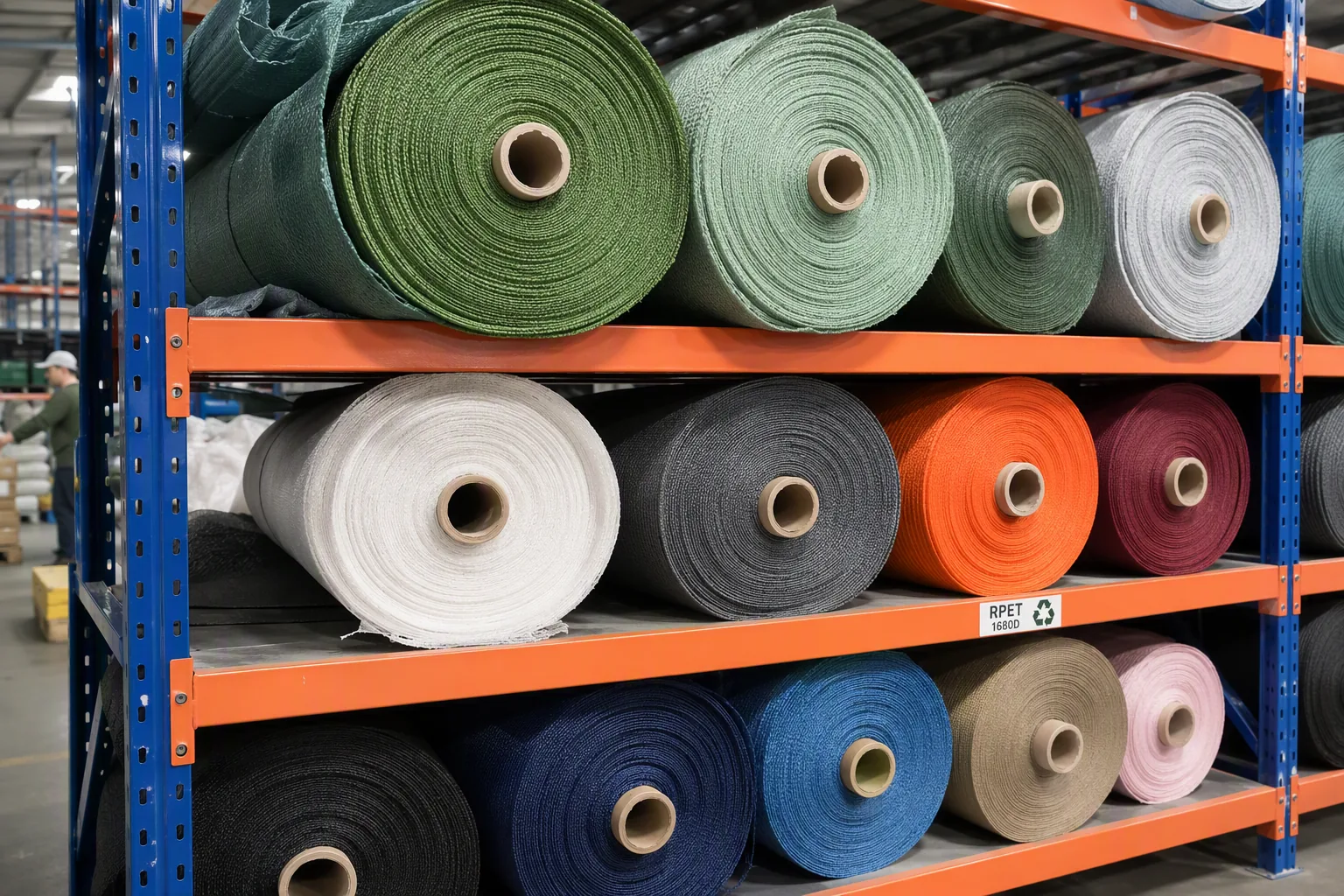
Rolls of recycled PET fabric in a bag factory
This guide covers the recycled fabric landscape in backpack production: how rPET is made, what certifications actually require, how performance compares with virgin material, how to specify and source it, and how to keep the claim defensible from the mill to the shipping carton.
Recycled content has become a commercial requirement rather than a differentiator. Understanding the drivers prevents both over-investment and under-preparedness.
The Demand Drivers
Driver
Typical requirement
Retailer sustainability programs
Minimum recycled content
Tender and bid scoring
Documented recycled percentage
Brand environmental commitments
Public targets
Consumer preference
Visible claim on the product
Regulation
Green claims substantiation
Corporate procurement
Supplier ESG criteria
The Business Case
Factor
Effect
Access to retail programs
Opens doors otherwise closed
Price positioning
Supports a premium
Marketing narrative
Story behind the product
Risk management
Pre-empts regulation
Supplier differentiation
Competitive advantage
The Cost Reality
Factor
Recycled vs virgin
Fabric cost
Often a parity or small premium
Certification cost
Adds a transaction cost
Documentation burden
Adds administrative work
Testing requirements
Adds laboratory cost
Minimum order quantity
Often higher
Lead time
Sometimes longer
The Claim Spectrum
Claim
Strength
“Made with recycled materials”
Weak without percentage
“Contains 50% recycled content”
Specific
“GRS certified recycled”
Verified
“100% recycled polyester”
Strong if documented
“Ocean-bound plastic”
Specific, requires proof
The Audience Map
Audience
What they check
Retail buyer
Certificate and percentage
Compliance team
Claim substantiation
End consumer
Label and brand story
Regulator
Evidence of the claim
Auditor
Chain of custody documents
The Risk Table
Risk
Consequence
Unverified recycled claim
Regulatory action
Certificate mismatch
Retail rejection
Wrong percentage stated
Greenwashing finding
No traceability
Claim withdrawn
Supplier cannot document
Program failure
Factory note: In most markets the claim itself is now regulated. A backpack labelled as 50% recycled content must be able to show, on demand, where that 50% came from and which certificate covers it. Factories that build the document trail from the start avoid expensive retrofits when a retail compliance team asks for evidence.
How Recycled Polyester Is Made
Knowing the production route explains why rPET performs as it does and where variation enters.
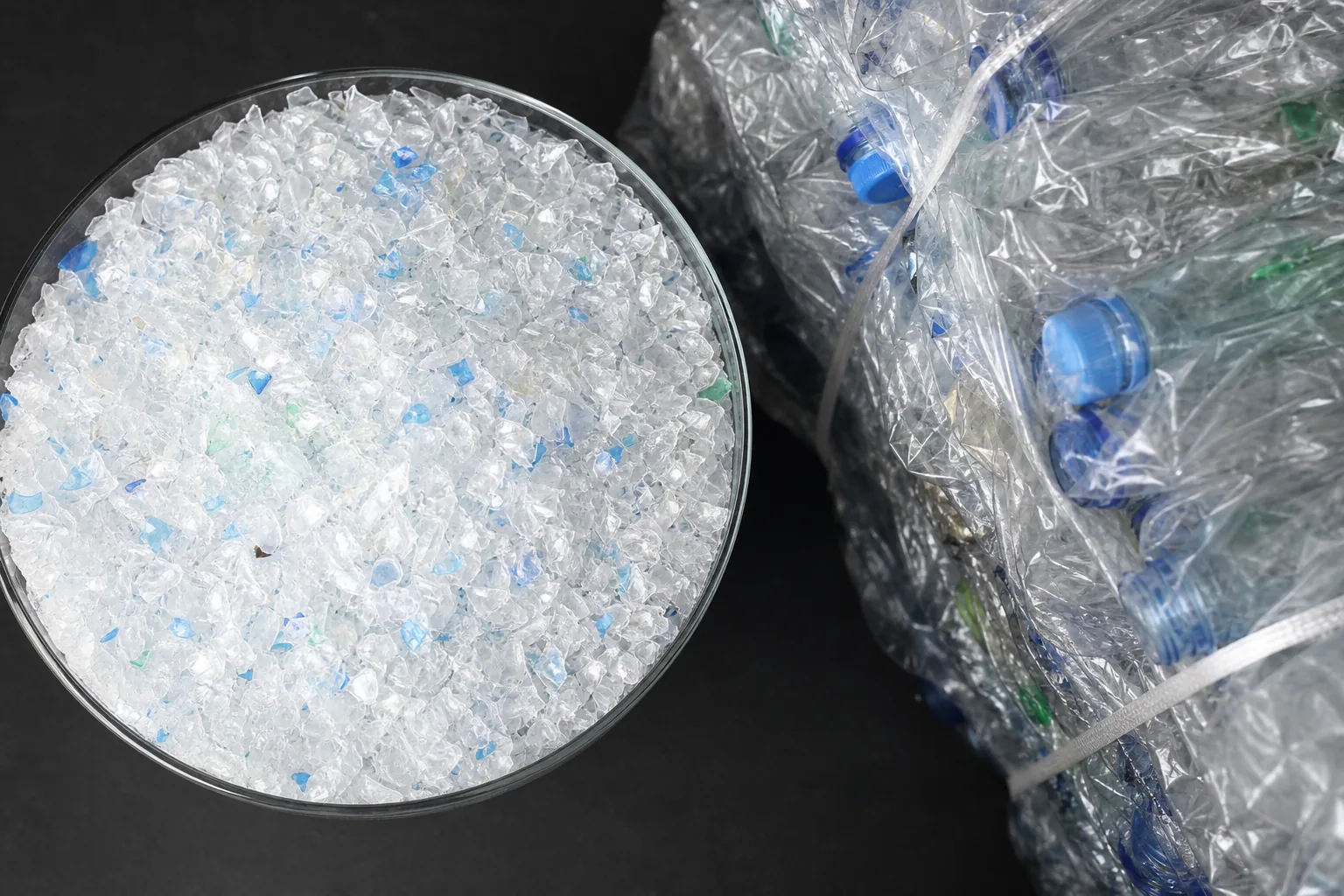
Recycled PET flakes and collected plastic bottles
The Feedstock Types
Source
Description
Post-consumer bottles
Most common, well established
Post-industrial waste
Factory scrap, clean stream
Ocean-bound plastic
Collected near coastlines
Textile-to-textile
Garment waste, newer
Mixed plastic waste
Lower grade, limited use
The Production Steps
Step
Process
1
Collection and sorting
2
Washing and label removal
3
Shredding into flakes
4
Melting and extrusion
5
Pelletising into chips
6
Melt spinning into filament
7
Drawing and texturing
8
Weaving or knitting into fabric
The Mechanical vs Chemical Route
Route
Process
Character
Mechanical
Melt and re-extrude
Most common, cost effective
Chemical
Depolymerise to monomers
Higher quality, higher cost
Hybrid
Combined streams
Varies
The Quality Factors
Factor
Effect on fabric
Feedstock cleanliness
Fewer defects
Sorting accuracy
Color consistency
Polymer chain length
Strength
Additive package
Durability, UV resistance
Spinning parameters
Evenness, tenacity
The Recycled Content Calculation
Method
Basis
Mass balance
Allocated across output
Physical segregation
Segregated batch
Book and claim
Certificate-based
Site-level
Averaged across facility
The Common Feedstock Percentages
Product
Typical recycled content
rPET 600D fabric
100% recycled yarn possible
Blended woven fabric
30–70%
Lining fabric
100% common
Webbing
50–100%
Mesh
Variable
The Fiber Property Table
Property
Recycled PET
Virgin PET
Tensile strength
Comparable
Reference
Abrasion resistance
Comparable
Reference
Color consistency
Slightly more variable
Reference
UV stability
Depends on additives
Reference
Dyeability
Good
Good
Cost
Parity to small premium
Reference
The Certification Landscape
Certification is what turns an unverified claim into a defensible one. Each scheme answers a different question.
The Main Schemes
Scheme
What it verifies
GRS
Recycled content plus social and environmental
RCS
Recycled content only
RCS Blended
Blended recycled content
OEKO-TEX
Restricted substances
bluesign
Chemical management in production
SCS Recycled
Recycled content verification
ISCC PLUS
Mass balance for bio and circular
The Scheme Comparison
Scheme
Content verified
Social criteria
Environmental criteria
GRS
Yes
Yes
Yes
RCS
Yes
No
No
OEKO-TEX
No
No
Chemical only
bluesign
No
No
Chemical and process
ISCC PLUS
Mass balance
No
Sustainability criteria
What GRS Requires
Element
Requirement
Recycled input
Minimum 20% recycled content
Chain of custody
Tracked from recycler to product
Social criteria
Worker standards
Environmental criteria
Wastewater, chemicals, energy
Chemical restrictions
Restricted substance list
Label grading
Logo plus percentage
The GRS Grading Table
Content
Label
95% or more recycled
GRS logo with percentage
20–94% recycled
GRS logo with percentage
Under 20%
GRS mark not permitted
The Certification Scope Question
Question
Why it matters
Which facility is certified
Certificate is site specific
Which process is covered
Not all products qualify
What is the validity date
Expired is unusable
Is the certificate transferable
Verified in database
Does it cover your fabric style
Scope match
The Document Chain
Stage
Document
Recycler
Recycled input declaration
Fiber producer
Certificate with transaction
Yarn spinner
Transaction certificate
Mill
Fabric certificate with content
Factory
Final product documentation
The Transaction Certificate
Detail
Content
Issued by
Certification body
Links
Seller to buyer
States
Product and recycled percentage
Quantity
Matches the shipment
Validity
Per transaction
The Verification Steps
Step
Method
Check the certificate number
Certification body database
Confirm the company name
Matches legal entity
Confirm the product scope
Fabric type covered
Confirm the dates
Current
Request the transaction certificate
Not only the logo
Check the content percentage
Matches the claim
Factory note: A certificate on the wall proves the factory can produce recycled goods; a transaction certificate proves that a specific shipment contains a specific percentage. Buyers who need a defensible claim should ask for the transaction certificate, because that is the document that ties the claim to the actual order.
Performance: How Recycled Fabric Compares
The performance question should be answered with test data rather than assumption. Modern rPET is close to virgin polyester in most backpack uses.
Tensile strength testing of woven recycled fabric in a textile lab
The Performance Comparison
Property
Recycled PET
Virgin PET
Difference
Tensile strength
Comparable
Reference
Minimal
Tear strength
Comparable
Reference
Minimal
Abrasion cycles
Comparable
Reference
Minimal
Color consistency
Slightly variable
Reference
Noticeable
Shrinkage
Comparable
Reference
Minimal
Hand feel
Comparable
Reference
Minimal
UV resistance
Additive dependent
Reference
Depends on spec
The Test Methods
Test
Method
Tensile strength
Strip method
Tear strength
Tongue tear method
Abrasion
Martindale cycles
Colorfastness to rubbing
Crockmeter
Colorfastness to light
Xenon arc
Water repellency
Spray rating
Hydrostatic head
Pressure test
Seam strength
Grab tensile
The Typical Test Values Table
Property
Typical requirement
Tensile warp
800 N or higher
Tensile weft
600 N or higher
Tear warp
40 N or higher
Abrasion
20,000 cycles minimum
Crocking dry
Grade 4 or better
Light fastness
Grade 4 or better
Water repellency
Grade 4 spray
The Variation Sources
Source
Effect
Feedstock mix
Strength variance
Color sorting
Shade variation
Spinning parameters
Evenness
Coating quality
Water resistance
Dyeing method
Color consistency
The Batch Consistency Rules
Rule
Reason
Approve a bulk sample
Verify the actual lot
Test each lot for color
Catch shade drift
Keep retention samples
Dispute evidence
Specify tolerances in writing
Remove ambiguity
Test the first bulk lot fully
Confirm performance claim
The Reliability Improvement Table
Practice
Effect
Long-term mill relationship
Consistent feedstock
Fixed yarn specification
Stable performance
Color approval per lot
Shade control
Regular testing schedule
Early detection
Documented spec sheet
Repeatable orders
Recycled Fabric Types for Backpacks
The recycled option exists across most backpack fabric categories, but availability and performance vary by type.
The Fabric Options
Fabric type
Typical use
Recycled availability
600D polyester
Main body
Common
300D polyester
Lining, light bodies
Common
210D ripstop
Lining, accents
Common
900D–1680D
Heavy duty base
Available
Cordura-style nylon
Premium durability
Available
Mesh
Pockets, back panels
Common
Webbing
Straps, trim
Common
Canvas
Casual styles
Available
The Fabric Specification Table
Spec
Typical value
Denier
600D
Recycled content
100% or blended
Coating
PU or PVC-free
Water repellency
DWR
Weight
220–260 g per square meter
Width
150 cm
Certification
GRS with transaction certificate
The Coating Question
Coating
Character
PU coating
Flexible, common
PU back coating
Better durability
PVC
Avoid, restricted
TPU
Recyclable-friendly option
DWR finish
Water repellency, PFC-free preferred
The Trims Question
Trim
Recycled option
Webbing
Recycled polyester available
Zipper tape
Recycled options emerging
Binding tape
Available
Thread
Recycled polyester available
Plastic hardware
Recycled options limited
Foam
Recycled content limited
The Content Consistency Table
Approach
Consistency
All main fabric recycled
Strong claim
Main fabric plus lining
Stronger claim
Full trim recycled
Difficult, few suppliers
Selective components
Verify the calculation
The Content Calculation Rule
A product claim must reflect the actual percentage across the product. Mixing a 100% recycled main body with virgin lining and virgin webbing produces a lower whole-product figure than the fabric claim suggests. Buyers should state whether the percentage refers to the main fabric or the complete bag.
Design and Construction Considerations
Recycled fabric is used like its virgin equivalent in most respects. Three areas need specific attention.
The Attention Areas
Area
Consideration
Color consistency
Approve per lot
Coating adhesion
Verify with the mill
Heat sensitivity
Test before heat processes
Seam behaviour
Test seam strength
Adhesive compatibility
Confirm with supplier
The Construction Adjustments
Process
Adjustment
Cutting
Standard method applies
Sewing
Standard needles and thread
Heat pressing
Verify temperature range
Welding
Test material response
Seam sealing
Confirm tape adhesion
Bar-tacking
Standard settings
The Heat Process Check
Process
Test before production
Heat transfer logo
Yes
Ultrasonic welding
Yes
Hot air seam sealing
Yes
Heat press lamination
Yes
Screen printing
Yes
The Construction Comparison Table
Element
Recycled fabric
Virgin fabric
Cutting
Same
Same
Stitching
Same
Same
Reinforcement
Same
Same
Heat processes
Verify
Reference
Edge finishing
Same
Same
Cleaning
Same
Same
The Color Management Table
Control
Method
Master standard
Physical swatch
Light source
Defined viewing condition
Tolerances
Written range
Approval authority
Named person
Per-lot record
Retained samples
The Logo Application
Method
Consideration
Woven label
Straightforward
Heat transfer
Verify temperature
Embroidered patch
Straightforward
Screen print
Ink adhesion test
Metal plate
Rivet or screw fixing
Factory note: Recycled fabric behaves like polyester in the sewing room. The two places that need verification are heat processes — transfers, welding, sealing — and color approval per lot. Factories that test these two areas before bulk production avoid nearly all recycled-fabric surprises.
Sourcing Recycled Fabrics
Sourcing looks similar to conventional fabric buying, with additional documentation requirements.
The Sourcing Criteria
Criterion
Requirement
Recycled percentage
Stated and verifiable
Certification
GRS or RCS with transaction certificate
Performance spec
Full physical test data
Color range
Availability per colorway
Minimum order
Per color, per style
Lead time
Including certificate issuance
Price
Including certification cost
The Mill Vetting Questions
Question
Purpose
What is the exact recycled percentage
Claim accuracy
Which certification applies
Scheme match
Can you issue transaction certificates
Claim chain
Which recycler supplies the flake
Traceability
What is the color consistency record
Quality risk
What tests are standard
Performance confidence
What is the MOQ per color
Planning
The Cost Structure
Cost element
Note
Fabric base price
Often parity with virgin
Certification premium
Varies by mill
Transaction certificate
Per shipment
Testing
Per lot or per season
MOQ premium
Higher for small runs
Documentation labour
Administrative
The Lead Time Table
Stage
Typical duration
Sample yardage
1–2 weeks
Bulk fabric order
4–8 weeks
Certificate issuance
Days after shipment
Testing
1–2 weeks
Total procurement
6–12 weeks
The Supplier Comparison Table
Factor
Check
Certification status
Valid and in scope
Recycled percentage
Documented
Transaction certificate capability
Confirmed
Performance data
Available
Color range
Adequate
MOQ
Workable
Lead time
Fits schedule
The Order Documentation Pack
Document
Purpose
Purchase order
Specified percentage
Mill certificate
Content and performance
Transaction certificate
Shipment linkage
Test report
Performance verification
Retention sample
Color reference
The Contract Clauses
Clause
Purpose
Recycled percentage specified
Defines the deliverable
Certification requirement
Sets the standard
Documentation delivery
Makes the claim possible
Testing responsibility
Limits disputes
Claim substantiation support
Protects the brand
Change notification
Prevents silent substitution
Factory note: Recycled fabric substitutions happen quietly. A mill short of certified feedstock may ship conventional fabric in the same construction, which sews identically but cannot be documented. The clause that protects the claim is a requirement for the transaction certificate to match the delivered quantity before payment.
Claims, Labelling and Compliance
Recycled content claims are regulated in most major markets. The wording on the label must match the evidence in the file.
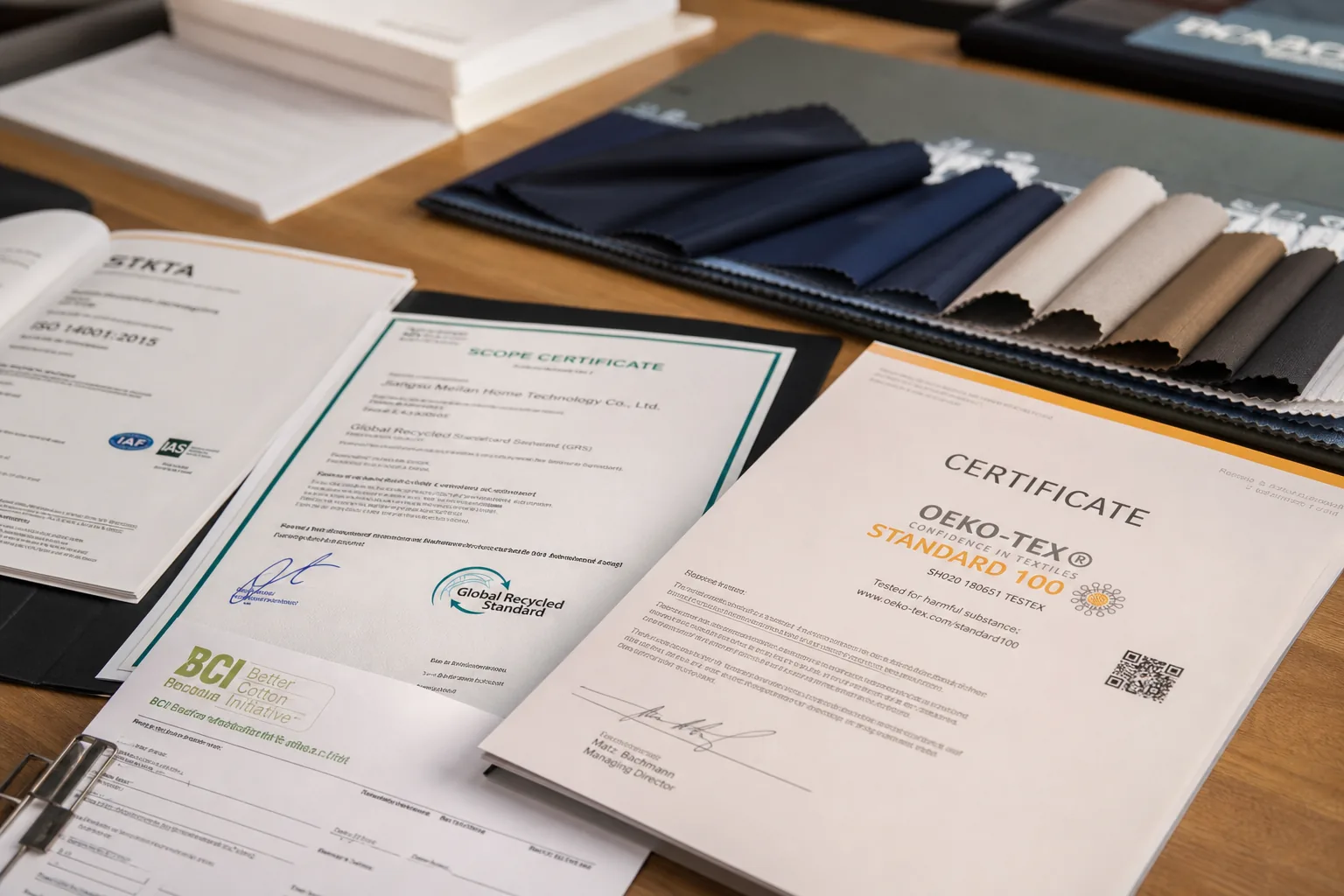
Sustainability certification documents and recycled content certificates
The Regulatory Landscape
Market
Framework
EU
Green claims directive and consumer protection rules
Factory note: The safest claim is the narrowest one that is fully documented. “Main body fabric 100% GRS certified recycled polyester” can be defended with a transaction certificate. “Sustainable backpack” cannot be defended with anything, and it invites scrutiny that a precise claim would never attract.
Traceability and Chain of Custody
Traceability is the mechanism that connects a claim on a label to a bale of collected plastic. Without it, the claim is an assertion.
The Chain of Custody
Stage
Document
Collection
Recycler input record
Flake production
Output declaration
Fiber production
Certificate with transaction
Yarn
Transaction certificate
Weaving
Fabric certificate
Dyeing and finishing
Process record
Factory
Product documentation
Brand
Final claim evidence
The Custody Models
Model
How it works
Physical segregation
Recycled material kept separate
Mass balance
Volume accounting across output
Certificate trading
Book and claim method
The Model Comparison
Model
Traceability strength
Practicality
Segregation
Strongest
Requires dedicated production
Mass balance
Strong
Widely used
Book and claim
Moderate
Flexible, less direct
The Traceability Requirements Table
Requirement
Purpose
Batch identification
Link order to certificate
Quantity matching
Verify delivered volume
Document retention
Support audits
Supplier declarations
Confirm content
Periodic verification
Confirm system integrity
The Audit Trail Test
Question
What it proves
Can you show the certificate for this lot
Chain exists
Does the quantity match
No substitution
Does the date align
No reuse of old documents
Does the scope cover this fabric
Applicability
Can the mill confirm
Independent verification
The Documentation Discipline
Practice
Reason
File per order
Retrievable
Digital plus physical
Backup
Named owner
Accountability
Retention period set
Claim window
Reviewed annually
Currency
The Weak Points
Weak point
Risk
Sub-supplier not certified
Chain break
Blended yarns unverified
Percentage error
Certificate issued after payment
Pressure to ship
Documentation handled informally
Loss of evidence
Multiple mills in one order
Mixed content
The Verification Options
Option
Method
Document review
Certificate check
On-site visit
Factory and mill
Third-party audit
Independent verification
Laboratory test
Fiber composition analysis
Combined
Strongest assurance
The Fiber Composition Test
Test
What it shows
Fiber identification
Synthetic content
Blend ratio
Percentage breakdown
Recycled marker analysis
Where available
Physical performance
Quality confirmation
Factory note: Traceability fails at the handover points, not inside the certified plants. The order that loses its certificate is usually the one where a broker supplied the yarn, or where two mills contributed to a single fabric order. Keeping the chain short is the cheapest way to keep the claim intact.
Communicating the Claim
The marketing value of recycled content depends on explaining it accurately. Overstatement creates legal risk; understatement wastes the investment.
The Message Structure
Level
Content
Product label
Percentage and scope
Hangtag
Material story
Website
Certification and process
Sales deck
Verified claim plus documentation
Press
Approved wording only
The Approved Wording Table
Audience
Suitable wording
Label
Main body 100% recycled polyester, GRS certified
Hangtag
Made with certified recycled materials
Website
Recycled content verified by an independent certification
Trade show
Documented recycled content, certificate available
Buyer meeting
Full documentation pack provided
The Prohibited Wording
Wording
Reason
100% eco-friendly
Unverifiable
Fully sustainable product
Unverifiable
Zero impact
False
Carbon neutral
Requires separate verification
Ocean plastic saved
Requires specific proof
The Consumer Question Table
Question
Honest answer
How much is recycled
The stated percentage in scope
Where does it come from
Bottles or industrial scrap
Is it certified
Name the scheme
Is performance reduced
Comparable in most properties
Can it be recycled again
Depends on construction and coating
The Story Elements
Element
Value
Feedstock source
Concrete origin
Certification scheme
Third-party credibility
Percentage
Specific and checkable
Performance data
Answers the durability question
Longevity argument
The strongest sustainability claim
The Longevity Angle
Argument
Strength
Recycled content
Good
Extended product life
Stronger
Repairability
Stronger
Verified content plus durability
Strongest combination
The Communication Risks
Risk
Mitigation
Marketing ahead of evidence
Publish after verification
Sales team overstating
Approved wording only
Different claims per channel
Single source of truth
Claim drift over seasons
Annual review
Supplier wording reused
Rewrite to your evidence
Factory note: Recycled content is a material fact, not a marketing slogan. Buyers who lead with the certification, the exact percentage, and the test data find that the claim becomes more persuasive, not less — because it is the only version that survives a compliance review.
Cost, Value and Program Design
Recycled fabric carries a small direct cost premium and a larger administrative one. Both should be planned rather than discovered.
The Cost Breakdown
Cost element
Relative impact
Fabric base
Low to moderate
Certification premium
Low
Transaction certificates
Low per order
Testing
Moderate per season
Administrative labour
Moderate
MOQ implications
Moderate at small volumes
Label and compliance review
Low
The Value Table
Value
Notes
Retail program access
Often decisive
Bid scoring advantage
Measurable
Premium positioning
Supports price
Risk reduction
Pre-empts regulation
Brand alignment
Marketing value
Supply chain modernisation
Process improvement
The Program Design Decisions
Decision
Options
Scope
Fabric only, or fabric plus lining
Certification
GRS or RCS
Percentage target
20%, 50%, 100%
Color range
Limited or full
Volume
Pilot or full program
Documentation
Standard or enhanced
The Phased Approach
Phase
Scope
1
Recycled lining in one style
2
Main body recycled in one collection
3
Recycled across fabric and lining
4
Trim expansion where available
5
Full documentation program
The Minimum Viable Program
Element
Minimum
Certified fabric
GRS or RCS
Transaction certificate
Per shipment
Physical test data
Per fabric
Color approval
Per lot
Claim review
Before publishing
Evidence file
Per order
The Return on Effort Table
Investment
Payback
Certification alignment
Retail access
Documentation system
Fewer claim disputes
Testing program
Fewer field failures
Label compliance review
Regulatory safety
Supplier development
Stable supply
Common Pitfalls and How to Avoid Them
Most recycled fabric problems are procedural rather than technical. Each has a known prevention.
The Pitfall Table
Pitfall
Prevention
Claim without certificate
Require transaction certificate
Percentage mismatch between label and fabric
Reconcile before printing
Scope ambiguity
Define fabric or whole-product basis
Certificate expired
Track expiry dates
Substitution by the mill
Certificate must match delivered quantity
Color inconsistency across lots
Per-lot approval
Heat process failure
Test before bulk
Higher MOQ than expected
Confirm before sampling
Longer lead time
Plan certificates into the schedule
Wording drift across channels
Single approved wording
The Prevention Checklist Table
Stage
Action
Specification
State percentage and scope
Purchase
Require certification and documents
Sampling
Verify performance and color
Bulk approval
Approve per lot
Production
Test heat processes
Labelling
Reconcile claim with evidence
Retention
File the evidence pack
The Risk Register
Risk
Likelihood
Impact
Documentation gap
Medium
High
Color variance
Medium
Medium
Cost premium above plan
Low
Medium
Lead time extension
Medium
Medium
Claim challenge
Low
High
The Escalation Triggers
Trigger
Action
Certificate missing at shipment
Hold payment
Percentage below specification
Reject or renegotiate
Color outside tolerance
Reject lot
Performance test failure
Investigate and re-test
The Buyer’s Recycled Fabric Checklist
A working checklist covering the full cycle from specification to claim defence.
Specification Stage
Item
Done
Recycled percentage defined
☐
Scope defined (fabric or whole product)
☐
Certification scheme selected
☐
Performance specification written
☐
Color tolerance defined
☐
Label wording drafted
☐
Sourcing Stage
Item
Done
Mill certification verified
☐
Transaction certificate capability confirmed
☐
Test data received
☐
Recycled percentage documented
☐
MOQ and lead time confirmed
☐
Cost impact modelled
☐
Production Stage
Item
Done
Bulk sample approved
☐
Color approved per lot
☐
Heat processes tested
☐
Seam strength verified
☐
Transaction certificate received
☐
Quantity reconciled
☐
Claim Stage
Item
Done
Label matches evidence
☐
Scope stated precisely
☐
Certification logo licensed
☐
Wording approved internally
☐
Evidence file complete
☐
Records retained
☐
The Eight Rules
Rule
Reason
Specify the percentage and the scope
Removes ambiguity
Require transaction certificates
Ties claim to shipment
Test heat processes before bulk
Prevents late failures
Approve color per lot
Controls the main variance
Define claim wording once
Prevents drift
Keep the supply chain short
Easier traceability
Plan certification into the lead time
Avoids delay
Lead with longevity, not just content
Stronger claim
FAQ
Is recycled polyester as strong as virgin polyester for backpack fabric?
In most backpack applications the difference is minimal. Modern rPET shows comparable tensile strength, tear strength, and abrasion resistance when the feedstock is clean and the spinning parameters are controlled. Properties are specified and tested, not assumed. Color consistency is the area where variation is more likely, which is why per-lot color approval matters.
What does GRS certification actually cover?
GRS verifies recycled content in the product, chain of custody from recycler to finished goods, social criteria for workers, environmental criteria including wastewater and chemical management, and compliance with a restricted substance list. It is broader than a content-only scheme, which is why it is the most commonly requested standard in backpack sourcing.
What is the difference between GRS and RCS?
RCS verifies recycled content and chain of custody only. GRS covers the same content requirements plus social and environmental criteria and chemical restrictions. If a buyer needs only a verified recycled percentage, RCS is sufficient; if a retail program or sustainability policy requires broader standards, GRS is the applicable scheme.
What recycled percentage should a backpack claim?
The claim must match the actual verified content of whatever scope it describes. If the label says “main body 100% recycled polyester,” that is a claim about the fabric. If it says “made with 50% recycled content,” that refers to the whole product and requires the calculation across all components, including lining, webbing, and trim.
What is a transaction certificate and why does it matter?
A transaction certificate is issued for a specific sale between a certified seller and a buyer, stating the product and its verified recycled percentage for that shipment. It is stronger evidence than a facility certificate, because it links the claim to the actual order rather than to the factory’s general capability.
How much more do recycled fabrics cost?
The fabric itself is often at parity or a small premium compared with virgin polyester, but the total program cost includes certification fees, transaction certificates, testing, and administrative labour. The honest way to evaluate it is on total cost including these items, weighed against retail program access and bid scoring value.
Can recycled fabric be used for waterproof backpacks?
Yes. Recycled fabric can be coated with PU or TPU and finished with a PFC-free DWR, then seam-sealed or welded. The verification step is testing the specific heat processes — hot air sealing, welding, and lamination — on the actual recycled fabric, because coating adhesion can differ from virgin material.
What happens if a mill substitutes virgin fabric?
The substitution is usually invisible on the sewing floor, which is why documentation is the control. Require that the transaction certificate matches the delivered quantity and specification before releasing payment. If the certificate cannot be produced for the quantity, the claim for that shipment cannot be supported.
Conclusion
Recycled fabrics have become a normal part of backpack production rather than a special project. Well-made rPET performs close to virgin polyester, is available across the main fabric types, and is priced near parity in most specifications.
The work sits in three places. First, in the specification: state the recycled percentage and define whether the claim covers the fabric or the whole product. Second, in the documentation: require GRS or RCS certification with a transaction certificate that matches the delivered quantity, and keep the evidence file per order.
Third, in the two technical areas that behave differently — color consistency per lot, and heat processes such as transfers, welding, and seam sealing, which should be tested before bulk rather than discovered during it.
For buyers, the practical sequence is straightforward. Choose the scheme, define the scope, verify the mill, approve color per lot, test the heat processes, reconcile the label with the evidence, and retain the file. For factories, the same discipline creates an advantage: a plant that can hand a buyer a complete document pack with the shipment wins the programs that require verification, and those programs are growing.
The strongest sustainability claim a backpack can make is still durability. Recycled content plus a long service life, documented and defensible, is a materially better proposition than a recycled percentage on a product that fails in a season — and it is the combination that both regulators and customers now expect.