Repairable Backpack Design: How Do Factories Plan for End of Life?
Repairable Backpack Design: How Do Factories Plan for End of Life?
A backpack is designed to be assembled. Almost nothing about a conventional bag is designed to be taken apart, and that single fact determines whether a broken zipper ends the product’s life or extends it by another five years.
Circular design changes the question at the pattern stage. Instead of asking how the bag should be built, the factory asks how it should come apart, who will repair it, which components will wear out first, and what happens to the materials when the bag is finally finished.
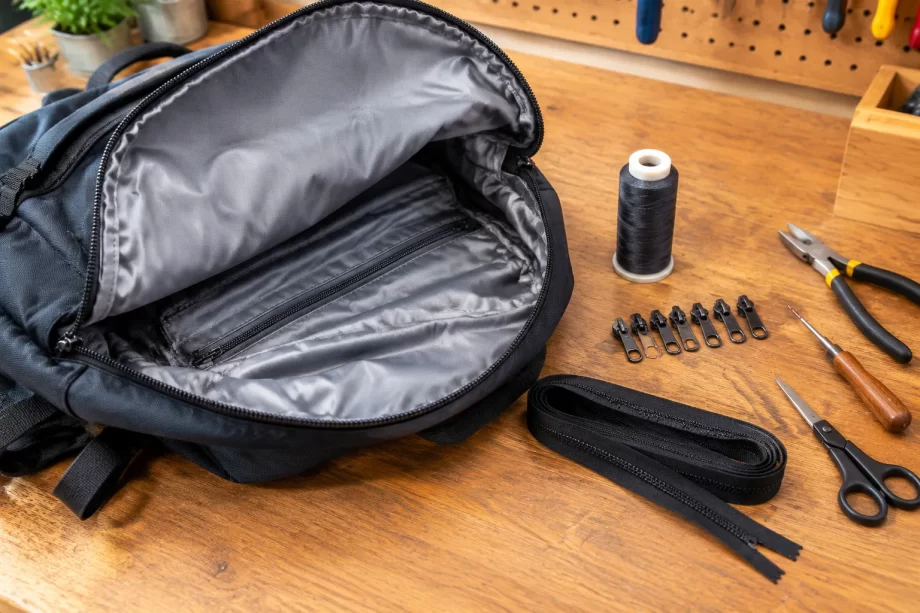
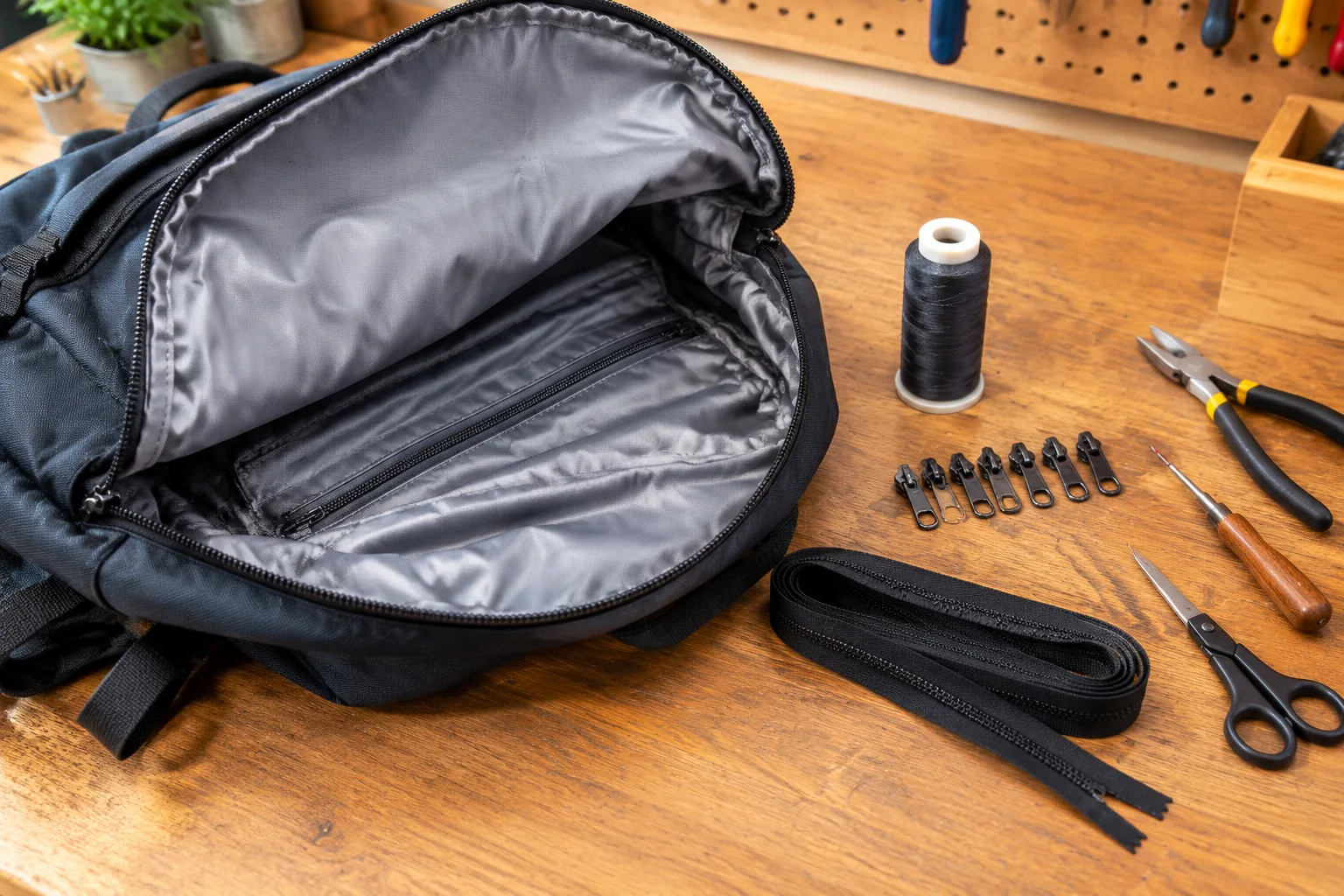
An opened backpack on a repair bench with tools, replacement zipper sliders and matching thread
This guide covers repairability and end-of-life from a bag manufacturer’s perspective. It starts with why circularity is a manufacturing decision rather than a marketing position, and with the principles that make a bag repairable at all.
It then covers how patterns and construction change, which fasteners and joints allow service, how spare parts and repair kits are organised, and what a repair programme requires in production. It closes with end-of-life pathways, disassembly and material separation, recycled content, and how claims are supported.
A bag’s repairability is fixed before the first stitch. If a zipper is sewn into a closed seam, if a buckle is riveted rather than screwed, if a lining is bonded rather than attached, then no repair policy can compensate for the construction.
Circularity is decided by the bill of materials and the seam plan, not by the sustainability section of a website.
The Design Lever Table
Lever
Where it is decided
Replaceable component
Bill of materials
Access to a fastener
Pattern and seam plan
Separable materials
Bonding versus stitching
Repairable seam
Stitch type and allowance
Spare part availability
Component standardisation
Disassembly time
Fastener and joint choice
The Cost Table
Stage
Cost of a repairable choice
Development
Additional design reviews
Component
Slightly higher hardware cost
Assembly
Marginal additional time
Tooling
Extra patterns for access panels
Warranty
Lower replacement rate
End of life
Lower disposal cost
The Barrier Table
Barrier
Nature
Cost pressure
Repairability adds visible cost
Volume logic
Replacement sells more units
No repair network
Nowhere to send the bag
Sealed construction
Waterproofing by bonding
Component variety
Too many parts to stock
No data
Failure points unknown
The Failure Table
Component
Typical failure
Zipper slider
Wear and misalignment
Zipper tape
Stitch pull-out
Shoulder strap
Webbing abrasion
Buckle
Impact fracture
Lining
Abrasion at the base
Base panel
Abrasion and water ingress
The first step in designing for repair is knowing which component fails first, and most factories have never assembled that data.
The Repairability Principles
Repairability is not a single feature. It is the cumulative result of a small number of decisions applied consistently across the bag.
The Principle Table
Principle
Practical meaning
Access
The part can be reached without cutting
Reversibility
The joint can be undone and redone
Standardisation
The part is available and common
Modularity
The part can be replaced as a unit
Diagnosability
The failure is visible and locatable
Information
The user knows how to get it repaired
The Access Table
Access method
Character
Open seam with binding
Reversible, tidy
Zipper in lining
Fast, needs a matching zip
Screw post through panel
Very serviceable
Snap or press stud
Quick, lower strength
Hook and loop panel
Easy, bulkier
Stitched closed
Not serviceable
The Reversibility Table
Joint
Undoable
Stitch
Yes, with unpicking
Screw
Yes, with a tool
Snap
Yes, with force
Rivet
Destructive
Ultrasonic weld
Destructive
Adhesive bond
Destructive
A rivet is a permanent decision. It is the right answer for a load path that will never be serviced and the wrong answer for anything a user might need to replace.
Designing for Repair
The pattern is where repairability is won or lost. An access opening, a seam allowance, or a component substitution costs almost nothing at the design stage and is impossible to add later without changing the product.
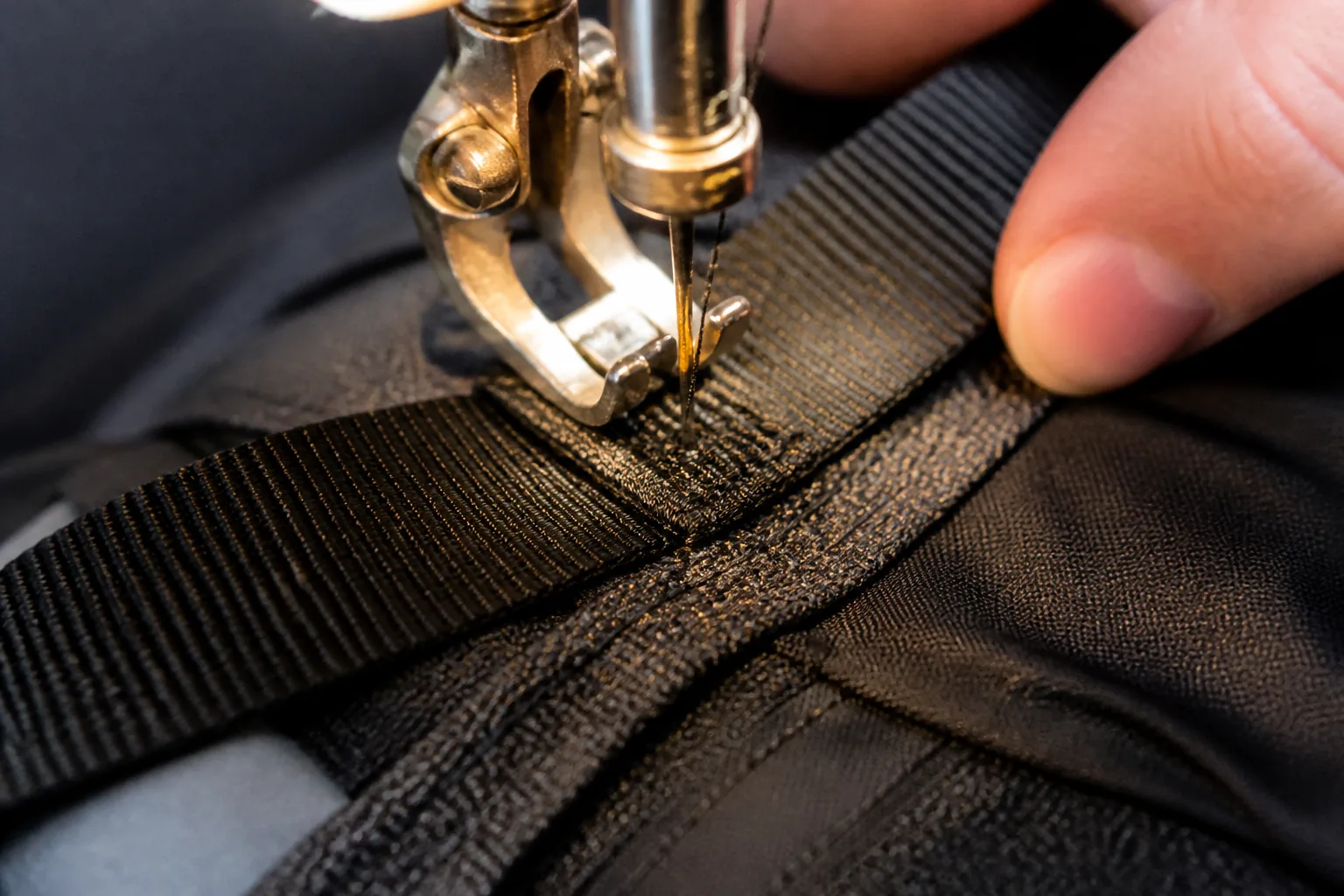
A repair stitch being sewn into a backpack seam with a reinforced bar tack and replaced webbing
The Pattern Table
Change
Effect
Access opening in lining
Zipper and lining reachable
Wider seam allowance
Repair stitching possible
Separate base panel
Base abrasion repairable
Replaceable strap end
Strap serviceable
Panelised lining
Local replacement
Marked repair points
Faster diagnosis
The Construction Table
Construction
Repair consequence
Bound seam
Clean opening and reclose
Flat-felled seam
Strong, harder to open
Topstitched seam
Easy to follow when repairing
Bound and bar tacked
Durable, serviceable
Welded seam
Watertight, not repairable
Glued panel
Not separable
The Component Table
Component
Repairable choice
Zipper slider
Replaceable slider
Zipper
Standard gauge and length
Buckle
Screw post or loop-through
Strap adjuster
Loop-through
Base
Separate panel
Lining
Panelised, not bonded
The Specification Table
Specification item
Requirement
Zipper gauge
A common size
Webbing width
A standard width
Thread type
Matches original
Hardware finish
Available as a spare
Stitch density
Consistent and documented
Colour
Matches repair stock
Designing for repair is mostly a matter of refusing to make a part unique when a standard part would do.
Fasteners, Joints and Serviceability
The joint decides the repair. Two bags can use identical buckles and have completely different service lives, because one attaches the buckle with a screw post and the other rivets it through three layers of coated fabric.
A screw post and binder screw beside a riveted joint and a replaceable side release buckle
The Fastener Table
Fastener
Serviceable
Strength
Screw post and binder
Yes
High
Snap or press stud
Yes
Medium
Loop-through webbing
Yes
High
Side release buckle
Yes
Medium
Rivet
No
High
Bartack only
No
High
The Joint Table
Joint
Tool needed
Reversible
Stitched seam
Needle and thread
Yes
Screw fixing
Screwdriver
Yes
Snap fixing
Setting tool
Partly
Rivet
Drill to remove
No
Weld
None
No
Adhesive
Solvent
No
The Load Path Table
Position
Appropriate fastener
Shoulder strap anchor
Stitched and bartacked
Strap adjuster
Loop-through
Compression strap
Screw post
Buckle body
Screw or loop-through
Padded back panel
Stitched, access via lining
Base reinforcement
Stitched, separate panel
The Trade-off Table
Decision
Cost
Screw instead of rivet
Slight hardware cost
Standard zipper gauge
Less design freedom
Access opening
Additional pattern piece
Panelised lining
More cutting and sewing
Replaceable strap end
Additional bartack
A serviceable joint is rarely weaker, but it is almost always slightly more expensive, and that difference is what the design review has to justify.
Spare Parts and Serviceable Hardware
A repairable bag without spare parts is a theoretical claim. The factory has to decide which components will be stocked, in what quantity, for how long, and who holds them.
The Spare Part Table
Part
Stocking logic
Zipper slider
High failure, low cost
Buckle
High failure, low cost
Strap adjuster
Medium failure
Webbing length
Cut to order
Base panel
Low failure, high value
Lining panel
Medium failure
Logo patch
Cosmetic replacement
The Kit Table
Kit type
Contents
Field repair
Slider, cord, needle
User kit
Slider and instructions
Service kit
Buckle set and tool
Panel kit
Base panel and thread
Trade kit
Assorted sliders
Retail kit
Colour-matched set
The Availability Table
Question
Decision
Which parts stocked
Failure data
How many
Expected repair volume
For how long
Product life plus margin
Where held
Factory, distributor, repairer
Who pays
Programme design
How reordered
Minimum level trigger
The Standardisation Table
Approach
Benefit
One slider family
Fewer SKUs
Two webbing widths
Simpler stock
Shared buckle across styles
Volume pricing
Common thread colour
Repair matching
Standard zipper length
Availability
Universal repair instructions
Lower training
The most useful repairability decision a factory can make is to use the same zipper slider across an entire collection, because it turns a hundred spare parts into one.
The Repair Programme in Production
Repair is a production process with its own labour, tooling, records, and quality standard. A factory that offers repairs without organising them as a process ends up with inconsistent work and no way to feed failures back into design.
The Process Table
Step
Activity
Intake
Identify model and fault
Diagnosis
Confirm the failed component
Quotation
Labour and part cost
Authorisation
Customer or programme approval
Repair
Standard method applied
Test
Function and appearance check
Return
Recorded and shipped
The Capability Table
Repair
Skill level
Slider replacement
Basic
Buckle replacement
Basic
Strap replacement
Intermediate
Zipper replacement
Advanced
Base panel replacement
Advanced
Lining replacement
Advanced
Full refurbishment
Advanced plus finishing
The Tooling Table
Tool
Purpose
Seam ripper
Open a seam cleanly
Walking foot machine
Sew through layers
Bartack machine
Restore load points
Screwdriver set
Hardware service
Snap setter
Replace studs
Colour-matched thread
Invisible repair
The Record Table
Record
Use
Model and batch
Traceability
Failed component
Design feedback
Repair performed
Cost and method
Labour time
Pricing and capacity
Part consumed
Stock planning
Outcome
Warranty and quality
The Feedback Table
Signal
Design response
Repeated slider failure
Change supplier or gauge
Strap abrasion
Change webbing or edge finish
Base wear
Reinforce the panel
Lining tear
Change lining or attachment
Buckle fracture
Change material or type
Seam pull-out
Increase allowance or density
A repair programme is the only reliable source of field failure data a factory will ever get, and most factories throw it away by not recording it.
End-of-Life Pathways
When repair is no longer viable, the bag enters one of a small number of pathways. Which one is available depends on construction, material mix, and whether a take-back route exists.
The Pathway Table
Pathway
Requirement
Reuse
Functional bag, second owner
Refurbishment
Repairable with cosmetic work
Remanufacture
Modular components reusable
Material recycling
Separable single materials
Energy recovery
Mixed, non-separable
Disposal
No route available
The Material Table
Material
Recycling character
Nylon fabric
Recyclable, mono-material preferred
Polyester fabric
Recyclable, widely accepted
PU coating
Complicates recycling
Foam padding
Often not recycled
Metal hardware
High value, easily separated
Plastic buckles
Recyclable by polymer type
Zipper chain
Metal and plastic separable
The Separation Table
Obstacle
Effect
Bonded layers
Cannot separate
Mixed fibre
Low value
Foam laminated to fabric
Contaminates stream
Rivets through layers
Slows disassembly
Printed coating
Limits reprocessing
Adhesive residue
Reduces quality
The Take-Back Table
Model
Character
Retail drop-off
Convenient, low capture
Postal return
Higher cost, better data
Brand collection
Controlled, marketing value
Repair-first policy
Extends life before return
Deposit scheme
High return rate
Upcycling partner
Niche, high margin
Recycling a bag is the last option, not the first. The environmental value of extending a bag’s life by three years exceeds the value of recycling it at year two.
Disassembly and Material Separation
Disassembly is a design property measured in minutes. A bag that separates into clean material streams in eight minutes can be recycled; the same bag with bonded layers and rivets everywhere becomes waste with extra steps.
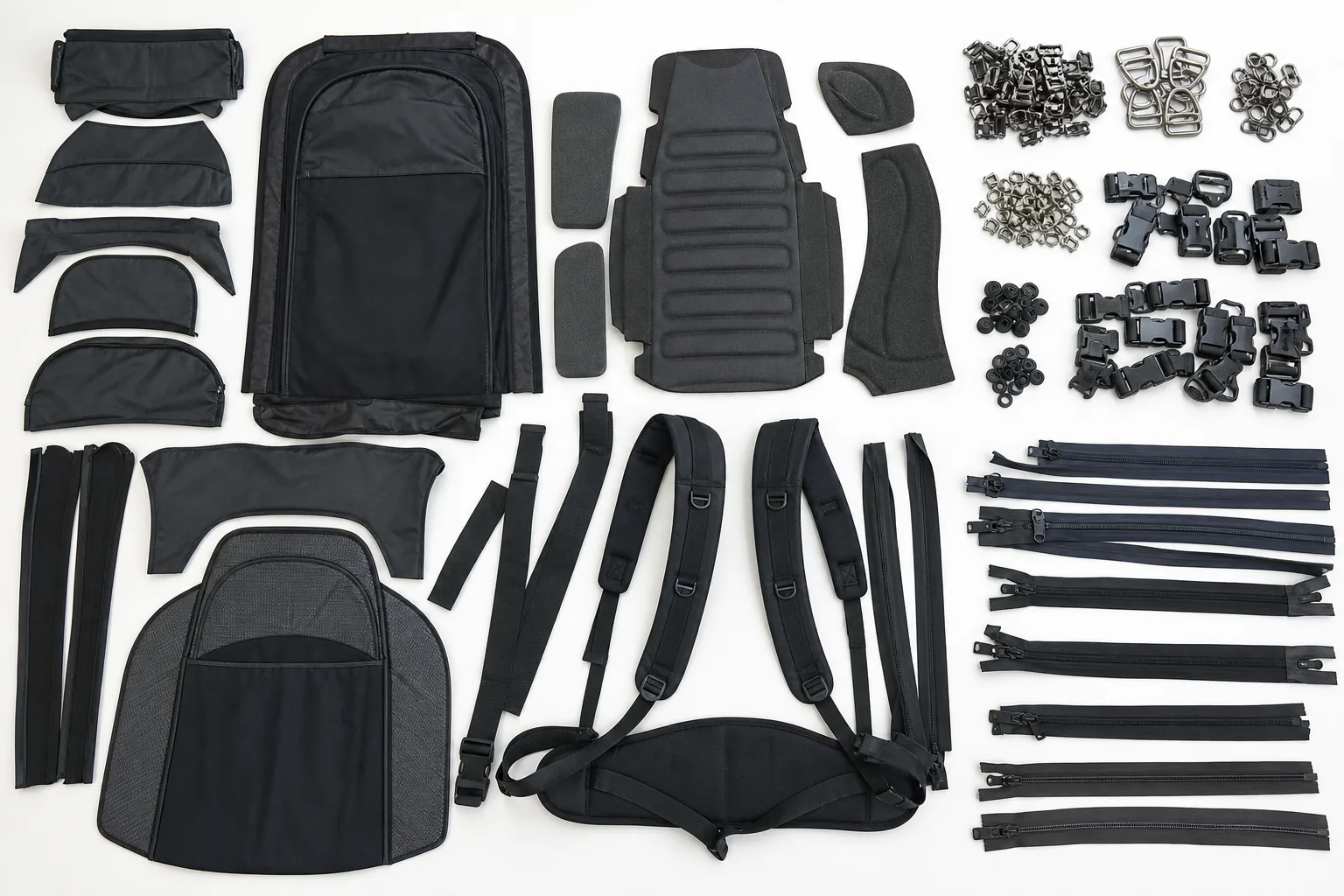
A disassembled backpack sorted into separate material groups: fabric panels, foam, metal hardware and plastic buckles
The Disassembly Table
Step
Time driver
Remove hardware
Fastener type
Open main seams
Stitch density
Separate lining
Attachment method
Remove foam
Lamination
Sort materials
Component marking
Bundle
Storage and transport
The Design Rule Table
Rule
Implementation
One material per component
Avoid laminates where possible
Mark polymer type
Moulded-in identification
Reversible fasteners
Screws over rivets
Mono-material panels
Same fibre face and back
Accessible seams
Standard stitch, wider allowance
Fewer material types
Target a defined maximum
The Marking Table
Component
Marking need
Buckle
Polymer identification
Zipper
Metal or polymer
Foam
Type and density
Fabric
Fibre content
Thread
Fibre content
Label
Material and care
The Yield Table
Outcome
Consequence
Clean single stream
Higher material value
Mixed stream
Downcycling
Contaminated stream
Disposal
High metal recovery
Revenue offset
Reusable components
Remanufacture input
Long disassembly time
Programme not viable
If disassembly takes longer than the material is worth, the recycling pathway closes regardless of what the design intended.
Recycled Content and Material Choices
Recycled content is the part of circular design most visible to buyers and the part most often overstated. The questions that matter are where the material came from, whether it performs, and how the claim is supported.
The Content Table
Type
Character
Post-industrial
Clean, consistent, traceable
Post-consumer
Variable, needs sorting
Pre-consumer offcut
Factory-specific
Chemical recycling
Feedstock-flexible
Mechanical recycling
Lower cost, quality limits
Bio-based virgin
Not recycled content
The Performance Table
Property
Recycled behaviour
Tensile strength
Usually adequate
Tear resistance
May be lower
Colour consistency
Harder to control
Coating adhesion
Requires validation
Abrasion
Comparable in quality grades
Cost
Often higher
The Traceability Table
Requirement
Evidence
Source identified
Supplier declaration
Chain of custody
Transaction records
Percentage stated
Mass balance or physical
Certification
Third-party scheme
Batch traceability
Records per lot
Claim basis
Documented method
The Claim Risk Table
Claim
Risk
“Made from recycled materials”
Percentage ambiguous
“100% recycled”
Rarely accurate for all components
“Ocean plastic”
Traceability difficult
“Recyclable”
Depends on local infrastructure
“Compostable”
Almost never true for bags
“Carbon neutral”
Depends on offsets
A recyclable claim is a claim about infrastructure, not about the material, and a bag is only recyclable where a facility will actually accept it.
Durability Versus Recyclability
These two goals pull in opposite directions. Durability favours bonded layers, coatings, and reinforced composites; recyclability favours single materials and reversible joints.
The Tension Table
Goal
Preferred choice
Durability
Laminated and coated fabric
Recyclability
Mono-material fabric
Water resistance
Welded or bonded seams
Repairability
Stitched seams
Light weight
Thin laminated layers
Material recovery
Thick single layers
The Resolution Table
Approach
Balance
Repair-first design
Extends life, defers recycling
Replaceable high-wear parts
Localises failure
Mono-material main body
Keeps the largest stream clean
Coating only where needed
Reduces contamination
Standard hardware
Enables refurbishment
Modular lining
Replaceable, separable
The Life Table
Scenario
Material consequence
Repaired twice, used eight years
Lowest annual impact
Recycled at year three
Moderate benefit
Discarded at year two
Highest impact
The strongest circular argument for a bag is not that it can be recycled, but that it does not need to be replaced.
Running the Circular Design Review
The decisions that determine repairability are made in the development meetings, so the review is the only place where circularity can be enforced before tooling is committed. A structured review makes the trade-offs explicit instead of leaving them to whoever raises the topic.
The Review Table
Stage
Circularity question
Concept
Which components will fail first
Specification
Which parts must be replaceable
Pattern
How does a repairer reach them
Materials
How many material types are used
Sampling
How long does disassembly take
Pre-production
Are spare parts and instructions ready
The Gate Table
Gate
Evidence required
Design freeze
Spare part list defined
Material approval
Recycled content recorded
Sample approval
Repair demonstrated
Production release
Instructions published
Launch
Take-back route live
Post-launch
Failure data collected
A circularity requirement that is not a gate is a preference, and preferences do not survive a cost review.
Refurbishment and Remanufacture Programmes
Between a repair and a recycling bin sits a commercial model that most bag factories ignore: taking a used bag back, restoring it, and selling it again. It only works when the construction allows it, which makes it a design consequence rather than a marketing initiative.
The Refurbishment Table
Stage
Activity
Collection
Take-back or postal return
Triage
Grade and decide route
Cleaning
Fabric and hardware
Restoration
Replace worn components
Inspection
Function and appearance
Re-labelling
Disclosure of condition
Resale
Own channel or partner
The Grading Table
Grade
Condition
A
Near new, cosmetic wear only
B
Functional, visible wear
C
Repairable, needs parts
D
Components salvageable only
E
Material recovery only
Scrap
No route
The Reverse Logistics Table
Element
Consideration
Collection point
Retail, postal, partner
Transport cost
Often the deciding factor
Consolidation
Batch before shipping
Customs
Returns and waste rules
Sorting labour
Skilled triage needed
Storage
Clean, dry, identified
The Economics Table
Line
Direction
Collection cost
Negative
Transport
Negative
Labour for restoration
Negative
Replacement parts
Negative
Resale price
Positive
Avoided disposal
Positive
Refurbishment is viable when the resale value of a graded bag exceeds the cost of collecting, restoring, and re-selling it, and design determines both sides of that equation.
The Resale Channel Table
Channel
Character
Own outlet
Highest margin, needs traffic
Certified pre-owned
Trust, requires grading
Wholesale to reseller
Fast, lower price
Employee sale
Simple, limited volume
Donation
Reputational, no revenue
Spare parts harvest
Value from failed units
The Quality Table
Requirement
Standard
Structural integrity
Load tested
Zipper function
Full cycle check
Strap condition
Abrasion limit
Cleanliness
Defined appearance grade
Disclosure
Condition stated
Warranty
Defined and limited
The Data Table
Data point
Use
Return reason
Design feedback
Failure age
Durability validation
Component replaced
Spare stock planning
Restoration time
Cost model
Resale price
Programme viability
Grade distribution
Collection quality
A factory that runs a refurbishment programme learns more about its own product than any laboratory test will reveal, because the failures arrive with an age, a use pattern, and a grade attached. That data is the input to the next pattern revision.
Repair Instructions and User Information
A repairable bag with no information is repairable only by the factory. The user has to know that a part can be replaced, what the part is called, and where to obtain it, and that information has to survive the life of the product.
The Information Table
Element
Purpose
Care label
Prevents avoidable damage
Component reference
Identifies the part
Repair point indication
Shows where to open
Spare part code
Enables ordering
Repair contact
Routes the request
Disassembly note
Supports end of life
The Channel Table
Channel
Reach
Hangtag
Every unit at purchase
Woven label
Survives the product
Product page
Searchable later
Repair portal
Ongoing access
Retailer portal
Trade access
Packaging insert
Low retention
The Clarity Table
Failure
Consequence
No part code
Repair abandoned
Vague description
Wrong part ordered
No contact route
User improvises
Instructions in one language
Excluded markets
Label removed at purchase
Information lost
Portal offline
Programme appears closed
The most common reason a repairable bag is thrown away is that the owner did not know it could be repaired, or could not find the part.
Claims, Standards and Regulation
Circularity claims are moving from voluntary marketing to regulated disclosure, and the direction is consistent across markets: say what you can prove, define the boundary, and keep the evidence.
The Requirement Table
Requirement area
Direction of travel
Recycled content
Mandatory disclosure in some markets
Durability claims
Must be substantiated
Repairability information
Increasingly expected
Green claims
Prior substantiation required
Waste handling
Producer responsibility schemes
Material marking
Required for some components
The Substantiation Table
Claim
Substantiation needed
Repairable
Spare parts and instructions exist
Recycled content percentage
Mass balance or physical records
Designed for disassembly
Documented method and time
Long life
Test data or field data
Recyclable
Accepted by a real facility
Sustainable material
Defined criteria met
The Product Passport Table
Field
Purpose
Model and batch
Identification
Material composition
Sorting and recycling
Component list
Repair and replacement
Disassembly guide
End-of-life handling
Spare part references
Serviceability
Care instructions
Life extension
A product passport is only useful if the data behind it is real, and the first version of any passport exposes how little a factory actually knows about its own bill of materials.
Common Circularity Mistakes
The Mistake Table
Mistake
Consequence
Repair without spare parts
Claim collapses at first failure
Spare parts without stock period
Part unavailable at year four
Access without a stated method
Repairer improvises
Recycled content without records
Claim unsubstantiated
Recyclable claim without a facility
Claim false in practice
Disassembly never timed
Recycling economics unknown
The Test Table
Assumption
How to check it
The part can be replaced
Replace it once in the sample room
Disassembly is quick
Time it with a stopwatch
Spares are available
Order one from the supplier
The material is recyclable
Ask the facility to accept it
Every circularity claim should be tested by doing the thing once, in the factory, before it is written on a hangtag. Most claims fail at that first attempt rather than at the audit.
The Circular Design Checklist
Structure
Item
Done
Failure points identified from field data
☐
High-wear components made replaceable
☐
Access opening designed into the lining
☐
Seam allowance widened at repair points
☐
Base panel separable
☐
Lining panelised, not bonded
☐
Materials
Item
Done
Material count limited by specification
☐
Main body mono-material where possible
☐
Polymer types marked on components
☐
Metal hardware separable
☐
Foam type and attachment documented
☐
Recycled content percentage recorded
☐
Service
Item
Done
Spare parts list defined
☐
Stock levels agreed
☐
Repair instructions written
☐
Repair labour time measured
☐
Repair records captured
☐
Failure data fed back to design
☐
End of Life
Item
Done
Disassembly sequence documented
☐
Disassembly time measured
☐
Take-back route defined
☐
Recycling partner confirmed
☐
Material streams specified
☐
Claims evidence retained
☐
FAQ
What makes a backpack repairable in practice?
Four things have to be true at once. The failed part must be reachable without destroying the bag, which means an access opening or a seam that can be opened. The joint must be reversible, which usually means a stitch or a screw rather than a rivet, weld, or adhesive bond. The replacement part must exist and be obtainable, which depends on using standard components rather than proprietary ones. And someone must be able to carry out the work, which requires instructions and a repairer with the right machine. A bag that satisfies three of the four is not repairable in any useful sense, because the missing condition is the one that stops the repair.
Which components should be designed as replaceable first?
Start with the components that fail most often and cost least to change: the zipper slider, the buckles, and the strap adjusters. These are high-frequency failures, low-cost parts, and they can be made serviceable with a screw post, a loop-through attachment, or a replaceable slider, none of which adds meaningful cost. The base panel and the lining come next, because they wear through abrasion rather than impact, and making them separate panels is a pattern decision rather than a hardware decision. Shoulder strap anchors should generally stay permanently stitched, because they carry the highest load and a serviceable joint there trades safety for a repair that rarely happens.
Does designing for repair conflict with water resistance?
It can, but the conflict is narrower than it appears. Water resistance at a seam is achieved either by sealing the seam, which is usually permanent, or by constructing the seam so water does not reach the interior, which can be reversible. A bound and topstitched seam with a storm flap is repairable and reasonably water resistant; a welded seam is watertight and not repairable. The practical resolution is to reserve welded or bonded construction for the areas that genuinely need it, such as a hydration pocket or a base, and to use repairable construction everywhere else. Very few bags need to be fully waterproof, and many are built as though they do.
How should a factory decide which spare parts to stock?
From repair data rather than from intuition. The first year of a repair programme will show which components actually fail, in what proportion, and at what age. Stocking decisions follow from that: high-frequency, low-cost parts such as sliders and buckles are held in quantity because they are cheap and turn over; low-frequency, high-value parts such as base panels are held in smaller numbers or made to order. The stocking period should match the product’s expected life plus a margin, because a spare part that is discontinued at year three makes a repairable bag unrepairable at year four. Standardising on one slider family across a collection is the single most effective way to keep the stock list short.
What is a realistic disassembly time target for a bag?
The useful target is set by the value of the recovered material rather than by an abstract standard. If the separated fabric, foam, and metal from one bag are worth very little, then a disassembly that takes twenty minutes cannot be justified economically and the recycling pathway will not operate at scale. The practical approach is to measure the current time, identify the three operations that consume most of it, and design them out. Rivets replaced by screws, bonded foam replaced by a pocketed insert, and a marked polymer on each plastic part will typically cut disassembly time substantially, and each of those changes is a design decision rather than a recycling investment.
How much recycled content can a bag realistically carry?
It varies by component, and the honest answer is usually a set of percentages rather than a single figure. The main fabric body can often carry a substantial recycled share in polyester or nylon, subject to performance validation for tear strength and coating adhesion. Webbing, zipper tape, and lining can follow. Metal hardware is already recycled material in most cases, though it is rarely counted. Foam is the difficult component, because recycled foam is less available and its compression behaviour changes. A claim that states the percentage by component is more defensible than one headline figure, and it also shows the buyer that the number was calculated rather than asserted.
Is a repairable bag more expensive to make?
Slightly, and the increase is concentrated in a few places. Screw-post hardware costs more than rivets. An access opening adds a pattern piece and a sewing operation. Panelising the lining adds cutting and handling time. Widening seam allowances has almost no cost. Against that, a repairable bag typically carries a lower warranty replacement rate, and the repair programme itself becomes a revenue line rather than a cost. The calculation that matters is not unit cost but total cost over the product’s life, and factories that only measure unit cost will always conclude that repairability is expensive.
What evidence should a factory keep to support circularity claims?
Keep the same evidence a buyer would ask for in an audit, because that is what it will become. For recycled content, that means supplier declarations, transaction records, and certification covering the batch. For repairability, it means a spare parts list, repair instructions, and a measured repair time. For disassembly, a documented sequence and a recorded time. For recyclability, a named facility that accepts the material and confirmation that it does. None of this is difficult to produce if the programme exists, and none of it can be produced retrospectively if it does not.
Conclusion
Repairability and end-of-life planning are decided in the same place as cost and quality: the pattern, the bill of materials, and the seam plan. A bag that is riveted, bonded, and sealed cannot be repaired no matter what policy surrounds it, and a bag built with a standard slider, an access opening, and a screw-post buckle can be kept in service for years with a few minutes of labour.
The sequence that works is unglamorous. Find out which components actually fail, using repair records rather than assumptions. Make the high-frequency, low-cost parts replaceable. Design an access route so a repairer can reach them. Standardise hardware across the collection so that one spare part serves many styles. Then measure the disassembly time and remove the operations that make material recovery uneconomic.
The commercial case is stronger than the environmental one, which is why it survives contact with a cost review. A repairable bag carries a lower warranty replacement rate, generates service revenue, and produces field failure data that improves the next design. The material recovery is a secondary benefit, and it only becomes real where a take-back route and a recycling partner exist.
The claims dimension is where programmes usually fail. A recyclable claim depends on local infrastructure, a recycled content claim depends on records, and a repairability claim depends on spare parts being available at year four rather than only at launch. Factories that build the evidence as they build the product can answer those questions; factories that assemble the answers afterwards cannot.
For buyers, the practical test is to ask which component fails first, what the replacement part is, how a repairer reaches it, and how long disassembly takes. A supplier with answers is designing for circularity. A supplier without them has a sustainability page.