Freight Modes for Bag Exports: How Do You Choose and Consolidate?
Freight Modes for Bag Exports: How Do You Choose and Consolidate?
A backpack is light for its volume. That single physical fact decides almost everything about how bag exports move, and it is why a shipment of bags behaves differently from a shipment of hardware or furniture.
Low density means the container fills before it reaches its weight limit, so the constraint is cubic metres rather than tonnes. It means that freight is a large share of landed cost, that consolidation is usually worth more than a rate negotiation, and that a carton design decision made in the factory can move more money than a freight quote.
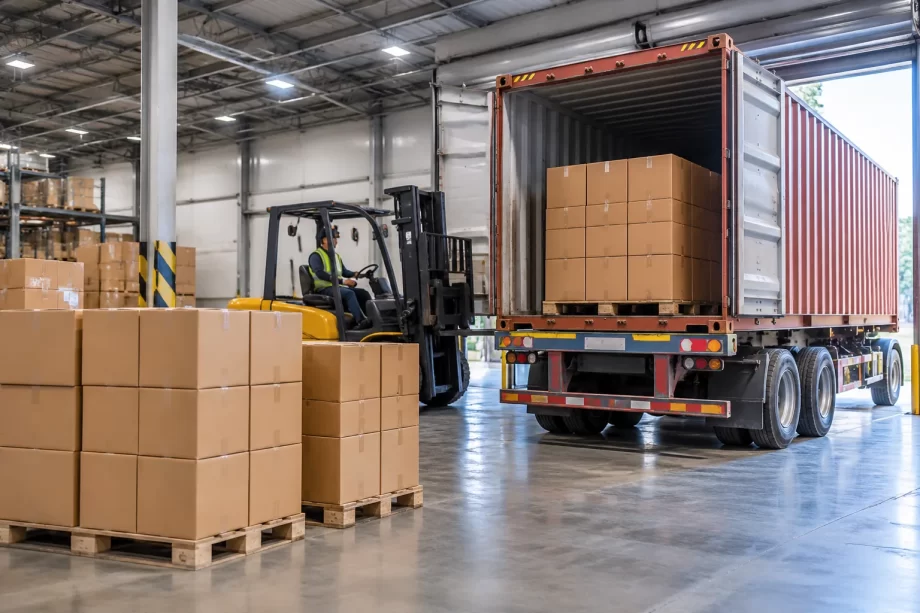
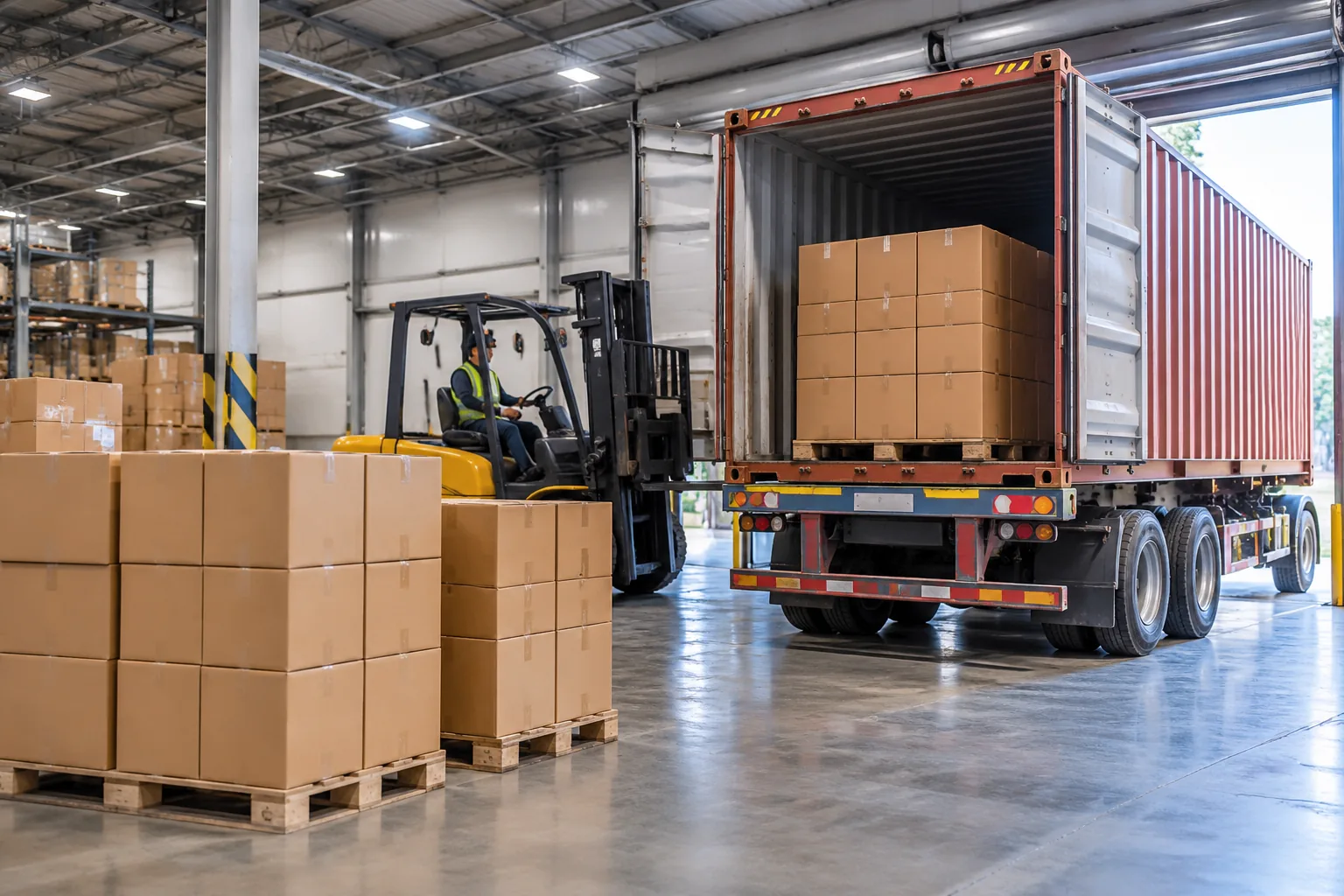
Cartons of bag products being loaded into a shipping container at a warehouse loading bay
This guide covers freight modes and order consolidation from a bag manufacturer’s perspective. It starts with why freight is a manufacturing decision, how the modes compare for bag cargo, and how containers are loaded.
It then covers consolidation mechanics, carton and volume utilisation, Incoterms and the split of responsibility, booking and cut-offs, documentation, risk and insurance, and the calculation of total landed cost.
Freight is usually treated as a purchasing task that happens after production. For bag cargo it is better understood as a design and packing consequence, because the largest controllable variable is not the freight rate but how much air travels inside the carton.
The Cost Share Table
Component
Driver
Ocean freight
Volume and route
Origin charges
Handling and documentation
Destination charges
Port and clearance
Inland transport
Distance and access
Duty
Classification and origin
Insurance
Value and mode
The Density Table
Cargo
Constraint
Finished bags, cartoned
Volume
Bags, compressed
Weight approaching
Fabric rolls
Weight
Hardware
Weight
Foam padding
Volume
Mixed accessories
Either
The Controllable Table
Lever
Owner
Carton dimensions
Factory
Packing density
Factory
Compression method
Factory
Order quantity per shipment
Buyer and factory
Mode selection
Buyer and forwarder
Consolidation
Forwarder
In a low-density cargo, the cheapest freight saving is almost always found in the carton, not in the rate.
The Trade-off Table
Decision
Effect
Smaller cartons
Better handling, more material
Larger cartons
Fewer units to handle, heavier
Compression
Higher density, creasing risk
Flat packing
Density gain, assembly needed
Mixed carton
Convenience, higher damage risk
Uniform carton
Efficient loading, less flexibility
The Measurement Table
Metric
Use
Cartons per container
Capacity planning
Cubic metres per unit
Density tracking
Chargeable weight
Air and LCL rating
Load factor
Container utilisation
Damage rate
Packing quality
Cost per unit shipped
Landed cost input
Comparing the Freight Modes
The mode choice is a trade between transit time, cost per cubic metre, and the risk the cargo will accept. For bag cargo, the usual answer is sea, and the interesting questions are which sea product and whether to consolidate.
The Mode Table
Mode
Transit
Cost
Sea FCL
Long
Lowest per cubic metre
Sea LCL
Long, plus consolidation
Higher per cubic metre
Rail
Medium
Between sea and air
Air freight
Short
Highest
Air express
Shortest
Highest, small parcels
Road
Regional only
Moderate
The Suitability Table
Cargo situation
Best mode
Full container volume
Sea FCL
Below one container
Sea LCL or co-load
Replenishment of a bestseller
Air or rail
Sample and launch order
Air express
Retail compliance deadline
Air or rail
Landlocked destination
Rail or road
The Time Table
Element
Note
Production lead time
Factory controlled
Inland to port
Domestic haulage
Port dwell
Schedule and clearance
Ocean transit
Route dependent
Destination clearance
Documentation quality
Final delivery
Inland and appointment
The Rate Table
Basis
Used for
Per container
FCL
Per cubic metre
LCL
Per chargeable kilo
Air
Per shipment
Courier
Per pallet
Some consolidations
All-in
Door-to-door quotes
A rate quoted per container and a rate quoted per cubic metre are not comparable until both are converted to cost per bag delivered.
Containers and Loading
Bag cargo loads well in standard equipment because cartons are regular and can be stacked tightly. The loading plan decides whether the container is used to its cubic capacity or wasted on voids.
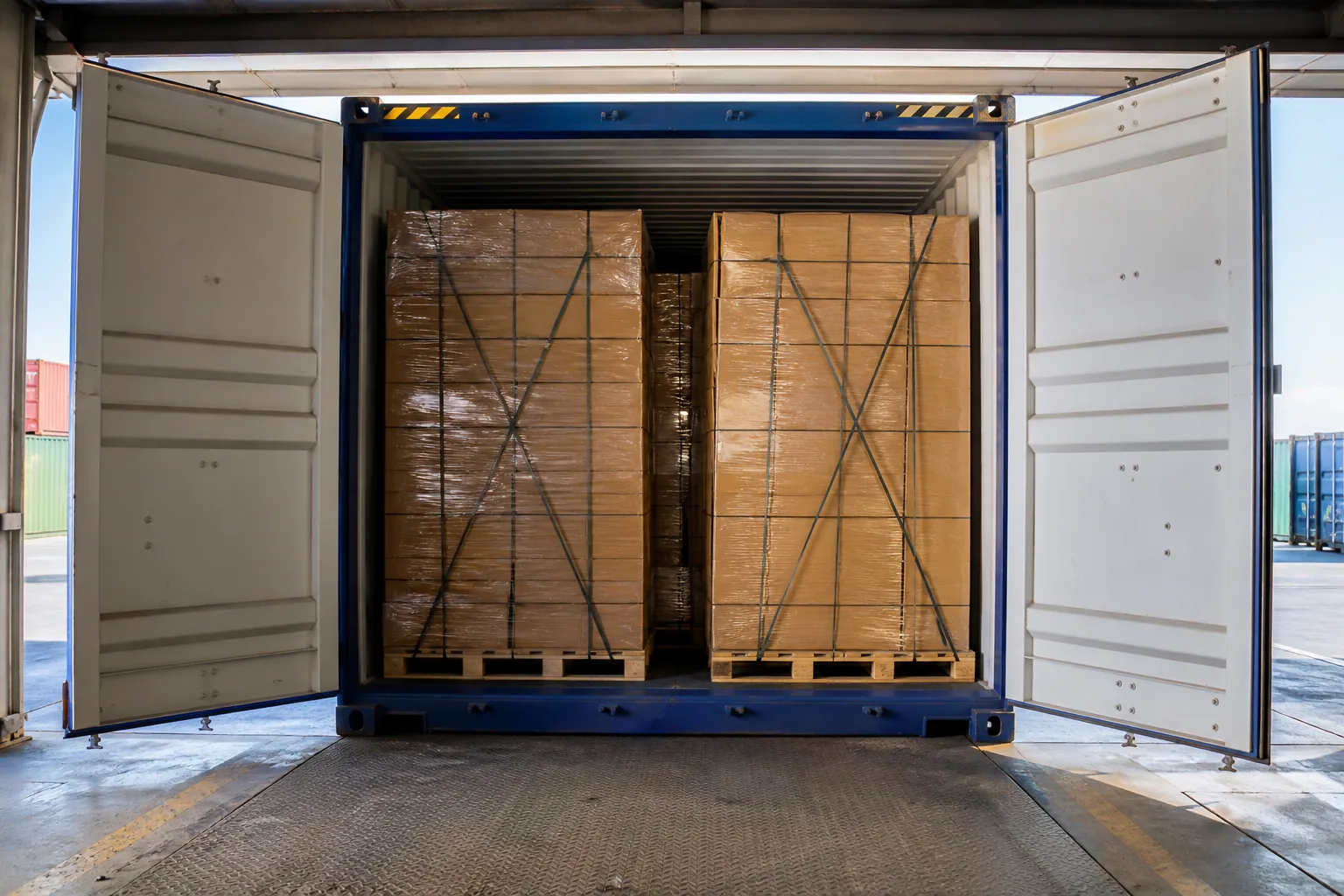
An open forty-foot container at a loading dock with neatly stacked cartons secured by straps
The Container Table
Type
Practical use
20ft standard
Dense cargo, smaller orders
40ft standard
Volume cargo, most bag shipments
40ft high cube
Extra height, tall stacks
20ft pallet-wide
Palletised loads
Reefer
Rarely needed for bags
Open top
Oversized items only
The Loading Table
Principle
Effect
Stack to the roof
Maximum cubic use
Interlock cartons
Stability in transit
Distribute weight
Axle compliance
Leave no voids
Prevent shifting
Strap the rear
Door security
Load heaviest low
Lower centre of gravity
The Utilisation Table
Measure
Target
Cubic utilisation
High
Weight utilisation
Moderate
Cartons per container
Recorded per style
Load plan documented
Every shipment
Voids filled
No empty columns
Damage after transit
Monitored
The Constraint Table
Constraint
Consequence
Carton size mismatch
Wasted height
Mixed carton sizes
Unstable stacking
Pallet requirement
Loses floor space
Retail labelling
Slower loading
Late cartons
Partial load or delay
Overweight
Re-handling at port
The Damage Table
Cause
Prevention
Compression
Carton strength grade
Moisture
Liner and desiccant
Shifting
Interlocking and straps
Handling impact
Corner protection
Crushing at base
Base reinforcement
Condensation
Ventilation and placement
A container loaded to the roof with no voids and no shifting will usually arrive in better condition than one loaded loosely with extra padding.
Consolidation Mechanics
Consolidation is the practice of combining cargo from several orders, suppliers, or buyers into one shipment so that each pays for a share of a container rather than for a share of a shared container’s inefficiency. For bag orders, which are often below container volume, it is the single most effective cost lever after packing density.
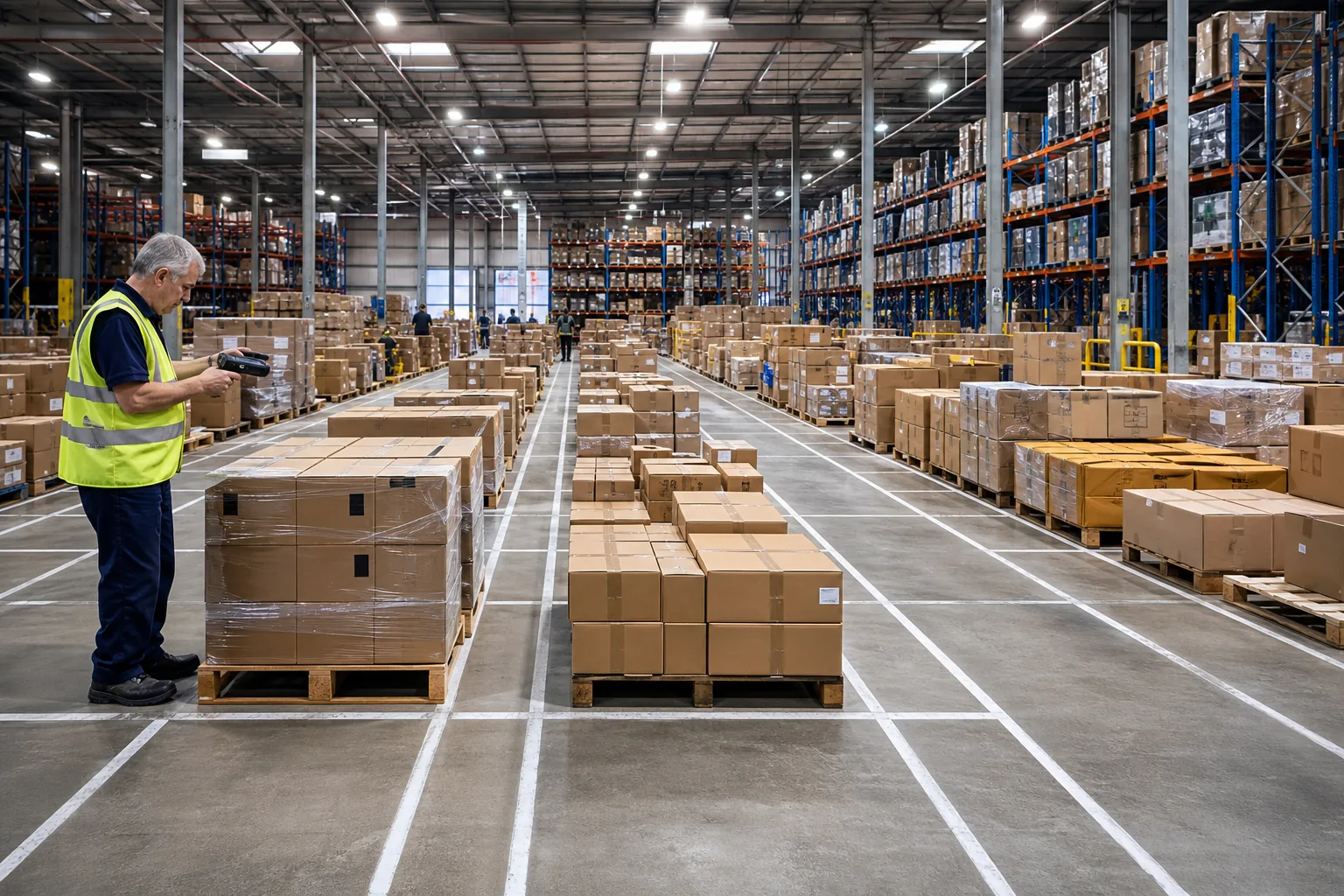
Cartons from several suppliers sorted into marked lanes in a freight consolidation warehouse
The Consolidation Table
Model
Character
Buyer consolidation
One buyer, several suppliers
Supplier co-load
Several buyers, one forwarder
Forwarder LCL
Shared container, weekly
Multi-country
Cargo gathered across origins
Bonded consolidation
Under customs control
Direct FCL
No consolidation
The Participant Table
Party
Role
Factory
Produces and cartons
Forwarder
Books and consolidates
CFS operator
Receives and stuffs
Buyer
Approves routing
Customs broker
Clears entry
Carrier
Moves the container
The Timing Table
Step
Constraint
Cargo ready date
Production completion
CFS cut-off
Before vessel cut-off
Documentation cut-off
Before loading
Vessel cut-off
Fixed by carrier
Departure
Schedule
Arrival and clearance
Destination queue
The Cost Table
Charge
Basis
Ocean freight
Per cubic metre
CFS handling
Per shipment or per cubic metre
Documentation
Per set
Destination handling
Per shipment
Inland delivery
Per delivery
Storage
Per day beyond free time
The Consolidation Risk Table
Risk
Mitigation
Late cargo misses cut-off
Buffer in ready date
Mixed cargo damage
Separated packing
One shipper delays all
Penalty terms
Documentation error
Pre-checked set
Loss in shared container
Insurance
Unclear liability
Written agreement
Consolidation saves money by sharing a container, but it also shares a schedule, which means the least reliable participant sets the departure date for everyone.
Carton and Volume Utilisation
The carton is where freight cost is decided. A carton that is 30 millimetres too tall wastes a row in the container; a packing method that leaves air inside each unit wastes the same volume thousands of times.
The Carton Table
Dimension
Consideration
Length and width
Fit the container grid
Height
Fit the stack height
Board grade
Compression strength
Closure
Tamper evidence
Labelling area
Retail and shipping
Print
Identification without reading
The Packing Table
Method
Density effect
Flat packed
Highest
Compressed with insert
High
Rolled
Medium
Folded with tissue
Medium
Hung in polybag
Low
Boxed individually
Lowest
The Grid Table
Container
Practical carton fit
20ft
Fewer rows, denser cargo
40ft
Long rows, volume cargo
40ft high cube
Extra vertical row
Palletised
Pallet footprint governs
Mixed sizes
Worse utilisation
The Improvement Table
Action
Typical effect
Reduce carton height
Additional row per stack
Standardise carton size
Predictable load plans
Increase compression
Higher units per carton
Remove inner boxes
Volume and cost saving
Right-size polybag
Less trapped air
Review per style
Finds the outliers
Volume utilisation is measured, not assumed. Factories that record cartons per container by style usually find one or two styles consuming far more space than their neighbours.
The Quality Table
Check
Purpose
Compression test
Carton strength
Drop test
Handling survival
Stack test
Warehouse endurance
Moisture check
Mould prevention
Seal check
Tamper evidence
Label check
Correct identification
The Record Table
Data
Use
Units per carton
Costing
Cartons per container
Capacity planning
Cubic metres per unit
Freight quotes
Gross weight per carton
Weight limits
Damage rate by style
Packing review
Carton cost per unit
Landed cost
Incoterms and the Split of Responsibility
The trade term decides who pays which cost, who carries which risk, and where the handover happens. Most disputes in bag shipments are not about freight rates but about an unclear split between a factory that believed delivery was complete and a buyer that believed freight was included.
The Term Table
Term
Handover
EXW
Factory premises
FCA
Carrier nominated by buyer
FOB
On board the vessel
CFR
Destination port, cost only
CIF
Destination port, cost and insurance
DAP
Named destination, not cleared
DDP
Named destination, cleared
The Cost Split Table
Term
Origin
Main freight
Destination
EXW
Buyer
Buyer
Buyer
FCA
Shared
Buyer
Buyer
FOB
Seller to port
Buyer
Buyer
CFR
Seller
Seller
Buyer
CIF
Seller
Seller
Buyer
DAP
Seller
Seller
Seller to door
DDP
Seller
Seller
Seller including duty
The Transfer Table
Term
Risk transfers
EXW
At factory
FCA
At carrier
FOB
On board
CFR
On board
CIF
On board
DAP
At destination
DDP
At destination
The Bag-Specific Table
Issue
Practical note
Palletisation
Agree before quoting
Container loading
Who supervises
Carton marking
Specified in the order
Inspection before loading
Buyer or third party
Damage in transit
Insurance responsibility
Duty liability
Depends on term and importer
Under CIF the seller insures the cargo, but the risk passes on board, which means the buyer holds a policy for a loss the seller arranged. Understanding that split prevents most claims arguments.
Booking, Cut-offs and Schedules
A booking is a chain of deadlines, and a bag shipment that misses one rarely misses only one. The factory controls the earliest link, which is the cargo ready date, and everything downstream compresses if it slips.
The Booking Table
Step
Timing
Space booking
Weeks before sailing
Container release
Before stuffing
Stuffing
Before gate cut-off
Gate in
Port deadline
Documentation
Before closing
VGM submission
Before loading
The Cut-off Table
Cut-off
Consequence of missing
Cargo cut-off at CFS
Rolled to next vessel
Gate cut-off
Container not loaded
Documentation cut-off
Bill of lading delay
VGM cut-off
Loading refused
Customs cut-off
Shipment held
Amendment window
Charges and delay
The Schedule Table
Factor
Variability
Weekly service
Fixed day
Seasonal congestion
Weeks of delay
Blank sailing
Booking cancelled
Port omission
Routing change
Weather
Route dependent
Peak season
Space shortage
The Buffer Table
Buffer type
Purpose
Cargo ready buffer
Absorbs production slip
Booking lead time
Secures space
Documentation lead
Allows correction
Transit buffer
Protects delivery date
Peak season buffer
Absorbs congestion
Stock buffer at buyer
Absorbs everything
The Communication Table
Update
Frequency
Booking confirmation
Once
Cargo ready status
Weekly
Stuffing report
On loading
Departure confirmation
On sailing
Arrival notice
Before arrival
Exception alert
Immediately
The most expensive freight problem in bag exports is not a high rate. It is a container that sails without the cartons, or cartons that arrive without the document that releases them.
Documentation for Bag Shipments
Documents do not move cargo, but missing documents stop it. A bag shipment that arrives with a wrong description, an inconsistent quantity, or an expired certificate will sit at destination while storage charges accumulate.
An export documentation desk with a stack of shipping documents, a folder and plain carton labels
The Document Table
Document
Purpose
Commercial invoice
Value and terms
Packing list
Cartons and contents
Bill of lading
Contract of carriage
Certificate of origin
Duty treatment
Test reports
Compliance evidence
Fumigation or ISPM
Wood packaging
The Consistency Table
Field
Must match
Description
Invoice, packing list, B/L
Quantity
Cartons and units
Weight
VGM and packing list
Value
Invoice and customs entry
Origin
Certificate and marking
Terms
Contract and invoice
The Description Table
Practice
Risk
Generic description
Classification dispute
Over-specific description
Mismatch with invoice
Material omitted
Different duty rate
Brand name missing
Trademark queries
Purpose omitted
Consumer goods rules
Unit count ambiguous
Quantity queries
The Pre-Shipment Check Table
Check
Method
Carton count
Physical count against list
Unit count
Cartons multiplied by pack
Gross weight
Weighed, not estimated
Cubic measurement
Measured, not nominal
Description
Read aloud against invoice
Certificate validity
Date checked on the day
A pre-shipment check is a ten-minute exercise performed while the container is still at the loading dock, and it is the last point at which an error can be corrected at no cost. Once the container is gated in, the same error becomes an amendment fee, a delay, or an examination at destination.
The Error Table
Error
Consequence
Invoice value mismatch
Customs hold
Missing certificate
Clearance refused
Wrong HS code
Duty reassessment
Packing list discrepancy
Examination
Late document
Storage charges
Illegible copy
Rejection
A packing list that does not reconcile with the container is the most common reason a compliant bag shipment is examined at destination.
Risk, Insurance and Damage
Bag cargo is not fragile in the way glass is, but it is vulnerable in specific ways: compression, moisture, and handling damage to cartons that then expose the contents. Insurance covers the financial loss; packing prevents it.
The Risk Table
Risk
Cause
Compression damage
Stack height and board grade
Moisture and mould
Condensation in transit
Carton collapse
Weak base or wet board
Handling tears
Manual handling
Pilferage
Unsecured cartons
Total loss
Casualty at sea
The Cover Table
Cover
Scope
All risks
Broad, subject to exclusions
Named perils
Limited list
Institute cargo clauses A
Widest standard
B and C clauses
Narrower
General average
Shared sacrifice
War and strikes
Separate cover
The Claim Table
Requirement
Evidence
Notice of loss
Prompt written notice
Survey
Independent inspection
Photographs
Condition on arrival
Packing evidence
Carton and method
Invoice and B/L
Value and carriage
Mitigation
Steps taken
The Prevention Table
Measure
Effect
Correct board grade
Resists compression
Liner and desiccant
Controls moisture
Interlocked stacking
Prevents shifting
Corner protection
Absorbs impact
Sealed cartons
Deters pilferage
Loading supervision
Catches problems early
The Moisture Table
Condition
Response
Long ocean transit
Desiccant and liner
Temperature cycling
Ventilation and placement
Humid destination
Sealed packing
Wet loading
Stop and document
Condensation drip
Avoid roof contact
Mould risk cargo
Treated materials
Mould claims are almost never caused by the destination climate alone. They are caused by moisture sealed into the carton at origin and then carried across a temperature gradient.
Total Landed Cost
Landed cost is the number that allows a freight decision to be compared with a production decision. A rate that looks cheap can produce a higher landed cost once origin charges, destination charges, duty, and the cost of capital tied up in transit are included.
The Component Table
Component
Basis
Ex-works price
Unit cost
Origin handling
Per shipment
Main freight
Per container or cubic metre
Insurance
Percentage of value
Duty
Classification and origin
Destination charges
Per shipment
Inland delivery
Per delivery
Inventory carrying
Transit time
The Calculation Table
Step
Action
One
Establish unit cost
Two
Add packing and carton cost
Three
Add origin charges
Four
Add freight per unit
Five
Add insurance
Six
Add duty and destination
Seven
Add carrying cost of transit
The Comparison Table
Mode
Landed cost character
Sea FCL
Lowest per unit, longest
Sea LCL
Higher per unit, flexible
Rail
Middle, shorter than sea
Air
Highest per unit, fastest
Express
Highest, smallest lots
The Hidden Cost Table
Cost
Often omitted
Storage at destination
Yes
Examination fees
Yes
Documentation amendments
Yes
Rework for retail compliance
Yes
Stock-out from late arrival
Yes
Capital tied in transit
Yes
A freight decision that ignores the carrying cost of transit time will always favour the slowest option, and a decision that ignores stock-out cost will always favour the fastest.
The Sensitivity Table
Variable
Effect on landed cost
Freight rate
Direct
Cubic utilisation
Multiplicative
Order size
Dilutes fixed charges
Transit time
Carrying cost
Duty rate
Large, binary
Damage rate
Replacement cost
The Consolidation Decision Matrix
The decision to consolidate is not purely a cost question. It trades freight saving against schedule control, and the right answer depends on how tight the delivery window is and how reliable the other participants are.
The Decision Table
Situation
Recommended
Volume above 60 per cent of container
Book FCL
Volume below 15 cubic metres
LCL
Fixed retail delivery date
FCL or air
Multiple suppliers, one buyer
Buyer consolidation
Repeated small replenishments
Co-load programme
Launch order, high value
Air or express
The Criterion Table
Criterion
Weight
Cost per unit
High
Schedule reliability
High
Damage risk
Medium
Documentation simplicity
Medium
Flexibility to add cargo
Low
Claims complexity
Low
The Scenario Table
Scenario
Path
Two factories, one buyer
Consolidate at CFS
One style, full container
Direct FCL
Samples plus bulk
Split shipment
Urgent replenishment
Air freight
Peak season congestion
Book early
The Split Shipment Table
Approach
Use
Air first, sea follow
Launch and replenishment
Partial FCL, rest LCL
Bridge to container volume
Direct to distribution centre
Retail deadlines
Port to warehouse
Cost control
Multi-port discharge
Regional spread
The Mode Switch Table
Trigger
Response
Production finished early
Move up the sailing
Production finished late
Switch part to air
Retail date pulled forward
Split shipment
Volume below forecast
Consolidate
Volume above forecast
Book an extra container
Port congestion rises
Consider rail alternative
Selecting and Managing a Forwarder
The forwarder converts a factory’s packing into a movement, and the quality of that conversion shows up in cut-off performance rather than in the quoted rate. A cheap forwarder that misses a sailing costs more than a competent one that does not.
The Selection Table
Criterion
What to check
Route coverage
Direct services on the lane
Consolidation frequency
Weekly or better
Documentation quality
Pre-checked sets
Communication
Named contact
Claims handling
Written process
Local presence
Origin and destination
The Performance Table
Metric
Target
Booking confirmation time
Within a day
Cut-off adherence
No missed sailings
Document accuracy
No amendments
Transit variance
Within schedule
Claim response
Within agreed days
Rate stability
No surprise surcharges
The Review Table
Question
Frequency
Did we miss any cut-off
Monthly
Were documents amended
Monthly
What did surcharges cost
Quarterly
How were claims handled
Per event
Is the lane still competitive
Half-yearly
Are consolidation options improving
Half-yearly
The Contract Table
Term
Purpose
Rate validity
Prevents mid-season change
Surcharge definition
Limits surprises
Liability limit
Sets claim ceiling
Cut-off responsibility
Clarifies duty
Document turnaround
Sets expectations
Termination terms
Exit route
A forwarder relationship is judged on the shipment that went wrong, not on the ten that went right, which is why the claims process should be agreed before it is needed.
The Freight and Consolidation Checklist
Packing
Item
Done
Carton dimensions fit the container grid
☐
Carton board grade tested
☐
Units per carton recorded
☐
Cubic metres per unit calculated
☐
Inner packaging minimised
☐
Moisture protection specified
☐
Booking
Item
Done
Cargo ready date confirmed
☐
Space booked with lead time
☐
Cut-off dates recorded
☐
Consolidation decision made
☐
Incoterm agreed in writing
☐
Insurance arranged
☐
Loading
Item
Done
Load plan prepared
☐
Cartons counted against packing list
☐
Weight distributed correctly
☐
Voids eliminated
☐
Rear secured
☐
Loading photographed
☐
Documents
Item
Done
Invoice consistent with packing list
☐
HS code confirmed
☐
Certificate of origin issued
☐
Test reports attached
☐
Bill of lading draft checked
☐
VGM submitted
☐
FAQ
Why is sea freight usually the right choice for bag exports?
Because the cost of moving a low-density product by air is dominated by volume rather than weight, and a bag occupies a great deal of space for very little mass. Air freight is charged on chargeable weight, which for bag cargo is almost always the volumetric figure, so a shipment that weighs a few hundred kilos can be billed as though it weighed several tonnes. Sea freight charges per cubic metre at a rate that is a fraction of the air rate, so the same volume costs far less. The trade is transit time, which is measured in weeks rather than days, and that is acceptable for planned production but not for a retail deadline that has already slipped.
When does consolidation make sense for a bag order?
Consolidation makes sense when the order is below the volume at which a full container becomes economic, and when the delivery window can absorb the extra handling days. The typical threshold in practice is somewhere below half a container of usable volume, at which point the cost per cubic metre of LCL or co-loading is lower than paying for empty space in a dedicated container. Above that threshold, the arithmetic usually reverses, because the fixed charges of consolidation are spread over a smaller volume and the schedule becomes dependent on other shippers. The second condition matters as much as the first: cargo that must sail on a specific vessel should not be placed in a shared container where a late participant can hold the departure.
How much does carton design actually affect freight cost?
More than most rate negotiations. Because the constraint is volume, a reduction in carton height that allows one additional row per stack increases the number of units in a container by a proportional amount, and that flows directly into cost per unit. Reducing trapped air inside the carton through compression or better folding has a similar effect, and it repeats across every unit in the shipment. A carton that is slightly too large for the container grid, by contrast, can waste a column of space across the entire load. The practical method is to measure cartons per container by style, identify the outliers, and redesign those rather than renegotiating rates on a packing method that is wasting space.
What is the most common documentation mistake in bag shipments?
An inconsistency between documents rather than a missing document. The invoice, packing list, and bill of lading describe the same cargo, and when the description, quantity, or weight differs between them, customs at destination has grounds to examine the shipment and the delay costs more than the freight saved anywhere else in the chain. The second most common problem is a description that is too generic, which invites a classification question, or too specific in a way that does not match the invoice wording. A pre-shipment check that reconciles the three documents field by field takes minutes and prevents the majority of holds.
Which Incoterm should a bag factory prefer?
The term should follow who is best placed to control the risk, and for most bag factories that means FOB at the nearest port. Under FOB the factory is responsible for production, packing, inland transport, and loading, and the buyer controls the ocean leg and destination charges. That split suits a manufacturer, because the factory controls what it can control and the buyer, who usually has better freight rates and destination relationships, controls the rest. CIF is common in practice but creates an awkward position: the factory buys insurance and pays freight it cannot optimise, while risk passes on board, so the buyer holds a policy for a loss the factory arranged. Ex-works is the least suitable, because it leaves the factory exposed to a buyer’s carrier arriving late and blaming the cargo.
How should a factory handle a buyer who insists on DDP?
DDP is workable but it transfers duty liability and destination compliance to the seller, which means the factory is now responsible for an import it does not control. Three conditions make it survivable. First, the HS classification must be confirmed in writing before the price is agreed, because a duty rate applied to the wrong code can eliminate the entire margin. Second, the destination broker must be appointed and priced before shipment, not discovered on arrival. Third, the term should exclude any destination requirement the factory cannot verify, such as a registration, a labelling obligation, or a producer responsibility fee. Where those conditions cannot be met, DAP is the honest alternative, because it delivers to the door without pretending to own the customs obligation.
What causes mould claims in bag shipments?
Moisture sealed into the shipment at origin, carried across a temperature gradient. Cartons packed in a humid climate contain water vapour in the board, the fabric, and the air inside the polybag. As the container moves through cooler nights and warmer days, that vapour condenses on the coolest surfaces, which are usually the container roof and the outer cartons, and the resulting free water creates the conditions for mould. The destination climate gets blamed because that is where the mould is discovered, but the water was loaded at origin. The controls are a measured moisture content before packing, a liner and desiccant calculated for the transit duration, and avoiding loading in rain or on wet pallets.
How much inventory should be in transit at any time?
That is a commercial decision expressed as a freight decision, and it is usually made implicitly rather than deliberately. Longer transit times require larger safety stock at the destination to cover the same service level, so a cheap ocean route with a long transit can carry a hidden working capital cost that offsets part of the freight saving. The useful calculation is total cost of ownership: freight per unit, plus the carrying cost of the inventory in transit, plus the carrying cost of the safety stock required by the transit variability. For high-value styles and short selling seasons, that calculation often favours a faster mode; for repeat basics with stable demand, sea is usually correct.
Conclusion
Freight looks like a purchasing activity and behaves like a manufacturing one. For bag cargo the binding constraint is volume, which means the decisions that move the largest amount of money are made in the carton specification, the packing method, and the loading plan, long before anyone negotiates a rate.
The sequence that works is straightforward. Measure cartons per container by style and find the outliers that consume space disproportionate to their value. Standardise carton sizes so that load plans become predictable and repeatable.
Choose the mode from the delivery requirement rather than from habit, and convert every quote to cost per bag delivered before comparing it. Consolidate when the volume sits below the threshold where a container is economic and the schedule can absorb the handling, and book a full container when the date is fixed.
Confirm the Incoterm in writing so that the split between origin and destination charges is agreed rather than assumed. Reconcile the invoice, packing list, and bill of lading field by field before the container leaves.
The failures that cost the most are rarely freight rates. They are a container that sails short because the cargo ready date slipped, a set of cartons that cannot be released because one certificate is missing, and a load that arrives with mould because moisture was packed at origin and shipped across a temperature gradient.
Each of those is preventable with a small amount of documentation and discipline, and each costs far more than the difference between two freight quotes.
For buyers, the practical questions are how many units fit in a container for a given style, what the factory does when a cut-off is at risk, which Incoterm is being quoted and what it excludes, and what evidence exists that the cargo was loaded dry. A supplier that can answer those four is controlling its logistics. A supplier that answers with a rate has not yet started.
The competitive case is simple. Two factories quoting the same bag at the same ex-works price can differ by a meaningful percentage in landed cost purely through packing density and consolidation choices, and the buyer sees only the landed number.