Backpack Export Packing: How Do You Cut Carton Damage Rates?
Backpack Export Packing: How Do You Cut Carton Damage Rates?
Most carton damage is designed in months before the container is loaded. The box is specified to hold the goods, not to survive the journey.
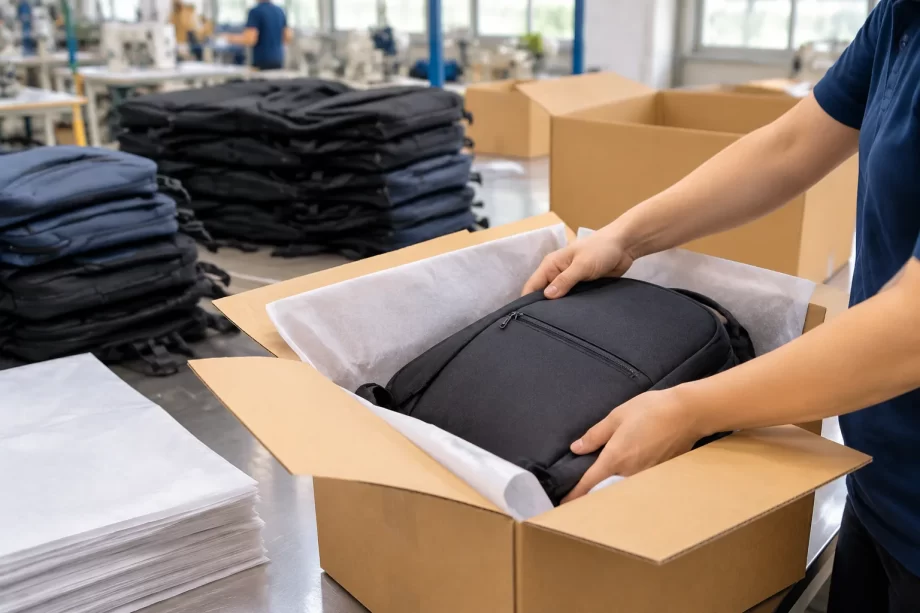
Packing station with folded backpacks and open corrugated cartons
A backpack is light, bulky and compressible. That combination is gentle on the carton floor and brutal on the carton walls, because a stack of light cartons in a container leans, settles and vibrates for weeks. A box that survives a pallet in the warehouse can still arrive crushed after four weeks at sea.
Carton damage is rarely one failure. It is a chain: board strength, internal void, stacking load, handling, moisture and transit time, each taking a small margin until the box has none left.
Where Carton Damage Comes From
The useful starting point is a damage log that records the failure location on the carton: corner, edge, face, top or base. Corner crush points to handling and stacking, face bulge points to insufficient board strength, base failure points to weight per carton, and a wet top layer points to container condensation rather than to anything the packer did.
Damage is usually attributed to the carrier. In most programmes the dominant causes are upstream, and they are measurable.
The Cause Table
Cause
Share of cases
Insufficient board grade
High
Void inside the carton
High
Over stacked pallets
Moderate
Handling at transfer
Moderate
Moisture absorption
Moderate
Poor sealing
Low
The Stage Table
Stage
Typical damage
Packing
Corner crush
Pallet build
Wall bulge
Warehouse
Stack collapse
Loading
Edge scuff
Ocean transit
Sweat and soften
Final delivery
Puncture
The Where Burden Table
Consequence
Effect
Rejected delivery
Full claim
Repacking
Labour
Markdown
Margin
Return freight
Direct cost
Brand perception
Orders
Insurance excess
Uninsured
Carton Specification Basics
Specify by measured value rather than by trade name. Two suppliers describing a box as double wall can deliver boards whose edge crush values differ by a third, and the difference only becomes visible when a stack of one collapses and a stack of the other does not.
Board grade, flute and box style decide how a carton behaves under load, and none of them can be judged by looking at the box.
The Board Table
Grade
Character
Single wall
Light goods
Double wall
Export standard
Triple wall
Heavy or long
Recycled content
Softer
Virgin kraft
Stronger
Coated
Moisture resistant
The Flute Table
Flute
Property
A
Thick, cushioning
B
Thin, crush resistant
C
Balanced
E
Fine, print quality
BC
Double wall
EB
Strong and thin
The Style Table
Style
Use
Regular slotted
Default
Full overlap
Stronger base
Half slotted
With lid
Telescopic
Tall goods
Die cut
Retail
Bliss box
Heavy goods
Measuring Board Strength
Board is sold by grade and behaves by test, and the two agree only when the tests are actually run on the delivered lot.
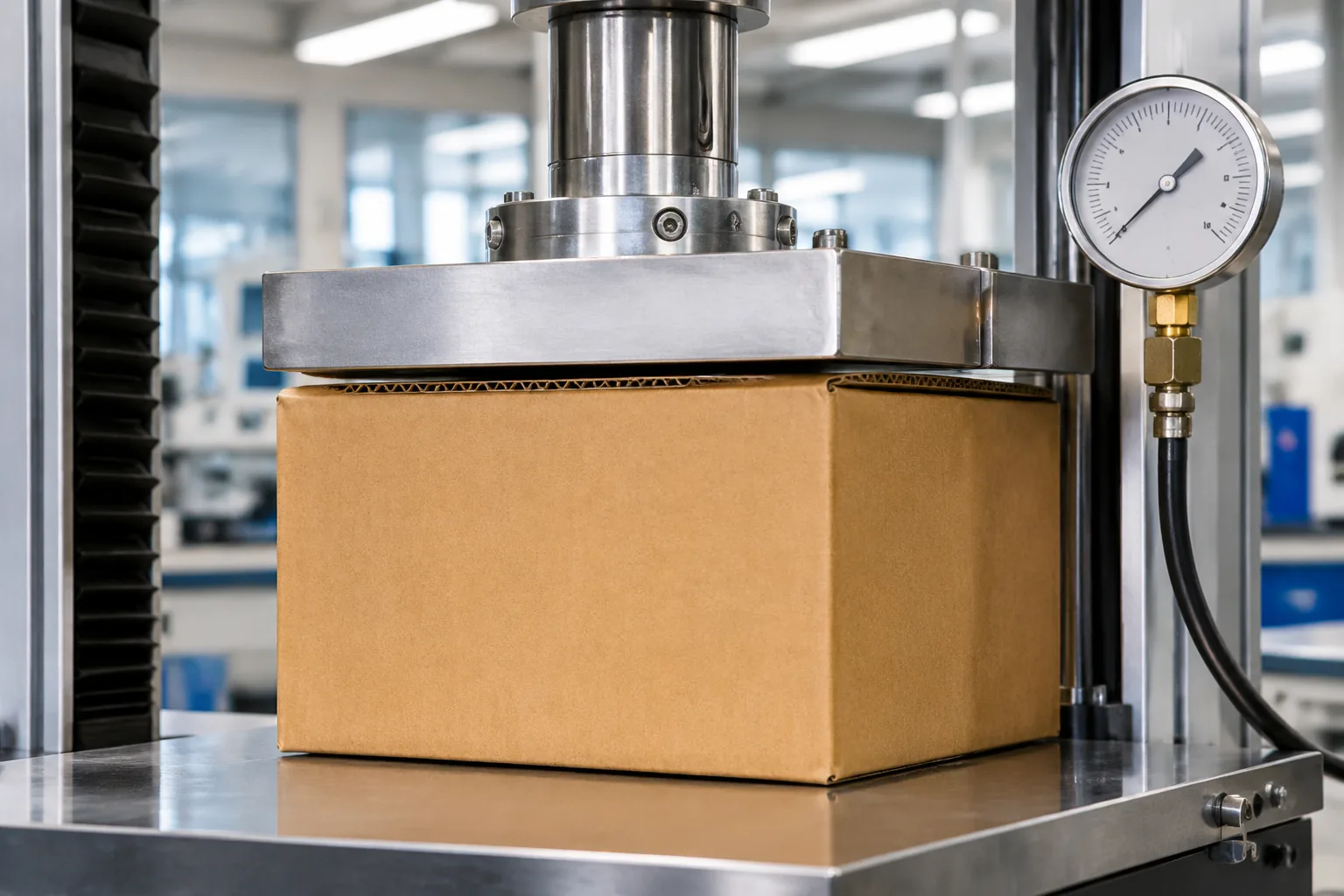
Corrugated carton under a compression testing machine
The Measuring Protocol Table
Test
Measures
Burst
Puncture strength
Edge crush
Vertical load
Compression
Stack capacity
Cobb
Water absorbency
Drop
Impact tolerance
Vibration
Transit endurance
The Report Table
Item
Content
Grade
Declared
Flute
Type
ECT value
Measured
Burst value
Measured
Moisture
Percent
Certificate
Supplier
The Measuring Tolerance Table
Situation
Action
Matches spec
Use
Below spec
Reject lot
Variable between lots
Sample each
No certificate
Test in house
Damaged on arrival
Claim supplier
Storage damp
Condition
Calculating Stack Load
Work the sum downwards from the top of the pallet, not upwards from the floor. The bottom carton carries every carton above it, plus a margin for the voyage, and that figure is what the compression test has to exceed. Factories that calculate only the pallet weight usually discover the mistake at the destination.
A carton fails when the load above it exceeds what the board can hold for the time it must hold it, and time is the part most factories forget.
The Load Table
Factor
Effect
Units per carton
Weight
Cartons per layer
Distribution
Layers in stack
Multiplier
Pallet height
Constraint
Storage weeks
Derating
Humidity
Derating
The Derating Table
Condition
Allowance
Short storage
Small
Weeks in warehouse
Moderate
Ocean transit
Large
High humidity
Large
Long term stacking
Largest
Refrigerated
Special
The Calculating Audit Table
Step
Purpose
Weigh carton
Base load
Count layers
Multiplier
Apply safety factor
Margin
Compare to ECT
Verdict
Adjust height
Fix
Record
Reference
Internal Protection and Void Fill
Bag cartons fail differently from box cartons because the content compresses. A carton packed full on the line settles within days, leaving space at the top, and from then on every carton above it rides on the board rather than on the goods. Adding a light fill or planning for settlement is cheaper than upgrading the board.
The void inside a carton is the single cheapest thing to fix and the single most common cause of crushed corners.
The Fill Table
Method
Suits
Kraft paper
Light bags
Tissue
Surface protection
Air pillows
Voids
Corrugated insert
Structure
Divider
Multiple units
Custom fit
Premium
The Internal Guard Table
Risk
Protection
Corner crush
Corner pads
Surface rub
Poly bag
Hardware scratch
Foam wrap
Strap crease
Tissue interleave
Moisture
Desiccant
Dust
Sealed bag
The Rule Table
Rule
Reason
No movement when shaken
Void eliminated
Weight centred
Stability
Heavy at bottom
Load path
No hard contact
Abrasion
Bag sealed
Moisture
One layer logic
Unpacking
Sealing and Taping Standards
Pressure matters as much as tape choice. A hand dispenser applying tape without firm pressure leaves a seam that looks closed and opens under vibration, and the failure is invisible in the loading photograph because the tape was there when the photo was taken.
A seal is a structural joint. A carton that opens in transit loses its contents and its stacking strength at the same moment.
The Tape Table
Type
Property
Acrylic
General
Hot melt
Cold resistance
Water activated
Tamper evident
Reinforced
Heavy cartons
Paper
Recyclable
Printed
Brand
The Method Table
Method
Strength
Single centre strip
Weak
H pattern
Standard
Full wrap
Strong
Double centre
Moderate
Stapled plus tape
Very strong
Banded
Extra
The Inspection Table
Check
Standard
Adhesion
No lift
Alignment
Straight
Coverage
Specified
Ends
Overlap
Print
Legible
Clean surface
Before
Palletisation and Edge Protection
Corner boards do more work than most packers expect. They carry vertical load past the carton corners, which are the weakest point of any box, and they spread the pressure of strapping so the top layer is not cut into. A pallet with boards and film usually survives handling that destroys the same pallet without them.
The pallet is the unit that gets handled, so its stability decides how the cartons are treated by every machine and driver in the chain.
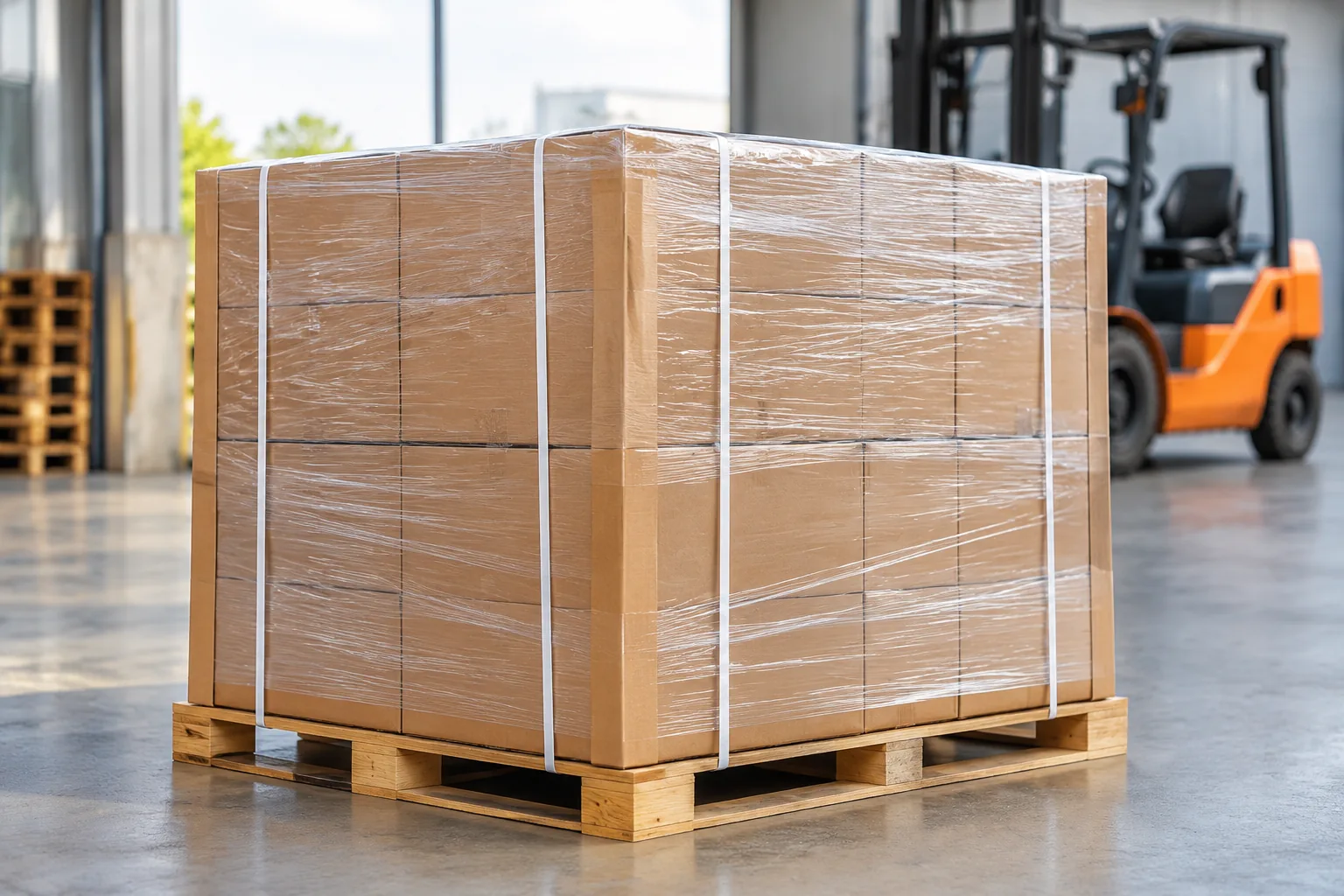
Palletised cartons with stretch film, corner boards and strapping
The Palletisation Pallet Table
Element
Purpose
Base
Load bearing
Layer pattern
Interlock
Corner board
Edge strength
Stretch film
Containment
Strapping
Vertical hold
Top cap
Protection
The Palletisation Flaw Table
Pattern
Stability
Column
Best strength
Interlock
Best stability
Pinwheel
Mixed
Brick
Simple
Chimney
Avoid
Mixed sizes
Poor
The Wrap Table
Parameter
Standard
Film tension
Firm, no crush
Turns
Specified
Base wrap
Include pallet
Top cover
Water shedding
Straps
Two minimum
Label visible
Yes
Container Loading and Bracing
Loading is where packing quality is either preserved or wasted, and the same load can be stable or destructive depending on the last two hours.
The Loading Table
Factor
Control
Weight distribution
Balanced
Wall gap
Filled
Door end
Braced
Stack height
To plan
Air bags
Gap fill
Photography
Record
The Bracing Table
Method
Use
Airbag
Vertical gap
Timber
Floor to ceiling
Strapping
Anchored load
Bar
Horizontal
Wedge
Small gap
Net
Light cartons
The Condition Table
Risk
Check
Container rain
Inspection
Floor damage
Walk through
Odour
Smell test
Holes
Light test
Cleanliness
Sweep
Seal
Number recorded
Moisture and Container Rain
Water damage often looks like crush damage by the time it reaches the customer, because a damp carton loses most of its stacking strength before it visibly fails.
Board absorbs moisture from the air, and a container moving between climates condenses water on the roof and inner walls. The resulting drip lands on the top layer first, which is why cartons at the top of a stack show damage while the lower ones look fine.
The Moisture Table
Source
Timing
Humid packing day
Immediate
Container sweat
Transit
Wet pallet
Storage
Roof leak
Handling
Floor water
Yard
Condensation
Temperature shift
The Moisture Measure Table
Measure
Effect
Desiccant
Absorbs vapour
Liner bag
Barrier
Top cap
Drip shield
Dry pallet
Prevents wick
Container check
No leaks
Packing humidity
Recorded
The Moisture Proof Table
Sign
Meaning
Water stain line
Standing water
Soft corners
Absorbed moisture
Musty smell
Long exposure
Mildew spots
Wet goods
Dry centre
Drip, not flood
Rusted hardware
Vapour
Handling at Transfer Points
Every transfer is an opportunity for damage, and the same carton may be handled a dozen times between the packing line and the customer’s dock.
Terminal handling is the least visible part of the chain and the hardest to control, so the packing has to assume a level of treatment worse than the factory would like. That assumption is what edge protection and internal fill are really buying.
The Handling Table
Point
Risk
Factory forklift
Fork impact
Warehouse stack
Compression
Truck loading
Drop
Terminal sort
Tipping
Rail or barge
Vibration
Final delivery
Manual carry
The Handling Guard Table
Risk
Measure
Fork impact
Corner boards
Stacking
Load plan
Drop
Internal fill
Tipping
Pallet stability
Vibration
Tight wrap
Manual carry
Handle holes
The Training Table
Role
Standard
Packer
Fill and seal
Forklift driver
Pallet handling
Loader
Stack and brace
Supervisor
Checklist
Warehouse
Storage height
Courier
Instructions
Packing Line Discipline
Packing is repetitive work performed under time pressure, which makes it exactly the kind of process that drifts without a written standard.
The drift is rarely dramatic. A packer who runs short of tissue uses less; a team under deadline stacks one layer higher; a new starter copies the person beside them rather than the work instruction. Each small change moves the failure point closer.
The Standard Table
Element
Specified
Units per carton
Fixed
Fill material
Type and amount
Tape pattern
H pattern
Label position
Fixed
Carton orientation
Declared
Seal check
Every carton
The Drift Table
Signal
Cause
Cartons heavier
Extra units
Lighter
Missing fill
Tape varies
Different operator
Label skewed
Rushed
Corners soft
Box softened
Mixed contents
Line change
The Packing Measure Table
Control
Frequency
First carton check
Each run
Random weight check
Hourly
Tape audit
Per shift
Photo of stack
Per lot
Retained sample
Per order
Feedback
Weekly
Testing Before Shipping
A packing specification that has never been tested is an opinion. A short pre-shipment test programme converts it into a claim the factory can defend.
The most useful sequence is cheap and quick: compression on a loaded carton, a drop test from handling height, and a vibration test that simulates road and rail. If the carton survives all three with corners intact, the design is plausible; if it fails, the failure usually happens in the first ten minutes.
The Testing Protocol Table
Test
Simulates
Compression
Stack load
Drop
Handling impact
Vibration
Road and rail
Incline
Tipping
Humidity
Climate
Impact
Fork strike
The Protocol Table
Element
Requirement
Sample
Production carton
Loading
Actual goods
Conditioning
Humidity first
Height
Handling height
Pass criteria
No crease
Record
Photos
The Outcome Table
Result
Response
Pass all
Release
Fail compression
Upgrade board
Fail drop
Add fill
Fail vibration
Tighten wrap
Fail humidity
Add barrier
Borderline
Test more units
Marking and Handling Symbols
Marking does not prevent damage directly, but it changes how people handle the box, and that is often the difference between a scuff and a puncture.
The Marking Mark Table
Mark
Purpose
Carton number
Identification
Gross weight
Lifting
Dimensions
Planning
Origin
Customs
Handling symbols
Care
Batch code
Traceability
The Symbol Table
Symbol
Meaning
Umbrella
Keep dry
Glass
Fragile
Arrows up
This way up
Stack limit
Do not exceed
Hook
Do not use hooks
Recycle
Material
The Compliance Table
Market
Requirement
EU
Wood packaging
US
ISPM 15
UK
Same
Asia
Varies
Retail
Barcodes
Carrier
Label format
Specification and Purchase Order Clauses
Damage prevention belongs in the purchase order, because a requirement that is not written down becomes a preference and then disappears.
The Clause Table
Clause
Content
Board grade
Named value
Box style
Specified
Units per carton
Fixed
Fill method
Described
Tape pattern
Drawn
Pallet spec
Standard
The Specification Tolerance Table
Item
Tolerance
Board grade
Certificate
Weight per carton
Range
Dimensions
Plus or minus
Compression
Minimum
Marking
Correct
Seal
Visual
The Dispute Table
Situation
Basis
Crush on arrival
Compression data
Wet goods
Moisture record
Short contents
Weight record
Wrong marks
Photo
Tape failure
Seal audit
Pallet collapse
Pattern photo
Measuring Damage Rates
Split the rate by customer as well. A single large buyer receiving full containers on a direct route will show a very different rate from a group of small buyers receiving consolidated shipments through a hub, and averaging the two hides both problems.
You cannot reduce a damage rate you do not measure, and most factories measure it only when a claim arrives, which is a biased sample by definition.
The unit of measurement matters. Damage per shipment hides the difference between a small order that lost two cartons and a large one that lost two, so express the rate per thousand cartons and per thousand units, and split it by cause and by route.
Receiving dock inspection of a crushed and water stained carton
The Metric Table
Metric
Definition
Carton damage rate
Damaged over shipped
Unit damage rate
Units lost
Claim rate
Claims over shipments
Cause split
By category
Route split
By lane
Trend
Monthly
The Source Table
Source
Reliability
Customer report
High, delayed
Receiving photos
High
Carrier survey
Medium
Forwarder note
Medium
Driver comment
Low
Internal audit
Preventive
The Review Table
Cadence
Decision
Per shipment
Immediate fix
Monthly
Route review
Quarterly
Spec review
Per season
Height review
Annual
Supplier review
Per claim
Root cause
Claims and Evidence
A damage claim is decided on documents, and the documents are produced before the shipment leaves, not after it arrives damaged.
The evidence set is short: the packing specification, the carton test report, photographs of the load before sealing, the seal number, and the receiving condition report. A factory holding those five items argues from fact; one holding none argues from memory.
The Claims Proof Table
Item
Timing
Packing spec
Before order
Test report
Per design
Load photos
At loading
Seal number
At closing
Receiving report
On arrival
Survey
On dispute
The Claim Table
Step
Action
1
Note on delivery
2
Photograph condition
3
Notify carrier
4
Preserve packaging
5
Submit documents
6
Follow up
The Weak Table
Gap
Consequence
No photos
Denied claim
No test data
Disputed cause
Packaging discarded
No inspection
Late notice
Excluded
No seal record
Unclear liability
Verbal agreement
Unprovable
Cost Trade Offs
Better packing costs money and damage costs more, but the trade is not linear and the sensible point is rarely the cheapest carton or the strongest one.
The Cost Burden Table
Element
Direction
Board upgrade
Plus cost
Fill material
Plus cost
Labour time
Plus cost
Carton size
Minus freight
Damage reduction
Minus cost
Claim admin
Minus cost
The Balance Table
Level
Character
Minimum
Cheapest, fragile
Standard
Typical export
Reinforced
High value
Over specified
Wasteful
Custom fit
Best protection
Mixed by route
Smart
The Decision Table
Condition
Choice
Short route
Standard
Long ocean
Reinforced
High value
Custom fit
Transhipment
Reinforced
Humid destination
Barrier
Repeat claims
Upgrade
Working With Carton Suppliers
The carton supplier is part of the quality system, and treating them as a price list is how a shipment ends up in boxes that were never going to survive.
A useful arrangement is a specification with named test values, a certificate per lot, a retained sample of each delivery, and a written rule for what happens when a lot fails. Cartons are cheap to re-make before filling and impossible to re-make after shipping.
The Supplier Table
Item
Agreed
Grade
Named
Flute
Named
Test values
Minimum
Certificate
Per lot
Sample
Retained
Lead time
Days
The Failure Table
Problem
Response
Soft board
Reject lot
Wrong flute
Reject lot
Print error
Rework
Late delivery
Expedite
Repeated issue
Second source
Price pressure
Re-spec
The Collaboration Table
Practice
Benefit
Share route data
Right grade
Share claim costs
Joint incentive
Test together
Trust
Forecast volume
Price
Standard sizes
Stock
Review annually
Improvement
Long Routes and Peak Season
Transit time and season both push a carton closer to failure, and the packing that works in a mild April does not automatically work on a December sailing.
The Route Table
Route factor
Effect
Transit weeks
Derating
Climate change
Condensation
Transhipment
Handling
Rail leg
Vibration
Tropical humidity
Softening
Winter cold
Tape failure
The Season Table
Season
Risk
Peak output
Rushed packing
Rainy season
Moisture
Holiday port congestion
Storage time
Typhoon window
Delays
Winter
Adhesive
New year
Staff change
The Adjustment Table
Condition
Change
Long ocean
Higher grade
Transhipment
Corner boards
Humid
Desiccant
Cold
Hot melt tape
Peak
Extra inspection
Congestion
Shorter storage
Warehouse Storage Practice
Cartons are often damaged before the container is loaded, in the factory’s own warehouse, and the cause is usually stack height and time.
The Storage Table
Factor
Standard
Stack height
Below test limit
Floor
Dry and level
Pallets
Intact
Aisle
Clear
Rotation
First in first out
Cover
Dust and drip
The Warehouse Exposure Table
Risk
Control
Over stacking
Height mark
Moisture
Off floor
Fork damage
Aisle width
Sun fade
Away from window
Pest
Programme
Long storage
Age label
The Warehouse Audit Table
Frequency
Action
Daily
Visual walk
Weekly
Height audit
Monthly
Condition report
Pre shipment
Re inspect
After rain
Roof check
Per lot
Record age
Buyer Requirements and Retail Packaging
Retail packaging and transport packing pull in opposite directions, and the compromise has to be designed rather than negotiated at the last minute.
A printed retail carton is attractive and weak. An export carton is strong and unglamorous. The usual solution is a plain outer carton with the retail unit inside, and the packing line needs to know which layer carries the protection.
The Layer Table
Layer
Function
Poly bag
Dust and moisture
Retail box
Presentation
Inner divider
Separation
Outer carton
Transport
Pallet
Handling
Container
Transit
The Requirement Table
Buyer ask
Implication
Retail ready
Double packing
Amazon ready
Label rules
Flat pack
Folding standard
Hanging
Hook strength
Barcoded
Scan accuracy
Recyclable
Material choice
The Compromise Table
Conflict
Resolution
Print versus strength
Outer plain
Size versus fill
Custom insert
Cost versus protection
Route based
Unboxing versus safety
Inner cushion
Recyclable versus sturdy
Test both
Speed versus quality
Line check
Retained Samples and Improvement
Keep the sample in the same conditions as the goods would have experienced where possible, and label it with the lot, the date and the container number. A carton kept on a dry shelf for a year tells you almost nothing about a carton that spent five weeks at ninety per cent humidity.
A retained carton from each shipment is the cheapest diagnostic tool available, and it answers questions that photographs cannot.
The Sample Table
Item
Kept
Carton
One per lot
Fill sample
Same
Tape sample
Same
Label
Photo
Load photo
Digital
Test report
Filed
The Diagnosis Table
Question
Sample tells
Was board soft
Feel and edge
Was fill missing
Open carton
Was tape wrong
Inspect
Was weight high
Weigh
Was it damp
Stain
Was it crushed
Crease
The Improvement Table
Finding
Action
Corner crush
Corner boards
Wall bulge
Higher grade
Loose contents
More fill
Tape lift
Hot melt
Moisture
Desiccant
Repeat complaint
Spec change
Common Failure Patterns
Certain failures recur across export programmes, and each one has a known cause that can be checked in minutes.
The Common Flaw Table
Pattern
Likely cause
Top layer crushed
Stack too high
All corners soft
Board too light
One end collapsed
Fork impact
Contents rattling
Void left
Bags creased
No interleave
Wet only on top
Container drip
The Common Audit Table
Symptom
First check
Crush
Stack height
Bulge
Units per carton
Tear
Edge protection
Moisture
Packing humidity
Opened seal
Tape pattern
Mixed contents
Line change
The Fix Table
Cause
Remedy
Stack height
Lower it
Units per carton
Reduce
Edge protection
Add boards
Humidity
Control room
Tape pattern
Standardise
Line discipline
Training
Pre Shipment Checklist
Specification
Item
Done
Board grade named
☐
Box style confirmed
☐
Units per carton fixed
☐
Fill method written
☐
Tape pattern drawn
☐
Pallet spec set
☐
Execution
Item
Done
Cartons meet grade
☐
Fill present
☐
Weight checked
☐
Seal audited
☐
Marks correct
☐
Pallet wrapped
☐
Closure
Item
Done
Load photos
☐
Seal number
☐
Sample retained
☐
Test report filed
☐
Buyer informed
☐
Claim pack ready
☐
FAQ
Is double wall board always the right choice for export cartons?
No. Double wall is the sensible default for ocean freight, but the right answer depends on load per carton, stack height and transit time. A light carton of soft bags stacked four high on a direct route can be fine in single wall, while a heavy carton stacked six high through a transhipment port needs double wall plus edge protection. Ask for the test values, not just the grade name.
How much void inside a carton is acceptable?
Practically none at the top and sides. The test is simple: seal the carton and shake it gently. If the contents move, the carton will settle in transit and the stack above it will lean. Fill with paper, air pillows or a corrugated insert until movement stops, and check that the fill does not push the walls outward.
Why do cartons arrive crushed when the pallet looks fine?
Usually because the load above them was heavier or higher than the compression strength allowed for, and the failure happened gradually over weeks. Cartons also lose strength in humid conditions, so a box that passed a compression test in a dry lab can fail in a container crossing the tropics. Apply a derating factor for transit time and climate.
How do we prove damage happened in transit rather than at packing?
With records made before the container closed: carton test values, load photographs showing intact cartons, seal number, and the receiving condition report. If those exist, the argument is straightforward. If the packaging was discarded at the receiving end, the claim usually fails regardless of what actually happened.
Does stronger packaging always reduce total cost?
Only up to the point where damage stops being the dominant cost. Board upgrades, fill material and corner boards all add cost per carton, and beyond a certain level the money is better spent on better stacking discipline or shorter storage. Measure damage per thousand cartons first, then upgrade where the rate is concentrated.
What causes tape to lift in cold weather?
Adhesive behaviour. Acrylic tape loses tack at low temperatures, so a carton sealed in a warm factory and shipped through a cold leg can open at the seam. Hot melt tape performs better in cold, and a double centre strip with adequate pressure at application reduces the risk further.
How many cartons should be opened for a pre-shipment check?
Enough to see the whole lot, not just the top layer. A practical approach is to open cartons spread across pallets and stack levels, inspect seal, fill, weight and marks, then photograph the load before closing. The number matters less than the spread, because the failures cluster at the edges and the top of the stack.
Should the carton be designed around the bag or the pallet?
Both, in that order. Design the internal fit so the bag cannot move, then check that the resulting carton footprint divides sensibly into the pallet and the container. A perfectly protective carton with an awkward footprint wastes cube and forces unstable stacks, which creates the damage it was meant to prevent.
Conclusion
Carton damage rates fall when the box is treated as an engineered component rather than a consumable. That means a named board grade with test values, a carton sized to the bag with no movement inside, a stack height computed from compression strength rather than from ceiling height, and a load that is braced and photographed before the doors close.
None of those steps is expensive on its own. What is expensive is discovering the gap at the customer’s dock, when the goods are already late, the packaging has been discarded, and the only remaining evidence is a photograph of a crushed box.
Treat the specification, the packing line and the loading bay as one system, measure damage per thousand cartons, and the rate will tell you where the next improvement belongs.
Wood Packaging and ISPM 15
If the shipment sits on a wooden pallet, the pallet is regulated packaging and its treatment status is checked at the border, not at the factory.
A pallet rejected on arrival can hold an entire container while it is re-treated or replaced, and the cost of that delay usually exceeds the value of the pallet many times over. Buy marked pallets from a supplier who provides the treatment certificate, and keep the certificate with the shipment documents.
The Wood Pallet Table
Type
Treatment
Heat treated
Marked
Methyl bromide
Restricted
Plastic
Exempt
Pressed wood
Exempt
Plywood
Case by case
Reused
Verify mark
The Wood Mark Table
Element
Meaning
IPPC logo
Standard
Country code
Origin
Producer code
Supplier
Treatment code
Method
Year
Batch
Legibility
Required
The Wood Exposure Table
Failure
Consequence
No mark
Rejected
Illegible
Inspection
Wrong treatment
Fumigation
Damaged board
Pallet failure
Wet pallet
Carton damage
Mixed pallets
Confusion
Repacking at Destination
Some buyers repack on arrival for retail, and repacking is where damage created in transit finally becomes visible and chargeable.
The factory cannot control the destination warehouse, but it can reduce the damage that appears during repacking by making the carton easy to open and the contents easy to handle, without staples that tear the retail pack.
The Repack Table
Step
Risk
Open carton
Blade damage
Remove fill
Tearing
Lift unit
Strap catch
Scan label
Wrong code
Re-box
Corner crush
Restack
Instability
The Design Table
Feature
Benefit
Perforated opening
Clean access
No staples
No scratches
Inner divider
Order
Visible label
Speed
Handle hole
Control
Uniform size
Stacking
The Allocation Table
Cost
Bearer
Transit damage
Carrier
Packing defect
Factory
Repack labour
Buyer
Retail damage
Shared
Disposal
Buyer
Claim admin
Claimant
Handover to the Forwarder
The forwarder sees the load after the factory does, and a short handover note prevents the most common excuse in a damage dispute.