
Backpack Fabric Testing: Abrasion, Tear Strength and Color Fastness Standards
Every backpack fabric makes a promise. The label says “durable,” “water-resistant,” or “premium quality” — but a label is a claim, not a fact. The only way to know whether a fabric actually delivers on its promise is to test it, under controlled conditions, against recognized standards.
Fabric testing is the quiet science behind every reliable backpack. It is what separates a 600D polyester that survives three years of school use from one that wears through in six months. It is what tells a manufacturer whether a coating will hold up to rain, whether a color will survive a season of sun, and whether a fabric can handle the load its seams will place on it. Without testing, every durability claim is guesswork.
This guide explains the core fabric tests used in backpack manufacturing — abrasion resistance, tear strength, color fastness, and the supporting tests that round out the picture — from a manufacturer’s perspective: what each test measures, how it is run, what the standards require, what numbers matter for different backpack products, and how to use test results when choosing fabrics and specifying your next line.
- Why Fabric Testing Matters in Backpack Manufacturing
- Abrasion Resistance: How Fabric Survives Rubbing
- Tear Strength: The Silent Failure Mode
- Color Fastness: The Tests Customers Actually See
- The Supporting Test Suite
- Building a Fabric Test Program: What Manufacturers Actually Do
- Specifying Test Requirements in Your Purchase Order
- Interpreting Results and Making Decisions
- From Fabric Tests to Finished Pack Tests
- Testing Costs and Building a Lab
- Common Fabric Testing Mistakes
- FAQ
- Conclusion
Why Fabric Testing Matters in Backpack Manufacturing
Fabric is the largest single material cost in a backpack and the first line of defense against the wear and tear of daily use. Yet fabric quality cannot be judged by eye. Two fabrics that look identical can differ by 3–5× in abrasion resistance, tear strength, or color fastness — differences invisible in a photo and often invisible in a swatch.
What Testing Actually Prevents
- Premature wear — fabric that abrades through in months instead of years.
- Tear failures — a small snag that becomes a long tear because the fabric cannot stop propagation.
- Color complaints — fading, bleeding, and staining that trigger customer returns.
- Coating failure — waterproofing that stops working after a few uses.
- Compliance rejections — failed chemical or physical tests that block market entry.
Manufacturer’s note: When a buyer asks “is this fabric good?” the honest answer is: “good for what?” A fabric is not good or bad in the abstract — it is adequate or inadequate for a specific use, tested against specific standards. The test data tells you whether the fabric matches the product’s real job.
The Cost of Skipping Tests
Skipping fabric testing saves a small amount per meter and can cost an enormous amount per product. The failure math is unforgiving:
- A fabric that fails abrasion early means returns across the whole production run.
- A color that fades in the first season triggers a different complaint class: not “broken,” but “looks cheap” — which is worse for the brand.
- A coating failure discovered in the field, after months of use, is almost impossible to attribute to any one batch.
Testing is not a cost line to minimize — it is an insurance policy with an excellent premium-to-coverage ratio.
Abrasion Resistance: How Fabric Survives Rubbing
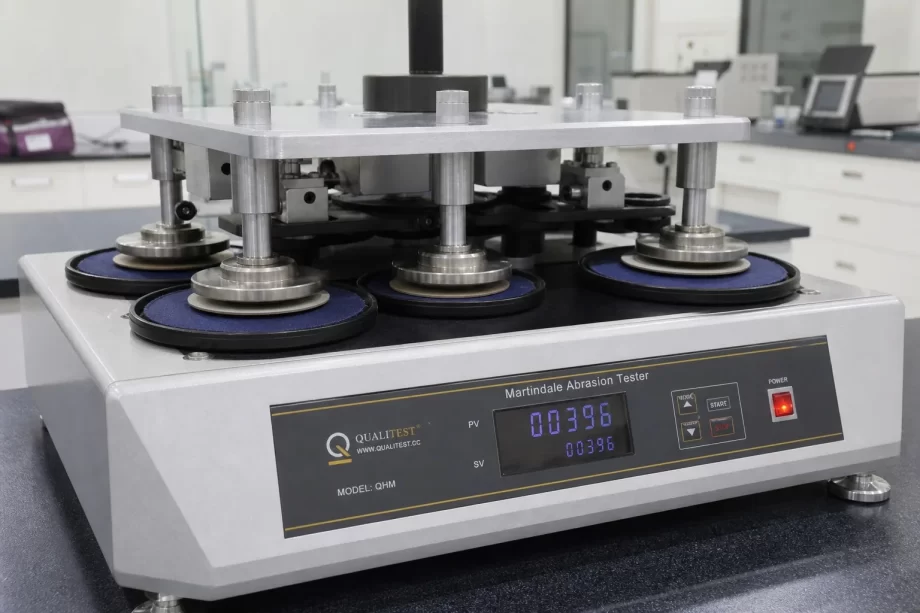
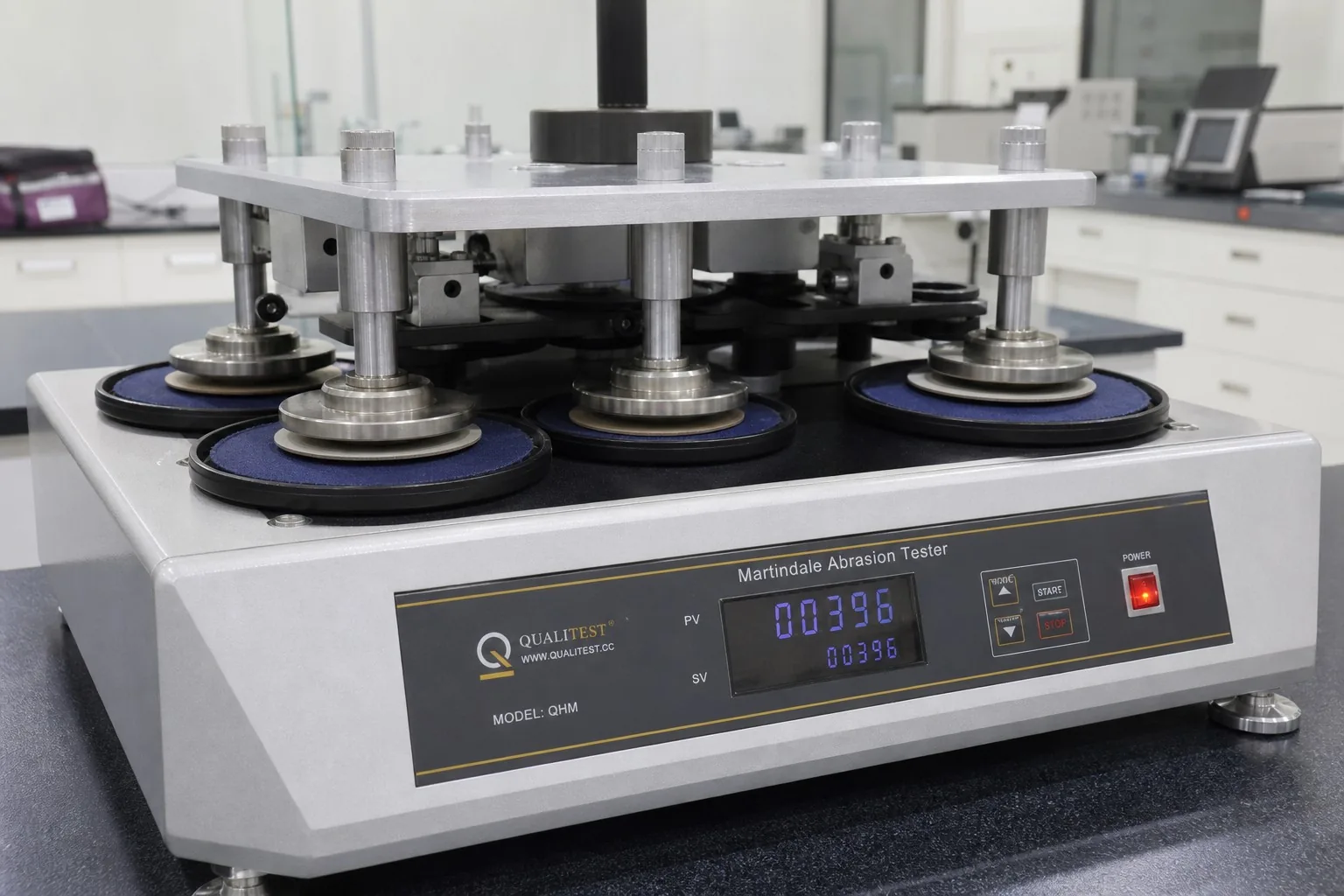
Abrasion resistance measures how well a fabric survives the rubbing, scraping, and friction of daily use. It is the closest proxy for “durability” in the backpack context — the fabric on the bottom of a pack, the contact points at the back, and the edges that rub against surfaces all take constant abrasion.
The Two Main Test Methods
| Test method | Standard | What it does | Typical use |
|---|---|---|---|
| Martindale | ISO 12947, ASTM D4966 | Circular fabric sample rubbed against standard wool fabric in a figure-eight motion | General wear resistance, also used for upholstery |
| Taber | ASTM D3884 | Rotating abrasive wheels rub against a circular sample | Heavier abrasion, coated fabrics, specific wear simulation |
The Martindale Test in Practice
The Martindale test rubs the fabric against a standard abrasive under controlled pressure until a defined endpoint — typically fabric breakdown (a hole) or a specified number of rubs. Results are reported in rubs:
| Application | Typical Martindale requirement |
|---|---|
| Light-use backpack | 10,000–20,000 rubs |
| Standard school/commuter pack | 20,000–40,000 rubs |
| Outdoor / hiking pack | 40,000–60,000+ rubs |
| Heavy-duty / tactical pack | 60,000–100,000+ rubs |
Manufacturer’s note: The rub count alone is not the whole story — the endpoint matters. A fabric can reach 40,000 rubs but look badly worn (fuzz, pilling, color change) at 10,000. Ask for both the rub count and the appearance grade at intervals. A fabric that survives but looks shabby is still a failure in the field.
The Taber Test for Coated Fabrics
The Taber test uses abrasive wheels with a specific load (typically 500–1000 g) and measures cycles to breakthrough or wear-through. It is commonly used for:
- Coated fabrics (PU/TPU) where coating integrity matters
- Heavy materials that would take too long on Martindale
- Comparing specific wear behaviors
Interpreting Abrasion Results
- Fiber type matters — nylon generally outperforms polyester on abrasion at equivalent construction; canvas varies with weight.
- Construction matters — ripstop constructions resist abrasion differently than plain weaves; ballistic weaves are abrasion champions.
- Coating matters — a coating can protect the fabric or degrade its abrasion performance, depending on formulation.
- The context matters — a fabric with 30,000 Martindale rubs is plenty for a commuter pack and inadequate for a tactical pack. Match the number to the product.
Tear Strength: The Silent Failure Mode
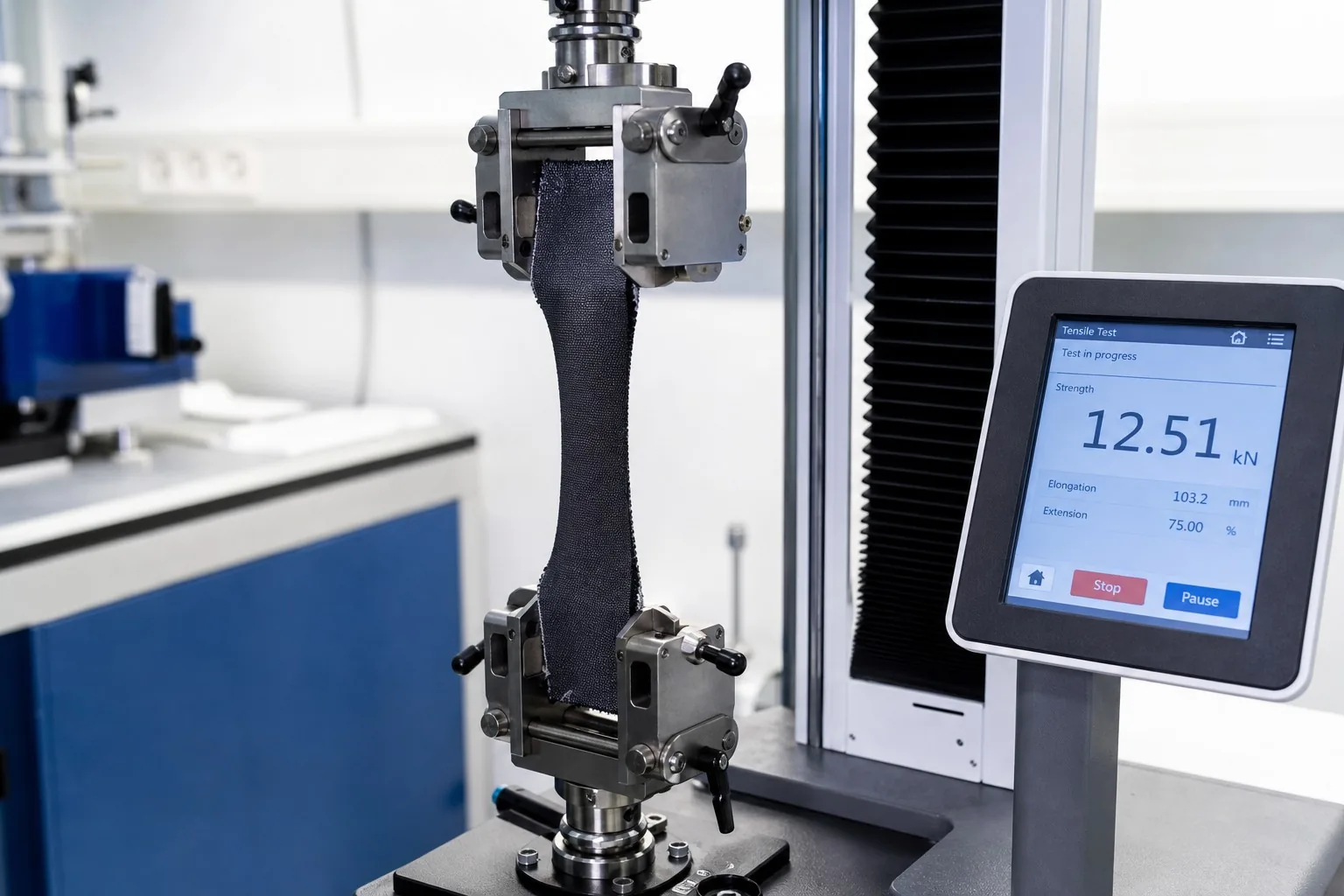
Tear strength measures how well a fabric resists tearing once a cut or puncture has started. This is a different property from abrasion — a fabric can be extremely abrasion-resistant and still tear easily if a snag creates a starting point.
Why Tear Strength Is Critical for Backpacks
Every backpack eventually gets snagged: a branch, a nail, a sharp corner, a zipper catch. When that happens, the question is not whether the fabric tears — it is whether the tear stops at the snag or runs the length of the pack. Tear strength determines the answer.
The Test Methods
| Test method | Standard | What it does |
|---|---|---|
| Tongue tear | ASTM D2261, ISO 13937-2 | Two tongues of fabric are pulled apart at a cut; measures force to propagate the tear |
| Trapezoid tear | ASTM D5587, ISO 13937-3 | Fabric cut in a trapezoid shape, pulled to tear; measures tear resistance |
| Wing tear | ISO 13937-1 | Similar principle with different sample geometry |
Typical Tear Strength Values
Tear strength is reported in Newtons (N) or pounds-force (lbf). Representative values for backpack fabrics:
| Fabric | Typical tear strength |
|---|---|
| 210D nylon | 8–15 N |
| 420D nylon | 15–25 N |
| 600D polyester | 20–35 N |
| 900D polyester | 30–50 N |
| 1680D ballistic nylon | 50–80+ N |
| 12 oz canvas | 40–70 N |
Manufacturer’s note: Tear strength and denier do not move together automatically. A 600D polyester with poor weaving can tear at 15 N while a good 420D nylon resists at 25 N. When comparing fabrics, always compare test data, not just the denier label.
The Ripstop Connection
Ripstop fabrics are designed specifically to limit tear propagation: the grid of reinforcement threads stops tears from running across the fabric. A ripstop construction typically improves tear strength by 30–100% over a plain weave of the same base fabric. This is why lightweight technical packs use ripstop nylon — they get tear resistance without the weight of heavier fabrics.
Color Fastness: The Tests Customers Actually See
Abrasion and tear failures are hidden until they happen, but color failures are visible from day one. Color fastness testing verifies that a fabric’s color survives the real-world attacks: washing, sunlight, rubbing, and perspiration.
The Core Color Fastness Tests
| Test | Standard | What it verifies |
|---|---|---|
| Washing fastness | ISO 105-C06 | Color survives laundering |
| Light fastness | ISO 105-B02 | Color survives sun exposure (Xenon arc) |
| Rubbing (crocking) fastness | ISO 105-X12 | Color does not transfer when rubbed |
| Perspiration fastness | ISO 105-E04 | Color survives sweat exposure |
| Water fastness | ISO 105-E01 | Color survives water exposure |
The Grading Scale
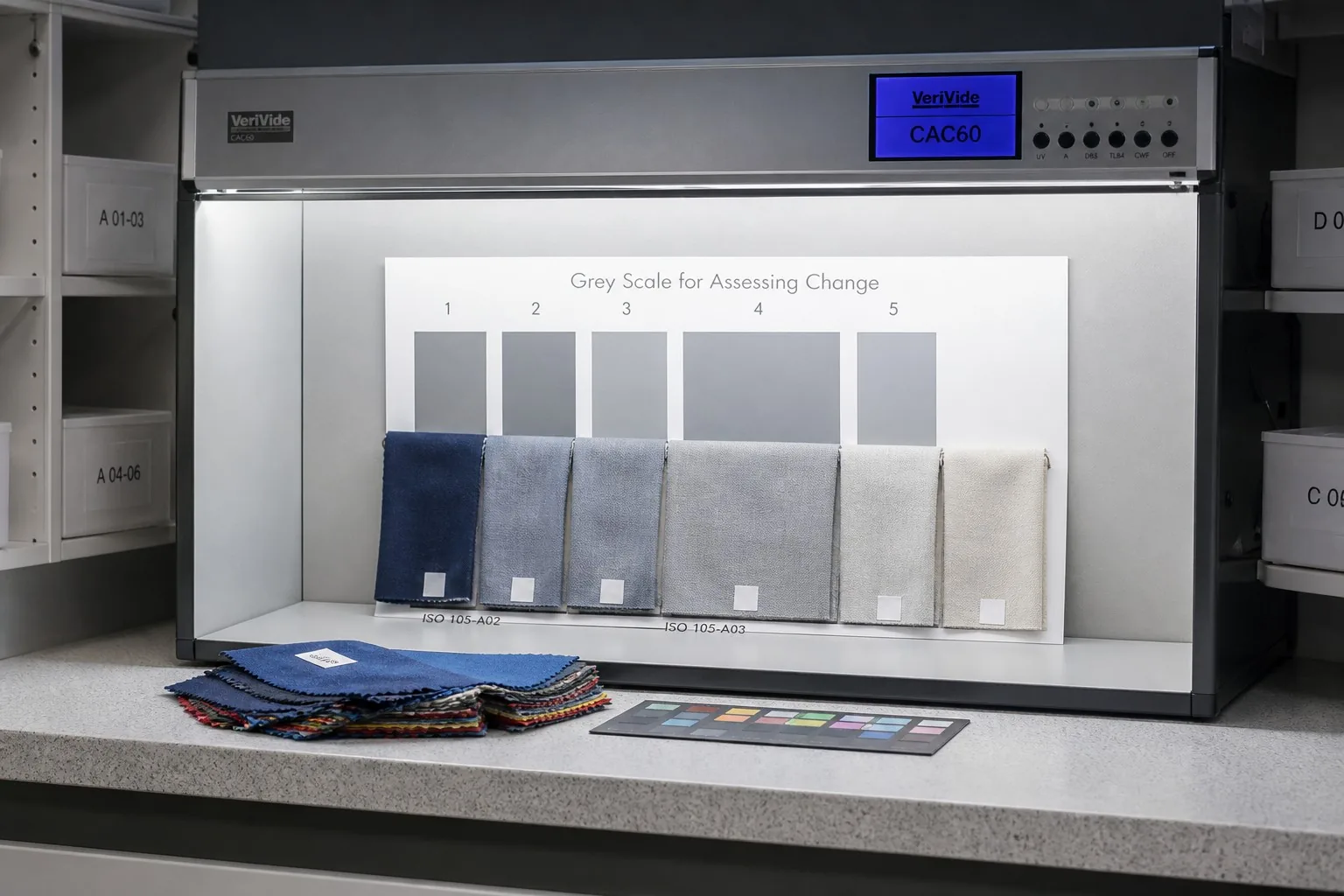
Color fastness is graded on a 1–5 scale (or 1–8 for light fastness), comparing the tested sample against a standard grey scale:
| Grade | Meaning | Backpack relevance |
|---|---|---|
| 5 (or 8) | No change / no transfer | Excellent |
| 4 | Slight change | Good — acceptable for most packs |
| 3 | Noticeable change | Borderline; risk of complaints |
| 1–2 | Severe change | Unacceptable for visible areas |
What Grades to Specify
| Use | Recommended minimum grade |
|---|---|
| Light fastness (shell fabric) | 4+ (outdoor packs: 5+) |
| Washing fastness | 4+ |
| Rubbing fastness (dry) | 4+ |
| Rubbing fastness (wet) | 3–4 |
| Perspiration fastness | 3.5–4 |
Manufacturer’s note: Light fastness is the most commonly mismanaged spec. A school pack that lives indoors may never need high light fastness, while a hiking pack that sits in the sun all day absolutely does. Specify light fastness by the product’s real sun exposure — not by a generic “premium” default.
The Shading Problem
Beyond individual color fastness, there is the shading problem: different dye lots of the same color code can differ visibly. Shading is controlled by:
- Master swatch retention — the approved color swatch is kept as the standard.
- Shade band — an agreed tolerance range (e.g., ΔE ≤ 1.5) for production acceptance.
- Lot blending — mixing dye lots before cutting so panels from different rolls match.
The Color Fastness Failure Modes
- Fading — light exposure (or poor dye) reduces color intensity over time.
- Bleeding — color transfers to other fabrics or surfaces when wet (a dark lining bleeding onto light clothing is a classic complaint).
- Crocking — color rubs off onto hands, clothes, or surfaces (common with deep dyes on synthetic fibers).
- Migration — color moves within the fabric over time (plasticizers in coated fabrics can cause this).
The Supporting Test Suite
Beyond the big three, a complete fabric testing program for backpacks includes several supporting tests:
Water Resistance Tests
| Test | Standard | What it measures |
|---|---|---|
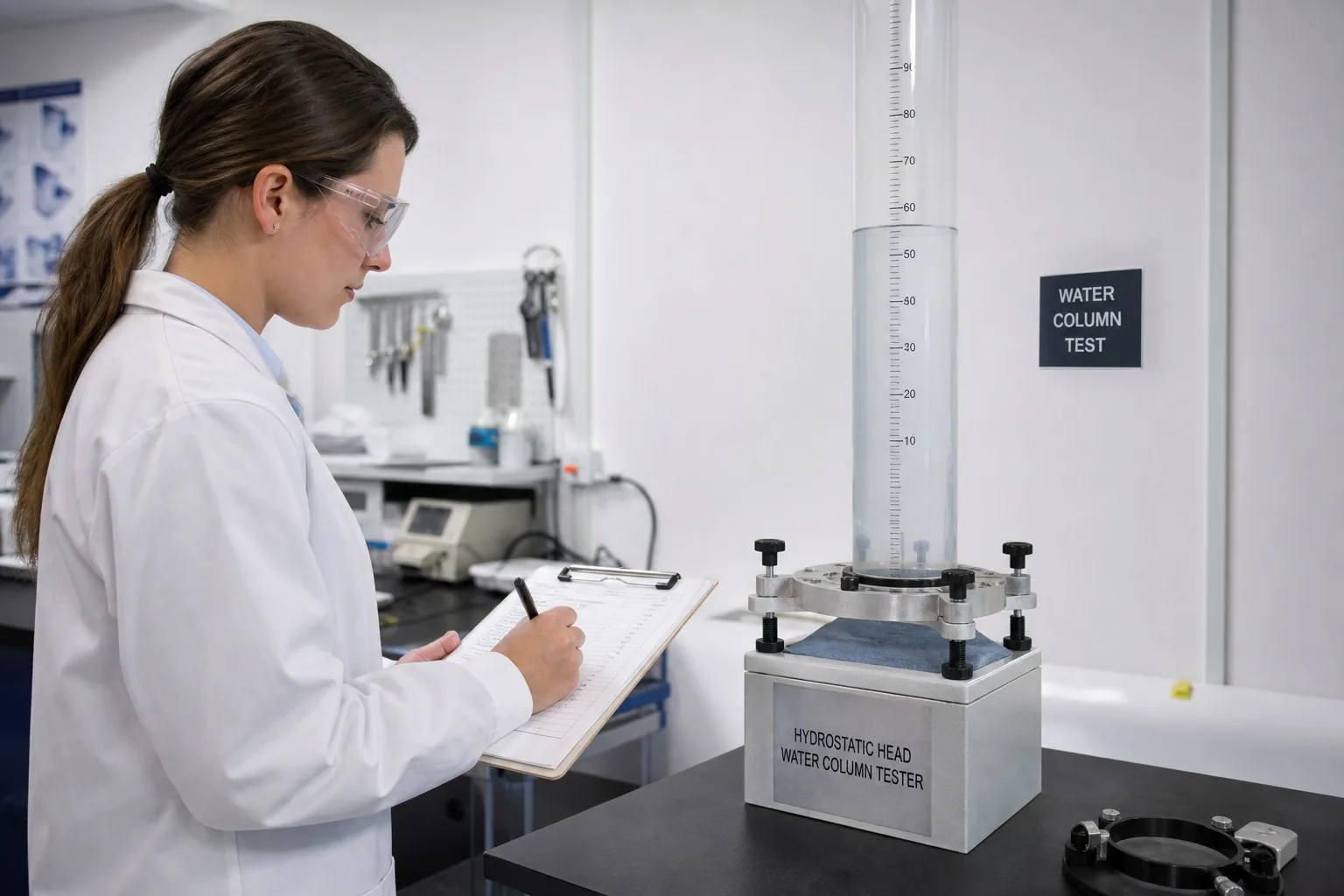
| Hydrostatic head (water column) | ISO 811 | Pressure the fabric resists before water penetrates (mm) |
| Spray test | ISO 4920 | Surface water repellency (beading) graded 1–5 |
| Water absorption | Varies | How much water the fabric soaks up |
These tests matter for coated and DWR-treated fabrics. The hydrostatic head rating (e.g., 3000 mm) is the number to specify for weather protection.
Seam Strength and Slippage
Fabric testing does not stop at the fabric — seams are tested too:
- Seam strength (ISO 13935) — force to break a sewn seam.
- Seam slippage (ISO 13936) — how much the seam opens under load.
These tests connect fabric quality to construction quality: a fabric with poor seam-holding behavior will produce weak packs regardless of sewing quality.
Physical Properties
- GSM (weight) — grams per square meter, verified against spec.
- Dimensional stability — shrinkage after washing (a lining that shrinks can distort the pack).
- Tensile strength — the fabric’s breaking strength under tension (less critical for packs than tear/abrasion, but relevant for straps and load paths).
Chemical and Compliance Tests
Depending on the market, additional chemical tests apply:
- REACH restricted substances — EU market requirement.
- CPSIA lead/phthalates — children’s products for the US market.
- Formaldehyde content — some apparel regulations.
- OEKO-TEX Standard 100 — voluntary certification covering harmful substances.
- PFAS testing — relevant for DWR-treated fabrics as regulations tighten.
Building a Fabric Test Program: What Manufacturers Actually Do
A fabric testing program does not require a full laboratory in-house. The practical structure used by most backpack factories:
The Three Testing Levels
| Level | What it covers | How it runs |
|---|---|---|
| Level 1: Incoming verification | Basic checks: GSM, color match, visual defects, coating presence | In-house, fast, every batch |
| Level 2: Performance testing | Abrasion, tear, color fastness, water resistance | Contracted lab or in-house for key tests |
| Level 3: Full compliance | Chemical, regulatory, certification testing | Accredited third-party labs |
In-House vs Third-Party Testing
| Approach | Advantages | Limitations |
|---|---|---|
| In-house | Fast, cheap per test, immediate feedback | Not accredited, operator-dependent |
| Third-party lab | Accredited, defensible, standard-compliant | Slower, cost per test |
The standard practice: use in-house testing for incoming material verification and rapid screening, and third-party accredited labs for the test reports that go to buyers and regulators.
The Test Report You Should Ask For
When evaluating a fabric, ask the supplier (or your factory) for:
- Fabric specification sheet (denier, GSM, weave, coating)
- Abrasion test report (Martindale or Taber, with endpoint and appearance grade)
- Tear strength report (tongue or trapezoid, warp and weft)
- Color fastness reports (light, wash, rub, perspiration)
- Water resistance report (hydrostatic head, spray grade)
- Any compliance certificates (REACH, OEKO-TEX, etc.)
Red Flags in Test Reports
- Missing test method — a report without the standard cited is not verifiable.
- No sample description — which fabric, which batch, which color?
- Only one test — durability is multidimensional; one test cannot prove a fabric.
- Supplier’s own lab only — useful, but not a substitute for accredited testing.
- Unrealistic numbers — a 600D polyester claiming 80,000 Martindale rubs deserves skepticism.
Specifying Test Requirements in Your Purchase Order
Testing belongs in the specification, not left to chance. Here is how to write a test requirement into a purchase order.
The Test Specification Template
| Item | Example requirement |
|---|---|
| Fabric | 600D polyester, plain weave, PU coated |
| Abrasion | Martindale ≥ 30,000 rubs (ISO 12947), no breakdown |
| Tear strength | ≥ 30 N warp and weft (ISO 13937-2) |
| Light fastness | ≥ 4 (ISO 105-B02) |
| Washing fastness | ≥ 4 (ISO 105-C06) |
| Rubbing fastness | Dry ≥ 4, wet ≥ 3 (ISO 105-X12) |
| Hydrostatic head | ≥ 3000 mm (ISO 811) |
| Compliance | REACH compliant, OEKO-TEX class II or equivalent |
Setting Realistic Requirements
The requirements must match the product and price point:
- A school pack at $15 retail cannot carry the same test spec as a $150 hiking pack — and does not need to.
- Over-specifying raises material cost and eliminates suppliers; under-specifying raises failure risk.
- Set the spec by the product’s real use and market, then verify with a sample test before production.
Manufacturer’s note: The best way to set requirements is to test three candidate fabrics and pick the one that meets the spec at the lowest cost — not to pick the cheapest fabric and hope. The test-first approach turns fabric selection from a gamble into a calculation.
When to Test in the Production Cycle
| Stage | Test |
|---|---|
| Material selection | Full performance suite on candidate fabrics |
| Pre-production | Verify the actual production fabric batch |
| First production | Incoming verification on each delivery |
| Ongoing | Batch verification, periodic full re-testing |
Interpreting Results and Making Decisions
The point of testing is decisions. Here is how to use the results:
The Decision Matrix
| Test result | Interpretation | Action |
|---|---|---|
| Abrasion below spec | Fabric wears too fast for the use | Upgrade fabric or reduce use expectations |
| Tear below spec | Snags will become long tears | Add ripstop construction or heavier fabric |
| Color fastness below spec | Fading/bleeding complaints expected | Change dye method (solution-dyed), supplier, or spec |
| Hydrostatic head below spec | Coating inadequate | Increase coating weight or switch to TPU |
| All tests pass | Fabric adequate for the use | Proceed, with batch verification |
The Balanced View
A good fabric is not the one that excels in one test — it is the one that clears every threshold relevant to its product at an acceptable cost. The best fabric for a product is the lowest-cost fabric that passes the full relevant test suite, verified by data.
From Fabric Tests to Finished Pack Tests
Fabric testing validates the material, but a backpack is a system — and the system needs its own testing. Finished pack tests connect fabric performance to the assembled product and catch failures that fabric tests cannot.
The Finished Pack Test Suite
| Test | What it verifies | Typical requirement |
|---|---|---|
| Load test | Pack holds rated weight without seam or strap failure | 10–25 kg depending on category, no failure |
| Drop test | Pack survives impacts (filled with test weight) | Multiple drops from 0.5–1 m, no structural failure |
| Zipper cycle test | Zippers survive repeated opening/closing | 500–10,000 cycles depending on grade |
| Strap pull test | Strap attachments hold under force | Force per spec, no separation |
| Water resistance test | Finished pack survives rain exposure | Rain test per spec, no ingress to protected compartments |
| Abrasion simulation | Bottom and contact points survive rubbing | Loaded pack dragged on test surface |
Why Finished Pack Tests Matter
- Interactions — fabric, thread, hardware, and construction interact; fabric tests cannot predict the assembly’s behavior.
- Stress concentrations — seams, corners, and attachments concentrate stress in ways a flat fabric sample never sees.
- Real failure modes — the field failures (strap pull-out, corner split, zipper tape tear) only appear in finished pack testing.
Manufacturer’s note: The most revealing single test is the loaded drop test: fill the pack to its rated load, lift it, and drop it flat on a hard surface from waist height, several times. It is brutal, it is fast, and it reproduces the most common real-world abuse. If a pack survives that, most other tests are formalities.
The Testing Pyramid
A complete program builds from fabric to finished product:
- Material level — fabric, hardware, zipper, webbing tests (this guide’s core).
- Component level — sub-assemblies: straps, pockets, back panels tested in isolation.
- Product level — finished pack tests simulating real use.
- Field level — trial units used in real conditions before full production.
Testing Costs and Building a Lab
Testing costs money, and the right investment depends on your scale, product category, and markets. Here is a realistic picture.
The Cost of Third-Party Testing
| Test | Typical cost (accredited lab) |
|---|---|
| Abrasion (Martindale) | $80–200 |
| Tear strength | $60–150 |
| Color fastness (one test) | $50–150 per test |
| Hydrostatic head | $60–150 |
| Full fabric performance suite | $400–1,000 |
| Compliance (REACH screening) | $500–2,000+ |
| Finished pack test suite | $300–800 |
What to Test In-House
For a factory at moderate volume, the practical in-house program:
| Test | In-house? | Why |
|---|---|---|
| GSM / weight check | Yes | Fast, cheap, every batch |
| Color match (visual/greyscale) | Yes | Immediate screening |
| Basic load test | Yes | Simple rig, daily QC |
| Martindale abrasion | Optional | Machine is affordable (~$5–15K) |
| Full accredited reports | No — third party | Credibility requirement |
Building a Basic In-House Lab
A basic fabric and product test corner requires modest equipment:
- Digital scale (GSM verification)
- Greyscale charts and light source (color checks)
- Load-test rig (weights, hooks, frame)
- Basic measuring tools (calipers, gauges)
- Optionally: Martindale machine, simple hydrostatic head tester
The in-house lab is not a substitute for accredited testing — it is the fast screening layer that protects production between accredited tests.
The Testing Budget Reality
For a factory producing 100,000 packs a year, an annual testing budget of $5,000–15,000 covers incoming verification plus periodic accredited testing. That is 5–15 cents per pack — a rounding error against the cost of one bad production run.
Common Fabric Testing Mistakes
Testing is only as good as the way it is run and interpreted. These are the mistakes we see most often in fabric selection and testing — and how to avoid them.
Mistake 1: Testing Only One Property
Durability is multidimensional. A fabric with excellent abrasion resistance and terrible tear strength will still fail in the field. Test the full relevant suite — abrasion, tear, color fastness, and the supporting tests — before making a decision.
Mistake 2: Comparing Tests Without Methods
“Fabric A passed abrasion, fabric B failed” is meaningless unless both tests used the same method, load, and endpoint. Always compare like for like: same standard, same conditions, same endpoint definition.
Mistake 3: Choosing by Denier Alone
Denier describes yarn thickness, not fabric quality. A well-constructed 420D can outperform a poorly constructed 600D on every test. Use test data, not denier labels, for decisions.
Mistake 4: Ignoring the Appearance Grade
A fabric that reaches the rub count but is fuzzy, pilled, or color-changed at 50% of the count is a field failure. Always check the appearance grade at intervals, not just the final breakdown point.
Mistake 5: Testing the Swatch, Not the Production Batch
The swatch you approved is not necessarily the fabric that arrives in production. Verify every production batch with incoming checks — GSM, color, visual, coating — and periodically re-run full performance tests.
Mistake 6: Treating Supplier Reports as Independent
Supplier reports have their place, but they are not independent. For claims that matter to your market, get accredited third-party reports. The premium is small; the credibility is real.
Mistake 7: Over-Specifying Without Cost Awareness
A test spec designed for a $150 hiking pack, applied to a $15 school pack, eliminates every affordable supplier and doubles material cost. Set requirements by the product’s real use and price point.
The Data-Driven Fabric Selection Process
The disciplined selection process that avoids these mistakes:
- Define the product — use case, load, environment, price point.
- Set the test spec — the full suite with standards and thresholds.
- Test candidates — run the suite on 2–4 candidate fabrics.
- Compare on data — pick the lowest-cost fabric that passes all thresholds.
- Verify production — incoming checks on every batch, periodic full re-testing.
- Feed back — field data (returns, complaints) refines the spec over time.
Manufacturer’s note: The factories with the lowest return rates do not necessarily buy the most expensive fabric — they buy the fabric that passes the right tests at the right price, verified batch after batch. Discipline beats budget, every time.
The Test Report File
A professional sourcing operation maintains a test report file for every fabric it uses:
- Fabric specification and supplier details
- Performance test reports with standards and dates
- Compliance certificates
- Incoming verification records per batch
- Field performance notes (what actually happened in use)
This file becomes the evidence base for every fabric decision — and the documentation buyers and auditors will ask for. A complete test file turns “trust us, it’s good fabric” into “here is the data.” In a market where claims are cheap and data is scarce, the file itself is a competitive advantage.
FAQ
What is the most important fabric test for a backpack?
There is no single most important test — durability is multidimensional. For most backpacks, abrasion resistance and tear strength are the core durability tests, with color fastness close behind because color failures are visible immediately. Water resistance matters for weather-exposed products.
What is a good Martindale abrasion result for backpack fabric?
For standard school and commuter packs, 20,000–40,000 rubs is typical and adequate. Outdoor and tactical packs should target 40,000–60,000+ rubs. Also check the appearance grade — a fabric that survives but looks shabby is still a field failure.
What does color fastness grade 4 mean?
On the 1–5 grey scale, grade 4 means slight color change or transfer — acceptable for most backpack applications. Grade 3 is borderline and often triggers complaints; grades 1–2 are unacceptable for visible areas.
Do I need to test every fabric batch?
Full testing of every batch is expensive and unnecessary. The practical approach: full performance testing at material selection and pre-production, then lighter incoming verification (GSM, color, visual, coating) on every delivery, with periodic full re-testing.
Are supplier test reports trustworthy?
Useful, but not sufficient. Supplier reports verify what they claim to test, but they are not independent. For critical products and markets, require accredited third-party test reports for the key performance and compliance claims.
How do I know which test standards to specify?
Use the international standards most buyers recognize: ISO 12947 (Martindale abrasion), ISO 13937 (tear), ISO 105 series (color fastness), ISO 811 (hydrostatic head). For specific markets, add the relevant compliance standards (REACH, CPSIA, OEKO-TEX).
Conclusion
Fabric testing is the difference between a durability claim and a durability fact. Abrasion resistance, tear strength, and color fastness are the core tests that define whether a backpack fabric can do its job — and the supporting suite (water resistance, seam strength, dimensional stability, compliance) fills out the picture.
For manufacturers, the lesson is structural: build testing into the process at three levels — fast incoming verification, performance testing at selection and pre-production, and accredited compliance testing for regulated claims. Track the results, and let the data drive fabric decisions instead of price or habit.
For buyers, the lesson is practical: ask for the test reports, verify the standards are cited, and set requirements that match the product’s real use. A fabric tested against the right standards is a fabric that will honor its label — and a pack that will honor your brand.
If you are selecting fabrics for a new line, our team can share our test program, walk you through the candidate fabrics with real test data, and help you set requirements that balance durability, cost, and market expectations.