
Dyehouse Water Recycling: What Can a Bag Factory Adopt First?
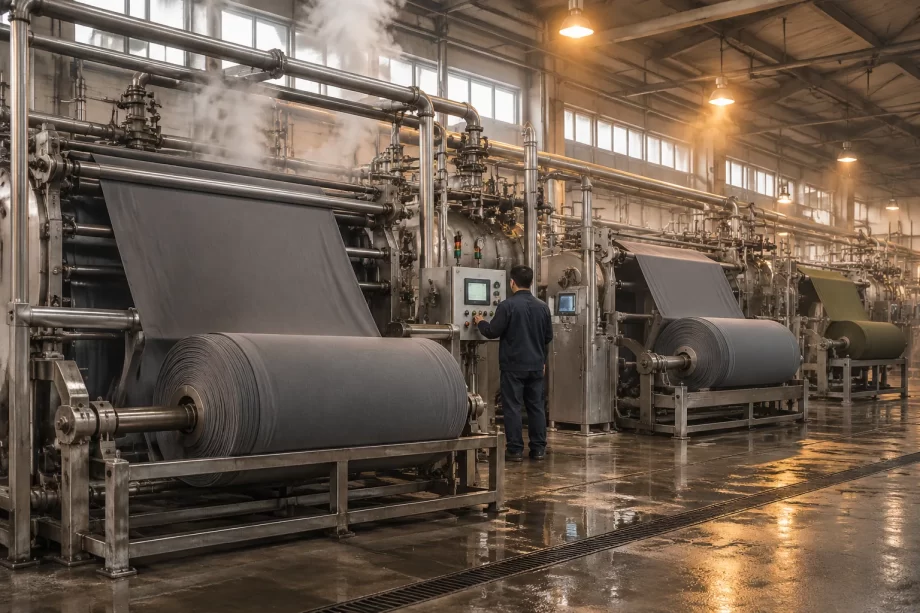
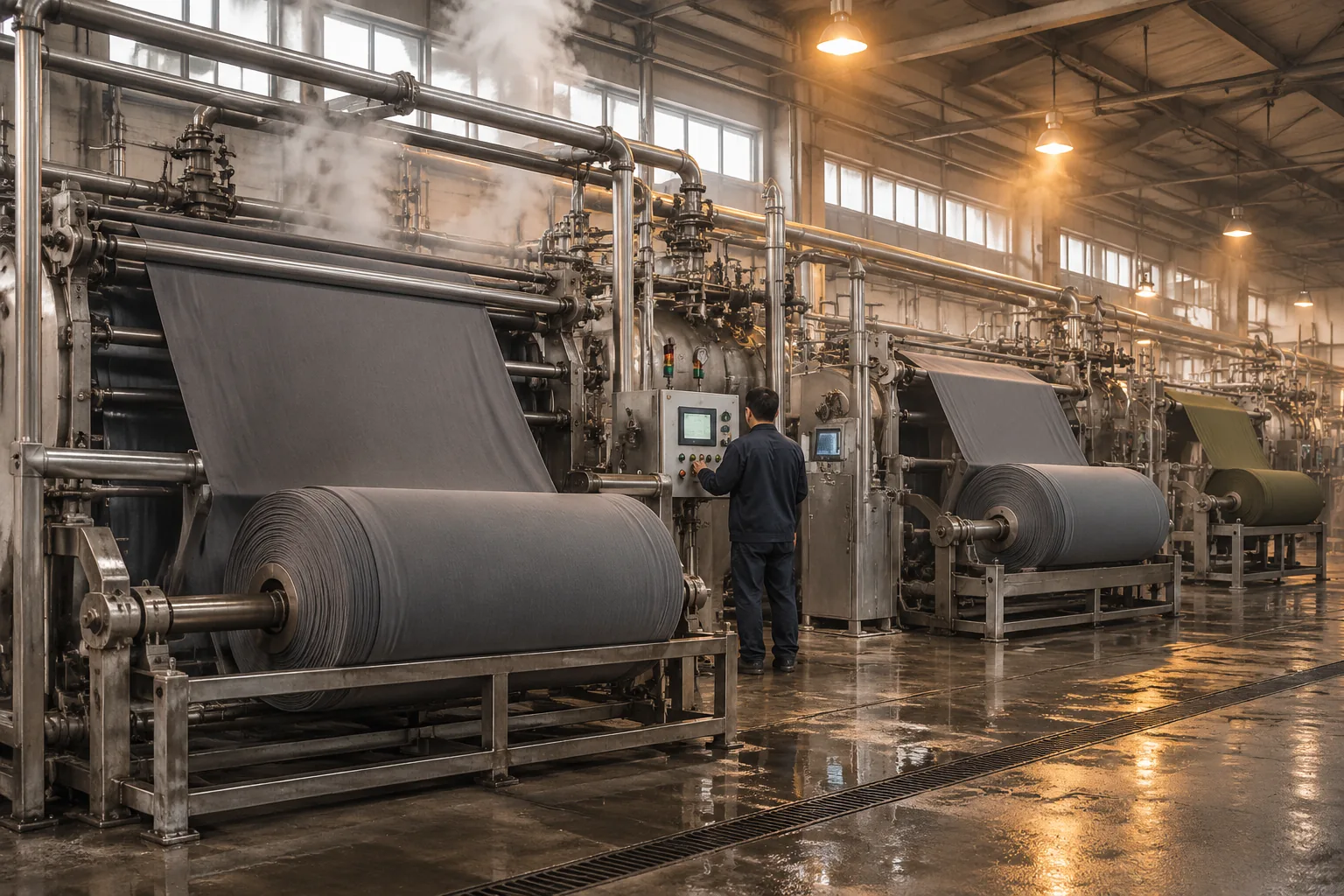
Water is the largest input in a backpack that nobody puts on a bill of materials. A finished thirty-litre daypack might hold less than a kilogram of woven nylon, but the fabric behind it passed through desizing, scouring, dyeing, soaping, rinsing and finishing, and each of those steps takes water in, holds it, and sends it out carrying something. Own-brand programmes that publish a product water footprint discover the same uncomfortable ratio: the overwhelming majority of the litres sit upstream of the cutting table, in the dyehouse that coloured the shell fabric, not in the plant that sewed the bag.
That geography creates a decision problem that most sourcing teams handle badly. The dyehouse is not owned by the bag factory, so water work there is treated as somebody else’s capital project. When a brand asks for a water story, the importer forwards a questionnaire to the mill, the mill returns a certificate and a single effluent report, and the file closes. Two seasons later the same brand asks a sharper question — how much of that water was reused, and what happens to the brine — and there is no answer, because no one ever built the measurement that would produce one.
This article takes the position that water recycling is a manufacturing specification before it is an environmental project. It looks at which reuse loops can be adopted first in a bag supply chain, what each one costs in capital and in risk, how reclaimed water interacts with the performance the finished pack has to deliver, and how to write the water specification into the tech pack and the supplier agreement so that the answer survives an audit. It is written for product developers, sourcing managers, quality engineers and factory owners who have to choose between a dozen plausible-sounding water projects and can only fund one this year.
- Where the Water Actually Goes in a Backpack Programme
- Why Dyehouse Water Recycling Is a Bag Factory Problem
- The Four Reuse Loops, Ranked by What You Can Adopt First
- The Treatment Train: What Each Stage Removes and What It Costs
- Water Quality Specifications for Reuse: How to Write Them Into the Tech Pack
- What the Reclaimed Water Actually Does to Backpack Fabrics
- Capex and Payback: How to Build Numbers You Can Defend
- Discharge Compliance: What the Permit Actually Requires
- A Ranked Adoption Roadmap
- What to Ask a Mill, and What to Put in the Contract
- FAQ
- Conclusion
The manufacturer’s view: no one in this chain gets credit for litres saved. Credit goes to a bag that passes the spray test, matches the approved shade, and arrives with effluent data the buyer can defend. Any reuse loop that threatens those three outcomes is not a water project — it is an unplanned sampling exercise.
Where the Water Actually Goes in a Backpack Programme
Before choosing a technology, it helps to see the whole path. Water enters a backpack programme at four distinct stages, and the constraints at each stage are different enough that a single “water saving” target is meaningless.
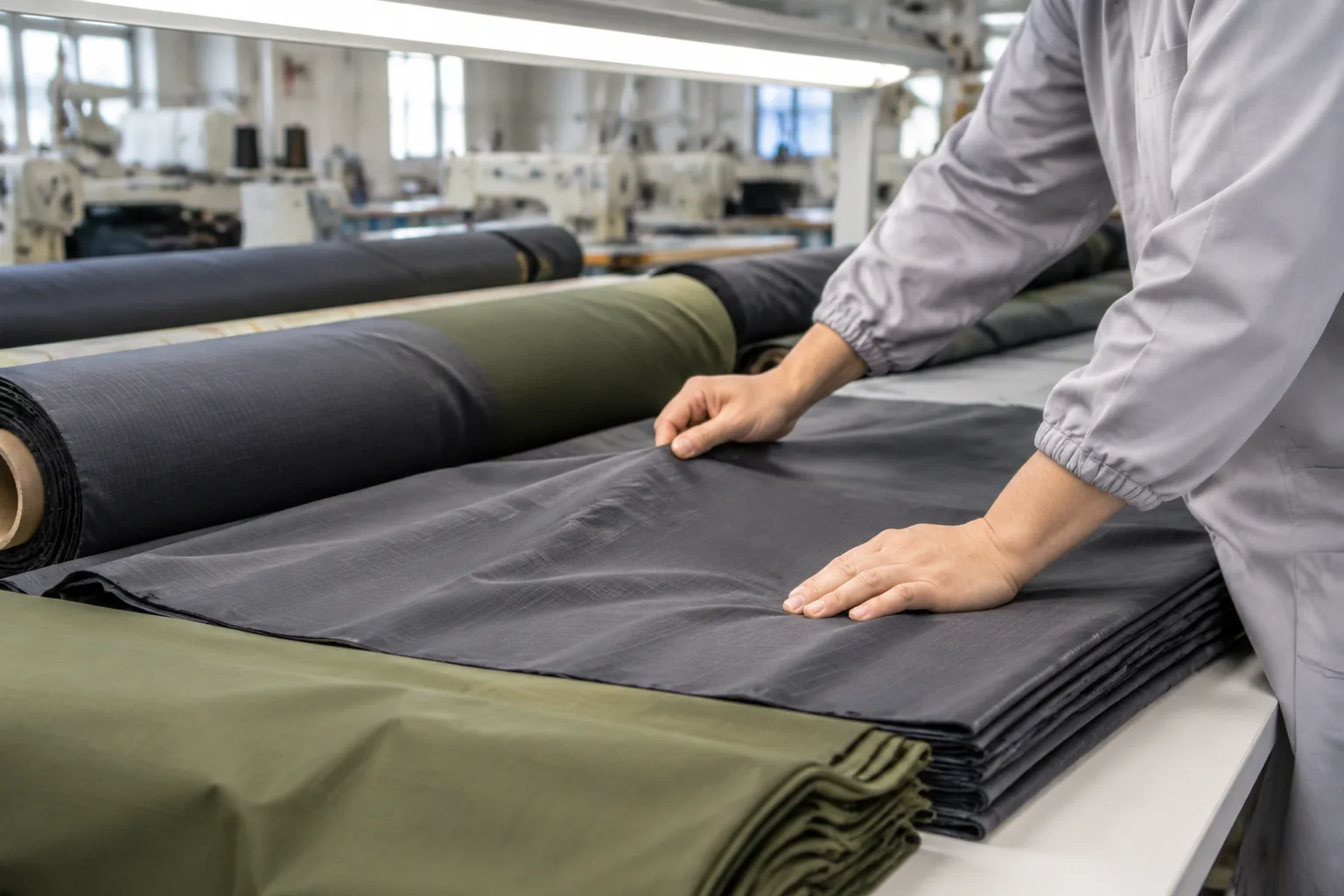
The first stage is preparation: sized warp yarns must be desized before dyeing, and desizing is one of the most polluted streams in the whole plant because it carries starch, polyvinyl alcohol or acrylic binders at high concentration. The second is wet processing of greige fabric — scouring, bleaching where a white base is needed, mercerising for cotton, heat setting for synthetics. The third is colour, in jet or beam machines or by continuous padding, followed by soaping and rinsing to remove unfixed dye. The fourth is finishing — coating, calendering, DWR application — plus the washing and cleaning that happens inside a bag plant when rolls are inspected, re-rolled, or when coating and printing lines are purged between colours.
| Process stage | Why water is used | Water quality needed | Dominant pollutant load | Realistic reuse potential |
|---|---|---|---|---|
| Desizing and scouring | Remove sizing agents, waxes and pectins from greige fabric | Soft, low-hardness, warm | Very high COD and BOD from starch and binders | Low for direct reuse, high after biological treatment |
| Bleaching and preparation | Carry chemical auxiliaries and rinse them out | Soft, low iron, controlled pH | Residual peroxide, alkali, chelating agents | Moderate, via counter-current rinse |
| Exhaust dyeing | Dissolve or disperse dye, salt and alkali; transfer to fibre | Very soft, low conductivity | Colour, salt, unfixed hydrolysed dye, COD | Low for the dyebath itself, high for the final rinses |
| Soaping and rinsing | Remove surface dye and auxiliaries; fix shade | Soft, consistent temperature | Colour, surfactants, moderate COD | High, the best candidate for cascade reuse |
| Finishing and plant cleaning | Dilute chemicals, clean lines, cool equipment | Variable, often non-critical | Low to moderate, mainly surfactants | High, this is where reclaimed water earns its keep |
Two conclusions follow. The streams with the highest pollution load — desizing, scouring, spent dyebaths — are where reuse is hardest and treatment is mandatory. The streams with the largest volume and the lowest load — final rinses, cleaning water, cooling water — are where a factory gets its first wins. Confusing the two is the commonest reason a water project fails its payback test: capital goes into reusing the dirty litres instead of the clean ones.
A water balance is the cheapest piece of equipment in the plant and the one most often skipped. Without a measured baseline, every percentage a supplier reports is an opinion.
The Split Between the Dyehouse and the Bag Plant
A cut-and-sew backpack factory typically controls a modest share of the programme’s water: the plant’s own washing and cleaning, the coating or printing line if it exists in-house, the testing laboratory, and domestic use in the facility. The mill that dyes the shell fabric controls the rest. This asymmetry matters for how you organise the work.
- What the bag factory can change alone: line cleaning routines, dry cleaning of coating equipment where the chemistry allows, counter-current rinse in any in-house washing, leak repair, cooling water closed loops, condensate recovery, and metering that produces real numbers.
- What requires mill cooperation: liquor ratio of the dyeing machines, rinse sequences, dyebath reuse by shade family, effluent treatment upgrades, membrane plants, and sludge handling.
- What requires brand agreement: how the improvement is paid for, and how the benefit is represented in a product claim.
A programme that only asks the mill for data and changes nothing in the bag plant looks like diligence but is not; a programme that fixes the bag plant and never discusses the dyehouse optimises the small part of the footprint. The workable structure is a phased plan in which the factory’s own loops are fixed first and used as proof of intent, so that the mill conversation is carried by someone who has already done the easy work.
Why Dyehouse Water Recycling Is a Bag Factory Problem
It is tempting to treat water as a compliance issue that belongs to the mill’s environmental manager. Three commercial realities make it the bag factory’s problem instead.
The first is that buyers no longer accept a certificate as an answer. Brand questionnaires in the outdoor, school and promotional segments converge on the same handful of data points, asked per order rather than per site: litres per kilogram of dyed fabric, share of that water reused, effluent results from an accredited laboratory, and the chemical inventory behind them. A supplier who cannot produce these numbers is compared against one who can, on price-neutral criteria.
The second is that effluent failure is contagious up the chain. When a mill’s discharge breaches a permit, the brand that put its label on the bag carries the reputational cost and the importer carries the operational one — orders moved, stock rebuilt in a hurry, air freight absorbed. The bag factory sits between those parties, and it is the party that selected the mill.
The third is economic. Water tariffs, discharge charges and the cost of operating under a permit cap all trend in one direction, so a ten percent cut in water intensity is not a rounding error: it is a line in the mill’s cost sheet, which means it is a line in your next price negotiation whether or not either side has labelled it that way.
A dyehouse with weak effluent control is not a cheap supplier. It is a supplier whose environmental cost has been postponed, and postponed costs are eventually presented to whoever placed the order.
The Three Questions Buyers Actually Ask
Boil the questionnaires down and only three questions survive. Everything else is a proxy for one of them.
- Is the effluent compliant, and can you prove it from a laboratory you did not choose? This is about permit limits, sampling discipline and chain of custody, not about intentions.
- How water-intense is the dyeing, measured per unit of product? Litres per kilogram of dyed fabric, with the boundary stated. A number without a stated boundary is not a metric.
- What happens to the water that is not reused? Treatment train, discharge point, sludge destination, and — the question that separates serious mills from brochure mills — what happens to the concentrate from any membrane plant.
Ask them of every fabric source, every season, in writing.
The Four Reuse Loops, Ranked by What You Can Adopt First
Not all reuse loops are equal. The correct adoption order is not the order of excitement, and it is not the order of regulatory fashion. It is the order in which a plant can save real litres while carrying the least risk of a shade claim, a performance failure or a failed compliance test.
The four loops below are ordered that way. The first requires no treatment plant at all. The last requires a membrane installation and a trained operator, and should be considered only after the first three are running and instrumented.
Loop One: Cooling Water and Condensate Recovery
Dyehouse machines are heated by steam, and steam systems return condensate that is already demineralised, hot and clean. Recovered condensate is the highest-quality water in the building and the only stream that can be reused without any risk to shade. Cooling water from heat exchangers on jet dyeing machines and from compressors is the second. Both are closed-loop opportunities: return condensate to the boiler feed tank, and hold cooling water in a circuit rather than sending it down the drain.
The capital is plumbing, a condensate receiver and a modest heat exchanger, and the risk to product is effectively zero. The saving is real but finite — a small share of the site total, larger where steam demand is heavy. What makes this loop first is its demonstration value: a plant that can show a metered, dated, quantified closed loop has crossed from claims into measurement.
Loop Two: Counter-Current Rinsing and Cascade Reuse
Every rinse step consists of several fills and drains. In the simplest arrangement each fill uses fresh water and each drain sends the entire volume to the effluent plant. In a counter-current arrangement, the cleanest rinse water enters at the final stage and flows backwards through the earlier stages, so the freshest water touches the cleanest fabric and the dirtiest water leaves first.
The change is a piping and control modification, not a treatment plant. Water savings in the rinse sequence of a batch dyeing cycle can be substantial, and the quality effect is normally positive because the final rinse is cleaner than it was before. This is the single most frequently recommended project in textile water programmes, and for good reason: it improves both water intensity and rinse consistency.
What it requires is discipline. Counter-current rinsing depends on valve sequencing and on operators not short-cutting the sequence under time pressure. A plant needs the sequence written into the machine recipe and the recipe controlled by the controller, not by habit.
Loop Three: Dyebath and Rinse-Water Reuse by Shade Family
Once a plant can schedule by shade, it can reuse. Dark shades and heavy builds — blacks, navies, deep olives, charcoal — tolerate water that would visibly shift a pale grey or a sand. Reusing rinse water from a black batch as the next black batch’s makeup water, or reusing a spent dyebath with a top-up calculation, saves both water and the salt and alkali already dissolved in it.
This loop is where the money is and where the risk sits. It demands scheduling by colour family rather than delivery date, shade measurement by instrument rather than by eye, and a rule that pale and mid shades never see reused process water except in floor cleaning. A plant that reuses across all shades will eventually ship ten thousand bags in a colour nobody approved, and that recovery dwarfs any water saving.
Loop Four: Membrane-Treated Reclaimed Water for General Use
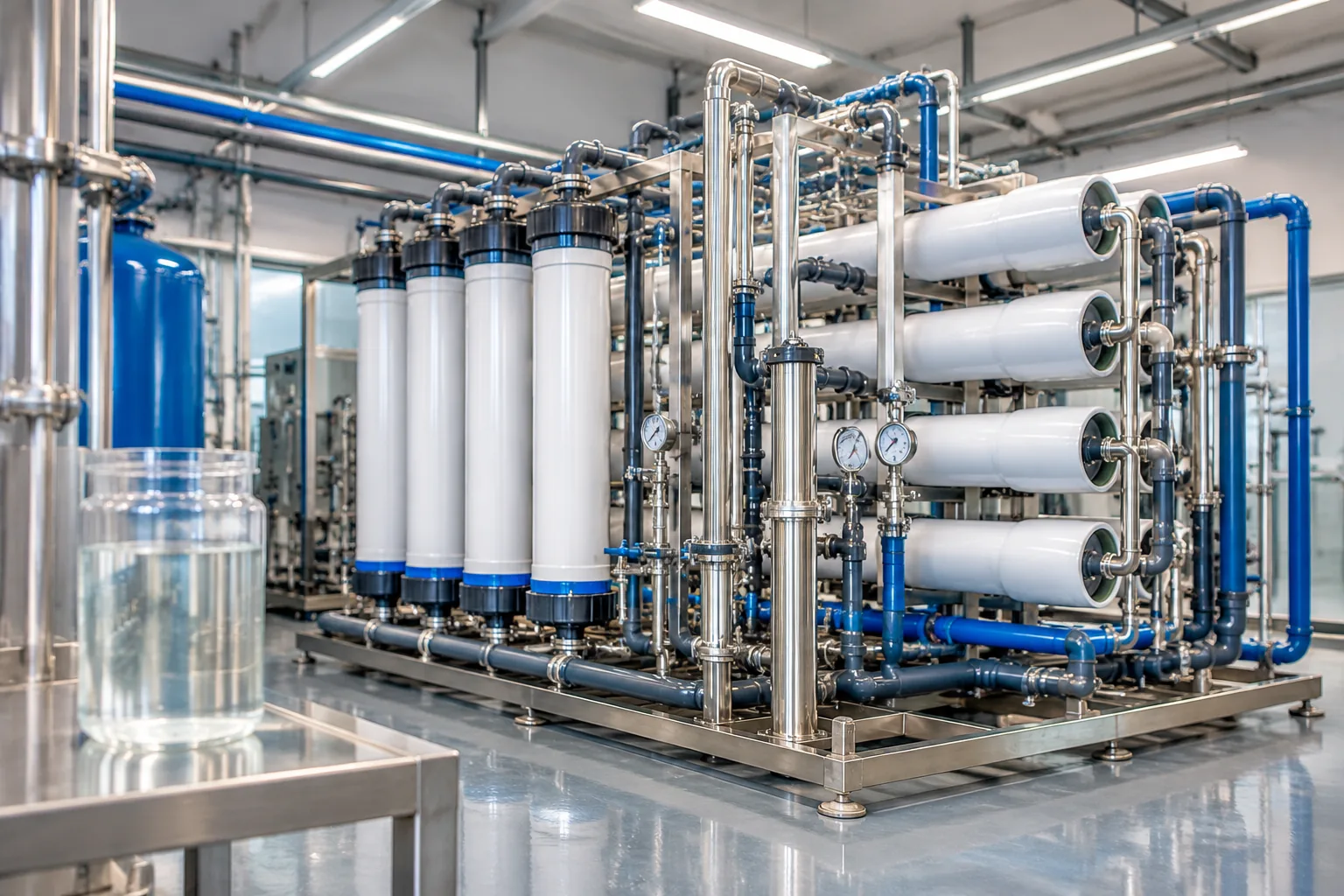
A treatment train ending in ultrafiltration and reverse osmosis can produce water clean enough to be treated as process water for a wide range of duties. This is the loop that most “dyehouse water recycling” literature is about, and it is genuinely valuable — but it is fourth, not first, because it carries the largest capital, the most operational complexity, and the only one that produces a concentrate stream somebody has to licence and pay for.
| Reuse loop | Capital band | Water saved | Shade risk | Time to implement | Payback band | Adopt first? |
|---|---|---|---|---|---|---|
| Cooling water and condensate recovery | Low | Small to moderate | None | Weeks | Under 1 year | Yes, immediately |
| Counter-current rinsing and cascade reuse | Low | Moderate to high | Very low | 1 to 3 months | 6 to 18 months | Yes, first process change |
| Dyebath and rinse reuse by shade family | Low to medium | High | Medium, shade dependent | 3 to 6 months | 1 to 2 years | Yes, with colour control |
| Membrane reclaimed water for general use | High | High | Low if specified | 9 to 18 months | 3 to 6 years | Third wave, after metering |
Adopt in order of shade risk per litre saved, not in order of technical sophistication. The most advanced plant is not the one with the biggest membrane skid; it is the one whose cheapest loops are still running three years later.
The Treatment Train: What Each Stage Removes and What It Costs
When a plant does move to treatment-based reuse, the sequence is well established. What varies is how far along the sequence a particular site needs to go, and that depends entirely on the reuse duty it is aiming for. Treating to a general discharge standard is one target. Treating to a standard a dyer will accept as process water is a considerably higher one.
| Treatment stage | What it removes | Typical outlet condition | Footprint | Capital band | Main operating cost | What it unlocks |
|---|---|---|---|---|---|---|
| Screening and equalisation | Rags, grit, and the flow and load swings that break every downstream process | Variable, but hydraulically stable | Large tank volume | Low to medium | Aeration and mixing power | Any reliable treatment at all |
| Chemical coagulation and dissolved air flotation | Colloidal dye, suspended solids, part of the COD, some phosphorus | Visibly clearer, colour sharply reduced | Medium, needs chemical storage | Medium | Coagulant and polymer | Colour compliance, protection of membranes |
| Biological treatment, activated sludge or MBBR | Soluble COD and BOD, some colour, ammonia | Low BOD, residual colour and COD | Large, needs blowers and clarifier | Medium to high | Aeration power and sludge handling | Discharge compliance for organic load |
| Ultrafiltration | Colloids, bacteria, residual turbidity, fine solids | Low turbidity, SDI suitable for RO feed | Medium skid plus tanks | Medium | Membrane replacement, backwash | Reliable pre-treatment for RO |
| Reverse osmosis | Dissolved salts, residual colour, most remaining COD | Low conductivity, near colourless | Medium skid plus high-pressure pumps | High | Power, antiscalant, membrane replacement | Water good enough for most process duties |
| Brine or concentrate handling | The reject stream from RO | Depends entirely on route chosen | Site specific | Medium to high | Evaporation or thermal energy, or haulage | The licence to operate the RO at all |
Two features of this table drive most project failures. The first is that equalisation is under-designed, because a tank looks like empty space on a drawing and gets value-engineered out; a plant without adequate equalisation sends shock loads into the biology every time a dark shade is dropped, and the biology never recovers its full performance. The second is that reverse osmosis is treated as the final answer rather than as a machine that converts a water problem into a brine problem. If nobody has costed the brine, the project is not costed.
Salt: The Constraint Nobody Budgets For
Reactive dyeing on cellulosic blends needs electrolyte — commonly sodium chloride or sodium sulphate — at concentrations high enough that the effluent is genuinely salty. Salt is highly soluble, it passes through biological treatment almost untouched, and it is the reason a plant cannot simply filter its way back to process water. Reverse osmosis removes it, and in doing so concentrates it into a reject stream that may be a third or more of the feed volume.
The consequences are practical and specific:
- Conductivity becomes the binding constraint on reuse, not colour. A plant may produce water that looks perfectly clear and still be unusable for light shades because the electrolyte load changes the dye strike rate.
- Recovery rate has to be designed, not wished for. A reverse osmosis stage pushing for very high recovery will scale, foul and fail early; the honest design point is the one the water chemistry supports, and the brine volume follows from it.
- Brine has four routes — discharge to a sewer or water body under permit, further concentration and evaporation, reuse in the next dark-shade dyeing batch, or off-site disposal. Each has a different cost and a different documentary burden, and the choice belongs in the project brief from day one.
- Salt recovery pays only at scale, so it is not a first-wave project for a bag supply chain.
Ask any mill proposing membrane reuse one question: what is your recovery rate, and where does the concentrate go? A clear answer with numbers indicates an engineered project. A vague answer indicates a purchase order for equipment.
Sludge: The Recurring Cost That Outlives the Equipment
Chemical coagulation produces sludge, and sludge is the part of a water project that keeps costing money after the ribbon is cut: a wet stream that must be dewatered, analysed, classified and disposed of through a licensed route, at a unit cost that rises as soon as the analysis shows metals or other regulated content.
For a bag programme the relevance is documentary. Buyers ask for the sludge destination alongside the effluent report, because a plant that meets its limits by transferring pollution into solid waste has not solved anything. A factory that can name its contractor, state monthly tonnage per unit of production and show the manifests answers that question before it is asked.
Water Quality Specifications for Reuse: How to Write Them Into the Tech Pack
The phrase “treated water” appears in more supplier agreements than it should, because it specifies nothing. Reuse decisions are made on a parameter list, with a threshold per duty, and the thresholds differ by an order of magnitude between washing a floor and rinsing a pale grey.
The table below is a specification template, not a universal standard. Local permit limits and dye-class sensitivity will move the numbers, and a plant should validate each threshold against its own shade trials before adopting it. What should not move is the principle: every reuse duty gets its own line, its own parameters, and a named test method.
| Reuse duty | Critical parameters | Indicative threshold band | Consequence if exceeded |
|---|---|---|---|
| Final rinse of pale and mid shades | Conductivity, colour, hardness, turbidity | Low conductivity, colour near absent, low hardness | Shade shift, dulling, poor levelness, re-dye and write-off |
| Dyebath makeup for dark shades | Conductivity, COD, colour | Conductivity managed by recipe, moderate COD tolerated | Levelness variation, shade drift across the batch |
| Soaping and washing after dyeing | Colour, COD, hardness | Moderate colour tolerated, hardness controlled | Surface dye not removed, crocking and fastness failures |
| Line cleaning and floor washing | Suspended solids, colour | Broad tolerance, solids controlled | Residue on equipment, transfer marks on fabric |
| DWR and coating preparation | Hardness, surfactants, turbidity | Very low hardness, low surfactant load | Repellency failure, adhesion loss, patchy finish |
| Boiler feed and cooling circuits | Hardness, conductivity, silica | Treated to boiler standard | Scaling, corrosion, energy penalty |
“Clear” is a visual impression. A specification is a number, a method and a sampling point. A supplier who answers a specification question with the word clear has not answered it.
Why Colour Needs a Number and Not an Opinion
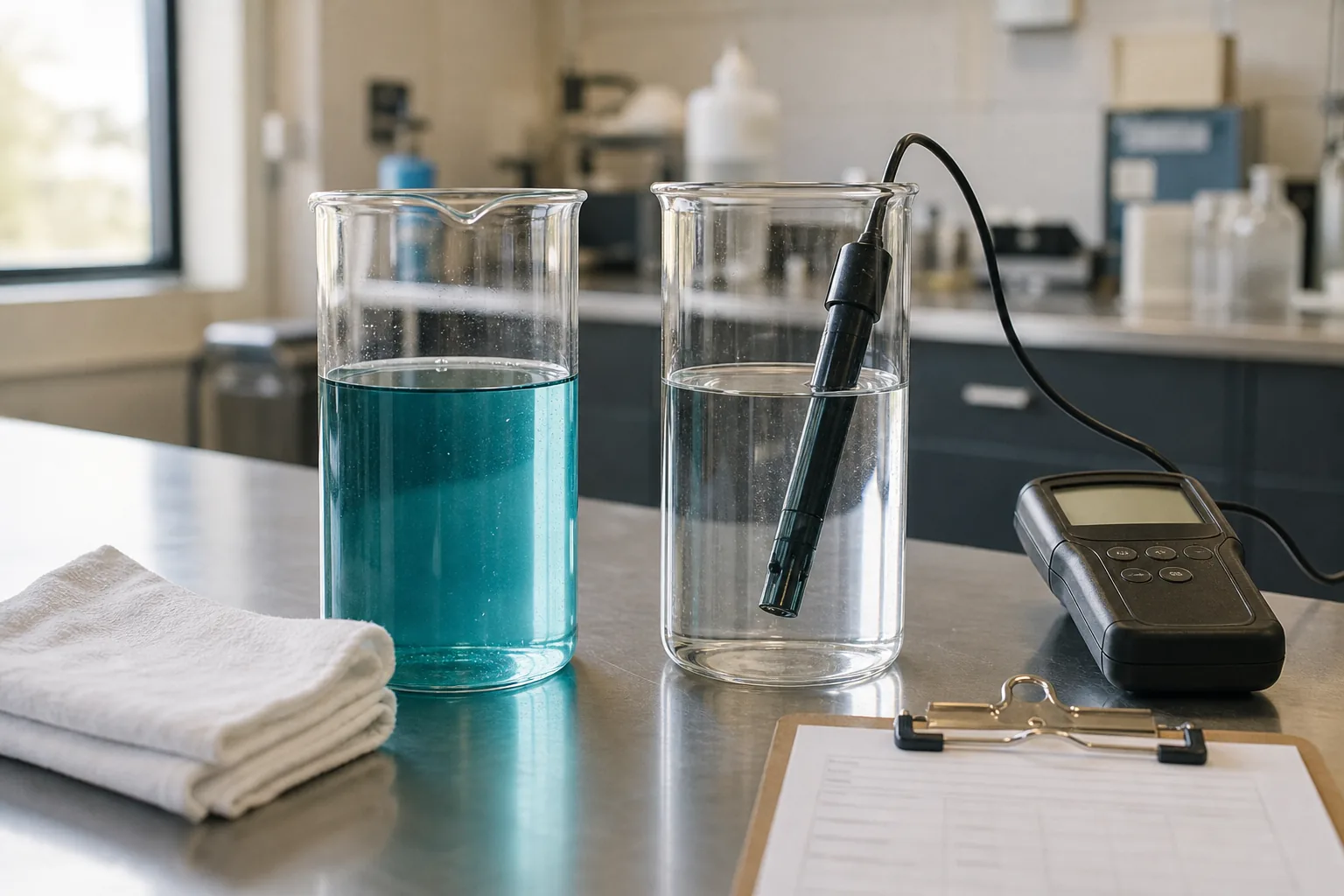
Colour in effluent is measured on a scale — ADMI or Hazen are the two common conventions — and the useful thing about a scale is that it exposes the difference between appearance and effect. Water at a low but non-zero colour value can look acceptable in a jar and still shift a light shade measurably when used as rinse water, because the residual dye in the water deposits on the fibre alongside the dye the dyer intended to put there.
Shade-critical reuse therefore needs a colour limit, a spectrophotometric check on the fabric, and a tolerance stated in the tech pack. A dE value agreed with the buyer for bulk is meaningless if the plant’s rinse water can move the shade on its own, and where a mill reuses into shade-critical duties the shade of each lot should be measured on the same instrument, with the reuse status of the water recorded on the batch card.
What the Reclaimed Water Actually Does to Backpack Fabrics
Reuse decisions are usually argued on water, and then settled on fabric. A backpack shell has to hold four properties that recycled water can quietly damage: shade consistency, colour fastness, water repellency, and coating adhesion. Each has a different failure mechanism, and each is testable before the first bulk lot.
Shade consistency. Residual dye, residual salt and residual surfactant all change how a dye behaves on the fibre. Salt speeds up strike and can cause unevenness at the start of a batch. Surfactant can retard uptake and produce a paler result. Residual colour adds a tint that is invisible on its own and cumulative across a rinse sequence. The result is a lot that is inside tolerance on the instrument but drifting in one direction, and drift is what generates claims in a multi-lot programme.
Colour fastness. Water that carries hardness or residual dye can leave surface colour that was never properly fixed. The symptom appears later, as crocking on a pale lining or as a fastness failure after a water soak, and it appears in the field rather than in the inspection room. Fastness to rubbing and to water should be re-verified for any lot dyed or rinsed with reclaimed water.
Water repellency. This is the most sensitive property in the whole list. DWR chemistries are surface effects, and they are compromised by hardness, by residual surfactant and by anything that changes the surface energy of the fibre. A plant can produce a fabric that passes every physical test and still fail the spray test, because the rinse water carried enough surfactant to mask the finish. If a mill proposes reclaimed water for a finishing line, the spray test is the gate.
Coating adhesion. PU and TPU coatings bond to a prepared surface. Residual oils, surfactants and inconsistent pH change that surface, and the failure mode is delamination after flexing rather than a visible defect at the coating line. Peel strength after flexing is the test that catches it, and it belongs in the first-article approval for any fabric produced with reused process water.
The order of testing matters: shade first, fastness second, spray rating third, adhesion fourth. Most reuse programmes that fail, fail at number three — and they fail because it was never tested.
A Pre-Approval Test Protocol for Reclaimed Water
Before reclaimed water is accepted for a shade-critical duty, run a short controlled comparison. It takes weeks and prevents a season of claims.
- Define the control. Produce the same shade three times with fresh water and three times with reclaimed water, same machine, same recipe, same operator shift if possible.
- Measure, do not judge. Spectrophotometric shade readings against the approved standard, with dE reported for each piece, not a pass or fail verdict.
- Run the finished-goods tests the pack actually needs. Spray rating, hydrostatic head where claimed, crocking dry and wet, fastness to water, and peel strength after flex where the fabric is coated.
- Test the worst case, not the average. Use the lightest shade and the brightest colour in the range, because that is where residual colour shows.
- Write the conclusion into the tech pack. If reclaimed water is approved for soaping but not for final rinse, that is a sentence in the construction notes and a line in the mill’s batch card.
Capex and Payback: How to Build Numbers You Can Defend
Water projects are approved or rejected on a payback figure, and the payback figure in most internal proposals is wrong in one direction: it flatters the project. The fix is not pessimism; it is completeness. Six cost lines and four benefit lines, with stated assumptions, produces a number that survives review.
The cost side. Equipment and installation are the visible part. The rest is what surprises: civil works and floor space, piping and electrical distribution, a control system that an operator can actually run, commissioning and operator training, and — the line that is almost always missing — the annual consumable and maintenance cost of membranes, chemicals, filters and laboratory testing.
The benefit side. Water purchase avoided, effluent discharge charge avoided, energy recovered where condensate or hot rinse water is returned, and the commercial value of a qualification the buyer asked for. That last line is real but should be kept separate, because mixing an intangible into a payback calculation destroys the credibility of the whole model.
The template below states its assumptions so any reader can substitute site data. It illustrates method, not a quotation.
| Line item | Assumption in the model | Annual effect |
|---|---|---|
| Effluent volume available for reuse | 200 cubic metres per day, 300 working days | 60,000 cubic metres per year |
| Reuse rate achieved | 50 percent of that volume | 30,000 cubic metres per year |
| Water purchase avoided | 1.20 per cubic metre, all-in including intake treatment | 36,000 saved |
| Discharge charge avoided | 0.60 per cubic metre | 18,000 saved |
| Consumables: membranes, chemicals, filters | Sized on the duty, replaced on schedule | 12,000 cost |
| Additional pumping and process energy | Low-pressure and high-pressure pumping | 9,000 cost |
| Maintenance labour and laboratory testing | Part of one technician plus quarterly accredited tests | 6,000 cost |
| Net annual benefit | Before capital recovery | 27,000 |
| Capital cost, treatment train including civils | Skid, tanks, piping, controls, commissioning | 320,000 |
| Simple payback | Capital divided by net annual benefit | About 12 years |
The conclusion is uncomfortable and useful: at those tariffs a membrane plant does not pay back on water savings alone inside a normal investment horizon. It pays back when the site is capped by a water scarcity constraint or a permit that limits growth, when the discharge penalty is materially higher, or when the capital is shared with a customer who needs the qualification.
That is precisely why the loop ranking earlier matters. Cooling water and condensate recovery, counter-current rinsing and shade-family reuse do not need a twelve-year argument. Their paybacks sit in months, they reduce the volume the membrane plant would have to treat, and they generate the metering data that makes the larger business case credible later.
The Four Lines That Ruin a Payback Model
- Uptime assumed at one hundred percent. A treatment train that is down for maintenance is discharging, not saving. Use a realistic availability figure, and remember that membrane plants lose capacity as they foul between cleanings.
- Membrane life assumed to be indefinite. Membranes are consumables with a finite life, and the replacement cost falls in year three or four, exactly when the model has become someone else’s responsibility.
- Energy ignored because water is the topic. Reverse osmosis runs at pressure. The electricity line is not a rounding error in a plant already paying for aeration and steam.
- Brine treated as free. Every cubic metre of concentrate has to be discharged under permit, evaporated, reused or hauled. If the model has no brine line, it has no brine plan.
Using the Model in a Commercial Negotiation
For a bag factory, the water model has a second life as a negotiation instrument. Three structures work in practice: amortised into price, with capital recovery visible as a per-metre line for a defined period and the assumption set attached; shared investment against a qualification, where the buyer part-funds the train because it needs the data and the mill grants declared capacity and priority scheduling; and performance-linked, where a rebate or penalty is tied to measured litres per kilogram and to quarterly effluent results.
A water surcharge without a water balance is a price increase with a sustainability cover note. Ask for the balance, the meter readings and the boundary statement before agreeing to the line.
Discharge Compliance: What the Permit Actually Requires
Permit vocabulary is remarkably stable across markets even where the numbers differ: pH, five-day biochemical oxygen demand, chemical oxygen demand, suspended solids, colour, ammonia nitrogen, and a list of metals and organic halogens where the plant’s chemistry warrants them. China sets dyeing and finishing effluent under its own national standard, GB 4287. The European Union regulates through the Industrial Emissions Directive, with BAT conclusions for the textiles industry adopted in 2022 that push permitted plants toward specified water and chemical performance. The United States works through the Clean Water Act and NPDES permits, with categorical pretreatment standards for textile mills. Layered on top of all of them, most global brands now write the ZDHC wastewater guidelines into purchase contracts, so the contractual limit is frequently stricter than the legal one.
| Parameter | Why dyehouse effluent carries it | Usual treatment route | Where permits are most often missed |
|---|---|---|---|
| COD and BOD | Desizing starch, surfactants, unfixed dye, soaping agents | Biological treatment after equalisation | Shock loads when a dark shade follows a light one |
| Colour | Hydrolysed reactive dye and unfixed pigment | Coagulation with flotation, then polishing | Pale shade runs and high-fixation failures |
| Suspended solids | Fibre fragments, chemical floc, biomass carry-over | Clarification and filtration | Poor clarifier operation after a biology upset |
| Ammonia nitrogen | Urea in printing pastes, some auxiliaries, dyeing additives | Nitrification in the biological stage | Cold seasons, when nitrifiers slow down |
| Metals | Copper and chromium from certain dye classes | Source substitution first, then precipitation | Legacy dye recipes not yet substituted |
| pH | Alkali from fixation, acid from neutralisation | In-line neutralisation before discharge | Batch dumping without neutralisation |
The evidence chain matters as much as the numbers. A compliant programme samples a marked point on a composite basis, uses an accredited laboratory the mill does not own, maintains chain of custody, and repeats at a frequency tied to production. Colour is the parameter where plants most often pass the eye test and fail the instrument, and it is also the parameter most likely to be tested by a brand’s own auditor rather than accepted from a supplier report.
Compliance is not a certificate that exists. It is a dated series of measurements taken at a fixed point by a party with no commercial interest in the result.
A Ranked Adoption Roadmap
Put end to end, the sequence below is what a bag programme can realistically execute in two years, with each phase producing something a buyer can read.
| Phase | Actions | Water effect | Capital | Evidence produced |
|---|---|---|---|---|
| Months 0 to 3 | Meter every intake and discharge point, build a water balance, baseline three months of production | None yet | Very low | A boundary-stated litres-per-kilogram figure |
| Months 3 to 6 | Condensate and cooling loops, leak repair, cleaning routines, dry purging where chemistry allows | Small to moderate | Low | Metered closed-loop records |
| Months 6 to 12 | Counter-current rinsing on all batch machines, rinse recipes locked in the controller | Moderate to high | Low | Before and after consumption per batch |
| Months 12 to 18 | Shade-family scheduling, dyebath and rinse reuse for dark shades, colour control by instrument | High | Low to medium | Shade drift data and reuse batch cards |
| Months 18 to 24 | Treatment upgrade, ultrafiltration and reverse osmosis for non-critical duties, brine and sludge plan | High | High | Effluent report plus concentrate route |
The order is not negotiable for a plant that has never measured anything, because each phase supplies the input the next one needs. Shade-family reuse without instrumented colour control produces claims; a membrane plant without a water balance produces a payback model nobody believes.
What to Ask a Mill, and What to Put in the Contract
Six data points, reported quarterly, answer almost every water question a brand will ask about a dyed fabric: litres per kilogram with the boundary stated, share of intake that is reused, COD and colour of final effluent, sludge tonnage per unit of production and its disposal route, chemical inventory conformance against the brand’s restricted substance list, and a notification of any process change affecting water or chemistry.
Around those six points, four clauses do the contractual work: a right to audit the treatment plant and review laboratory reports, an obligation to notify before changing dye class, treatment chemistry or water source, a corrective action process with agreed timelines when a limit is missed, and a statement of which lots were produced with reclaimed water so that traceability survives into a warranty claim.
Red flags are consistent and easy to check: a reuse percentage with no denominator, rainwater harvesting presented as recycling, a single grab sample offered as an effluent programme, a sludge route the sales office cannot name.
FAQ
Is dyehouse water recycling actually a bag factory’s responsibility, given the mill owns the dyehouse?
The mill owns the equipment and the permit, but the bag factory owns the supplier relationship and the buyer’s questionnaire. In practice the factory is the party that must produce the water data, so it needs the metering, the audit right and the contract clause even though it does not own the plant.
Which single project should a plant adopt first?
Condensate and cooling water recovery, followed immediately by counter-current rinsing. Both need plumbing and discipline rather than a treatment plant, both carry effectively no shade risk, and both give the plant its first metered numbers to build a larger case on.
Can reclaimed water be used for light shades if it looks clear?
Appearance is not a specification. Low but non-zero colour and residual salt can shift a pale shade measurably, so light shades should be restricted to water that has been tested for colour, conductivity and hardness against a limit, and the shade should be checked on an instrument rather than by eye.
What is the biggest hidden cost in a membrane reuse project?
The concentrate. Reverse osmosis turns a water problem into a brine problem, and the brine needs a permitted route, a cost and a plan. Projects that are costed without a brine line are not costed, and they tend to stall after the equipment has been delivered.
Does reused water affect DWR and coating performance?
Yes, and this is where most programmes fail first. Hardness, residual surfactant and pH change the fibre surface, which shows up as a failed spray rating or as delamination after flexing. Test the spray rating and peel strength on the worst-case shade before approving reclaimed water for any finishing duty.
Conclusion
Water recycling in a backpack supply chain is not one project but a ladder of four loops, ordered by shade risk rather than engineering ambition. A plant that climbs it in sequence ends up with metered savings, controlled colour and a treatment plant that justified itself on evidence instead of optimism.
For the bag factory, the work that matters most is unglamorous: meter the water, write the specification into the tech pack, test the worst-case shade before approving reuse, and require six numbers every quarter from every fabric source. A defensible file is the only thing that survives a brand audit, a permit inspection, or a customer who has started asking better questions than the last one.