Extended Producer Responsibility: Who Pays for a Bag’s Waste?
Extended Producer Responsibility: Who Pays for a Bag’s Waste?
Extended producer responsibility turns the end of a bag’s life into a cost that someone has to register, declare and pay for. In most markets that someone is the party that places the bag on the market, which is rarely the factory that made it.
Warehouse dispatch desk with shipping cartons on a pallet and a packing list
The distinction matters because a bag factory is usually a supplier, not a producer in the legal sense. Yet the factory sits in the middle of the data chain: it knows the weights, the material composition, the packaging and the shipment volumes that a producer’s declaration depends on.
This guide explains what EPR obligations actually require, who holds them across different selling models, how fees are calculated, what evidence has to be kept, and where a manufacturer can influence the outcome through design and data quality.
The perspective is that of a plant supplying backpacks, daypacks and bags to brands, retailers and distributors who sell into regulated markets.
Extended producer responsibility is a policy model rather than a single rule, and it is built from a small set of obligations that repeat across jurisdictions.
The Obligation Table
Obligation
What it means
Registration
Enrol with a scheme
Declaration
Report volumes
Fee payment
Fund collection
Reporting
Periodic data
Labelling
Information duty
Records
Evidence retention
The Principle Table
Principle
Effect
Polluter pays
Cost follows the product
Producer defined
Placing on market
Collective systems
Shared infrastructure
Individual systems
Direct responsibility
Eco-modulation
Fees vary by design
Full cost
Collection and treatment
The Scope Table
Category
Typical treatment
Household packaging
Usually covered
Transport packaging
Often covered
Product packaging
Covered
The bag itself
Depends on market
Textiles
Growing coverage
Accessories
Usually out of scope
The Distinction Table
Term
Meaning
Producer
Places on market
Importer
Brings into market
Distributor
Sells onward
Marketplace
Facilitates sale
Waste holder
Discards the item
Scheme
Collects the fee
The Timeline Table
Stage
Producer action
Market entry
Register first
First sale
Declare volumes
Periodic cycle
Submit returns
Fee invoice
Pay on time
Audit request
Produce records
Scheme change
Re-register
Read the definition of producer in each market before assuming your role, because the obligation attaches to who places the bag on the market, not to who sews it.
Who Holds the Obligation
The party that owes the fee changes with the selling model, and the same bag can create obligations for different companies in different channels.
The Channel Model Table
Selling model
Obligation holder
Own brand retail
Brand
Private label
Brand or retailer
Wholesale
Importer or brand
Marketplace sale
Platform or seller
Direct export
Importer of record
Contract manufacture
Buyer
The Role Table
Party
Typical duty
Factory
Data provision
Brand owner
Registration
Importer
Registration and fees
Retailer
Compliance check
Platform
Seller verification
Scheme
Collection and audit
The Responsibility Clause Table
Clause
Purpose
Responsibility matrix
Names the obligated party
Data supply
Sets reporting duty
Weight and material data
Enables declaration
Fee pass-through
Allocates cost
Indemnity
Covers misdeclaration
Audit support
Access to records
The Cost Bearer Table
Arrangement
Cost bearer
Absorbed in price
Brand
Separate line item
Transparent
Volume-based recharge
Factory
Shared by negotiation
Both
Absorbed by retailer
Retailer
Not allocated
Risk
The Documentation Table
Document
Who issues
Registration number
Scheme
Declaration receipt
Scheme
Fee invoice
Scheme
Material specification
Factory
Weight statement
Factory
Certificate of compliance
Producer
Write the responsibility matrix into the supply agreement, because the question of who pays arrives as an invoice with a deadline and no time to negotiate the principle.
Registration and Reporting
Registration is the entry point and the point where most programmes discover they cannot answer basic questions about their own products.
The Enrolment Data Table
Data point
Source
Legal entity
Company records
Market of sale
Sales data
Product categories
Range list
Estimated volumes
Forecast
Packaging types
Specification
Contact owner
Compliance role
The Reporting Table
Return
Frequency
Volume declaration
Monthly or quarterly
Material breakdown
Periodic
Packaging split
Periodic
Fee reconciliation
Annual
Change notification
On event
Audit file
On request
The Unit Caution Table
Unit
Caution
Items
Simple, less precise
Kilograms
Requires weights
Composite weight
Material split needed
Packaging only
Excludes product
Product only
Excludes packaging
Both
Double counting risk
The Data Table
Field
Precision needed
Net weight
Per item
Gross weight
Per shipment
Material fractions
Percentage
Packaging composition
Per component
Recycled content
Where modulated
Country of sale
Per market
The Reporting Failure Table
Failure
Consequence
Late registration
Penalty
Under-declaration
Back fees
Wrong category
Fee error
Missing material split
Default rate
No audit file
Dispute
Unregistered market
Enforcement
Build the weight and material dataset once, at the style level, and reuse it for every market, because re-deriving weights per country is where reporting accuracy collapses.
Fee Structures and Eco-Modulation
The fee is intended to pay for collection and treatment, and its structure is where design decisions begin to carry a price.
The Fee Basis Table
Basis
Character
Per kilogram
Common for packaging
Per item
Common for products
Per category
Simplified
Modulated
Design-linked
Minimum fee
Small volumes
Cap and floor
Volume protection
The Modulation Table
Design factor
Direction
Recyclability
Lower fee
Recycled content
Lower fee
Material mixing
Higher fee
Hazardous substances
Higher fee
Repairability
Emerging
Excess packaging
Higher fee
The Fee Cost Share Table
Element
Share
Collection
Largest
Sorting
Significant
Treatment
Material dependent
Administration
Small
Communication
Small
Reserve
Variable
The Mechanism Table
Market
Typical mechanism
Collective scheme
Fee per unit
Competitive scheme
Tendering
Deposit system
Return-linked
Individual system
Direct
Hybrid
Mixed
Voluntary
Brand-led
The Forecast Table
Input
Effect on fee
Volume growth
Higher total
Weight reduction
Lower total
Material shift
Rate change
Packaging reduction
Lower total
Channel change
Different scheme
Regulation change
Rate review
Model the fee per style rather than per portfolio, because a light bag with mixed materials can cost more per unit than a heavy bag of one polymer.
Scope: Packaging Versus the Product
A bag arrives at a customer wrapped, boxed, bagged and labelled, and each of those layers may attract a different obligation from the bag itself.
The Layer Table
Layer
Typical scope
Poly bag
Packaging
Carton
Packaging
Tape and filler
Packaging
Hang tag
Packaging
Tissue wrap
Packaging
The bag
Product or textile
The Market Table
Market type
Product scope
Packaging-only EPR
Bag excluded
Textile EPR
Bag included
Bag-specific rules
Included
Voluntary schemes
Variable
Deposit systems
Rare for bags
Emerging frameworks
Shifting
The Definition Table
Question
Consequence
Is the bag packaging
Depends on use
Is a reusable bag packaging
Often treated separately
Is a promotional bag packaging
Frequently yes
Is a retail carrier bag packaging
Yes
Is a backpack a textile
In some markets
Is a laptop sleeve a textile
Often yes
The Item Boundary Table
Item
Reason for uncertainty
Detachable pouch
Separate item
Rain cover
Accessory
Shoulder strap
Part of product
Card insert
Packaging
Desiccant
Packaging
Spare buckle
Part or accessory
The Category Registration Table
Category
Registration need
Packaging
Usually mandatory
Textile product
Where scheme exists
Carrier bags
Specific rules
Reusable bags
Varies
Accessories
Often excluded
Promotional goods
Where placed on market
Split the declaration between packaging and product before submitting it, because submitting one combined weight invites a default rate on both.
Producer Responsibility Organisations
Most producers discharge their obligation through a collective organisation, and choosing one is a commercial decision with compliance consequences.
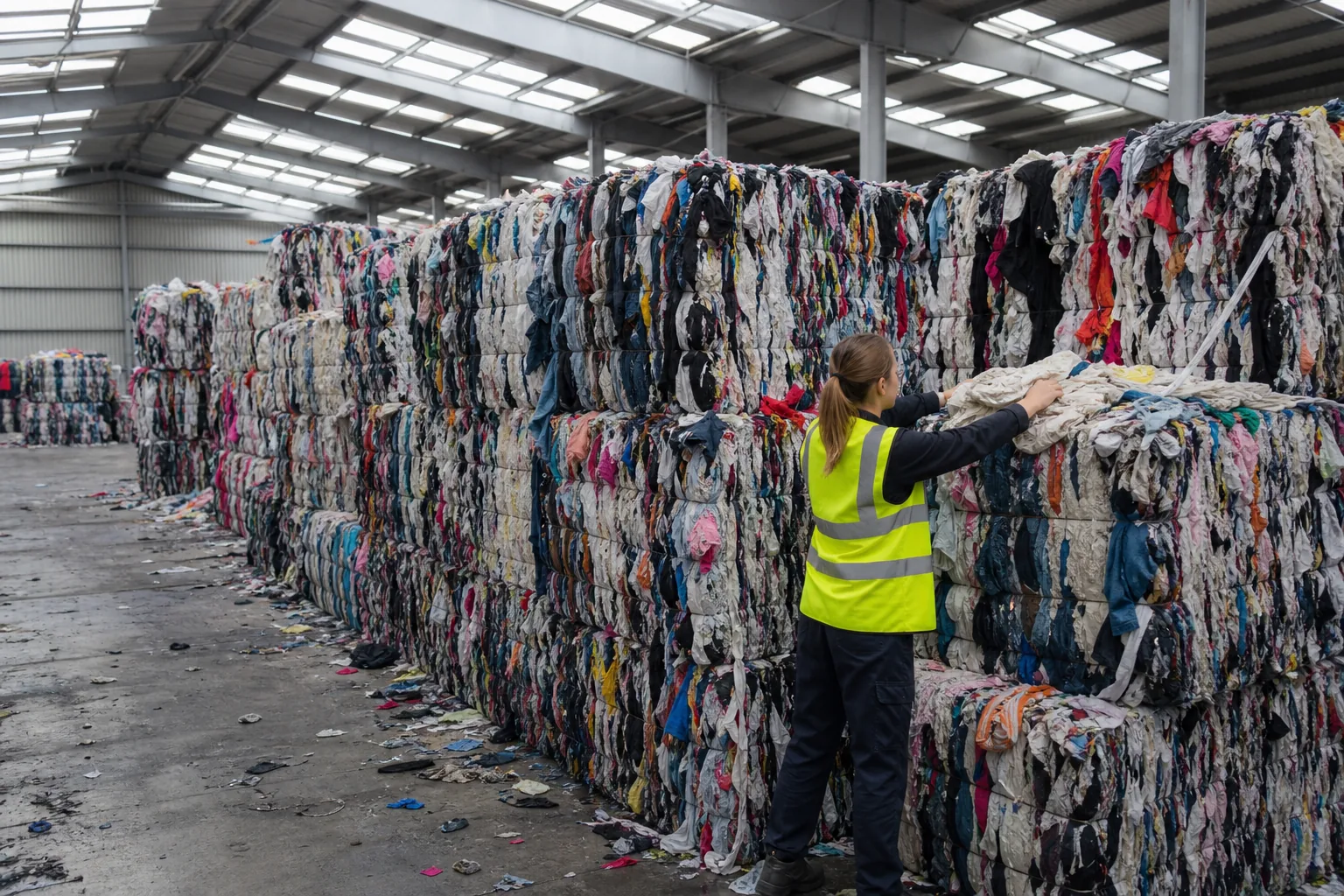
Baled fabric offcuts stacked in a textile waste sorting facility
The Scheme Model Table
Model
Character
Single national scheme
Simple, non-competitive
Competing schemes
Price comparison
Sector scheme
Industry-run
Municipal contract
Local variation
Individual compliance
Direct operation
Hybrid
Scheme plus own
The Selection Table
Criterion
Why it matters
Market coverage
Legal sufficiency
Fee level
Cost
Service quality
Data support
Reporting portal
Effort
Audit reputation
Credibility
Contract terms
Exit flexibility
The Scheme Service Table
Service
Typical provision
Registration
Included
Reporting
Portal
Fee calculation
Included
Audit support
Varies
Communication
Often shared
Advisory
Limited
The Scheme Term Table
Term
Watch for
Duration
Multi-year lock-in
Fee adjustment
Indexation
Data ownership
Who holds records
Termination
Notice period
Liability
Misdeclaration
Dispute
Resolution route
The Comparison Table
Situation
Sensible choice
Single market, small volume
National scheme
Multiple markets
Coordinated schemes
Large volume
Competitive tender
Complex range
Advisory-heavy scheme
Marketplace sales
Platform scheme
New market entry
Pilot scheme
Treat the scheme contract like any other supply contract, because a multi-year lock-in at an uncompetitive fee is a cost that cannot be designed away.
Evidence and Certificates
Compliance is proven by documents that have to survive an audit years after the sale, and the evidence chain is short enough to build properly.
The Proof Table
Document
Proves
Registration certificate
Enrolment
Declaration submission
Reporting
Fee invoice and receipt
Payment
Scheme statement
Volume accepted
Material specification
Weight basis
Weight statement
Data accuracy
The Retention Table
Record
Typical period
Registration
Duration plus years
Declarations
Several years
Invoices
Financial period
Weight data
Duration
Material specs
Product life
Correspondence
Audit window
The Traceability Table
Link
Evidence
Style to weight
Specification
Weight to shipment
Packing list
Shipment to market
Invoice
Market to scheme
Declaration
Scheme to fee
Statement
Fee to product
Cost allocation
The Audit Table
Question
Answer source
Are you registered
Certificate
Did you declare
Submission
Is the weight right
Specification
Did you pay
Receipt
Which products
Range list
Which markets
Sales data
The Weakness Table
Weakness
Risk
Weight from memory
Under-declaration
No market split
Wrong scheme
Missing invoices
Unproven payment
Style list outdated
Scope gap
No owner
Missed deadlines
Paper only
Retrieval failure
Keep the evidence as a single audit file per market per year, because reconstructing a declaration three years later from emails is the most expensive form of compliance.
Cross-Border Sales and Distance Selling
A bag sold across a border creates an obligation in the destination market, and the channel used to reach the customer determines who registers.
The Channel Table
Channel
Obligation point
B2B export
Importer of record
Direct e-commerce
Destination market
Marketplace fulfilment
Platform rules
Distributor
Distributor registers
Retail concession
Retailer registers
Sample shipment
Usually excluded
The Distance Table
Model
Producer role
Own web shop
Seller is producer
Marketplace seller
Seller or platform
Dropship
Seller of record
Subscription
Recurring volume
Agent model
Principal
Licensing
Licensee
The Threshold Table
Situation
Typical effect
Small volume
Exemption possible
Micro-enterprise
Reduced duty
First year
Registration grace
Sporadic sales
Still in scope
Returns
Adjust declaration
Exports
Different market
The Cross-Border Document Table
Document
For cross-border
Commercial invoice
Volume basis
Customs entry
Import proof
Packing list
Weights
Registration proof
Market access
Scheme statement
Local compliance
Contract terms
Responsibility
The Trigger Risk Table
Risk
Trigger
Unregistered market
Direct e-commerce growth
Double registration
Multiple channels
Wrong weight basis
Packaging only
Returns unaccounted
Refund cycles
Distributor default
Unmonitored partner
Platform suspension
Missing registration
Check the registration position of every destination market before launching a direct channel, because the obligation follows the delivery address rather than the invoice currency.
Marketplace and Platform Duties
Marketplaces now carry verification duties of their own, and their checks reach back into the factory’s documentation more often than sellers expect.
The Platform Table
Duty
Holder
Seller verification
Platform
Registration check
Platform
Product listing data
Seller
Take-back information
Seller
Reporting to scheme
Seller
Suspension
Platform
The Onboarding Table
Request
Typical source
Company registration
Platform
EPR number
Platform
Category declaration
Platform
Volume estimate
Seller
Material data
Seller
Compliance statement
Seller
The Listing Table
Field
Compliance use
Material
Scope category
Weight
Fee basis
Packaging
Separate declaration
Country of origin
Not determinative
Recycling info
Information duty
Durability claim
Modulated schemes
The Suspension Table
Trigger
Consequence
No EPR number
Listing removed
Invalid number
Removal
Mismatch category
Review
Non-payment
Restricted
Complaint
Investigation
Repeat failure
Account action
The Coordination Table
Party
Coordination need
Brand
Registration ownership
Factory
Data provision
Platform
Verification
Scheme
Confirmation
Logistics
Volume data
Finance
Fee settlement
Give the marketplace the same registration number that appears on the scheme statement, because a mismatch between what the platform verifies and what the scheme holds is a suspension waiting for a routine check.
Data You Need and Where It Lives
EPR reporting runs on data that the factory already holds for other purposes, which is why the exercise fails when those records are not linked.
Compliance manager reviewing registration paperwork at a desk with a laptop
The Source Table
Data
System
Net weight
Bill of materials
Material split
Specification
Packaging weight
Packing standard
Shipment volume
ERP or invoices
Destination market
Sales order
Style reference
Product master
The Weight Table
Method
Accuracy
Weigh the sample
High
Calculate from BOM
High
Estimate by size
Low
Copy from supplier
Variable
Historical average
Moderate
Guess
Unusable
The Link Table
Link
Field
Style to market
Sales order
Market to category
Product master
Category to scheme
Registration
Shipment to style
Packing list
Packaging to style
Packing standard
Return to volume
Credit note
The Spreadsheet Table
Column
Content
Style code
Identifier
Net weight
Grams
Material fractions
Percentage
Packaging group
Code
Market
Country
Annual volume
Units
The Control Table
Control
Purpose
Single source
Consistency
Version date
Currency
Owner
Accountability
Review cycle
Accuracy
Change log
Traceability
Reconciliation
Completeness
Build one style-level dataset with weights, fractions and packaging groups, because every market declaration is a filtered view of that single table.
Forecasting Fees Into Costing
Once the fee exists, it becomes a cost per unit, and a cost per unit that is not in the quotation is a margin loss discovered at invoice.
The Unit Cost Basis Table
Element
Basis
Product fee
Per item or kilogram
Packaging fee
Per component
Scheme administration
Annual
Reporting effort
Staff time
Audit support
Occasional
Penalty provision
Risk
The Product Fee Table
Product
Relative fee
Light daypack
Low
Large travel pack
Moderate
Mixed-material pack
Higher
Heavy canvas pack
Weight-driven
Small accessory
Minimal
Packaging per unit
Often comparable
The Sensitivity Table
Change
Effect
Ten percent weight cut
Proportional saving
Single-material switch
Rate improvement
Packaging elimination
Direct saving
Market shift
Different rate
Volume growth
Higher total
Scheme change
Unknown
The Quote Table
Approach
Consequence
Absorb silently
Margin erosion
Line item
Transparent
Built into price
Hidden
Recharged at cost
Neutral
Shared
Negotiated
Ignored
Loss
The Review Table
Cycle
Action
Annual
Recalculate rates
Per scheme change
Update
Per new market
Model
Per design change
Reassess
Per contract
Confirm allocation
Per audit
Validate
Quote the fee as a visible line rather than buried in the unit price, because a buyer comparing two quotations will otherwise choose the one that hid it.
Design Levers That Lower Fees
Eco-modulated fees give design decisions a price, and the levers that matter for a bag are limited and well understood.
The Lever Table
Lever
Fee effect
Mono-material shell
Lower rate
Reduced mixed trims
Lower rate
Recycled content
Lower rate
Removable components
Better sorting
Reduced packaging
Direct saving
Repairable construction
Emerging benefit
The Material Table
Choice
Recyclability
Single polymer shell
High
Polymer plus coating
Moderate
Multi-layer laminate
Low
Mixed fibre blend
Low
Metal hardware
Separable
Foam padding
Separable
The Trim Table
Trim
Design treatment
Zipper
Same polymer family
Webbing
Single material
Binding
Matches shell
Labels
Removable or compatible
Thread
Matching polymer
Hardware
Detachable
The Packaging Table
Change
Saving
Remove inner tissue
Weight cut
Right-size carton
Volume cut
Paper instead of plastic
Rate change
Reusable tote
Different category
Remove hang tag
Weight cut
Consolidate inserts
Fewer components
The Trade-off Table
Objective
Conflict
Lower fee
Performance
Recyclability
Waterproofing
Weight reduction
Durability
Fewer materials
Colour range
Less packaging
Damage rate
Repairability
Cost
Choose two design levers per season and verify them with the scheme before adoption, because a claimed recyclability improvement that the scheme does not recognise earns no fee reduction.
Recyclability Criteria in Practice
Schemes assess recyclability against criteria that are written for sorting facilities rather than for designers, and the gap between the two explains most modulation disputes.
The Criterion Table
Criterion
Practical test
Material count
Separable fractions
Component size
Above sorting threshold
Joining method
Reversible or not
Coating presence
Compatible or barrier
Hazardous content
Absent
Colour
Sortable
The Assessment Table
Question
Scheme concern
What is the main material
Dominant fraction
What is attached
Contamination
Can it be removed
Handling time
What does it become
Output quality
Is there a market
End use
Is it proven
Track record
The Claim Evidence Table
Claim
Supporting document
Mono-material
Specification
Recycled content
Certificate
Detachable trims
Design drawing
Reduced packaging
Packing standard
Repairability
Spare parts list
Recyclability
Scheme recognition
The Gap Table
Gap
Result
Design not recognised
No reduction
Criteria change
Rate review
Local variation
Market difference
Data absent
Default rate
Claim overstated
Dispute
Scheme discretion
Uncertainty
The Working Table
Step
Purpose
Read the criteria
Know the target
Map the design
Identify gaps
Test separability
Verify practically
Agree with scheme
Confirm treatment
Document the basis
Protect the rate
Review annually
Stay current
Ask the scheme to confirm in writing how a specific design will be treated before relying on a lower fee, because modulation is often discretionary and a verbal assurance does not bind the next invoice.
Audit, Enforcement and Penalties
EPR enforcement has become data-driven, and the triggers are usually visible in the producer’s own numbers before an authority contacts them.
Retail shelf with assorted backpacks and a product information label holder
The Trigger Table
Trigger
Signal
Volume mismatch
Sales versus declaration
Market sales data
Customs or platform
Scheme referral
Non-payment
Competitor report
Market distortion
Random selection
Routine audit
Complaint
Specific allegation
The Check Table
Check
Authority looks at
Registration
Current and correct
Category
Accurate
Volume
Supported
Weight
Verifiable
Payment
Settled
Records
Retained
The Penalty Table
Finding
Consequence
Late registration
Fixed penalty
Under-declaration
Back fees plus penalty
Non-payment
Interest and enforcement
Repeat failure
Escalation
Obstruction
Additional sanction
Market ban
Extreme cases
The Defence Table
Evidence
Weight
Registration certificate
Strong
Declaration history
Strong
Fee receipts
Strong
Weight methodology
Moderate
Supplier specifications
Moderate
Reconstructed records
Weak
The Remediation Table
Step
Action
Quantify
Establish the gap
Disclose
Approach the scheme
Settle
Pay back fees
Correct
Fix the process
Document
Record the change
Monitor
Verify control
Approach the scheme with a quantified correction before it approaches you, because voluntary disclosure converts a penalty into a settlement in most programmes.
Working With Brands as a Supplier
A factory that supplies several brands carries several different EPR positions at once, and the value it adds is consistency of data rather than ownership of the obligation.
The Request Table
Brand request
Typical timing
Style weight list
Onboarding
Material composition
Development
Packaging specification
Pre-production
Shipment volume report
Quarterly
Recycled content evidence
Per season
Design change notice
On event
The Format Table
Format
Usability
Style-level spreadsheet
High
Per-shipment list
High
Catalogue average
Low
Verbal confirmation
Unusable
Certificate only
Partial
Packing list only
Partial
The Consistency Table
Risk
Control
Different weights per brand
Single dataset
Different material names
Common taxonomy
Packaging counted twice
Defined boundaries
Volume mismatch
Shared reconciliation
Version drift
Dated releases
No audit trail
Change log
The Supplier Offer Table
Offer
Benefit to brand
Weight data package
Faster declaration
Packaging breakdown
Accurate split
Recycled content file
Modulation support
Design change alert
Avoids re-declaration
Annual summary
Audit readiness
Query response
Reduced friction
The Responsibility Boundary Table
Question
Answer position
Who registers
Brand or importer
Who declares
Producer
Who pays
Producer
Who supplies data
Factory
Who audits
Scheme or authority
Who indemnifies
By contract
Package the data a brand needs into a standard release with a date and a version, because a factory that answers the same EPR questions five times in five formats creates five chances to be inconsistent.
Common Compliance Failures
The same failures appear across producers of every size, and almost all of them are organisational rather than technical.
The Compliance Failure Table
Failure
Root cause
Unregistered market
Channel expansion
Wrong category
Range complexity
Stale weights
Design changes
Packaging excluded
Scope misreading
No market split
Reporting shortcut
Deadline missed
No owner
The Cause Table
Cause
Prevention
No compliance owner
Named role
No market register
Central list
No data link
Style dataset
No calendar
Renewal dates
No change trigger
Design gate
No audit file
Filing standard
The Corrective Table
Failure
Remedy
Unregistered
Register and disclose
Wrong category
Reclassify and adjust
Stale weights
Rebuild dataset
Missing packaging
Amend declarations
No split
Reconstruct volumes
Missed deadline
File and notify
The Maturity Table
Level
Character
Reactive
Responds to invoices
Registered
Basic compliance
Reported
Timely returns
Controlled
Data linked
Designed
Fees in design
Leading
Scheme dialogue
The Governance Table
Element
Requirement
Owner
Named individual
Calendar
All deadlines
Register
All markets
Data
Style level
Budget
Fee provision
Review
Annual
Give one person the compliance calendar across all markets, because EPR failures are almost always deadlines that belonged to everyone and were tracked by no one.
Small Producer Exemptions and Transition
Thresholds and transition periods are where a growing producer quietly outgrows an exemption, and the moment is rarely noticed internally.
The Exemption Table
Basis
Effect
Turnover threshold
Below it, reduced duty
Volume threshold
Per category
Micro-enterprise
Simplified reporting
First-year grace
Registration delay
Category exclusion
Out of scope
Voluntary scheme
Reputation only
The Transition Table
Event
Requirement
Crossing a threshold
Register promptly
New market launch
Register first
Channel switch
Reassess role
Acquisition
Merge obligations
Range expansion
Category review
Regulation change
Update scope
The Monitoring Table
Indicator
Watch level
Annual volume
Near threshold
Packaging weight
Rising
Market count
Expanding
Channel mix
Direct sales growth
Range breadth
Category creep
Scheme changes
New duties
The Preparation Table
Step
Action
Measure
Current volumes
Model
Fee at threshold
Register
Early if close
Budget
Provision
Document
Basis of position
Review
Annually
The Exposure Table
Risk
Consequence
Silent threshold breach
Back fees
Assumed exemption
Penalty
Wrong enterprise size
Reclassification
Group aggregation
Combined threshold
Partial year
Pro-rating error
No evidence
Dispute lost
Track volume and packaging weight against the threshold every quarter, because an exemption that expired two years ago is repaid in full with a penalty attached.
The Manufacturer’s EPR Checklist
Role and Scope
Item
Done
Producer role defined per market
☐
Responsibility matrix agreed
☐
Markets and channels listed
☐
Product versus packaging split
☐
Categories confirmed
☐
Thresholds monitored
☐
Data
Item
Done
Style-level weights recorded
☐
Material fractions documented
☐
Packaging weights recorded
☐
Market split in sales data
☐
Dataset owner assigned
☐
Change log maintained
☐
Compliance
Item
Done
Registration current
☐
Declarations submitted on time
☐
Fees paid and receipted
☐
Evidence file per market
☐
Audit support ready
☐
Review scheduled
☐
Design
Item
Done
Modulation criteria reviewed
☐
Mono-material options assessed
☐
Packaging reduction plan
☐
Detachable trims considered
☐
Spare parts defined
☐
Scheme confirmation obtained
☐
FAQ
Who pays the EPR fee for a bag sold in a regulated market?
The party that places the bag on that market, which is usually the brand, the importer of record or the marketplace seller depending on the channel. A contract manufacturer supplying a brand does not normally hold the obligation, because it does not place the product on the market under its own name. The exception is when the factory sells directly, for example through its own web shop into a destination market, at which point it becomes the producer for that volume. The practical consequence is that the fee follows the commercial channel rather than the manufacturing location.
Is the bag itself or its packaging covered?
Both can be, but under different rules and often different schemes. Packaging EPR is well established in most regulated markets and covers the poly bag, carton, tape, filler and hang tags that travel with the product. Product EPR for bags is newer and depends on whether the market treats a backpack as a textile or as a durable good, and whether a specific bag rule exists, for example for retail carrier bags. The useful discipline is to declare packaging and product as separate lines, because combining them invites a default rate on the total.
How is the fee calculated?
Most schemes use weight or unit count multiplied by a category rate, with modulation applied where the scheme recognises design factors such as recyclability or recycled content. Weight-based fees reward lighter products and packaging, unit-based fees are simpler to administer and less sensitive to design. Where modulation exists, the rate depends on criteria written around sorting practice, so a design improvement that is not recognised by the scheme earns nothing. The consequence for a factory is that weight data accuracy matters directly, because an inaccurate weight produces an inaccurate fee every reporting cycle.
Does a factory need its own EPR registration?
Only where it places products on a regulated market under its own responsibility. A pure contract manufacturer supplying a registered brand does not need its own registration for that volume, though it will be asked for data that feeds the brand’s declaration. A factory selling directly, operating a web shop into regulated markets, or acting as importer of record does need registration. Many factories hold registrations without realising they no longer apply, or operate without one after starting a direct channel, and both situations are better resolved before an authority raises them.
What happens if volumes are under-declared?
The scheme or authority compares declared volume against external data such as sales records, customs entries or marketplace reports, and an under-declaration typically results in back fees for the period plus a penalty and interest. Voluntary disclosure before the discrepancy is identified usually converts the case into a settlement with a smaller financial consequence. The evidence that helps is a documented methodology, even an imperfect one, because it shows the error was methodological rather than deliberate. Reconstructed records assembled after the request carry much less weight.
How does selling through a marketplace change the obligation?
It adds a verification layer. Marketplaces increasingly require sellers to provide a valid EPR registration number for the relevant category before a listing is allowed to remain live, and they check that the number matches the scheme’s records. The obligation itself usually stays with the seller, not the platform, but the platform enforces it. The consequence for a factory supplying sellers is that registration proof may be requested as part of onboarding, and a mismatch between the number given to the platform and the number held by the scheme is a common cause of listings being removed.
Can design reduce the fee?
Yes, where the scheme applies eco-modulation, and the levers that matter for a bag are material simplification, detachable trims, recycled content and packaging reduction. A mono-material shell with compatible trims and separable hardware scores better than a laminate with bonded foam and mixed fibres. What matters commercially is confirming treatment with the scheme before relying on a reduction, because modulation criteria vary and are often discretionary. A design change that costs money and earns no fee reduction is a common outcome when the confirmation step is skipped.
What records should a factory keep to support a brand’s declaration?
The style-level dataset is the core: net weight per item, material fractions by percentage, packaging weights by component, and the market split of shipments. Alongside it, keep the material specifications that justify the fractions, the packing standard that defines the packaging group, and the shipment records that tie volume to destination. Retain them for the period the scheme requires, typically several years, in a form that can be retrieved quickly. The failure that hurts is not the absence of data but its dispersal across systems that no longer reconcile.
Conclusion
Extended producer responsibility is a data obligation wearing a fee. The fee is the visible part, and the part that management notices, but the compliance position rests on whether the producer can state, with evidence, what it placed on which market, at what weight, in what material composition.
For a bag manufacturer the practical implications are narrow and clear. The obligation usually sits with the brand or importer, so the factory’s role is to supply accurate style-level data and to understand which of its own activities create a direct obligation.
Weights, material fractions and packaging composition have to be recorded once and reused across every market. Design decisions carry a fee consequence where modulation exists, and that consequence is only real when the scheme has confirmed how it will treat the design.
The failures that recur are organisational: an unregistered market created by a new sales channel, a declaration based on weights from a superseded specification, packaging omitted because it looked incidental, and a deadline that belonged to nobody. Each is preventable with a register, a calendar, a dataset and a named owner.
A factory that can produce a style-level weight and material record on request, and that knows which of its sales channels create obligations, is in a position to support any brand’s declaration and to defend its own. That is a modest capability, and it is the difference between a fee that is planned and a penalty that is discovered.