Multi-Destination Shipping: How Do You Plan a Split Container?
Multi-Destination Shipping: How Do You Plan a Split Container?
A split container is an efficiency decision that quietly becomes a risk decision. One container, several consignees, and a set of assumptions about who unloads what and when.
Destination labels on cartons grouped in a factory shipping area
For a backpack factory shipping to distributors in three or four markets, the appeal is obvious: one container rate instead of three, one booking instead of three, and a full load instead of a half-empty one. The problems appear later, when the first consignee unloads its block and the remaining cargo travels onward with less restraint than it was planned for.
This guide covers how a split container is planned properly: how destinations are grouped, how the load is divided so each stop is accessible without disturbing the rest, how cartons and pallets are labelled, what the documents must show, and where the cost and transit time trade-offs actually sit.
A split container fails for reasons that are structural rather than accidental, and most of them trace back to a decision made at the booking stage.
The Split Failure Failure Table
Failure
Cause
Cargo damaged after first stop
Restraint removed
Wrong cartons unloaded
Label confusion
Shortage claim
Count mismatch
Customs delay
Document inconsistency
Excess freight cost
Poor grouping
Consignee refusal
Arrival timing
The Split Failure Cost Table
Cost
Trigger
Detention
Slow unloading
Repacking
Block disturbance
Re-forwarding
Missed stop
Demurrage
Delay at yard
Claim
Damage or shortage
Administration
Multiple documents
The Assumption Table
Assumption
Risk
Each buyer unloads only its block
Blocks are not isolated
Restraint survives partial unload
It usually does not
Labels are unambiguous
Similar codes confuse
Documents match cargo
Versions diverge
Stops run in sequence
Routing changes
Timing suits everyone
It rarely does
The Stakeholder Table
Party
Concern
Factory
Cost per container
Buyer
Arrival date
Forwarder
Routing complexity
Consignee
Unloading control
Customs
Entry accuracy
Insurer
Risk allocation
The Decision Table
Question
If no
Can blocks be isolated?
Ship separately
Is there a load plan per stop?
Do not split
Will all stops be sequenced?
Reconsider
Are documents per stop ready?
Delay booking
Is restraint re-usable?
Add material
Is unloading supervised?
Add instruction
Treat a split container as several shipments that happen to share a box, because the moment the first consignee opens the doors the plan has to work without your supervision.
Destination Grouping Logic
Grouping decides whether the container is efficient or merely full, and it has to balance geography against volume.
The Grouping Table
Basis
Suitability
Same country
Strong
Same customs territory
Strong
Adjacent markets
Moderate
Same buyer, several DCs
Strong
Different continents
Weak
Mixed regulation
Weak
The Volume Table
Distribution
Preference
Balanced thirds
Ideal
One dominant block
Acceptable
Many tiny blocks
Poor
Single carton stop
Avoid
Half and half
Good
Uneven quarters
Workable
The Route Table
Pattern
Character
Sequential stops
Simple control
Hub deconsolidation
Flexible
Direct discharge
Fast
Feeder distribution
Regional
Cross-dock
Time critical
Mixed
Complex
The Constraint Table
Constraint
Effect
Customs territory
Grouping limit
Import licence
Destination lock
Labelling law
Segregation need
Duty rate
Cost variation
Quota
Volume control
Certification
Market access
The Scoring Table
Factor
Weight guide
Volume fit
High
Route simplicity
High
Document uniformity
Moderate
Unloading control
High
Cost saving
Moderate
Risk increase
High
Group destinations by customs territory before grouping them by geography, because two neighbouring countries with different import requirements turn one clean container into two separate compliance exercises.
Zone Layout Inside the Container
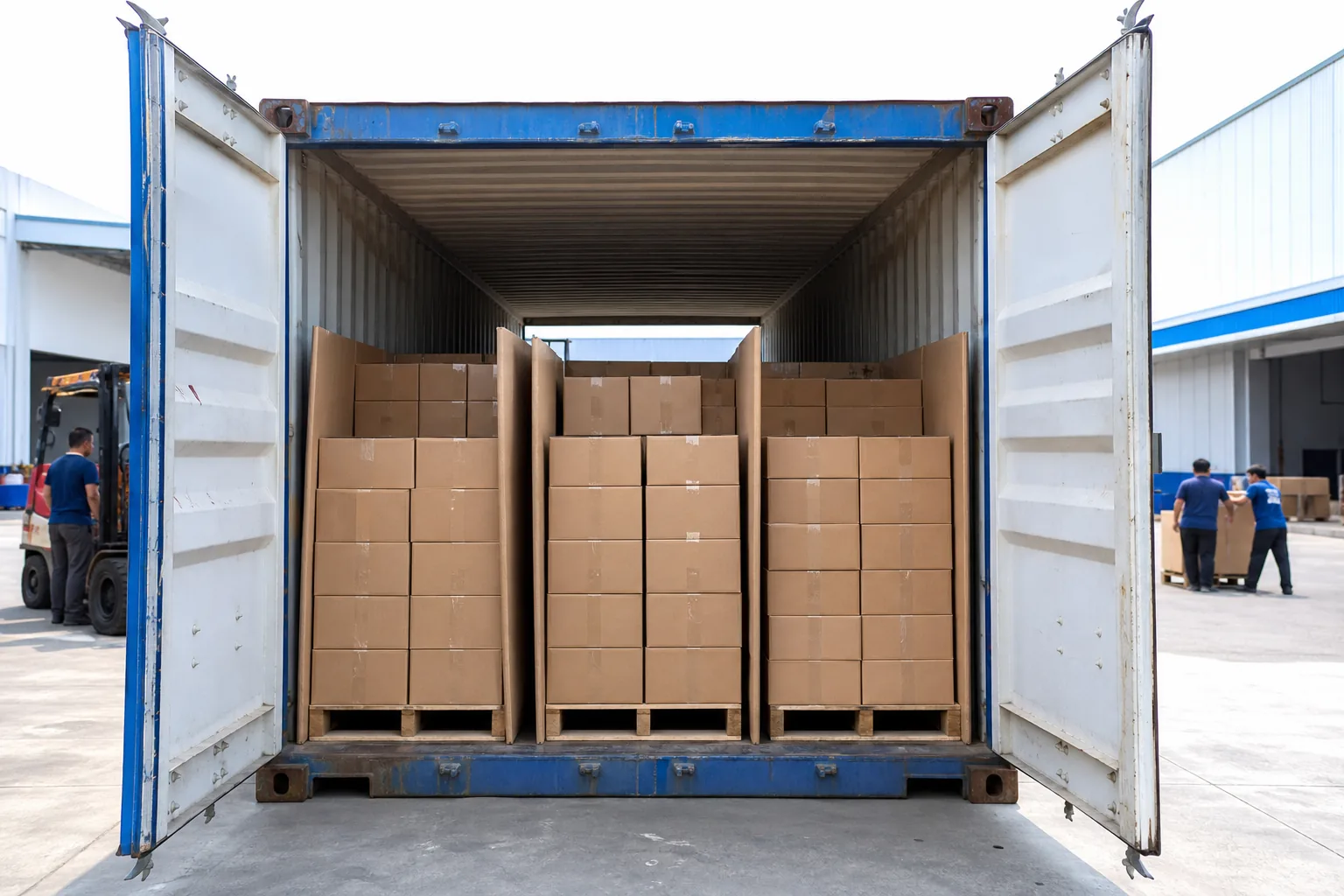
The physical layout is what makes a split container workable, and it must be designed so each stop removes one block without destabilising the rest.
Container loaded with cartons segregated into blocks by destination
The Layout Table
Layout
Sequence
Front to rear
First stop at rear
Rear to front
First stop at door
Side by side
Difficult
Layered
Access problems
Vertical slices
Best access
Mixed
Avoid
The Zone Table
Zone
Content
Door block
First destination
Middle block
Second destination
Forward block
Final destination
Top layer
Light cargo
Floor layer
Heavy cargo
Corner
Protected goods
The Access Table
Stop
Needs
First
Clear door path
Second
Exposed face
Third
Remaining volume
All
Count visible
All
Labels visible
All
Restraint reachable
The Stability Table
After stop
Risk
First removed
Forward block exposed
Second removed
Rear void
Third
Trivial
Partial unload
Mixed remnants
Half block
Lean
No re-brace
Collapse
The Sequence Table
Step
Action
Plan
Assign blocks
Load
Reverse order
Brace
Per block
Label
Per stop
Photograph
Each stage
Instruct
Consignee
Load the container in reverse stop order so the first destination sits at the doors, because a block buried behind two others will be unloaded by a consignee who has neither the time nor the equipment to dig it out.
Dividing and Isolating Blocks
Isolation is what prevents one consignee’s unloading from becoming another consignee’s damage claim.
The Divider Table
Divider
Use
Plywood panel
Full separation
Honeycomb board
Light separation
Corrugated sheet
Surface only
Netting
Visual and retention
Airbag row
Gap filling
Strap lines
Cohesion
The Method Table
Method
Strength
Full height divider
Strong
Partial divider
Moderate
Airbag barrier
Moderate
Strapping only
Weak
Labelling only
None
Colour coding only
None
The Re-brace Table
Situation
Action
Block removed
Close gap
Void appears
Fill immediately
Strap released
Re-tension remainder
Divider removed
Replace barrier
Partial layer
Re-stack
Uncertain
Photograph and report
The Kit Table
Item
Quantity basis
Airbags
Per remaining void
Strapping
Per re-brace
Corner protectors
Per strap line
Divider panels
Per stop
Tape and labels
Spares
Instruction sheet
Per stop
The Divider Instruction Table
Content
Purpose
Unload sequence
Correct order
Block identification
Avoid confusion
Re-brace method
Preserve stability
Photo requirement
Evidence
Contact
Escalation
Document reference
Traceability
Include a re-bracing kit and a one-page instruction inside the container for every intermediate stop, because the crew that unloads at stop two has no context beyond what is physically in front of them.
Labelling and Identification
In a single-destination container a label is administrative. In a split container it is the mechanism that keeps two buyers’ cargo apart.
The Label Table
Label element
Purpose
Consignee name
Ownership
Destination code
Routing
Stop number
Sequence
Carton count
Verification
Block code
Layout
Handling marks
Care
The Colour Table
Scheme
Risk
Colour per destination
Colour blindness
Colour plus code
Best
Code only
Reliable
Number only
Reliable
Symbol only
Ambiguous
None
Unacceptable
The Placement Table
Position
Visibility
Two adjacent faces
Good
Top face
Blocked
One face
Weak
Under tape
Hidden
Inside carton
Useless
Pallet label
Supplementary
The Label Data Table
Field
Standard
Format
Fixed structure
Size
Legible at distance
Language
Destination language
Barcode
Scannable
Duplicate
One spare
Removal
Not permitted
The Label Error Table
Error
Consequence
Similar codes
Mis-shipment
Label on one face
Invisible
Label under film
Unreadable
Handwritten amendment
Disputed
Mixed pallets unlabelled
Confusion
Missing stop number
Sequence error
Print the stop number as the largest element on every carton label, because a consignee scanning a wall of cartons reads the biggest number first and that number decides whether the carton stays or goes.
Marking, Barcodes and Scanning
Scanning turns a visual arrangement into a verifiable record, and it is the cheapest control available in a multi-stop load.
The Technology Table
Method
Capability
Barcode
Item level
QR code
Data rich
RFID
Bulk read
Manual list
Fallback
Photo record
Evidence
None
Unverifiable
The Scan Table
Point
Purpose
Packing
Build record
Loading
Confirm block
Stop one
Verify removal
Stop two
Verify removal
Arrival
Verify receipt
Final
Close file
The Record Table
Field
Content
Scan time
Timestamp
Location
Stop code
Operator
Identity
Carton id
Unique
Result
Pass or exception
Photo
Condition
The Discrepancy Table
Finding
Action
Extra carton
Hold and query
Missing carton
Search before departure
Wrong block
Relocate
Damaged carton
Photograph
Unreadable label
Reprint
Unknown code
Stop and escalate
The Reconciliation Table
Stage
Expected
Loaded
Full manifest
Stop one
Minus block one
Stop two
Minus block two
Final
Zero balance
Documents
Match each stage
Claim
Supported
Scan cartons out at every stop rather than counting pallets, because a pallet count cannot tell you which destination’s cartons are still on board.
Documentation Across Multiple Stops
Documents are where split containers most often go wrong, because each destination needs its own set and each set must reconcile against one physical load.
Dispatch desk with shipping documents, route schedule and labelled cartons
The Document Table
Document
Per stop
Commercial invoice
Yes
Packing list
Yes
Bill of lading
Split or one
Certificate of origin
Per rule
Insurance certificate
Per value
Loading list
One master
The Bill Table
Option
Character
One bill, several consignees
Simple booking
Separate bills per stop
Clean title
Master plus house
Flexible
Switch bill
Complex
To order
Controlled
Straight
Named only
The Consistency Table
Field
Must match
Carton count
Physical load
Weight
Weigh ticket
Description
Invoice
Destination
Label
Consignee
Buyer record
Marks
Carton printing
The Version Table
Risk
Control
Multiple invoice versions
Single register
Amended packing list
Controlled revision
Late changes
Cut-off rule
Email amendments
Written confirmation
Language variants
One reference copy
Missing signature
Checklist
The Filing Table
Record
Retention
Invoice set
Statutory period
Packing list
Statutory period
Bill copies
Statutory period
Scan log
Claim period
Photos
Claim period
Correspondence
Contract period
Issue one controlled master packing list that every stop’s documents reference, because when three invoices describe the same container differently the discrepancy surfaces at the border rather than in your office.
Bills of Lading and Consignment Structure
The bill of lading decides who can claim the cargo, and a split container forces a choice that has consequences beyond freight.
The Structure Table
Structure
Suitability
Single consignee, notify others
Simple
Multiple consignees, one bill
Problematic
Separate bills per block
Clean
Master and house bills
Forwarder led
Groupage
Small volumes
Direct
Fast
The Bill Risk Table
Structure
Risk
One bill, several buyers
Title ambiguity
Separate bills, one container
Coordination
House bills
Counterparty exposure
To order
Endorsement chain
Straight bill
Inflexible
Electronic
System dependency
The Release Table
Method
Control
Original bills
Strong
Telex release
Fast
Sea waybill
No title
Bank undertaking
Conditional
Letter of indemnity
Risk transfer
Electronic release
System
The Carrier Table
Item
Confirm
Stops permitted
In booking
Additional stops
Charges
Re-stow allowed
Not typical
Liability per stop
Limited
Survey at stop
Available
Documentation
Per stop
The Bill Instruction Table
Party
Receives
Consignee one
Bill, invoice, list
Consignee two
Bill, invoice, list
Forwarder
Full set
Carrier
Booking terms
Insurer
Declaration
Factory file
Copies
Agree with the carrier in writing that the container will be opened at intermediate stops, because a standard booking assumes one seal, one opening and one discharge point.
Deconsolidation and Intermediate Stops
The physical act of removing one block is where a well-planned load is either preserved or destroyed in twenty minutes.
Container being partially unloaded at a transshipment yard with cartons separated on the dock
At an intermediate stop the container arrives with a seal that must be cut, a load that must be inspected against a plan the local crew has never seen, and a deadline that is usually a truck waiting outside the gate. Everything that was designed at the loading dock is tested in that window, and the parts of the plan that depended on supervision are the parts that fail first.
The practical answer is to make the plan self-executing: blocks that are physically distinct, labels that identify the stop without reference to a list, a restraint kit that sits inside the container where it will be needed, and a single page that tells the crew what to remove, what to leave, and how to close up what remains.
The Stop Table
Stop type
Activity
First discharge
Remove door block
Intermediate
Partial unload
Transshipment
Rehandle
Hub
Deconsolidate
Final
Full discharge
Return
Empty reposition
The Activity Table
Step
Control
Open seal
Photograph
Inspect load
Compare to plan
Identify block
Verify labels
Remove cartons
Count and scan
Re-brace remainder
Kit used
Reseal
New seal recorded
The Stop Timing Table
Stop
Allowance
Single block
Half day
Two stops
One day each
Transshipment
Yard dependent
Customs hold
Unpredictable
Re-bracing
Two hours
Documentation
Same day
The Equipment Table
Item
Need
Forklift
Pallet handling
Pallet truck
Loose cartons
Ladder
Upper layers
Strapping tool
Re-brace
Air pump
Airbags
Seal press
Integrity
The Supervision Table
Role
Present
Consignee agent
Yes
Carrier surveyor
On request
Forwarder
Remote
Factory
Remote
Customs
As required
Insurer
On claim
Photograph the interior before and after every partial unload, because the condition of the remaining cargo at stop two is the only evidence that distinguishes a loading fault from an unloading fault.
Cost Structure of a Split Container
The saving is real but narrower than it appears, and the costs that erode it are usually the ones nobody budgeted for.
The Split Cost Cost Table
Element
Behaviour
Ocean freight
Shared
Booking fee
Per booking
Documentation
Per stop
Deconsolidation
Per stop
Re-bracing material
Per stop
Supervision
Per stop
The Saving Table
Saving
Size
Freight consolidation
High
Booking overhead
Moderate
Terminal handling
Moderate
Insurance
Proportional
Administration
Negative
Transit time
Negative
The Hidden Table
Cost
Source
Detention at stop
Slow unload
Re-forwarding
Missed routing
Repacking
Block disturbance
Extra labels
Re-labelling
Survey
Damage check
Claim handling
Dispute
The Comparison Table
Option
Cost profile
One container, one stop
Baseline
Split container
Lower freight, higher admin
Separate LCL
Higher freight, simple
Groupage
Variable
Direct full container per buyer
Highest freight
Hub distribution
Middle
The Threshold Table
Condition
Split viable
Each block above minimum
Yes
Stops within one region
Yes
Documents uniform
Yes
Unloading controlled
Yes
One small block
Marginal
Different continents
No
Compare the split container against separate LCL shipments on total landed cost rather than on freight rate alone, because the administrative and supervision costs of a second stop frequently exceed the freight difference.
Transit Time and Sequencing Trade-offs
Time is the second currency in a split decision, and it moves in the wrong direction for everyone except the first stop.
The Time Table
Stop
Effect
First
Earliest
Second
Plus one stop
Third
Plus two stops
Final
Latest
All
Route dependent
Documentation
Cut-off bound
The Delay Table
Cause
Impact
Unloading overrun
Whole chain
Customs inspection
Days
Missing document
Hold
Re-bracing time
Hours
Equipment shortage
Hours
Congestion
Unpredictable
The Promise Table
Buyer
Commitment
First stop
Firm date
Intermediate
Window
Final
Wide window
All
Written in contract
All
Buffer stated
All
Escalation path
The Routing Table
Route
Sequencing
Direct call
Simple
Feeder relay
Moderate
Hub and spoke
Complex
Inland barge
Slow
Rail leg
Fixed schedule
Road distribution
Flexible
The Buffer Table
Buffer
Basis
Customs
Two days
Port congestion
Three days
Unloading
One day
Documentation
One day
Inland
Two days
Total
Cumulative
Quote the final destination a wider window than the first, because the later a stop sits in the sequence the more accumulated delay it inherits from every stop before it.
Insurance and Liability Allocation
Insurance for a split container is not automatically what the shipper assumes, because cover attaches to a shipment rather than to a portion of one.
The Cover Table
Aspect
Treatment
Declared value
Per consignment
Transit clause
Per shipment
Partial unload
Often unaddressed
Subsequent leg
Must be declared
Damage after stop
Disputed
Shortage
Per block count
The Liability Table
Party
Responsibility
Shipper
Packing and stowage
Carrier
Custody during carriage
Consignee
Unloading
Forwarder
Arrangement
Insurer
Covered perils
Surveyor
Cause evidence
The Gap Table
Gap
Consequence
Undeclared intermediate stop
Cover questioned
No survey at stop
Cause unclear
Mixed consignments
Attribution
Value split undocumented
Under-insurance
Late notification
Reduced recovery
No re-brace record
Fault presumed
The Declaration Table
Item
Detail
Route
Full sequence
Stops
Named
Values
Per block
Packing
Described
Unloading method
Stated
Survey arrangement
Agreed
The Claim Table
Claim
Evidence
Pre-stop damage
Loading photos
Post-stop damage
Stop photos
Shortage
Scan log
Water damage
Desiccant record
Handling damage
Survey report
Third party fault
Tally records
Declare every intermediate stop to the insurer before departure, because a policy written for one loading and one discharge does not automatically extend to a container opened in between.
Customs and Duty Across Destinations
A split container crosses more than one customs frontier, and each frontier treats the whole container as potentially its concern.
The Entry Table
Market
Requirement
Separate entry
Per destination
Transit procedure
For remaining cargo
Bonded movement
Under control
Seal integrity
Documented
Partial clearance
Allowed or not
Re-export
Procedure
The Procedure Table
Situation
Route
Direct discharge
Standard entry
Partial entry
Remaining in bond
Transit
T1 or equivalent
Bonded warehouse
Storage
Free zone
Deferred duty
Re-consignment
New export
The Duty Table
Factor
Effect
Classification
Rate
Origin
Preference
Value
Assessment
Quantity
Quota
Split entry
Documentation
Currency
Conversion
The Customs Risk Table
Risk
Control
Wrong entry value
Consistent invoicing
Missing certificate
Pre-arranged
Classification dispute
Advance ruling
Seal broken
Survey record
Cargo held
Buffer in schedule
Penalty
Compliance review
The Broker Table
Item
Confirm
Both destinations aware
Written
Transit document
Prepared
Broker coordination
Named contacts
Bond coverage
Checked
Timing
Aligned
Contingency
Agreed
Confirm that the destination customs authority permits partial clearance of a container before booking, because some jurisdictions require the entire container to be entered at once.
Loading Execution on the Dock
A split container is loaded in an order that feels backwards to a crew used to loading single-destination cargo, and the discipline has to be explicit.
The Order Table
Step
Block
First loaded
Final stop
Second
Intermediate
Third
First stop
Last
Door bracing
Always
Reverse sequence
The Check Table
Check
Standard
Block separation
Physical barrier
Label visibility
Facing out
Count per block
Verified
Weight placement
Per plan
Restraint
Per block
Photograph
Per stage
The Crew Table
Role
Duty
Supervisor
Sequence control
Loader
Stacking
Checker
Count per block
Labeller
Verify marks
Photographer
Stage record
Driver
Seal
The Dock Error Table
Error
Consequence
Wrong load order
Access blocked
Blocks not separated
Mixed cargo
Labels facing in
Identification loss
Count at container level only
Shortage disputes
Single restraint zone
Post-stop instability
No stage photos
No evidence
The Handover Table
Item
Given to
Load plan
Carrier and forwarder
Stop instructions
Each consignee
Re-brace kit
In container
Contact list
In container
Photo set
Filed
Seal number
All parties
Label each block with its stop number before it goes in rather than after the container is full, because once the doors are blocked the cartons that need marking are the ones you cannot reach.
Palletisation for Multi-Stop Loads
Palletising per destination rather than per order is what allows a stop to be unloaded by machine instead of by hand.
The Pallet Table
Basis
Effect
One pallet per destination
Clean unload
Mixed destination pallet
Confusion
One pallet per order
Fragmented
Layer per destination
Awkward
Loose cartons
Slow
Pallet plus loose
Mixed
The Specification Table
Item
Standard
Pallet size
Market standard
Height
Container fit
Weight
Handling limit
Overhang
None
Wrap
Full height
Label
Two faces
The Wrap Table
Method
Suitability
Stretch film
General
Strapping
Heavy
Corner board
Edge protection
Top frame
Stability
Shrink hood
Weather
None
Not acceptable
The Fit Table
Constraint
Check
Container width
Pallet count
Door height
Loaded height
Floor strength
Point load
Fork access
Clearance
Block boundary
Separation
Unload path
Straight
The Mixed Table
Situation
Solution
Small destination
Pallet plus cartons
Odd carton count
Top layer
Heavy item
Base layer
Fragile
Separate pallet
Samples
Marked box
Returns
Never mixed
Build one pallet per destination wherever volume allows, because a forklift can move a labelled pallet in one lift and cannot move a mixed stack without reading every carton.
Final Mile and Onward Distribution
The container arriving is not the end of the journey for the later stops, and the onward leg is where a good plan loses its advantage.
The Onward Table
Mode
Suitability
Direct delivery
Single stop
Cross-dock
Fast transfer
Warehouse hold
Consolidation
Rail
Long distance
Road linehaul
Regional
Courier
Small parcels
The Handling Table
Step
Risk
Unload at stop
Block damage
Temporary storage
Mixed cargo
Re-load
Re-stacking
Documentation
Re-entry
Delivery
Signature
Return
Empty flow
The Control Table
Item
Method
Custody transfer
Signed handover
Condition check
Photo at each move
Count
Scan based
Damage report
Immediate
Responsibility
Documented
Escalation
Named contact
The Onward Timing Table
Stage
Buffer
Arrival
Port schedule
Clearance
Two days
Unload
One day
Onward
Two days
Delivery window
Buyer agreed
Total
Cumulative
The Onward Cost Table
Element
Behaviour
Onward freight
Per leg
Handling
Per touch
Storage
Per day
Documentation
Per entry
Insurance
Per leg
Administration
Per stop
Nominate who takes custody at each handover in advance, because cargo that sits in a yard between two carriers has no owner in practice and no protection in a claim.
Common Failure Patterns
The same failures recur across split shipments, and each has a specific cause that a plan can remove before the container is booked.
The Recurring Failure Failure Table
Failure
Cause
Cargo collapsed after stop one
No re-brace
Buyer received wrong cartons
Label ambiguity
Shortage claim
Count at container level
Customs hold at second stop
Transit document missing
Damage to remaining cargo
Divider removed
Extra cost
Stops not quoted
The Detection Table
Signal
Meaning
Doors hard to open at stop two
Load moved
Cartons out of block order
Disturbance
Missing labels
Identification loss
Strapping on floor
Restraint released
Mixed pallets
Unloading error
Photos missing
No evidence
The Root Cause Table
Root cause
Prevention
No stop-level plan
Written layout
No re-brace kit
Kit per load
Labels printed late
Label at packing
Counting by pallet
Scan per carton
Carrier not informed
Written booking terms
Consignee untrained
Instruction sheet
The Correction Table
Finding
Action
Repeated damage at stop two
Review divider design
Repeated label errors
Simplify code scheme
Repeated shortage
Introduce scanning
Repeated customs hold
Pre-file transit documents
Repeated delay
Add buffer or drop a stop
Repeated cost overrun
Reprice the split
The Review Table
Frequency
Action
Per shipment
Check plan adherence
Monthly
Damage and discrepancy summary
Quarterly
Compare split versus LCL
Annually
Contract terms review
On claim
Root cause analysis
On new market
Re-plan grouping
Review split containers as a portfolio rather than one at a time, because a single damaged stop looks like bad luck and five in a year looks like a layout that needs redesigning.
Metrics and Programme Control
A split-container programme improves only when it is measured, and the metrics are simple enough to collect from documents already produced.
The Metric Table
Metric
Direction
Damage rate per stop
Down
Shortage rate
Down
Documentation errors
Down
On-time at each stop
Up
Cost per carton
Down
Claim value
Down
The Metric Data Table
Metric
Source
Damage rate
Survey and photos
Shortage
Scan reconciliation
Documentation errors
Entry rejections
On-time
Stop timestamps
Cost per carton
Freight and charges
Claim value
Finance record
The Target Table
Metric
Practical target
Damage rate
Below single-stop baseline
Shortage
Zero tolerance
Documentation rejection
Under one per shipment
On-time first stop
Above ninety percent
On-time final stop
Above eighty percent
Re-brace compliance
Documented every stop
The Responsibility Table
Role
Owns
Logistics manager
Plan and booking
Supervisor
Loading sequence
Documentation
Per-stop sets
Quality
Packing standard
Finance
Cost tracking
Management
Standard approval
The Improvement Table
Lever
Effect
Better dividers
Less damage
Scanned loading
Fewer shortages
Standard labels
Fewer mis-ships
Pre-filed documents
Fewer holds
Fixed re-brace kit
Faster stops
Fewer stops
Less complexity
Track damage per stop rather than per container, because a split container with one damaged stop reports as a single event and hides the pattern that a stop-level metric reveals.
Contract Terms and Responsibilities
A split container needs a written allocation of duty, because the default position in most contracts assumes a single delivery point.
The Clause Table
Clause
Purpose
Delivery point
Named per buyer
Sequence
Stop order fixed
Transit time
Window not promise
Unloading
Buyer responsibility
Re-brace
Buyer or agent
Survey
Rights reserved
The Allocation Table
Duty
Party
Packing standard
Seller
Block layout
Seller
Labelling
Seller
Intermediate handling
Buyer
Onward freight
Buyer
Insurance
Per Incoterm
The Incoterm Table
Term
Fit with split
CFR first port
Workable
CIF first port
Workable
DAP each stop
Clear but costly
DDP each stop
Most exposure
FCA factory
Simplest for seller
EXW
Buyer controls all
The Notification Table
Event
Notice to
Load completion
All consignees
Departure
All consignees
Estimated arrival
Per stop
Delay
Affected consignee
Damage
All and insurer
Shortage
Carrier and insurer
The Dispute Table
Dispute
Basis
Damage at stop
Photos and survey
Shortage
Scan log
Delay
Booking terms
Cost overrun
Quotation
Wrong cargo
Label record
Refusal
Contract clause
Write the stop sequence into the contract rather than into an email, because a routing change made by phone weeks later has no standing when a buyer claims against an agreed delivery date.
Pre-Shipment Checklist
Before Booking
Item
Done
Destinations grouped
☐
Volume per block confirmed
☐
Carrier accepts stops
☐
Transit documents planned
☐
Insurance declared
☐
Cost comparison completed
☐
Before Loading
Item
Done
Block layout drawn
☐
Labels printed per stop
☐
Dividers and kits staged
☐
Loading order briefed
☐
Weigh plan confirmed
☐
Photos protocol set
☐
Before Sealing
Item
Done
Blocks separated
☐
Labels facing out
☐
Count per block verified
☐
Re-brace kit inside
☐
Instructions inside
☐
Seal photographed
☐
FAQ
How many destinations can one container reasonably serve?
Two or three. Each additional stop adds a document set, an unloading event, a re-bracing operation and a delay that compounds for everyone further down the sequence. Beyond three stops the administrative and supervision cost usually exceeds the freight saving, and a hub deconsolidation becomes the cheaper structure.
Should the first stop be at the door or at the front?
The first stop goes at the doors, which means the container is loaded in reverse order. A block loaded first and buried behind two others cannot be removed without unloading cargo that belongs to someone else, and the crew doing it has no instruction to re-stack it correctly.
What happens to the load after the first consignee unloads?
It becomes less stable unless someone actively restores restraint. The remaining blocks lose the support of the removed one, straps that crossed the boundary are released, and any void left behind allows movement. This is why a re-bracing kit and a one-page instruction belong inside the container, not in an email.
Do we need separate bills of lading for each consignee?
Usually yes, if each buyer needs to take title to its own cargo. A single bill covering several consignees creates ambiguity about who can claim what, particularly if one buyer’s payment is delayed. Separate bills with one container booking is the common structure, arranged through the forwarder at booking stage.
Is insurance automatically valid for a container opened at an intermediate stop?
Not necessarily. Cover attaches to a described transit, and a policy written for one loading and one discharge may not extend to a stop that was never declared. Declare the full route and the stop sequence before departure, and agree who surveys damage found at an intermediate point.
Can customs clear part of a container and leave the rest in bond?
In many jurisdictions yes, using a transit or bonded movement procedure, but it must be confirmed with the destination broker and authority in advance. Some markets require the entire container to be entered at once, which makes a split container impractical regardless of how well the load is planned.
How should pallets be built for a multi-stop load?
One pallet per destination wherever volume allows, wrapped full height, labelled on two adjacent faces, with the stop number as the largest element. Mixed pallets defeat the purpose, because a forklift driver at the second stop cannot identify which cartons belong there without reading each label.
When is it better to ship separately instead of splitting a container?
When one block is small, when destinations sit in different customs territories, when the intermediate stop cannot be supervised, or when the buyer at the later stop needs a firm date. In each case the freight saving is real but smaller than the cost of complexity, delay or damage.
Conclusion
A split container is a good instrument when the load is designed around the stops rather than around the carton count. The sequence has to run in reverse when loading, each block needs physical separation and its own restraint, labels must be readable from a forklift seat, and the documents must reconcile stop by stop against a single master packing list.
The failures are predictable: restraint removed at the first stop and never restored, labels that only make sense to the person who printed them, counts taken at container level so no one can prove what left at which door, and an insurance policy that was never told the container would be opened twice.
None of this requires new equipment. It requires the plan to be written before the booking, the re-bracing kit to be inside the container rather than in a warehouse, and the metrics to be recorded per stop so that a repeated failure becomes visible before it becomes a habit.