
Packaging Waste Rules: How Do Bag Exporters Stay Compliant Now?
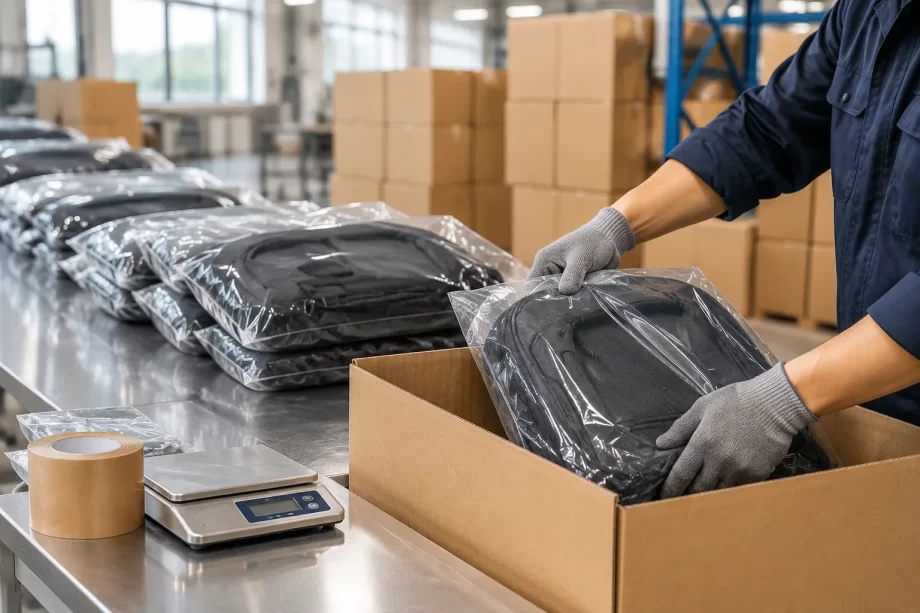
A backpack is a textile product. Everything that ships around it is a regulated packaging stream, and in most export programmes the packaging is the part nobody engineers. The bag gets a tech pack, a material specification, a colour standard and a drop-test protocol. The polybag it is folded into gets whatever the packing department bought last quarter.
That asymmetry has become expensive. Since the European Packaging and Packaging Waste Regulation began applying on 12 August 2026, and with plastic packaging taxes running in the United Kingdom, Spain and Italy alongside national producer responsibility schemes across the European Union, the film and board that leave a bag factory are now counted, taxed, declared and in some markets rejected if they cannot be recycled. A brand’s fee is calculated from the weight and material of packaging that a factory in Guangdong or Zhejiang specified without being asked.
For a manufacturer, that is either a liability or a commercial advantage. Factories that can hand a buyer a complete packaging data file — component weights, material codes, recycled content percentages, recyclability status and a declaration of conformity — win orders that factories without that file cannot comfortably quote for. Factories that cannot produce it become the reason a brand misses a registration deadline.
This article is written from the factory floor outward. It sets out which rules now reach a backpack carton, what actually ships inside one and what it weighs, how fees and plastic taxes are calculated on that mass, how design decisions on a polybag or a hangtag change the bill, what evidence a buyer will demand, and how to build the weighing and documentation routine that makes all of it repeatable rather than a scramble before every shipment.

- Why Packaging Became the Hardest Part of a Bag Export Order
- The Four Rule Families That Reach a Backpack Carton
- What Actually Ships With a Backpack, and What It Weighs
- EPR Fees: Where the Money Actually Goes
- Plastic Packaging Taxes in Practice
- PPWR: What Changes Between Now and 2030
- Designing Packaging That Passes: Eight Changes That Pay
- The Evidence File: What You Must Be Able to Produce
- Capturing Weight Data at the Factory
- Where Export Packaging Quietly Fails an Audit
- A Twelve-Month Work Plan
- FAQ
- Conclusion
The manufacturer’s view: packaging compliance is not a legal department problem that arrives at the end of an order. It is a data problem that starts when the packaging specification is set, and a factory that does not weigh what it ships cannot declare what it ships.
Why Packaging Became the Hardest Part of a Bag Export Order
Ten years ago, packaging was a cost line and a damage-prevention question. A buyer asked for a polybag thick enough not to split, a carton strong enough to survive a container, and a hangtag attached the way the brand wanted. Nobody asked what the film weighed in grams, because nobody was charged by the gram.
Three changes moved packaging from an operations detail to a compliance obligation.
The first is that the cost is now per kilogram. Plastic packaging taxes and modulated producer responsibility fees both scale with the mass of material a brand places on a national market, differentiated by material type. A heavier polybag, a laminated hangtag, a plastic-coated carton or a shrink-wrapped pallet all increase a number the brand reports every year.
The second is that the obligation attaches to the party placing the product on the market, and that party is almost never the factory. The importer of record or brand owner carries the registration, the fee and, in the event of an error, the penalty. Which means the buyer needs data from the factory in a form their compliance scheme will accept. This is the origin of most packaging arguments between a bag supplier and an overseas customer: not a disagreement about quality, but a missing weight.
The third is that design rules have started to bind. Recyclability by design, caps on empty space in transport packaging, minimum recycled content in plastic packaging and harmonised labelling are no longer voluntary commitments in a sustainability report. They are conditions on being allowed to sell the pack-in-box at all, and they are checked at the packaging component level rather than the product level.
A brand can design a beautiful recyclable backpack and still fail a packaging review because of the polybag, the silica gel sachet and the laminated hangtag that travel with it. Compliance is assessed on the component, not on the hero product.
The practical consequence is a shift in what packing means. It used to be the last operation before the container; it is now a specification agreed before the purchase order, because the packaging choice changes the buyer’s declared tonnage, fee band, recyclability grade and, in the European Union, whether the consignment can be placed on the market at all.
The Four Rule Families That Reach a Backpack Carton
Buyers rarely ask a factory to understand legislation. They ask for specific documents. But the requests only make sense if the factory knows which of four rule families is generating them, because each one asks for different information and each one fails in a different way.
Extended Producer Responsibility and Registration
Extended producer responsibility is the oldest of the four and the one that most directly produces paperwork. A producer — the brand, importer or in some schemes the first domestic distributor — registers with a national scheme, declares the mass of packaging it placed on the market by material category, and pays a fee that funds collection and recycling.
The schemes differ in name and detail but not in structure. Germany runs registration through the national packaging register with a system participation requirement, France combines a producer responsibility organisation with a national sorting label, and Spain, Italy, the Netherlands, Belgium and the Nordics each run their own. The United Kingdom moved to a reformed packaging responsibility system with reporting obligations on larger producers, and comparable frameworks now exist in Canadian provinces, several United States states, Chile, India and South Africa.
What matters on the factory floor is narrow but critical. The fee is calculated on packaging mass per material, so the buyer needs a weight per component and a material classification that matches the scheme’s categories, not the factory’s purchasing vocabulary. “PE film” is not a category. “Plastic — polyethylene, flexible” is closer to what a scheme will accept.
In every scheme the unit of account is the component, and the unit of measurement is the kilogram. A factory that can supply both, per SKU, per order, removes the single largest source of delay in a buyer’s registration cycle.
Plastic Packaging Taxes
Where a tax exists, it sits alongside EPR rather than replacing it, so a shipment can be caught twice by two different mechanisms measuring different things. The United Kingdom taxes plastic packaging components that contain less than thirty percent recycled plastic, charged per tonne above a de minimis threshold, with the rate rising by inflation each April. Spain levies a tax per kilogram on non-recycled plastic contained in non-reusable plastic packaging. Italy legislated a comparable tax on non-reusable plastic packaging, with implementation repeatedly deferred.
The common thread is that these taxes are aimed at virgin plastic mass and relieved by recycled content or by reuse. That makes two data points commercially decisive: the weight of plastic in the packaging, and the percentage of recycled content in it — documented, not asserted.
Design, Recyclability and Minimisation Rules
This is the family that changed most recently and the one that will drive packaging redesign through the rest of the decade. The European regulation that began applying in August 2026 sets a direction of travel that is now difficult to reverse: packaging placed on the market must be designed for recycling against a performance scale, plastic packaging must meet minimum recycled content thresholds, the empty space in grouped, transport and e-commerce packaging is capped, and packaging must be reduced to the minimum volume and weight needed to do its job.
The dates matter more than the wording. Recyclability requirements bite from 2030, recycled content minimums start in the same year and tighten later, and harmonised labelling obligations arrive ahead of them. A packaging specification agreed today will still be in production when those rules apply, which is why buyers are already asking suppliers to move a polybag from a multi-layer laminate to a mono-material film.
Labelling and Declaration Duties
The fourth family is the one factories meet most often and understand least: what must be printed, and what must be signed. Sorting labels, material identification marks, fibre composition where packaging is paper-based, recycling instructions, and declarations of conformity that state which rules a packaging component complies with.
A declaration of conformity is not a marketing document. It is a technical statement that a named component, at a stated weight and material composition, meets a defined set of requirements, supported by documentation that must be available on request. When a buyer asks a bag factory to sign one, they are asking the factory to accept that the data behind it is accurate.
| Rule family | Who is legally obligated | What the factory must supply | What goes wrong most often |
|---|---|---|---|
| EPR registration and fees | Brand, importer of record, or first domestic distributor | Component weight per SKU and a material classification matching the scheme | Weights taken from a supplier invoice for a different bag size |
| Plastic packaging tax | Producer or importer of the plastic component | Plastic mass per component and documented recycled content percentage | Recycled content claimed on a supplier letter with no certificate behind it |
| Design and recyclability rules | Producer placing packaging on the market | Material construction, layer structure, and a recyclability statement | Multi-material laminates that no sorting stream can separate |
| Labelling and declarations | Producer, with technical file from the supplier | Correct marks, material codes, and a signed declaration of conformity | Declaration signed against an older specification |
What Actually Ships With a Backpack, and What It Weighs
Most packaging arguments between a factory and a brand can be traced to a single omission: nobody has ever written down the full bill of packaging for one SKU. The bag is specified in detail; the packaging envelope around it is not.
A typical export-ready backpack shipment contains far more components than the people who pack it would list from memory. Each one has a weight, a material and a compliance consequence.

| Component | Typical material | Indicative weight per unit | Scheme category | Recyclability status | Effort to fix |
|---|---|---|---|---|---|
| Inner polybag | LDPE film, 40 to 60 micron | 12 to 22 g | Plastic, flexible | Good if mono-material and unprinted | Low |
| Polybag closure | Adhesive flap or paper header | 1 to 3 g | Paper or plastic, mixed | Depends on the header material | Low |
| Hangtag | Coated board, 350 to 400 gsm | 2 to 4 g | Paper, composite | Poor if plastic-laminated | Low |
| Tag attachment | Cotton string, nylon barb or plastic staple | 0.3 to 1.5 g | Textile, plastic or metal | Good for cotton, poor for nylon barbs | Low |
| Silica gel sachet | Paper and PE laminate with desiccant | 1 to 3 g | Composite | Poor, usually not recyclable | Medium |
| Tissue or interleaving | Unbleached tissue paper | 3 to 8 g | Paper | Good if uncoated | Low |
| Inner master carton | Corrugated board, single wall | 15 to 35 g per unit at 20 to 30 units per carton | Paper | Good if unbleached and unlaminated | Low |
| Carton sealing tape | BOPP or paper, water-activated | 0.2 to 0.6 g per unit | Plastic or paper | Poor for BOPP, good for paper | Low |
| Pallet wrap | Stretch LLDPE film | 20 to 60 g per pallet, apportioned per unit | Plastic, flexible | Good if mono-material and thin | Medium |
| Edge protectors and straps | Board and PP strapping | 10 to 25 g per pallet | Paper and plastic | Mixed | Medium |
| Desiccant in the carton | Container desiccant bag | 50 to 200 g per carton | Composite | Poor | Medium |
Read that table as a compliance manager reads it and the arithmetic is uncomfortable. Per-unit packaging mass commonly lands between twenty and forty grams across film, board and paper, and plastic is about half of it. On twenty thousand units that is several hundred kilograms of plastic for a brand to declare — a figure no pack list currently states, and that most brands first discover when their scheme asks.
The number that matters to a buyer is not the carton weight they can read off a shipping document. It is the per-unit, per-component weight, split by material, that lets them declare tonnage by category. Almost no factory volunteers this. The ones that do become preferred suppliers.
Two details make the table usable. Weights must be measured on the actual production component, not taken from a nominal specification: film thickness varies within a roll, board weight varies between lots, and the gap between 40 and 55 micron film is a third of the declared plastic mass. And the classification must be done once, properly, then reused. A component library with material codes attached is worth more than any individual declaration, because most SKUs share most components.
EPR Fees: Where the Money Actually Goes
A producer responsibility fee looks like a tax and behaves like an insurance premium. It funds the collection, sorting and reprocessing of packaging once it becomes waste, and it is charged on the mass a brand places on the market. Understanding its structure tells a factory exactly which packaging changes will reduce the buyer’s bill and therefore which changes are worth quoting.
How a Fee Is Calculated
The arithmetic is a chain of four multipliers, and the third and fourth are where design decisions show up.
- Declared mass per material category, in tonnes, from the annual declaration. This is the factory’s data.
- Base rate per material per tonne, set by the scheme. Paper and board are conventionally cheaper than plastic; flexible plastic and composite materials sit at the top.
- Modulation, an adjustment applied for design characteristics. Packaging that is easily recyclable receives a discount; packaging that disrupts sorting carries a surcharge.
- Collection and sorting reality, which some schemes reflect through a separate material-specific rate rather than a single national figure.
A worked illustration makes the leverage obvious. Take a brand placing forty tonnes of packaging on one national market per year: fifteen tonnes of flexible plastic film, twenty tonnes of corrugated board, and five tonnes of composite material comprising hangtags, sachets and laminated headers.
- Moving the polybag from 55 to 45 micron mono-material film cuts flexible plastic mass by roughly eighteen percent, about 2.7 tonnes.
- Replacing the laminated hangtag with an unlaminated board tag moves most of that five-tonne composite stream into the paper category, where both the base rate and the modulation surcharge are materially lower.
- Neither change touches the backpack. Both change the fee, the recyclability grade and the tonnage reported to the tax authority.
Modulation is the mechanism that finally connects a factory’s packaging line to a brand’s finance department. A design change worth two grams per unit looks trivial on a packing table and becomes a five-figure annual number at the declaration level.
The Importer Problem, and Why Factories Get Asked to Register
In most schemes the obligated party is the entity that first places the packaged product on the national market. For a brand importing finished backpacks, that is the brand or its local importer — not the factory. But a subset of schemes and tax regimes require a local establishment or an authorised representative, and a small number of markets look through to the party that manufactures or first supplies the packaging.
This produces the request factories encounter most: a buyer asking their supplier to register, to act as an authorised representative, or at minimum to provide a declaration the buyer can file. A factory should treat these requests carefully and consistently.
- Providing data is normal service. Providing data is not the same as accepting the legal obligation.
- Acting as an authorised representative is a real legal role with liability attached; price it, contract it, and limit it to named markets.
- Signing a declaration for a component the factory specifies is reasonable, because the factory controls the specification and holds the evidence. Signing for a design the buyer specified is riskier, because the factory is certifying someone else’s decision.
The cleanest position for an export manufacturer is to own the data and the specification, and to be explicit about where liability sits. Buyers respect a supplier who says “here is the file, here is what I can certify, here is what your importer must sign” far more than one who signs everything to close the order.
What a Declaration Must Actually Contain
Schemes differ in format but converge on content. A declaration that survives review contains the packaging component identified by name and article number; the material and, where relevant, the layer structure; the weight per component with the unit stated; the number of components per product; the recycled content percentage with the certificate reference; the recyclability classification against the applicable scale; the applicable registration or scheme reference; and the signature of a named person with the date and the specification version it refers to.
The version reference is the detail that saves factories in disputes. Packaging specifications change quietly — a polybag supplier substitutes a film, a hangtag printer adds a varnish, a carton supplier moves to a heavier flute — and a declaration that does not name the specification version it was issued against becomes a false statement by accident. Change control is therefore not administrative tidiness; it is the mechanism that keeps declarations true.
Plastic Packaging Taxes in Practice
Plastic taxes are narrower than EPR fees and easier to reason about, because they hinge on two facts: the mass of plastic in the packaging, and whether that plastic contains enough recycled content to qualify for relief.
The United Kingdom Model
The United Kingdom tax is the clearest example of the pattern. It applies to plastic packaging components manufactured in or imported into the United Kingdom that contain less than thirty percent recycled plastic, charged per tonne, with the rate indexed each April and a de minimis tonnage threshold below which a business is not liable. Plastic packaging that meets the recycled content threshold falls outside the charge entirely, and exports are relieved.
For a backpack shipment, the components in scope are the polybag, any plastic closure, the stretch wrap and any plastic strapping. Corrugated cartons, paper tape and board hangtags sit outside the plastic scope but inside EPR. The commercially significant point is the thirty percent threshold: it is a cliff edge rather than a gradient, so a film at twenty-eight percent recycled content is taxed on its full mass while a film at thirty-two percent is not taxed at all.
That cliff edge is why recycled content certificates matter more than recycled content claims. Schemes and tax authorities increasingly expect documentary evidence of the recycled content in the specific component, not an average for the supplier’s production, and a mass balance approach that is acceptable in one jurisdiction may not be accepted in another.
The Spanish and Italian Models
Spain taxes non-recycled plastic contained in non-reusable plastic packaging at a rate per kilogram, with registration and periodic self-assessment, and with the taxable base defined by non-recycled plastic mass rather than total packaging mass. Italy legislated a comparable tax with a per-kilogram rate and a de minimis, and implementation has been deferred repeatedly.
The design lesson is identical in both: reusable packaging, or packaging with certified recycled plastic, reduces or eliminates the taxable base. That pushes a factory toward two questions it will be asked — whether the polybag can be replaced by a reusable alternative that still protects the bag, and whether the film can carry certified recycled content above the relevant threshold.
| Jurisdiction | Mechanism | Taxable base | Relief route | Factory data required |
|---|---|---|---|---|
| United Kingdom | Plastic packaging tax per tonne | Plastic components under 30 percent recycled content | Certified recycled content above threshold, export relief | Plastic mass per component, recycled content certificate |
| Spain | Tax per kilogram on non-reusable plastic packaging | Non-recycled plastic mass | Reusable packaging, certified recycled content | Plastic mass, recycled percentage, reusability statement |
| Italy | Tax per kilogram on non-reusable plastic packaging | Non-recycled plastic mass, with de minimis | Recycled content, reusability | As Spain, with deferral-dependent timing |
| European Union schemes | EPR fee modulation | Total packaging mass by material | Design for recycling, recyclability grade | Weight, material, construction, recyclability class |
Two grams of film does not feel like money on a packing line. Multiplied by a million units and a per-kilogram tax, it is a budget line — and on the recycled content side, the difference between twenty-eight and thirty-two percent can be the difference between a taxable and a non-taxable component.
PPWR: What Changes Between Now and 2030
The European regulation that began applying in August 2026 is the one that will occupy packaging engineers for the rest of the decade. Its importance for a bag factory is that it moves the compliance question from “what is this packaging made of” to “is this packaging designed to be recycled, and is it the minimum necessary”.
The Requirements That Bind First
Several obligations apply from the outset and affect documentation immediately: placing packaging on the market requires conformity, technical documentation must exist and be retained, and the producer must be able to demonstrate compliance on request. For a factory supplying European buyers, this is where the declaration file stops being optional.
Alongside that, the regulation caps empty space: grouped, transport and e-commerce packaging must not exceed a defined empty space ratio, with the practical threshold commonly cited as fifty percent of the volume, and void fill must be reduced to what is functionally necessary. A carton sized for a bag family rather than for the bag is now a compliance defect, not merely a freight inefficiency. Double-walled board used to compensate for poor fit attracts scrutiny, and over-boxing a retail-ready pack so that it palletises cleanly is increasingly hard to justify.
The 2030 Requirements That Drive Today’s Design
Design for recycling becomes binding in 2030, against a performance scale that effectively requires packaging to reach a recyclability grade rather than merely being theoretically recyclable. Plastic packaging must also meet minimum recycled content thresholds from the same date, differentiated by packaging type and contact sensitivity, with the levels for general plastic packaging well above the ten percent that applies to contact-sensitive non-PET formats.
Three consequences follow for backpack packaging, and all three are specification decisions made years before the deadline.
- Mono-material becomes the default. A polybag from one polymer family, unprinted or printed with compatible inks, recycles in a film stream. One with a laminated header, a paper insert and a metallised panel does not, and no amount of consumer instruction fixes that.
- Recycled content must be contractual. A film specified at thirty percent post-consumer recycled content needs a supplier who certifies it lot by lot, and a factory that records the certificate against the batch.
- Minimisation becomes measurable. Thickness, carton size, component count and unnecessary layers become explicit parameters in a specification rather than habits inherited from a previous programme.
The regulation does not ask whether a bag’s packaging is theoretically recyclable in a perfect system. It asks whether the component is designed so that a real sorting stream can process it. That distinction eliminates most composite packaging, and composite packaging is what most backpack polybags currently are.
A harmonised labelling regime arrives ahead of the 2030 requirements, replacing the patchwork of national marks with a single format and material identification. Hangtags, polybag print and carton marks all fall in scope within the same window, which is reason enough to consolidate packaging artwork revisions instead of managing them one market at a time.
Designing Packaging That Passes: Eight Changes That Pay
The useful question is not which packaging is most sustainable in the abstract. It is which changes reduce declared mass or improve recyclability enough to justify their cost and operational disruption, on a line that ships tens of thousands of units.

| Design change | Compliance effect | Cost impact per unit | Production impact | Priority |
|---|---|---|---|---|
| Mono-material LDPE polybag, no header | Moves film into a recyclable stream, improves grade | Neutral to slight increase | None if the sealing line already runs LDPE | 1 |
| Reduce film from 55 to 45 micron | Cuts plastic mass roughly 18 percent | Decrease of a few percent | Requires a burst-strength check | 1 |
| Certified recycled content above 30 percent | Removes UK PPT liability, improves fee modulation | Increase of 3 to 8 percent on film | Certificate tracking per lot | 1 |
| Unlaminated board hangtag | Moves composite to paper category | Slight decrease | Artwork re-approval | 2 |
| Paper water-activated tape instead of BOPP | Removes a plastic component entirely | Slight increase | Sealing equipment change | 2 |
| Right-size the carton to the packed bag | Addresses empty space ratio directly | Decrease in board cost and freight | New die or dimension set | 2 |
| Replace silica gel with a carton-level desiccant | Fewer per-unit composite components | Decrease in component count | Condensation risk review needed | 3 |
| Paper-based mailer for e-commerce direct | Removes film from the consumer-facing pack | Increase, protection dependent | Only viable for non-fragile formats | 3 |
Three of those changes are close to free and should be standard on any export programme: a mono-material bag, a thin but adequate film, and a carton that fits. Certified recycled content costs money and buys tax relief, and the arithmetic only works when the buyer’s volume and market mix are known, which is why it belongs in the quotation conversation rather than in a unilateral factory decision.
The remaining changes depend on the product. A paper mailer is excellent for a twenty-litre daypack and unacceptable for a structured camera bag, and a carton-level desiccant is better than per-bag sachets for compliance and worse for humidity control if the carton is opened and resealed in transit. The point is not to eliminate every component; it is to be able to state, per component, why it exists and what it costs the buyer in declared mass.
A packaging specification that a factory can defend line by line — this component, this weight, this material, this function, this recyclability status — is worth more commercially than any sustainability claim on a website. It answers the buyer’s question before they ask it.
The Evidence File: What You Must Be Able to Produce
When a buyer’s compliance team reviews a supplier they are not looking for good intentions but for a file that would survive an audit if the packaging were challenged. It has seven parts, and factories that assemble it once for a product family reuse it for years.
- A packaging bill of materials per SKU, listing every component with material, construction and measured weight.
- Material and layer specifications from each packaging supplier, including film structure and board grade.
- Recycled content certificates, traceable to the component and the lot, not to a supplier’s general capability.
- Recyclability statements with the classification applied and the reasoning recorded, including any component that fails and why it is retained.
- Declarations of conformity, version-referenced and signed by a named responsible person.
- Test records where the design relies on a performance claim, such as film burst strength or carton compression.
- A change log recording every packaging substitution with the date, the reason and the re-declaration that followed.
The change log is the part most factories omit and the part auditors value most. Packaging changes are usually cost improvements — a cheaper film, a lighter board, a substitute tape — and each is defensible alone. A chain of them without documentation is how a factory ends up certifying a declaration that no longer describes the product.
Capturing Weight Data at the Factory
Everything above depends on one capability that most bag factories do not currently have: knowing, to the gram, what each packaging component weighs and being able to reproduce that number on demand. Building it is not difficult, but it has to be a routine rather than a project.
Build the Component Library First
Start with the component list, not the SKU list, because most SKUs share most components. A factory making thirty backpack models typically uses three or four polybag sizes, two hangtag formats, two carton families and one tape. Weighing components once and mapping SKUs to them cuts the measurement workload by an order of magnitude.
Weigh Ten, Use the Mean, Record the Spread
Single-sample weighing is where declarations go wrong. Cut ten components from at least three lots, weigh each on a scale fine enough for the component — a hundredth of a gram for a hangtag, a gram for a carton — and record mean and range. If the spread exceeds roughly ten percent on a nominally identical component, the supplier is not controlling the specification, which is worth acting on before it becomes a declaration error.
Separate Net from Gross, and Per Unit from Per Carton
The most common arithmetic failure is mixing scopes. A carton weight belongs to the carton; the per-unit board mass is the carton weight divided by the packed quantity, and the packed quantity varies by bag volume and folding method. Declarations built on “about twenty units per carton” drift by ten to fifteen percent as soon as a buyer changes the folding instruction. Record the packed quantity with the weight, and recalculate rather than reuse.
Map to Scheme Categories Once
Every scheme has its own taxonomy and the mapping is not intuitive from the factory’s side: paper tape with a plastic reinforcement is a composite, while a polybag with a printed band of the same polymer family is still plastic. Do the mapping once with the buyer’s compliance contact and store the classification code in the component library.
Put Change Control Around Packaging, Not Just Product
Product change control is well established in bag factories: a new buckle, a different zip, a revised panel all go through approval. Packaging changes typically do not, because they are bought by the packing department and consumed without a sample. Route every packaging substitution through the same approval gate as a component change, with a single question attached: does this alter the declared weight, material or recyclability status, and if so, who re-declares?
Factories fail packaging audits for the same reason they fail any audit: the data existed at some point, in someone’s spreadsheet, and nobody owned it. Assign the packaging data file to a named person with a review cadence, and most of the failure modes disappear.
Where Export Packaging Quietly Fails an Audit
These defects recur across factories and are worth finding before a buyer’s auditor does.
- Declared weight does not match production. A specification written at 50 micron but produced at 58 micron inflates declared mass and, in a tax market, the buyer’s liability.
- Recycled content claimed without a certificate. A supplier letter stating “up to 30 percent” is not evidence of 30 percent in the shipped component.
- Laminates described as recyclable. A film with a paper header, a metallised layer or a PVDC coating does not recycle in a standard film stream, however the summary describes it.
- Empty space unmeasured. Cartons sized for a family rather than a SKU, with void fill compensating, fail the empty space test and cost freight.
- Declarations signed against a superseded specification. The most serious finding, because it is a false statement rather than an omission.
- No retention. Documentation exists for the current order but not for a shipment eighteen months old — exactly the window an authority or a customer dispute will target.
A Twelve-Month Work Plan
The sequence matters more than the speed. Trying to fix design and documentation at once produces neither.
This quarter. Weigh every packaging component in current production. Build the component library, the SKU mapping and the material classification, and issue a first packaging bill of materials to your top five buyers. Change no designs yet.
Next quarter. Substitute what is cheap and uncontroversial: mono-material polybag without a header, right-sized carton, paper tape where the sealing line allows. Re-weigh, re-declare, and add recycled content certificates where the film supplier can provide them.
Following two quarters. Take the harder changes to the buyer: recycled content thresholds, removal of composite components, carton rationalisation across a family, and the labelling artwork that must change once the harmonised format applies. Price these as engineering changes, not favours.
Annually. Reconcile declarations against production, audit two packaging suppliers, and check the file against the markets served. Regulations are still moving.
Done in this order the work costs almost nothing in engineering time, and a great deal in credibility if skipped. The weighing exercise is unglamorous, and it is the whole foundation.
FAQ
Is the polybag around a backpack counted as packaging under these rules?
Yes, and it is usually the largest plastic component in the shipment. A 45 to 55 micron LDPE bag weighs roughly 12 to 22 grams per unit, which on a twenty-thousand-piece order is several hundred kilograms of declared plastic — in scope for producer responsibility fees and, in tax markets, for tax on any share of virgin plastic.
Who is legally responsible for declaring the packaging, the factory or the brand?
Almost always the brand, the importer of record or the party first placing the packaged product on that national market. The factory’s obligation is contractual: accurate weights, material classifications, recycled content evidence and, where agreed, a declaration of conformity. Acting as an authorised representative is a separate legal role, to be priced and contracted.
Can a backpack factory sign the declaration of conformity for its packaging?
It can and often should, provided the factory controls the specification and holds the evidence behind every statement — measured weights, supplier declarations, recycled content certificates, recyclability classification. Signing for a design the buyer specified is the other risk: the factory would be certifying a decision it did not make.
What recycled content percentage actually matters for plastic packaging?
Thirty percent is the threshold that most often decides liability in the United Kingdom, where a component below it is taxed on full mass and a component at or above it is not taxed at all. The European recycled content requirements binding from 2030 set higher minimums for general plastic packaging. Because these thresholds are cliffs, documented content beats an average claim.
Does a paper hangtag avoid the plastic rules entirely?
Only if it is genuinely paper. A coated, laminated or plastic-laminated tag sits in the composite category, which typically attracts higher fees and poorer recyclability classification than plain board. Switching to unlaminated board with a cotton string is one of the cheapest compliance improvements available, and it also simplifies artwork.
What happens if the packaging changes after the declaration is filed?
The declaration becomes inaccurate, and in tax markets that is the buyer’s exposure. Every substitution — a lighter film, a different tape, a new hangtag finish — should pass the same approval gate as a component change, with one question attached: does this alter weight, material or recyclability, and if so, who re-declares and by when?
Conclusion
Packaging waste compliance is usually presented to factories as a legal subject. In practice it is a measurement subject. Every obligation described in this article resolves, eventually, to three facts about a component: what it is made of, how much it weighs, and whether it can be recycled in a real sorting stream. Factories that can state those three facts per component, per SKU, on request, find that the rest of the compliance conversation becomes administrative.
The work is unglamorous and it is not optional. Weigh the components. Classify them once against the scheme taxonomy. Keep the certificates with the component. Put packaging changes through change control so declarations stay true. Then treat the resulting file as something a buyer is buying, because in a market where every brand must declare tonnage it cannot see, the supplier who supplies the number is the supplier who keeps the programme.
A backpack factory cannot control which markets its customers sell into or how those markets tax packaging. It can control whether the customer has the data to comply, and that is now a competitive product in its own right.