
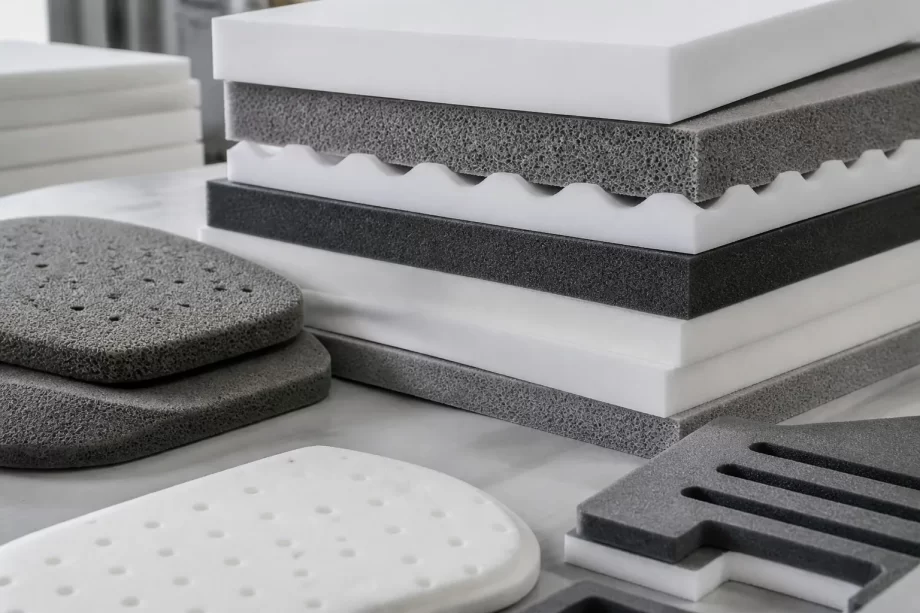
Backpack Padding and Lining: Foam Types, Insulation and Fabric Choices
When a customer picks up a backpack, the first thing they feel is not the shell fabric — it is the padding. The cushioning in the back panel, the softness of the shoulder straps, the protective sleeve around the laptop, the smooth lining that lets items slide in and out. These invisible layers determine comfort, protection, and durability, and they are decided entirely by the factory’s material and construction choices.
Padding and lining are also where cost and quality diverge most visibly. Two backpacks can look identical on the outside and feel completely different — one stiff and uncomfortable after an hour, the other supportive for a full day. The difference is foam density, construction method, and lining quality, all chosen long before the shell fabric is sewn.
This guide explains backpack padding and lining from the manufacturing perspective: the foam family (EVA, PU sponge, memory foam, PE, XPE), foam density and hardness selection, the manufacturing processes (cutting, lamination, heat pressing, quilting), laptop compartment design, lining fabric choices, insulation layers, ergonomic back panels, cost and quality trade-offs, and the testing that verifies it all.
- Why Padding and Lining Matter More Than They Cost
- The Foam Family: What Manufacturers Actually Use
- Foam Density and Hardness: The Numbers That Matter
- The Manufacturing Processes
- Laptop Compartment Design: The Engineering Inside
- Lining Fabrics: The Inside That Sells
- Insulation: Keeping Things Hot or Cold
- Ergonomic Back Panels: Engineering Comfort
- Cost, Quality, and the Spec Sheet
- Testing: Verifying Padding and Lining
- The Buyer’s Selection Framework
- Padding and Lining by Pack Category: The Specification Guide
- Environmental and Compliance Considerations
- Common Padding and Lining Defects
- Working with Your Factory on Padding and Lining
- FAQ
- Conclusion
Why Padding and Lining Matter More Than They Cost
Padding and lining are a small fraction of a backpack’s material cost — often 10–20% — but they drive a disproportionate share of customer satisfaction.
| Experience | Driven by | Failure symptom |
|---|---|---|
| Comfort | Back panel and strap foam | Shoulder pain, back fatigue |
| Protection | Laptop sleeve and padding | Damaged electronics |
| Organization | Lining and compartments | Poor usability |
| Durability | Lining quality, foam resilience | Flattened padding, torn lining |
| Perceived quality | Hand feel of padding and lining | “Cheap” impression |
| Weather behavior | Lining water resistance | Wet contents |
Manufacturer’s note: Customers rarely name foam density in a review, but they feel it. The same shell with premium padding sells for 30% more and earns better reviews; the same shell with thin foam gets returned as “uncomfortable.” Padding is the cheapest way to raise perceived quality — and the easiest way to destroy it.
The Foam Family: What Manufacturers Actually Use
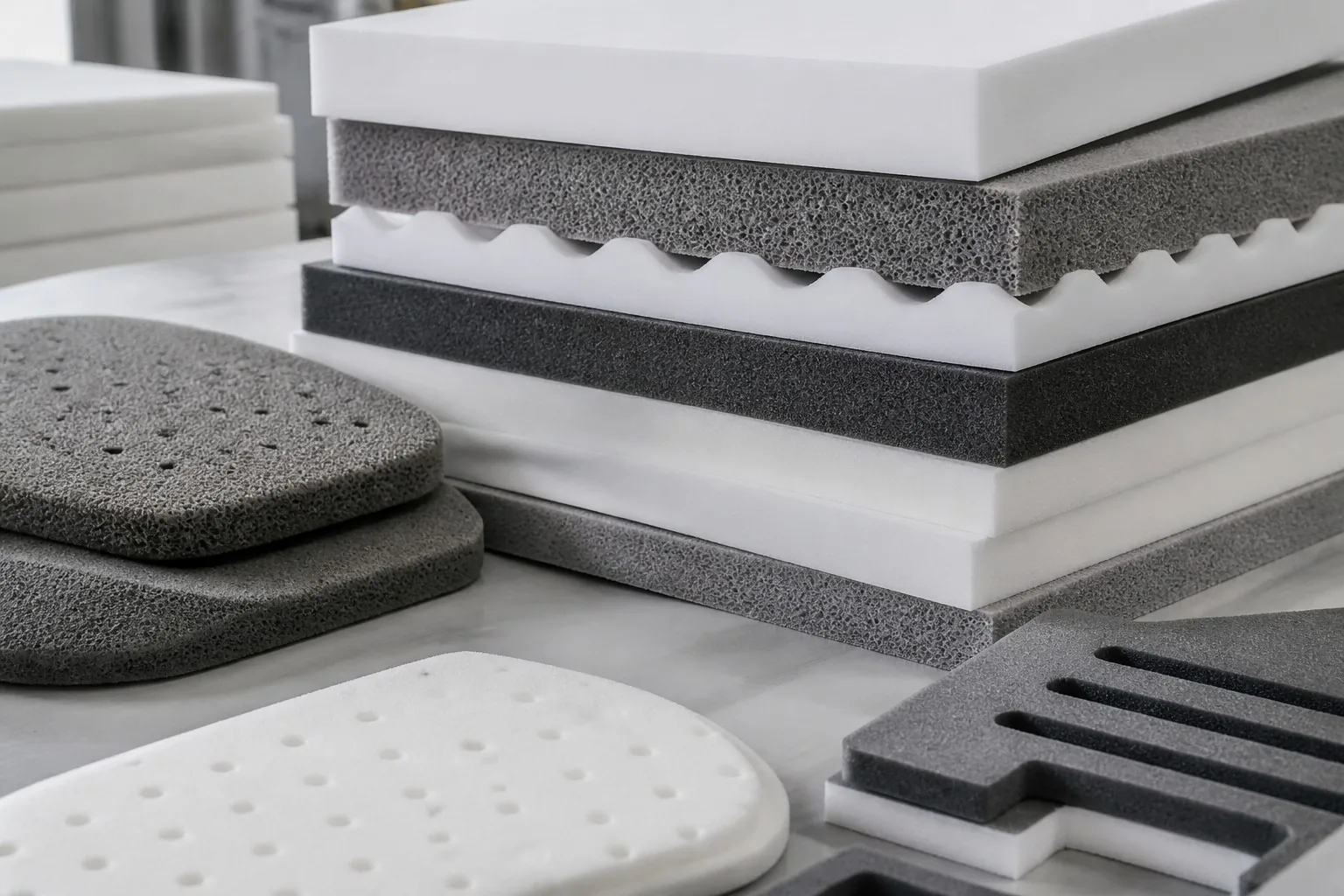
Every padding material is a compromise between support, weight, cost, and manufacturing behavior. These are the workhorses:
| Foam type | What it is | Typical use | Character |
|---|---|---|---|
| EVA | Ethylene-vinyl acetate (closed-cell) | Back panels, laptop sleeves, soles | Firm, lightweight, holds shape |
| PU sponge | Polyurethane foam (open-cell) | Straps, general cushioning | Soft, comfortable, absorbs impact |
| Memory foam | Viscoelastic PU | Premium straps and panels | Slow-recovery, pressure-relieving |
| PE foam | Polyethylene (closed-cell) | Light padding, stiffeners | Light, waterproof, cheap |
| XPE/IXPE | Cross-linked PE | Premium back panels, mats | Denser, more durable than PE |
| Latex | Natural rubber foam | Luxury applications | Resilient, expensive |
Closed-Cell vs Open-Cell: The Critical Distinction
| Property | Closed-cell (EVA, PE, XPE) | Open-cell (PU sponge, memory) |
|---|---|---|
| Structure | Sealed air cells | Interconnected cells |
| Water absorption | Very low | Absorbs moisture |
| Firmness | Firm, structural | Soft, cushioned |
| Shape holding | Excellent | Compresses, recovers |
| Weight | Light | Heavier per volume |
| Best for | Panels, sleeves, stiffeners | Straps, comfort layers |
Manufacturer’s note: The most common padding mistake is using the wrong cell structure for the job. Closed-cell foam in a shoulder strap is too stiff; open-cell sponge in a laptop sleeve absorbs a spill and delivers it to the laptop. The right answer is usually a combination: a firm closed-cell core for structure, a soft open-cell layer for comfort.
Foam Density and Hardness: The Numbers That Matter
Foam quality is defined by density (mass per volume) and hardness (indentation force deflection, IFD). These numbers translate directly to real-world feel.
Density
| Density | Feel | Typical use | Cost |
|---|---|---|---|
| Low (~15–25 kg/m³) | Soft, compresses quickly | Cheap straps, packaging | Low |
| Medium (~25–40 kg/m³) | Balanced comfort | Standard straps and panels | Medium |
| High (40+ kg/m³) | Firm, supportive, long-lasting | Premium panels, ergonomic packs | High |
Hardness (IFD)
IFD measures how much force compresses the foam a set amount. Higher IFD = firmer:
| IFD range | Feel | Best for |
|---|---|---|
| Low IFD (soft) | Plush, sinks in | Laptop sleeves, gentle cushioning |
| Medium IFD | Supportive | All-day carry straps |
| High IFD (firm) | Rigid support | Back panels, load transfer |
The Practical Guidance
- Straps — medium-density open-cell foam (25–35 kg/m³) for all-day comfort; too soft collapses, too firm digs.
- Back panels — firm closed-cell EVA or XPE (35–50 kg/m³) for load support and shape.
- Laptop sleeves — medium foam with closed-cell water protection; the sleeve must cushion impact without adding bulk.
- The density check — squeeze the foam and time the recovery; premium foams recover fully and slowly.
The Manufacturing Processes
How padding becomes part of a backpack is as important as the material itself. These are the core operations:
1. Cutting
| Method | Best for | Notes |
|---|---|---|
| Die cutting | High-volume, consistent shapes | Precision, low per-unit cost |
| CNC cutting | Complex contours | Flexibility, higher cost |
| Knife cutting | Prototypes, small runs | Simple, manual |
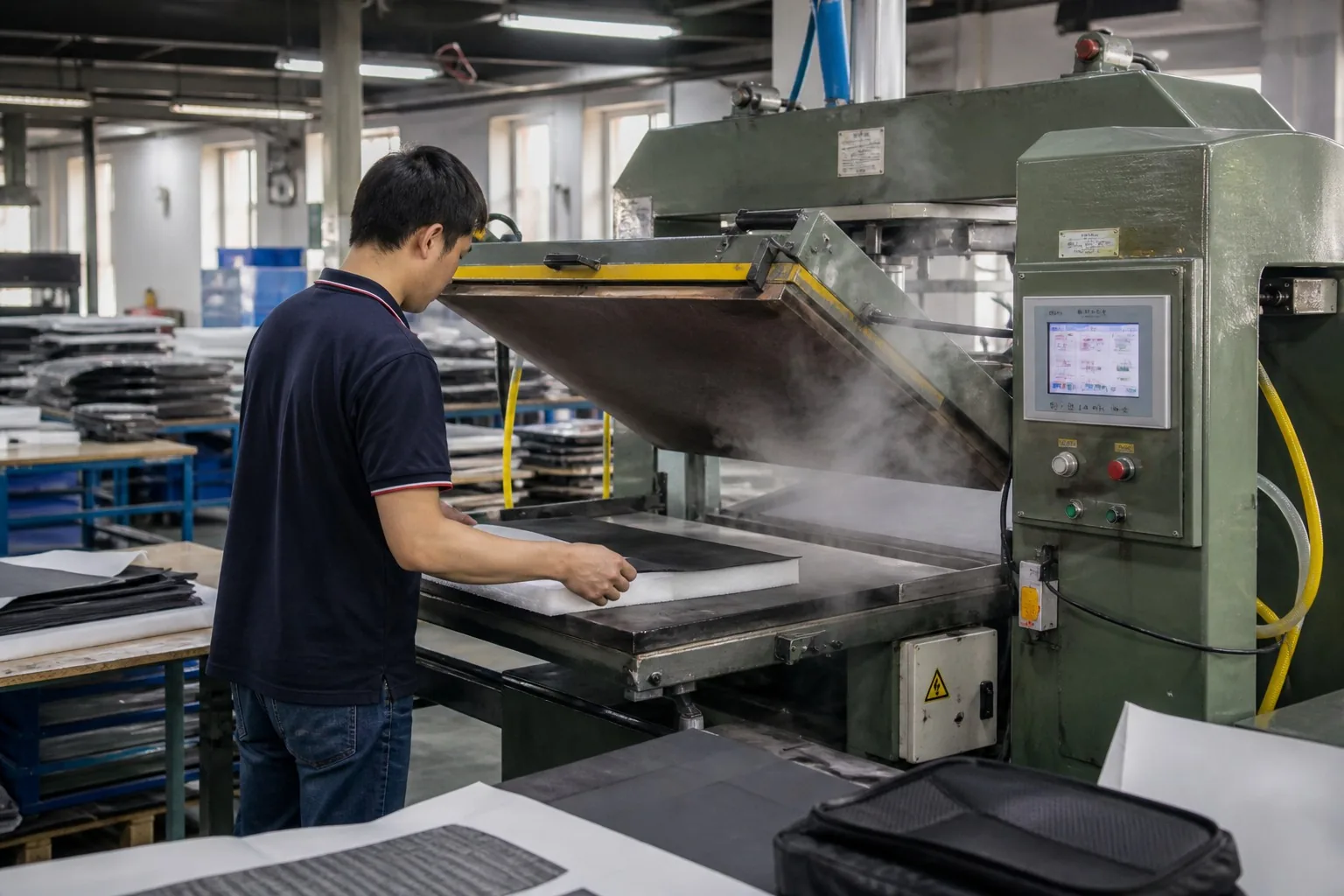
2. Lamination (Foam-to-Fabric Bonding)
Foam is bonded to fabric before cutting or after:
| Method | How it works | Pros | Cons |
|---|---|---|---|
| Adhesive spray | Spray glue, press together | Flexible, common | Solvent smell, QC variability |
| Flame lamination | Heat melts foam surface to fabric | Strong bond, no adhesive | Requires skilled operation |
| Hot-melt film | Adhesive film activated by heat | Consistent, clean | Higher material cost |
| Heat pressing | Pressure + heat bond | Fast, uniform | Equipment cost |
3. Quilting
Quilting stitches foam between fabric layers, creating the classic cushioned panels:
- Pattern — diamond, channel, or grid stitching; the pattern controls how the foam moves.
- Function — quilting keeps foam in place, distributes load, and adds structure.
- The craft — consistent stitch depth and tension separate premium quilting from amateur work.
4. Assembly and Sewing
Padded panels are sewn into the pack with specific rules:
- Foam panels are sewn with walking-foot machines to avoid shifting.
- Edges are bound or finished to contain foam.
- Bar-tacks reinforce attachment points on padded panels.
Laptop Compartment Design: The Engineering Inside
The laptop sleeve is the most engineering-intensive part of modern backpacks. It protects expensive equipment, and its failures are the most expensive to discover.
The Two Suspension Designs
| Design | How it works | Pros | Cons |
|---|---|---|---|
| Bottom-drop | Laptop rests on the pack bottom | Simple, cheaper | Impacts transfer to laptop |
| Suspended (raised bottom) | Sleeve hangs, bottom floats | Protects from drops | More construction, cost |
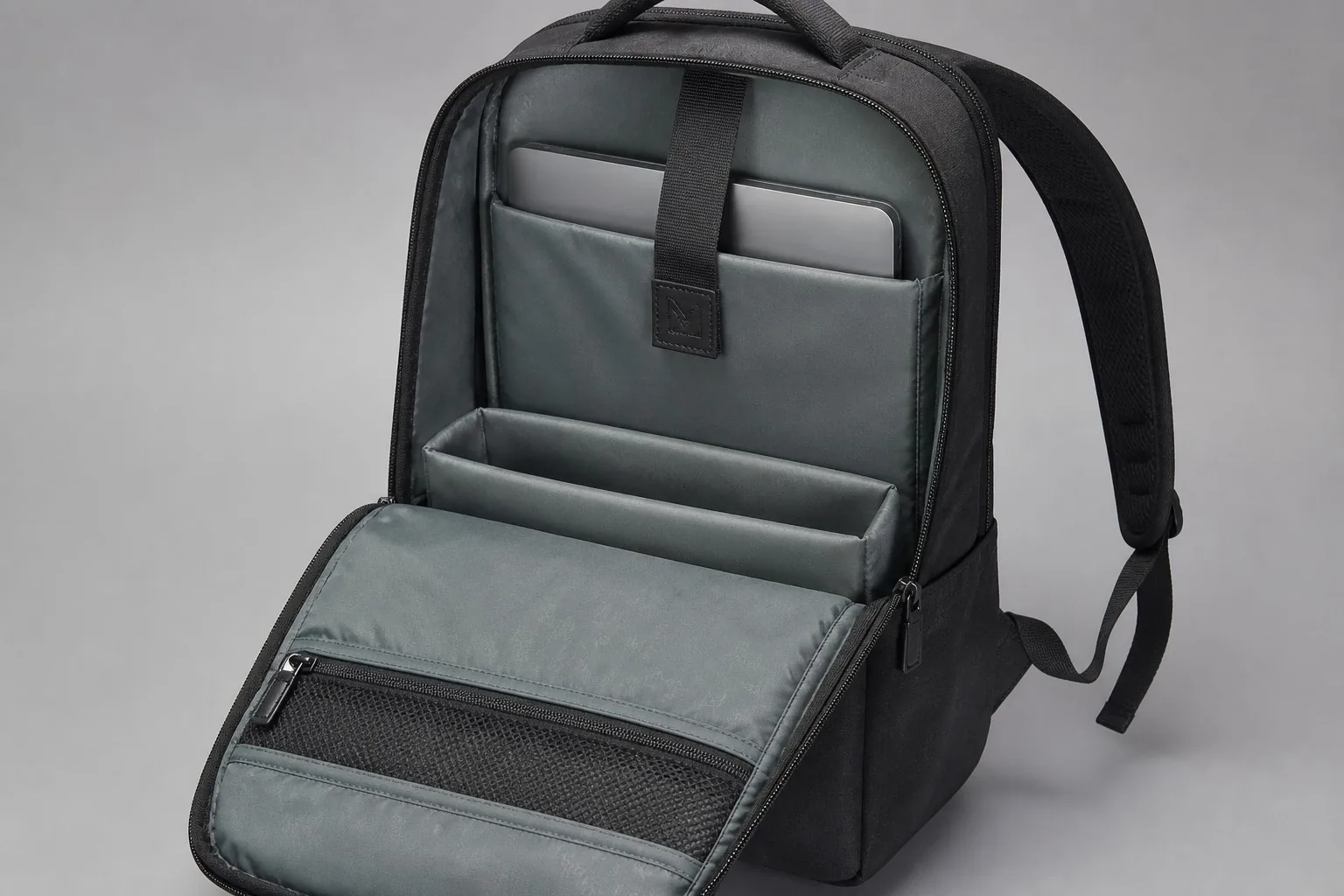
The suspended design is standard for quality packs: the laptop sleeve bottom sits 2–4 cm above the pack bottom, so a hard drop lands on the pack, not the laptop.
The Sleeve Construction
| Layer | Role |
|---|---|
| Outer shell | Abrasion resistance, water shedding |
| Closed-cell foam | Impact absorption, shape |
| Lining | Smooth entry, soft contact |
| Padding walls | Side protection (thicker at bottom) |
| Suspension panel | Raised bottom support |
The Size Standards
| Laptop size | Sleeve internal dimensions (approx.) |
|---|---|
| 13–14 inch | 32–34 × 22–24 cm |
| 15–16 inch | 36–38 × 25–27 cm |
| 17 inch | 40–42 × 28–30 cm |
Manufacturer’s note: The suspended laptop bottom is the single most valuable engineering feature a backpack can have, and the least visible one. It costs a small amount of foam and sewing, and it prevents the most expensive damage a backpack can cause. Every quality pack spec should include it.
Lining Fabrics: The Inside That Sells
The lining is what customers touch most — and what factories often under-spec. Lining choices shape usability and durability.
The Lining Fabric Options
| Fabric | Properties | Typical use | Cost |
|---|---|---|---|
| 210D nylon | Light, smooth, durable | Standard linings | Low |
| 300D/420D polyester | Mid-weight, cleanable | Commuter, laptop packs | Low-mid |
| 600D polyester | Heavy-duty, abrasion-resistant | Work, tactical packs | Mid |
| Ripstop lining | Tear-resistant | Premium, hard-use packs | Mid |
| Oxford cloth | Textured, classic | School, casual packs | Low |
| Mesh (3D air mesh) | Breathable | Back panels, straps, bottle pockets | Mid |
| TPU-coated lining | Waterproof | Outdoor, wet-weather packs | High |
The Lining Decision Matrix
| Pack type | Recommended lining | Why |
|---|---|---|
| School pack | 210D–300D nylon/polyester | Light, durable, colorful |
| Commuter/laptop | 300D–420D, TPU for laptop area | Cleanable, protective |
| Outdoor | TPU-coated or ripstop | Water resistance, durability |
| Tactical | 420D–600D or ripstop | Hard use, no fraying |
| Fashion | Oxford or soft touch | Aesthetic feel |
The Lining Rules
- Wash fastness — dark linings must not bleed onto contents; test before bulk.
- No fraying — raw edges must be finished or bound.
- Smooth entry — the lining slides against contents; rough linings snag.
- Ventilation — breathable mesh panels in the right places reduce odor and moisture.
- Color coding — lining color signals organization (e.g., bright lining = easy to see contents).
Insulation: Keeping Things Hot or Cold
Insulated backpacks are a growing category — lunch bags, bottle pockets, and insulated food compartments for commuters, students, and outdoor users.
The Insulation Materials
| Material | R-value (approx.) | Weight | Best for |
|---|---|---|---|
| Aluminum foil + PE foam (3–5 mm) | Low-mid | Light | Lunch bags, bottle sleeves |
| Foil + closed-cell foam (5–8 mm) | Mid | Moderate | Food compartments |
| Multi-layer foil sandwich | High | Heavier | Premium insulated packs |
| Reflective bubble wrap | Low-mid | Very light | Budget insulation |
The Insulated Compartment Construction
| Layer | Role |
|---|---|
| Outer fabric | Durability, cleaning |
| Insulation layer | Thermal barrier |
| Foil lining (reflective side inward) | Reflects temperature |
| Sealed seams | Prevents thermal leakage |
| Closure | Zipper or flap seals the compartment |
The Thermal Test
Insulation claims should be tested:
- Temperature retention test — contents held at temperature for a defined period (e.g., 4–8 hours).
- Leakage check — insulated compartments must not leak when a bottle spills.
- The honesty rule — label the retention time you can prove, not the one you hope for.
Ergonomic Back Panels: Engineering Comfort
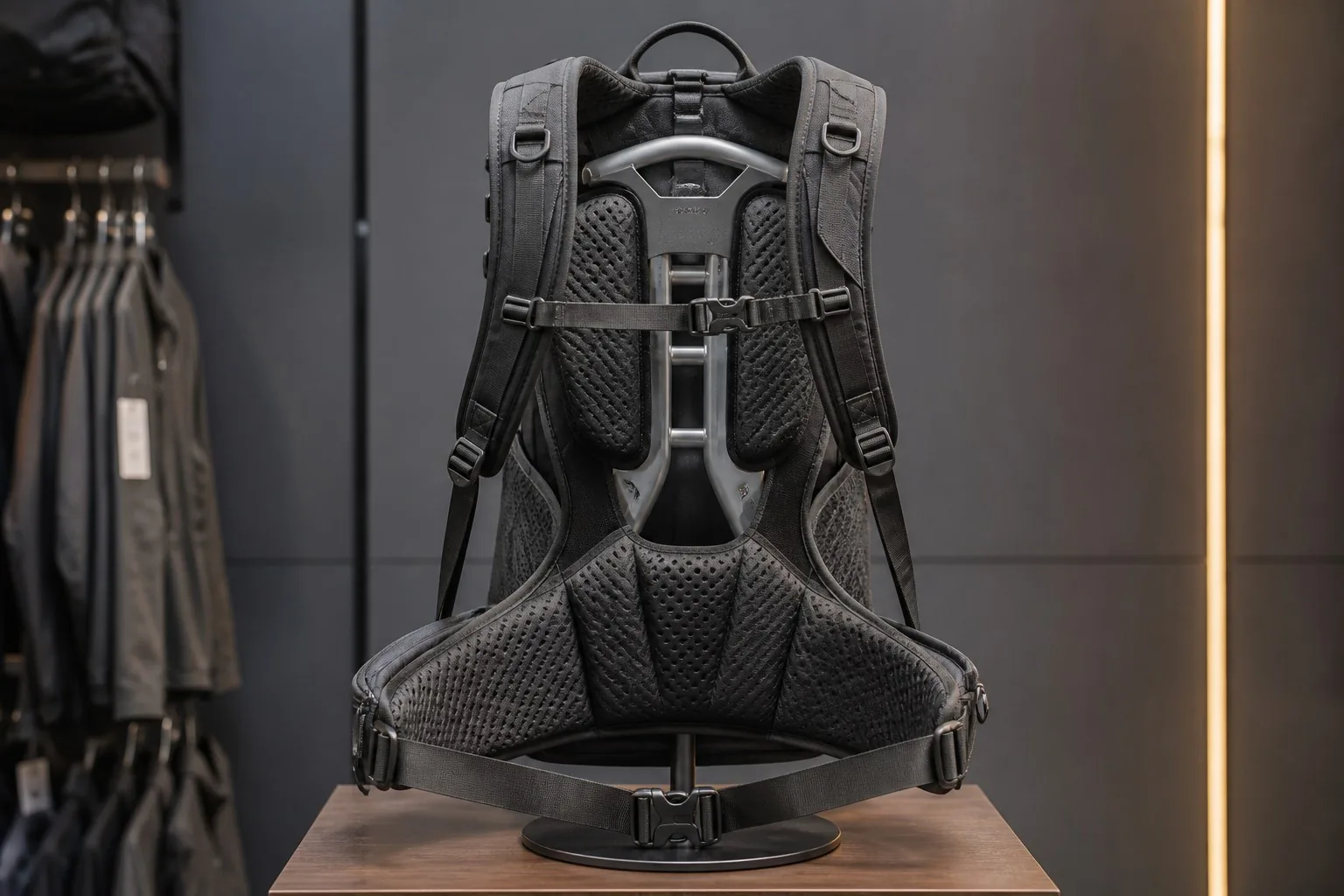
The back panel is where padding engineering matters most. Modern packs use layered systems to distribute load, ventilate, and protect.
The Back Panel Layers
| Layer | Material | Function |
|---|---|---|
| Outer mesh | 3D air mesh | Breathability, air channels |
| Comfort foam | Open-cell medium foam | Pressure distribution |
| Support panel | EVA/XPE, sometimes with frame | Load transfer, structure |
| Frame (premium) | Aluminum or plastic stay | Load transfer to hips |
| Channel design | Molded grooves | Ventilation airflow |
The Ventilation Problem
| Solution | How it works | Trade-off |
|---|---|---|
| Mesh channels | Air gaps between foam ridges | Less contact surface |
| Molded troughs | Deep grooves in foam | Manufacturing cost |
| Suspended mesh | Mesh over frame, no contact | Weight, complexity |
| Perforated foam | Holes in foam | Limited improvement |
Manufacturer’s note: The best back panels balance three conflicting goals: load support, ventilation, and low weight. Every layer added helps one and hurts another. The engineering discipline is knowing which trade-offs your customer’s use case demands — a commuter needs ventilation, a hiker needs load transfer, a student needs weight.
Cost, Quality, and the Spec Sheet
Padding and lining costs must be specified precisely — vague specs invite substitution.
The Spec Sheet Requirements
| Component | Spec items |
|---|---|
| Back panel foam | Type (EVA/XPE), density, thickness, hardness (IFD) |
| Strap foam | Type, density, thickness, width |
| Laptop sleeve | Foam type, thickness, suspension height |
| Lining | Fabric, denier, coating, color |
| Insulation | Material, thickness, R-value claim |
| Construction | Lamination method, quilting pattern |
The Cost Levers
| Lever | Cost effect | Quality effect |
|---|---|---|
| Foam density ↑ | +material cost | +support, +life |
| Lining denier ↑ | +cost | +durability |
| Suspended laptop bottom | +small cost | +protection (big) |
| Quilting pattern | +labor | +structure, +feel |
| Lamination method | varies | +consistency |
| Insulation thickness | +cost, +weight | +thermal performance |
The Substitution Trap
The most common quality fraud in padding is silent substitution: a cheaper foam at the same thickness, or a thinner lining at the same color. The pack looks the same in photos and weighs similar — but the feel and lifespan are different.
- Check foam density — weigh a known volume; density is verifiable.
- Check lining — compare denier and hand feel against the approved sample.
- Check the spec sheet — the contract must name density, thickness, and IFD, not just “foam.”
Testing: Verifying Padding and Lining
Padding needs its own test battery, separate from shell fabric tests.
The Padding and Lining Tests
| Test | What it verifies | Typical pass |
|---|---|---|
| Foam density | Mass per volume | Matches spec |
| IFD hardness | Firmness | Matches spec |
| Compression set | Recovery after prolonged compression | <10–15% set |
| Resilience (rebound) | Bounce-back | 40–60% |
| Aging test | Foam stability over time | No crumbling or yellowing |
| Flammability | Fire resistance (where required) | Meets local standard |
| Lining wash fastness | Color stability | No bleeding |
| Lining tear strength | Durability | Meets spec |
| Thermal retention | Insulation claim | Holds temperature per claim |
The Real-World Checks
- Squeeze test — compress the strap and panel; premium foam recovers fully.
- Weight test — loaded pack on the panel; no bottoming out.
- Laptop drop test — drop the loaded pack (protected height); laptop survives.
- Wash test — wash the lining; no bleed, no shrink.
- Zipper-clearance check — run every zipper with the pack stuffed; lining must not snag or jam.
- Carry test — a fully packed sample carried for an hour reveals comfort issues no instrument catches.
The Verification Rule
Never accept a padding or lining claim without verification: density numbers for foam, denier for lining, retention hours for insulation, and a sealed sample for feel. The spec sheet is the contract, the sample is the law, and the test report is the evidence — all three must agree before production starts.
The Buyer’s Selection Framework
When selecting padding and lining for a new line, work through this framework:
- [ ] Define the use case (commute, school, outdoor, tactical, premium)
- [ ] Set the comfort priorities (support, ventilation, weight)
- [ ] Specify foam types, densities, thicknesses, and IFD on the spec sheet
- [ ] Choose the laptop sleeve design (suspended is the default for quality)
- [ ] Select lining fabric matched to the pack category
- [ ] Add insulation where the product claims it
- [ ] Agree on lamination and quilting construction methods
- [ ] Set the test battery (density, compression, wash, thermal)
- [ ] Approve the sealed sample for feel and function
- [ ] Verify foam and lining against spec at incoming inspection
Manufacturer’s note: The sealed sample is the only reliable quality anchor for padding and lining — photos cannot show density or hand feel. Approve the sample by touch, specify it in writing, and verify production against both. That discipline costs nothing and prevents the most common substitution complaints.
Padding and Lining by Pack Category: The Specification Guide
Different pack categories need different padding and lining systems. This is the starting point for a spec sheet:
| Category | Back panel | Straps | Laptop sleeve | Lining | Special notes |
|---|---|---|---|---|---|
| School pack | Medium EVA 5–8 mm | Medium foam 10–15 mm | Optional, basic | 210D–300D nylon | Lightweight, colorful, easy-clean |
| Commuter/laptop | Firm EVA 8–12 mm + ventilation | Medium foam 15–20 mm | Suspended, 8–10 mm walls | 300D–420D, TPU laptop area | Ventilation priority |
| Hiking pack | XPE panel + frame stay | Firm foam 15–25 mm + load transfer | None or light | Coated or ripstop | Load transfer, weight discipline |
| Tactical | Firm EVA 10–15 mm | Firm foam, wide 20–25 mm | Heavy padding 10+ mm | 420D–600D ripstop | Hard use, no fraying |
| Travel pack | Firm EVA + frame | Medium-firm 20 mm | Suspended, heavy | 300D–420D | Structure, organization |
| Fashion pack | Light EVA 3–5 mm | Light foam 10 mm | Optional | Oxford or soft touch | Aesthetics first |
| Insulated/lunch | Thin foam + insulation | Light | None | Foil + closed-cell | Thermal integrity |
The Thickness Guidance
| Component | Typical thickness range | Application |
|---|---|---|
| Back panel | 5–15 mm | More for load-bearing, less for fashion |
| Shoulder straps | 10–25 mm | More for heavy loads, wider straps |
| Laptop sleeve walls | 6–12 mm | More for premium protection |
| Laptop sleeve bottom | 10–15 mm | Critical for drop protection |
| Hip belt | 10–20 mm | Load transfer on hiking packs |
| Chest strap | 5–10 mm | Comfort without bulk |
The Spec Template
Every padded component on the spec sheet needs the same fields:
- Component name (back panel, strap, sleeve)
- Foam type (EVA, XPE, PU, memory)
- Density (kg/m³)
- Thickness (mm)
- Hardness (IFD where relevant)
- Lamination method (adhesive, flame, hot-melt)
- Cover fabric (mesh, fabric, coated)
- Tolerances (±mm)
Environmental and Compliance Considerations
Padding and lining face growing environmental and regulatory scrutiny. Factories and buyers should plan for it.
The Environmental Questions
| Material | Environmental profile | Alternatives |
|---|---|---|
| EVA | Petroleum-based, recyclable in limited streams | Bio-based EVA (partial) |
| PU sponge | Petroleum-based, hard to recycle | Recycled PU, bio-PU |
| PE foam | Petroleum-based, recyclable | Recycled PE |
| Memory foam | Complex chemistry | Plant-based memory foam |
| Linings | Polyester/nylon, recyclable | Recycled polyester linings |
The Compliance Checklist
| Requirement | Scope | What to verify |
|---|---|---|
| REACH | EU | Restricted substances in foam and lining |
| Prop 65 | California | Chemical disclosure |
| OEKO-TEX Standard 100 | Voluntary | Harmful substances in textiles |
| Flammability standards | Market-specific (e.g., furniture, kids’ items) | Foam and lining fire behavior |
| VOC/odor | Foam off-gassing | Low-VOC foam, ventilation in storage |
| Phthalates | PVC components, some foams | Test where applicable |
Manufacturer’s note: Foam odor is a surprisingly common complaint in budget backpacks — the foam off-gasses in the box and the customer smells it on opening. Quality factories use low-odor foam, ventilate finished goods before packing, and can provide VOC data on request. If a pack smells chemical out of the box, it is a material quality signal, not a shipping accident.
The Sustainable Design Rules
- Right-size the foam — over-padding wastes material and weight; spec the minimum that meets performance.
- Recycled content — recycled PE and recycled polyester linings are available at modest premiums.
- Mono-material where possible — simpler foam/lining combinations are easier to recycle.
- Document the claims — every sustainability claim needs a certificate; vague claims fail audits.
Common Padding and Lining Defects
Padding and lining have their own defect map. Knowing these defects helps buyers inspect and factories prevent:
| Defect | Symptom | Root cause | Prevention |
|---|---|---|---|
| Foam shifting | Padding moves inside the panel | No quilting, weak lamination | Quilt or tack panels |
| Panel collapse | Padding flattens quickly | Low-density foam | Spec density, test compression |
| Foam odor | Chemical smell on opening | Cheap foam, no ventilation | Low-odor foam, air finished goods |
| Quilt inconsistency | Uneven cushion appearance | Tension drift, poor pattern | First-piece checks |
| Lining wrinkles | Puckered interior | Tension mismatch, thin lining | Tension calibration |
| Lining fraying | Threads at edges | Unfinished edges | Edge binding |
| Lining bleed | Color transfer to contents | Poor dye fastness | Wash fastness test |
| Adhesive bleed-through | Stiff, shiny spots on fabric | Excess adhesive | Controlled application |
| Foam protrusion | Foam visible at seams | Poor containment | Bound edges, wider allowances |
| Sleeve bottom collapse | Laptop hits pack bottom | Suspension not constructed | Verify sleeve bottom height |
| Insulation delamination | Foil separates from foam | Weak bonding | Bond quality check |
| Zipper snag on lining | Zipper catches fabric | Lining too close to zipper | Design clearance |
The Three Inspection Moments
| Stage | Padding/lining checks |
|---|---|
| Incoming | Foam density spot-check, lining hand feel, odor |
| In-line | Lamination quality, quilting, edge finishing |
| Finished | Squeeze test, laptop sleeve drop test, zipper clearance |
Manufacturer’s note: The foam-shifting defect is the most common hidden quality issue in budget packs. The fix is simple — quilting or tacking the panel — but it adds a sewing step that cheap lines skip. If a back panel feels lumpy or the padding moves under your fingers, the pack was built without that step, and it will worsen with use.
Working with Your Factory on Padding and Lining
Padding and lining are where factory relationships show. Here is the practical playbook:
Before Production
- Feel the sealed sample — approve by touch, not photos; density and hand feel cannot be photographed.
- Spec the numbers — density, thickness, IFD, lining denier, all on the purchase order.
- Agree on substitution rules — any material change requires written approval before use.
- Confirm lamination method — ask which process the factory will use and why.
During Production
- Incoming checks — spot-check foam density and lining against the spec; substitution is most likely to happen here.
- First-piece checks — verify the first padded panel, quilt pattern, and lining seams.
- Odor check — open a finished pack at the factory; a chemical smell now is a return problem later.
The Cost Conversation
| Discussion | What it changes |
|---|---|
| “Why is this foam cheaper?” | Density or supplier difference — verify before accepting |
| “Can we use thinner lining?” | Saves cost, risks fraying and feel — trade-off |
| “Quilting adds $0.50 — is it worth it?” | Prevents foam shift and returns — usually yes |
| “The sample felt better than production” | Spec drift or substitution — investigate immediately |
The Reorder Discipline
- Keep the sealed sample and spec on file for reorders.
- Re-verify density and lining on every reorder — suppliers change materials between seasons.
- Feed field complaints (flattened padding, torn lining) back into the next spec.
The Future of Padding: What to Watch
Padding technology is evolving, and the changes will reach backpack factories:
- Recycled foams — post-industrial and post-consumer recycled EVA/PE are becoming practical at scale, cutting material cost and footprint.
- Plant-based foams — bio-PU and bio-based EVA offer partial renewable content with similar performance.
- Molded one-piece panels — injection-molded EVA back panels reduce assembly labor and improve ergonomics, though tooling costs are high.
- Digital density verification — lightweight measuring tools make foam density checks routine at incoming inspection.
- Air-mesh innovation — new 3D spacer fabrics improve ventilation and reduce the foam needed.
The factories that adopt these early will offer better performance and cleaner environmental stories — and buyers who spec the numbers, not just the names, will be ready to evaluate them.
The Bottom Line
Padding and lining are not the most expensive components of a backpack, but they are the most felt. Every customer who carries the pack for a day, every laptop that survives a drop, and every return that does not happen is a vote on the padding and lining decisions made at the factory.
Specify foam by density and hardness, build the suspended laptop sleeve, match the lining to the use case, test what you claim, and verify production against the sealed sample. Do that, and the invisible layers will do their job — comfortably, protectively, and invisibly.
FAQ
What is the best foam for backpack shoulder straps?
Medium-density open-cell foam (about 25–35 kg/m³) gives the best balance of comfort and support for all-day carry. Too-soft foam collapses under load; too-firm foam digs into the shoulders. Some premium packs layer memory foam over a firmer base for extra comfort.
What is the difference between EVA and PE foam in backpacks?
EVA is firmer, holds shape better, and is the standard for back panels and laptop sleeves. PE foam is lighter and cheaper but less durable. XPE (cross-linked PE) is a denser upgrade for premium panels. Choose EVA or XPE for structural padding and PE only for light, disposable applications.
Should laptop compartments have a suspended bottom?
Yes — for quality packs, the suspended (raised) laptop bottom is the standard. It leaves 2–4 cm of space below the laptop so a hard drop lands on the pack’s bottom foam, not the laptop. The added cost is small and the protection is significant.
What lining fabric should I use for a laptop backpack?
For commuter and laptop packs, 300D–420D polyester or nylon with a cleanable finish works well, with a TPU-coated or reinforced section in the laptop area for water protection. Match the lining to the pack’s use: lighter for school, tougher for tactical, coated for outdoor.
How do I verify foam quality at a factory?
Check the spec numbers: density (kg/m³) and hardness (IFD) against the approved sample. Do the squeeze test (full recovery, no permanent compression), check the compression set in testing, and inspect the foam’s cut surface for uniform cell structure. Density is measurable — never accept “good foam” without numbers.
Can I add insulation to a normal backpack?
Yes — insulated compartments are added as layered constructions: outer fabric, insulation (foil + closed-cell foam), and a reflective foil lining with sealed seams. Specify the retention claim you can prove (e.g., 4 hours) and test it. Insulation adds weight and cost, so use it only where the product promises it.
What tests should padding and lining pass?
Foam density and IFD verification, compression set (<10–15%), resilience (40–60%), aging stability, and flammability where required. Linings need wash fastness and tear strength. Insulated compartments need thermal retention tests. Add a real-world laptop drop test for laptop packs.
Conclusion
Padding and lining are the invisible engineering of a backpack — the layers that determine comfort, protection, and perceived quality. The choices are technical: closed-cell versus open-cell foam, density and hardness numbers, lamination and quilting methods, suspended laptop sleeves, lining denier, and insulation layers. Each choice trades cost against a measurable experience.
The factories that build great packs treat padding as engineering, not filler: they specify foam by density and IFD, they build suspended laptop compartments, they match linings to use cases, and they verify with tests and sealed samples. The buyers who succeed specify those details on the purchase order and verify them at inspection.
If you are developing a new line, our factory can help you select the right foam system for your product, produce padded and lined samples you can feel before you commit, and run the density, compression, and durability tests that prove the spec — because comfort is not a claim, it is a specification.