
How to Choose a Backpack Factory: Capability Checklist
Choosing a backpack factory is the most important decision a bag brand makes. A good factory delivers quality, meets deadlines, communicates clearly, and grows with you. A wrong factory costs money, time, and reputation — and the mistake usually surfaces only after the container has shipped. The difference between the two is rarely luck; it is how carefully the buyer checked the factory’s real capabilities before committing.
The good news: the checks are learnable. This guide is a complete capability checklist for choosing a backpack factory — what to verify in documents, what to look for on the production floor, how to judge equipment, capacity, quality systems, material sourcing, sampling ability, communication, and compliance — plus the factory tour checklist and the trial order strategy that protects you before you scale.
- Why the Factory Choice Matters
- Step 1: The Document Screen
- Step 2: Equipment Capability Check
- Step 3: Capacity and Scale Check
- Step 4: Quality System Check
- Step 5: Material Sourcing Check
- Step 6: Development and Sampling Check
- Step 7: Communication and Commercial Check
- Step 8: The Factory Tour Checklist
- Step 9: Compliance and Audit Check
- Step 10: The Trial Order Strategy
- Factory Types: Manufacturer, Trader, and Integrated
- Price and Quote Interpretation
- The Selection Timeline and Decision Process
- The Common Factory Selection Mistakes
- Managing the Partnership Long Term
- Reading Factory Performance Data
- The Final Self-Check Before You Commit
- Intellectual Property Protection
- FAQ
- Conclusion
Why the Factory Choice Matters
A backpack is a simple product with a complicated production chain. Dozens of operations, hundreds of components, and a dozen materials come together in one finished pack. The factory controls every one of them.
| What goes wrong | How it shows up | Cost to you |
|---|---|---|
| Weak quality system | Defects found at arrival inspection | Returns, refunds, brand damage |
| Low capacity honesty | Missed delivery dates | Lost season, lost sales |
| Limited equipment | Can’t do the design properly | Compromises, downgraded features |
| Poor material sourcing | Fabric/hardware shortages, substitutions | Quality drops, delays |
| Weak communication | Misunderstandings, wrong specs | Rework, disputes |
| Compliance gaps | Audit failures, customs issues | Fines, blocked shipments |
Manufacturer’s note: Buyers often choose factories by price and then discover capability after the fact. The factories that deliver are the ones whose capabilities match the order — equipment for the design, capacity for the volume, quality systems for the standard, and communication for the relationship. Matching capabilities to needs is the whole game.
Step 1: The Document Screen
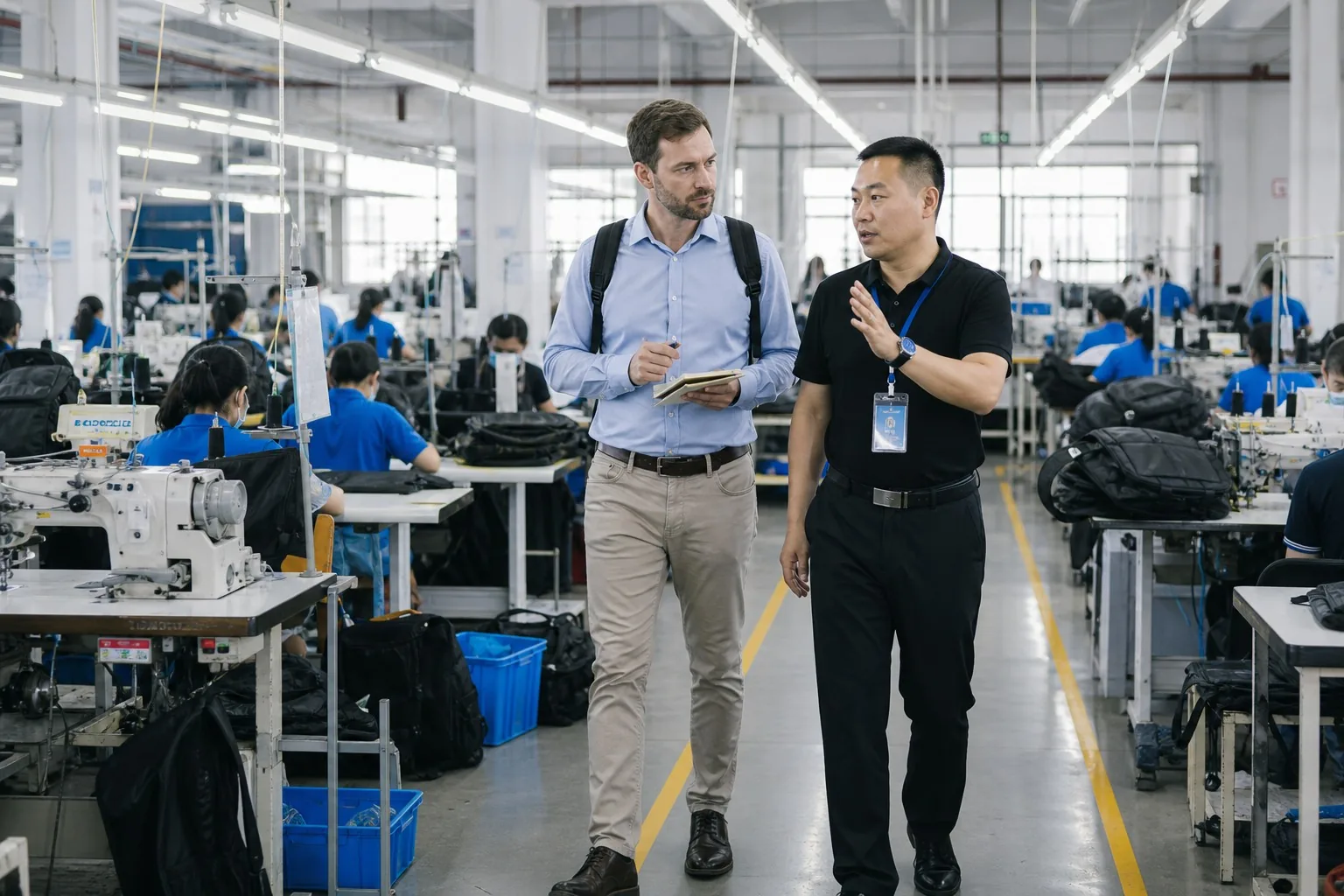
Before visiting anything, verify the basics. The documents tell you what the factory claims; the visit tells you what it is.
The Paper Checklist
| Document | What to verify | Red flags |
|---|---|---|
| Business license | Legal entity, years in business, scope | Mismatched scope, recent registration only |
| Export experience | Export records, destination markets | No export history |
| Factory certifications | ISO 9001, BSCI, SEDEX, WRAP | Expired or unverifiable certs |
| Product testing reports | Material tests, drop tests, chemical tests | Outdated or generic reports |
| Client references | Real clients you can contact | Vague or unverifiable claims |
| Trade records | Alibaba/Made-in-China history, reviews | New accounts, negative patterns |
The Verification Questions
- Can the factory show export records to your target market?
- Do the certifications match the factory name and address?
- Can they name specific clients in your product category?
- How many years have they made backpacks specifically?
- Are they a manufacturer or a trading company with factory claims?
Manufacturer’s note: Trading companies can be excellent partners — but the buyer should know who is actually sewing the bags. Ask to visit the production site, and confirm the certificate-holding entity operates it. The factory that invites inspection has nothing to hide.
Step 2: Equipment Capability Check
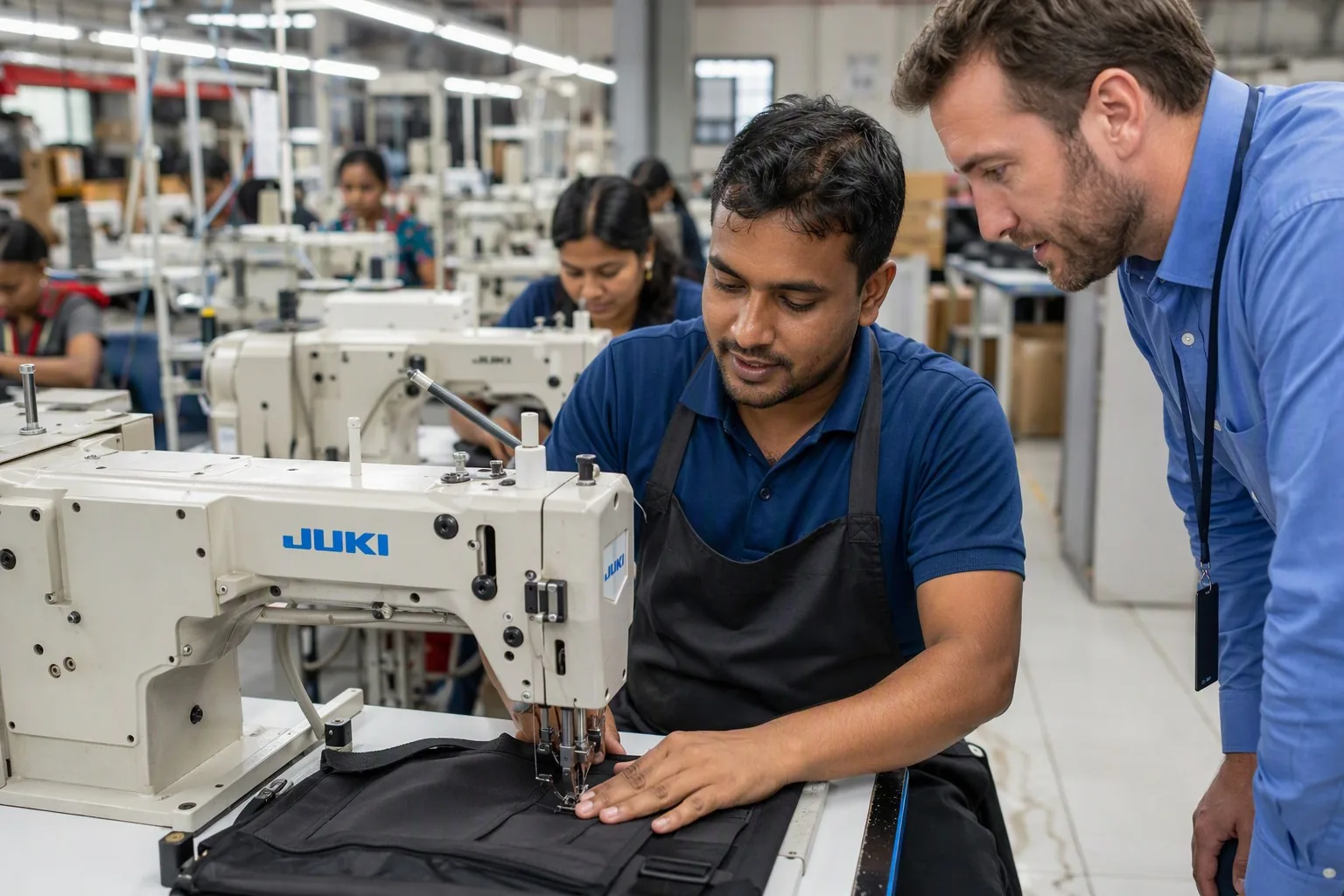
The equipment tells you what the factory can actually make. A backpack needs a specific machine family:
The Backpack Machine Checklist
| Machine | What it does | Needed for |
|---|---|---|
| Flatbed lockstitch | General sewing | Most seams |
| Overlock (serger) | Edge finishing | Linings, bindings |
| Bar-tack machine | Reinforcement stitches | Stress points, straps |
| Double-needle machine | Parallel stitching | Decorative seams, hems |
| Heavy-duty walking-foot | Thick layers, leather | Straps, leather packs |
| Binding machine | Edge binding | Bound edges |
| Buttonhole/eyelet machines | Holes and eyelets | Hardware attachment |
| Cutting table + cutter | Fabric cutting | All production |
| Heat press / lamination | Bonding, fusing | Padding, interfacing |
| Embroidery machines | Logo embroidery | Decorated products |
The Equipment Questions
| Question | What the answer reveals |
|---|---|
| How many machines per type? | Capacity for that operation |
| Which machines are running now? | Utilization and real activity |
| When were the machines bought? | Investment level, maintenance |
| Do you have a spare walking-foot or bar-tack machine? | Backup capability for bottlenecks |
| Can you handle 1000D nylon and leather? | Heavy-material capability |
| Do you have embroidery or printing in-house? | Logo integration without outsourcing |
Step 3: Capacity and Scale Check
A factory’s stated capacity means little without verification. Check what you can see:
The Capacity Indicators
| Indicator | What to look for |
|---|---|
| Number of production lines | Total line capacity |
| Operators per line | Output per line per day |
| Orders in production | Current loading (busy or empty?) |
| Sample room activity | Development capability in action |
| Warehouse stock | Material readiness |
| Finished-goods area | Delivery pipeline |
The Capacity Questions
- How many lines are running today, and on what products?
- What is the current utilization — 60%, 90%?
- What is the daily output per line for a standard pack?
- How much of your order volume can they take before overloading?
- Do they run one shift or two?
- What is the peak-season capacity vs the normal-season capacity?
Manufacturer’s note: A factory that is completely empty during the season is a warning — it may lack orders because it lacks capability or reputation. A factory that is 90% booked and still quotes your lead time honestly is telling you the truth. Busy factories are usually busy for a reason: they deliver.
Step 4: Quality System Check
The quality system is the factory’s immune system. Look for the structure, not just the claim:
The Quality Structure Checklist
| Element | What to verify |
|---|---|
| QC department | Exists, separate from production? |
| In-line QC | Inspectors on the floor, not just final |
| Final inspection | AQL-based, documented |
| Test equipment | Force gauges, scales, zipper testers |
| Defect tracking | Records, root cause, corrective action |
| Sealed samples | Approval samples signed and retained |
| Traceability | Batch records, material lots, operators |
The Quality Questions
- Where is the QC department and how many inspectors?
- What AQL level do you use for final inspection?
- Show me your defect records from last month.
- How do you handle a rejected batch — rework, re-inspect, ship?
- Do you test materials on arrival, or trust the supplier?
- What testing do you run on finished packs (drop, load, zipper)?
Step 5: Material Sourcing Check
Materials are 60–70% of a backpack’s cost and most of its quality. The factory’s material network matters:
The Material Checklist
| Material | What to check |
|---|---|
| Fabrics (nylon, polyester, canvas) | Suppliers, stock, certifications |
| Webbing and straps | Widths, tensile strength, printing |
| Zippers | Brand, sizes, types |
| Buckles and hardware | Quality brands, plating, strength |
| Foam and padding | Density consistency |
| Threads | Type, strength, color match |
| Labels and trims | Availability, lead time |
The Material Questions
- Which fabric suppliers do you work with? Can I see the mill certificates?
- Do you stock fabric, or order per project?
- What is the material lead time for 600D polyester and 1000D nylon?
- Can you source and certify recycled fabrics (GRS)?
- How do you verify zipper and buckle strength?
- What happens when a material is out of stock — substitute or wait?
Step 6: Development and Sampling Check
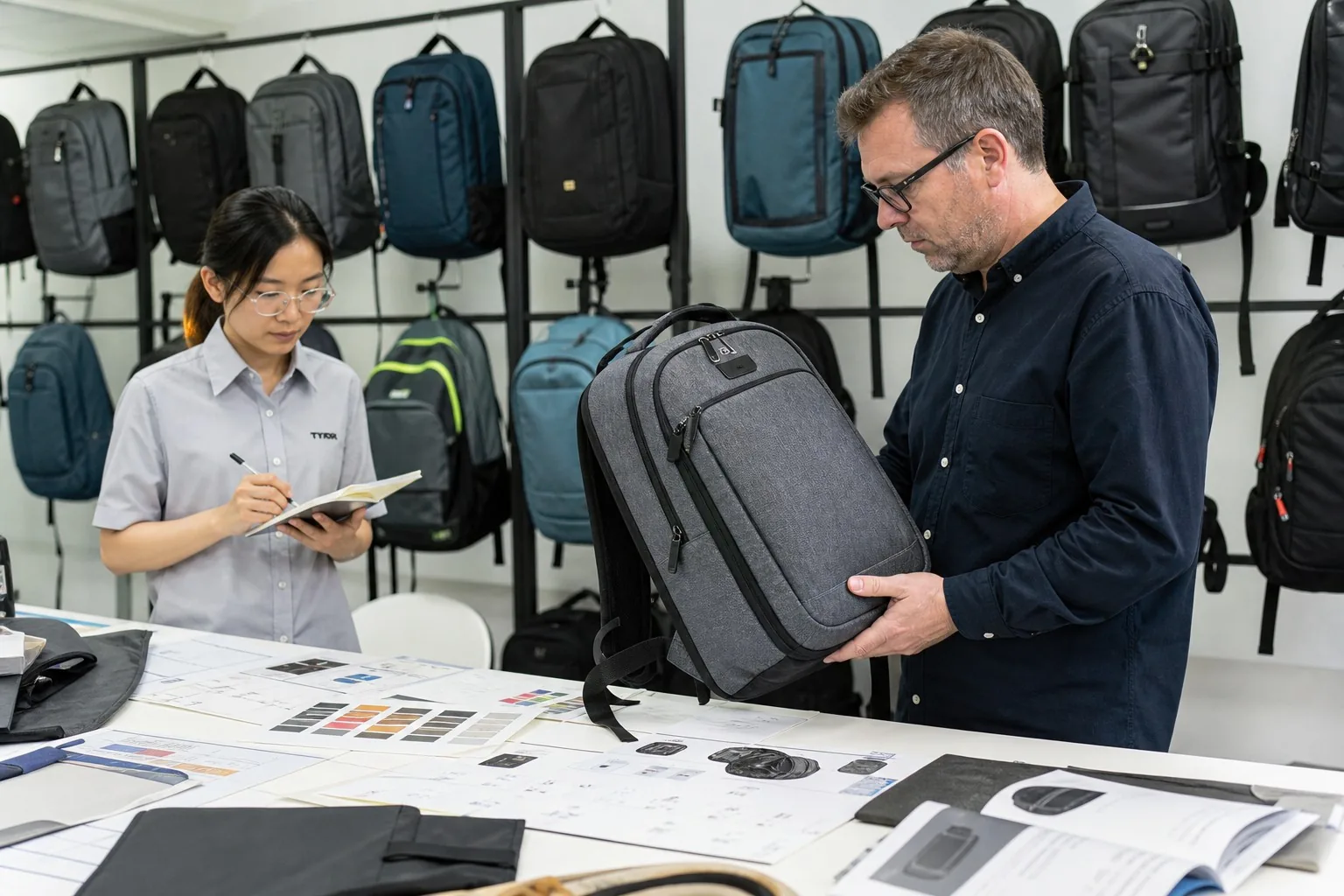
Your product starts in the sample room. Its capability determines your first impression:
The Sampling Capability Checklist
| Capability | What to verify |
|---|---|
| Sample room staff | Pattern makers, technologists |
| Pattern software | CAD patterns (better than manual) |
| Sample turnaround | Days per sample round |
| Sample quality | Stitching, finishing, detail fidelity |
| Tech pack literacy | Reads specs correctly, questions ambiguities |
| Sample fee policy | Fair, transparent, credited on order |
The Sampling Questions
- How many days for a first development sample?
- Can you make patterns from my tech pack, or do you need physical samples?
- What sample revisions are included before sampling fees apply?
- Can you do a waterproof taped-seam sample?
- Show me samples of a similar product you have developed.
Step 7: Communication and Commercial Check
The best factory on paper fails if communication breaks down:
The Communication Checklist
| Dimension | What to assess |
|---|---|
| English (or your language) | Clear written and spoken communication |
| Response time | Replies within 24 hours? |
| Technical literacy | Understands specs, asks good questions |
| Proactivity | Reports issues before they become crises |
| Contract discipline | Clear quotes, terms, and follow-through |
| Cultural fit | Working style matches yours |
The Communication Tests
- Send a detailed tech pack and see if the questions come back smart.
- Ask for a quote with a breakdown — do you get clarity or vagueness?
- Introduce a change mid-process and watch how it is handled.
- Request a weekly progress report — do you get it without chasing?
Manufacturer’s note: Communication quality in the quote stage predicts communication quality in production. If the salesperson is vague about lead times, costs, and terms before the order, the production team will be vague after it. The buyers who check communication early avoid the most expensive surprises.
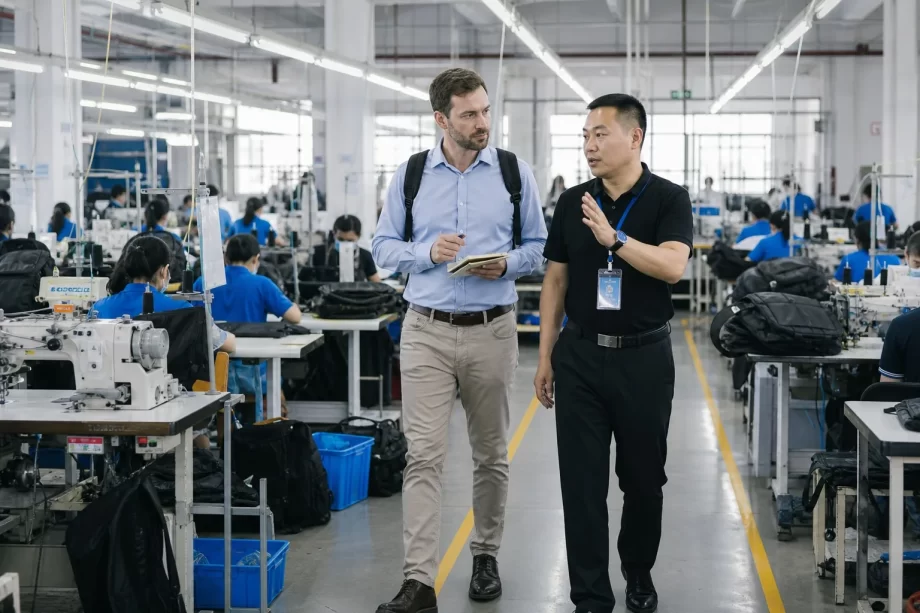
Step 8: The Factory Tour Checklist
Nothing replaces the visit. Here is the 10-point tour checklist:
| # | Check | Look for |
|---|---|---|
| 1 | Entry and reception | Organization, professionalism |
| 2 | Production floor | Clean, organized, active |
| 3 | Cutting area | Layout, waste management, marker quality |
| 4 | Sewing lines | Line balance, work-in-progress flow |
| 5 | QC stations | Inspectors present, tools in use |
| 6 | Sample room | Staffed, equipped, active |
| 7 | Warehouse | Stock organization, material labels |
| 8 | Finished-goods area | Packing quality, carton condition |
| 9 | Toilets and cafeteria | Real working conditions |
| 10 | Offices | Management presence, planning boards |
The Tour Observation Rules
- Walk the whole floor, not just the showroom route.
- Watch operators — are they rushing, waiting, or working steadily?
- Look at work-in-progress — is it organized or chaotic?
- Check the QC station is actually used, not decorative.
- Talk to a supervisor — do they know their numbers?
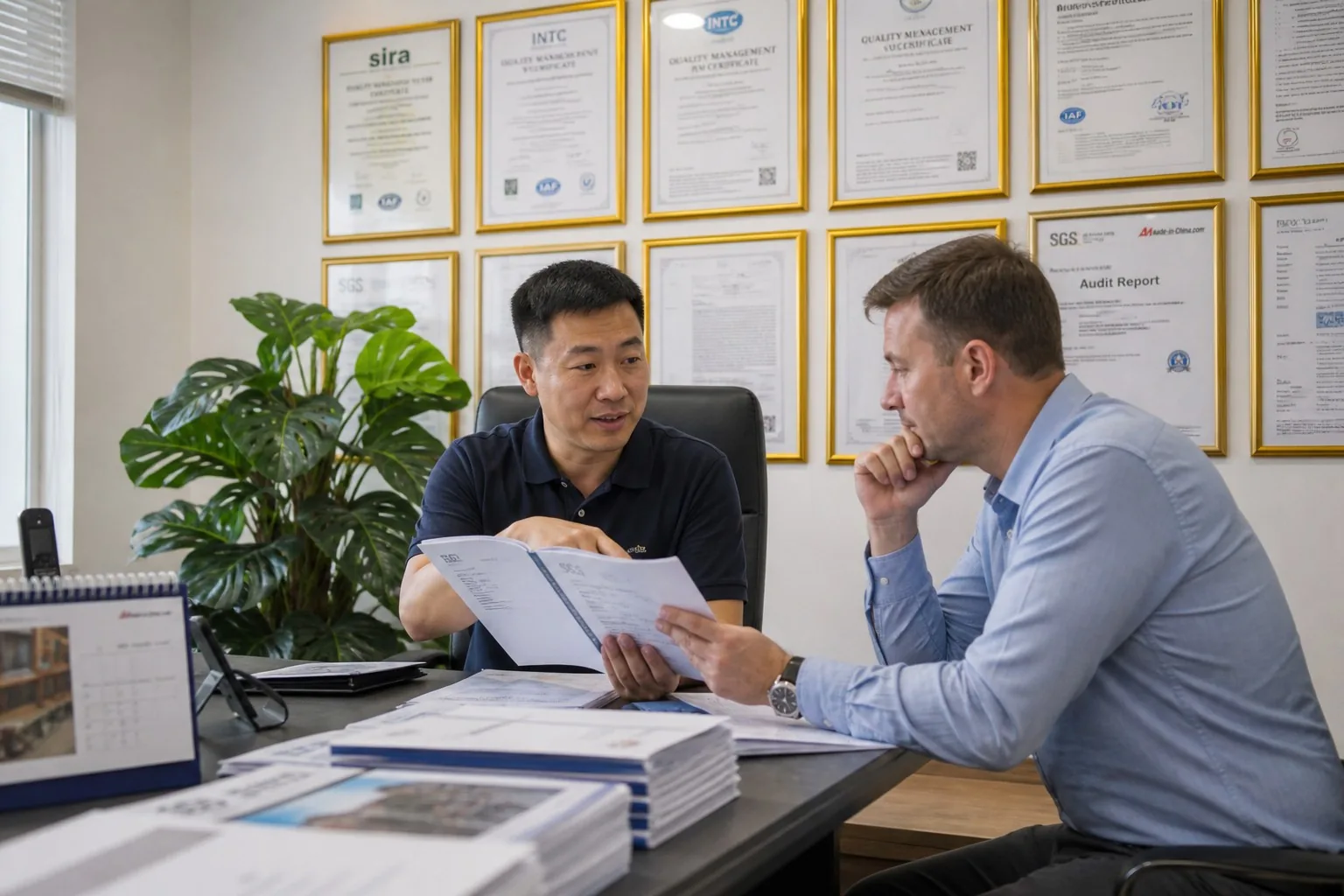
Step 9: Compliance and Audit Check
Compliance protects you from legal and reputational risk:
The Compliance Checklist
| Area | What to verify |
|---|---|
| Social compliance | BSCI, SEDEX, SA8000, local labor law |
| Environmental | Waste handling, chemical management, discharge |
| Product compliance | REACH, Prop 65, CA Prop 65, CPSIA (children) |
| Documentation | Audit reports current and real |
| Customs readiness | Export docs, HS codes, origin certs |
The Compliance Questions
- Which social compliance audits have you passed, and when?
- Do you have REACH/Prop 65 compliance documentation for materials?
- Can you provide the mill’s chemical test reports (OEKO-TEX, bluesign)?
- How do you handle chemical waste and wastewater?
- Have you been audited by any of your current buyers? Can I see the report?
Step 10: The Trial Order Strategy
The most reliable capability test is a small order. Trial orders are cheap insurance:
The Trial Order Design
| Element | Recommendation |
|---|---|
| Quantity | Small — 100–500 units |
| Product | Representative of your main line |
| Specification | Full spec, no shortcuts |
| Inspection | Third-party or your own inspection |
| Timeline | Normal lead time, no rush |
| Success criteria | Quality, on-time, communication — scored |
The Trial Order Scorecard
| Criterion | Weight | What to score |
|---|---|---|
| Sample quality | 25% | Matches spec, workmanship |
| Production quality | 25% | Inspection result, defect rate |
| On-time delivery | 20% | Shipped on the promised date |
| Communication | 20% | Responsiveness, transparency |
| Problem handling | 10% | How issues were resolved |
| Total | 100% | Scale before 85%, reconsider below |
The Scaling Decision
| Score | Decision |
|---|---|
| 90%+ | Strong partner — scale with confidence |
| 75–89% | Promising — address gaps, next order improves |
| 60–74% | Risky — fix specific issues or reconsider |
| Below 60% | Move on — the problems will compound |
Manufacturer’s note: The trial order is the cheapest lesson you can buy. A small order that reveals a communication gap costs a few hundred dollars; the same gap on a full container costs thousands plus a season. Buyers who trial-order before scaling rarely regret it — the ones who skip it often do.
Factory Types: Manufacturer, Trader, and Integrated
Not every “factory” is the same kind of organization. Understanding the types changes what you check:
| Type | What they are | Strengths | Risks |
|---|---|---|---|
| Manufacturer | Owns the factory, sewers on staff | Direct quality control, competitive pricing | Capacity limits, specialization |
| Trading company | Sells on behalf of factories | Wide product range, sourcing flexibility | No direct QC, quality drift |
| Integrated (工贸一体) | Owns factory + trading arm | Best of both, direct control | Larger MOQ focus |
The Manufacturer Check
If you buy from a manufacturer:
- Verify the factory is real — visit it.
- Check specialization — backpacks specifically, or mixed goods?
- Confirm capacity fits your volume now and for growth.
- Understand their MOQ and how it scales.
The Trader Check
If you buy from a trading company:
- Ask which factories they work with — visit at least one.
- Clarify who holds quality responsibility — trader or factory?
- Get the factory name on the invoice if compliance matters.
- Check inspection and return processes — who fixes defects?
The Integrated Check
Integrated companies usually offer the smoothest experience, but verify:
- The factory and trading arm are the same legal entity or clearly linked.
- The trading staff understand production, not just sales.
- Prices are competitive, not padded by the trading layer.
- Quality disputes have a clear owner.
Manufacturer’s note: The type matters less than the capability and the honesty. A good trader with a real factory behind it can serve you well; a weak manufacturer with a showroom can fail you. Verify what you are actually buying — the organization, the floor, and the people who will make your product.
Price and Quote Interpretation
Price is where most buyers start and where most mistakes happen. Read quotes like an analyst:
The Quote Anatomy
| Component | Share of typical backpack cost | What it covers |
|---|---|---|
| Materials | 55–65% | Fabric, webbing, zippers, hardware, thread |
| Labor | 15–25% | Cutting, sewing, assembly, packing |
| Overhead | 8–12% | Management, rent, utilities, tools |
| Profit | 5–10% | Factory margin |
| Total | 100% | Your FOB price before freight |
The Incoterm Reality
| Term | What is included | What you arrange |
|---|---|---|
| EXW | Factory gate only | Everything after pickup |
| FOB | Loaded on vessel at port | Sea freight, insurance, customs |
| CIF | Freight + insurance to destination port | Destination-side clearance |
| DDP | Delivered, duties paid | Nothing — but price is higher |
The Low-Price Warning Signs
| Sign | What it means |
|---|---|
| Price 20%+ below others | Materials or quality are being cut |
| No material breakdown | Hidden substitution risk |
| Unusually fast lead time | Line not booked or volume overstated |
| Vague on certification | Compliance will be your problem |
| No inspection allowed | Defects are expected |
The Fair Comparison Method
- Standardize the spec — same fabric, zippers, hardware.
- Standardize the terms — same incoterm, same port.
- Request a breakdown — materials vs labor vs overhead.
- Check the lead time behind the price.
- Weight the price against quality and delivery history.

The Selection Timeline and Decision Process
Factory selection follows a process. Rushing it is the most expensive mistake a buyer can make:
The Selection Timeline
| Phase | Duration | Actions |
|---|---|---|
| Sourcing and shortlist | 1–2 weeks | Platforms, referrals, trade shows |
| Document screen | 1 week | Verify licenses, certs, references |
| Quote comparison | 1–2 weeks | Standardize specs, request breakdowns |
| Factory visits | 1–2 weeks | Tour 2–3 shortlisted factories |
| Sample rounds | 2–4 weeks | Development samples, comments |
| Trial order | 3–6 weeks | Small order, score the result |
| Decision | ~8–16 weeks total | Commit or move on |
The Shortlist Method
- Start with 8–10 candidate factories.
- Screen documents → keep 4–5.
- Compare quotes → keep 3.
- Visit the 3, score each → choose 1–2.
- Trial order the winner; keep the runner-up warm.
The Scoring Matrix
| Criterion | Weight | Factory A | Factory B | Factory C |
|---|---|---|---|---|
| Capability fit | 25% | 4 | 3 | 5 |
| Quality system | 20% | 4 | 5 | 3 |
| Capacity and lead time | 15% | 3 | 4 | 4 |
| Communication | 15% | 5 | 3 | 4 |
| Price competitiveness | 15% | 3 | 4 | 4 |
| Compliance | 10% | 4 | 5 | 3 |
| Weighted total | 100% | 3.9 | 4.0 | 3.9 |
Manufacturer’s note: Score with data, not impressions. The factory with the best sales pitch is rarely the factory with the best production record. Weight the criteria that match your priorities — a compliance-critical brand weights compliance heavily; a price-driven brand weights price. The matrix makes the decision visible and defensible.
The Common Factory Selection Mistakes
The failure patterns repeat across the industry. Recognize them to avoid them:
| Mistake | Why it happens | The fix |
|---|---|---|
| Choosing on price alone | Lowest quote looks smart | Compare quality and delivery history too |
| Skipping the visit | Distance, time, cost | Virtual tours + third-party audit |
| Trusting the showroom | Demo rooms look great | Walk the real production floor |
| Ignoring communication | Sales talks well, production doesn’t | Test with real specs and changes |
| No trial order | Saving time | Trial orders save seasons |
| One factory dependency | Convenience | Keep a qualified backup |
| Vague contracts | Speed | Written specs, terms, and remedies |
The Dependency Warning
Single-factory dependence is a risk:
- Capacity shocks (factory overloaded) stop your supply.
- Material or labor issues stop everything.
- Negotiation power drops with dependence.
- A qualified second factory protects you.
The backup strategy: keep a second factory qualified (samples passed, terms agreed) even if all volume goes to the first. The qualification cost is small; the emergency cost is not.
Managing the Partnership Long Term
A good factory relationship compounds — like any partnership, it needs maintenance:
The Relationship Practices
| Practice | How often | What it does |
|---|---|---|
| Quarterly business review | Quarterly | Align forecasts, review scorecards |
| Annual factory visit | Yearly | See the floor, meet the team |
| Forecast sharing | Seasonally | Factory plans materials and capacity |
| Issue post-mortems | After problems | Fix root causes together |
| Recognition | Continuous | Good partners deserve loyalty |
| Escalation path | Always | Known process for disputes |
The Supplier Scorecard
Score each factory quarterly across quality, delivery, price, communication, and flexibility. Use the score to:
- Decide order allocation between factories.
- Set improvement targets with the factory.
- Justify price discussions with data.
- Identify when to move volume or add capacity.
Manufacturer’s note: The best buyer-factory relationships are honest relationships. Forecasts shared, issues raised early, and scorecards reviewed together create a partnership that survives seasons. Buyers who treat the factory as an extension of their own team get capacity, priority, and quality that spot-market buyers never see.
Reading Factory Performance Data
Numbers separate real factories from marketing factories. Learn to read the key ones:
The Performance Metrics
| Metric | Healthy range | What it means |
|---|---|---|
| On-time delivery rate | 90%+ | Promises become deliveries |
| First-pass yield | 90%+ | Quality without heavy rework |
| Defect rate (final inspection) | <5% | The quality standard in practice |
| Sample acceptance rate | 80%+ | Development capability |
| Response time | <24 hours | Communication discipline |
| Changeover efficiency | High | Scheduling and flexibility |
The Data Questions
- “What was your on-time delivery rate last quarter?” — a real factory tracks this.
- “What is your current defect rate at final inspection?” — real numbers or vague talk?
- “Can you show me last month’s inspection records?” — documentation exists?
- “How many sample rounds does the average new design take?” — development realism.
- “What is your current utilization?” — capacity truthfulness.
The Data Snapshot Test
The fastest capability test in a factory visit: ask for a snapshot of the last complete order.
- The customer name and destination market (anonymized is fine)
- The quantity and the actual production days
- The on-time status and any delays, with reasons
- The final inspection result and defect rate
- The sample rounds it took to approve
A factory that can reconstruct a completed order in numbers is running a real system. A factory that can only say “everything went fine” has no system — and no system means the next order is a gamble. Five minutes of questions reveal more than an hour of tour.
The Vague Answer Detection
| Answer | What it signals |
|---|---|
| “Very good” | No data — no tracking |
| “Almost always” | Avoids the number |
| “It depends” | No process |
| “Let me check” (often) | No immediate knowledge |
| “Around 95%” (specific) | Data-driven — promising |
Manufacturer’s note: Factories that track their numbers can share them; factories that don’t cannot. The buyer who asks for on-time rates, defect rates, and inspection records before ordering is doing what the best buyers do — verifying with data, not impressions. Any factory that resists sharing its scoreboard should explain why.
The Final Self-Check Before You Commit
Before signing with any factory, run this checklist honestly:
- [ ] Documents verified (license, certs, references, exports)
- [ ] Equipment matches my product requirements
- [ ] Capacity verified for my volume, now and in peak season
- [ ] Quality system observed in action (QC stations, records)
- [ ] Material sourcing and certification confirmed
- [ ] Sampling capability tested with a real tech pack
- [ ] Communication tested with real questions and changes
- [ ] Factory visited (or third-party audit completed)
- [ ] Compliance documents reviewed (social, product, customs)
- [ ] Trial order completed and scored
- [ ] Backup factory qualified
- [ ] Contract covers specs, terms, inspection, remedies
Count the unchecked boxes. Zero unchecked — commit with confidence. One or two — close the gaps before ordering. Three or more — the factory is not ready, and neither are you.
Intellectual Property Protection
Designs are a brand’s most valuable asset — and the factory sees every detail of them. IP protection is part of factory selection:
The IP Protection Checklist
| Measure | What it does |
|---|---|
| NDA before sharing specs | Legal baseline for confidentiality |
| Written IP clauses in the PO | Ownership of patterns, designs, molds |
| Molds and tooling ownership | You own the tooling, not the factory |
| Sample marking | Clear ownership labels on samples |
| Limited design access | Patterns shared only with the development team |
| No-showroom rule | Your designs never displayed in showrooms |
| Audit rights | Factory allows IP compliance checks |
The IP Questions
- Do you sign NDAs before receiving designs?
- Who owns the patterns and molds after production?
- Have you ever produced a copy of a client’s design for another buyer?
- Can you guarantee my design is not shown in your showroom or online catalog?
- What happens to my patterns when our cooperation ends?
The IP Red Flags
| Red flag | Risk |
|---|---|
| Refuses to sign NDA | Your design may be shared |
| Showroom full of “similar” designs | Copies are the business model |
| Vague on mold ownership | Tooling may be reused |
| Asks to keep patterns “for reference” | Designs may be reused |
| No clear IP clause experience | Contracts will be weak |
Manufacturer’s note: IP protection is not distrust — it is professional practice. Reputable factories sign NDAs, clarify mold ownership, and keep client designs confidential as a matter of course. The factory that hesitates on IP terms is signaling how it will behave later. Buyers who protect their IP in the selection stage never lose a design to the market.
FAQ
How do I verify a backpack factory is real and not a trading company?
Ask for the business license, request a visit to the production site, and confirm the license-holding entity operates it. Check export records, certifications, and client references. If the factory resists a site visit or the address doesn’t match, treat it as a red flag.
What certifications should a backpack factory have?
Look for ISO 9001 (quality system), BSCI or SEDEX (social compliance), and product-level compliance like REACH/Prop 65 for materials. Certifications should be current and verifiable. For children’s products, CPSIA compliance is essential.
How many samples should I ask for before production?
Typically 2–4 rounds: development sample, fit/comment sample, pre-production (PP) sample, and sometimes a shipment sample. Each round should refine the design toward the approved standard. Fewer rounds are possible for simple products; complex designs may need more.
What questions should I ask a factory before placing an order?
Ask about equipment for your specific design, current line loading and utilization, material lead times, QC process and AQL level, sampling turnaround, communication process, compliance documents, and their on-time delivery rate over recent orders.
Should I order a trial quantity before scaling?
Yes. A trial order of 100–500 units tests quality, delivery, and communication at a small cost. Score the trial across quality, on-time rate, communication, and problem handling; scale only when the score justifies it.
How do I compare quotes from different factories fairly?
Compare like for like: same spec, same materials, same inspection standard, same incoterm. Ask each factory for a breakdown (materials, labor, overhead) and for the lead time behind the price. The cheapest quote is only valuable if the factory can deliver quality on time.
What are the warning signs of a bad backpack factory?
Vague answers to technical questions, resistance to site visits, unverifiable certifications, empty or chaotic production floors, material stock excuses, slow communication, and on-time promises without evidence. Any single warning deserves a check; several mean walk away.
Conclusion
Choosing a backpack factory is a process of verification, not hope. Check the documents, walk the floor, verify the equipment, measure the capacity, examine the quality system, test the communication, confirm the compliance — then run a trial order and score it. Every check reduces the risk of a costly surprise.
The factories that welcome inspection, answer technical questions with numbers, and perform on trial orders are the ones worth scaling with. The rest are lessons you can avoid.
If you are evaluating factories for your next backpack order, we welcome the same scrutiny: ask for our certifications, walk our floor, check our equipment, and let our trial order performance speak. The best factory relationship starts with the buyer’s careful questions — and a factory confident enough to answer them.