Kids’ Backpack Safety Standards: What Must Manufacturers Prove?
Kids’ Backpack Safety Standards: What Must Manufacturers Prove?
A backpack designed for an adult and a backpack designed for a seven-year-old can be built from the same fabric on the same line by the same operators, and they are not the same product in the eyes of a regulator. The children’s bag is subject to limits on chemicals, on cords, on small parts, and on the warnings that must accompany it, and the manufacturer is expected to hold evidence showing that each limit was met.
This is the point at which a bag factory stops competing on price and construction and starts having to prove compliance. A buyer sourcing a school backpack for a European or North American retailer will ask for test reports, declarations, and the documentation behind them. A factory that cannot produce those reports does not lose a negotiation; it loses the programme.
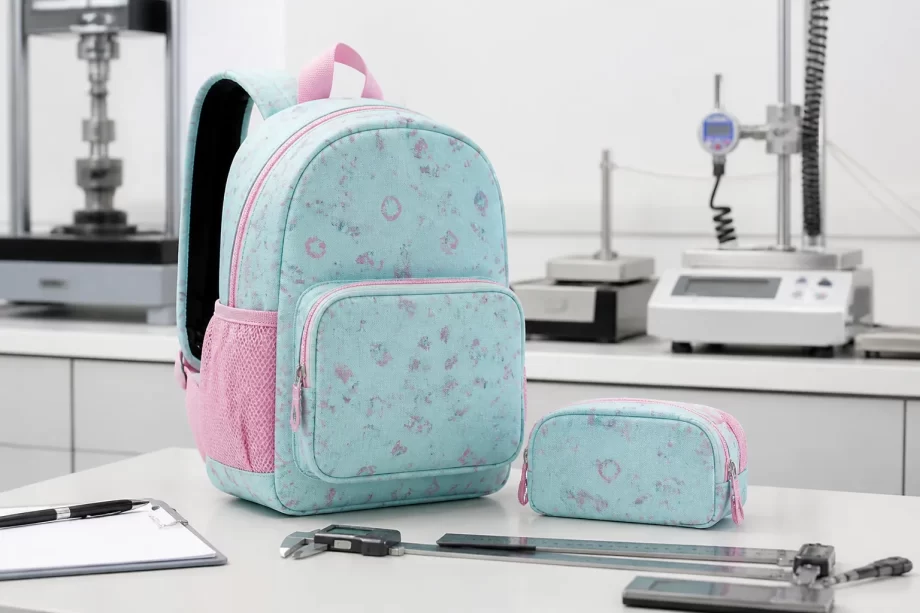
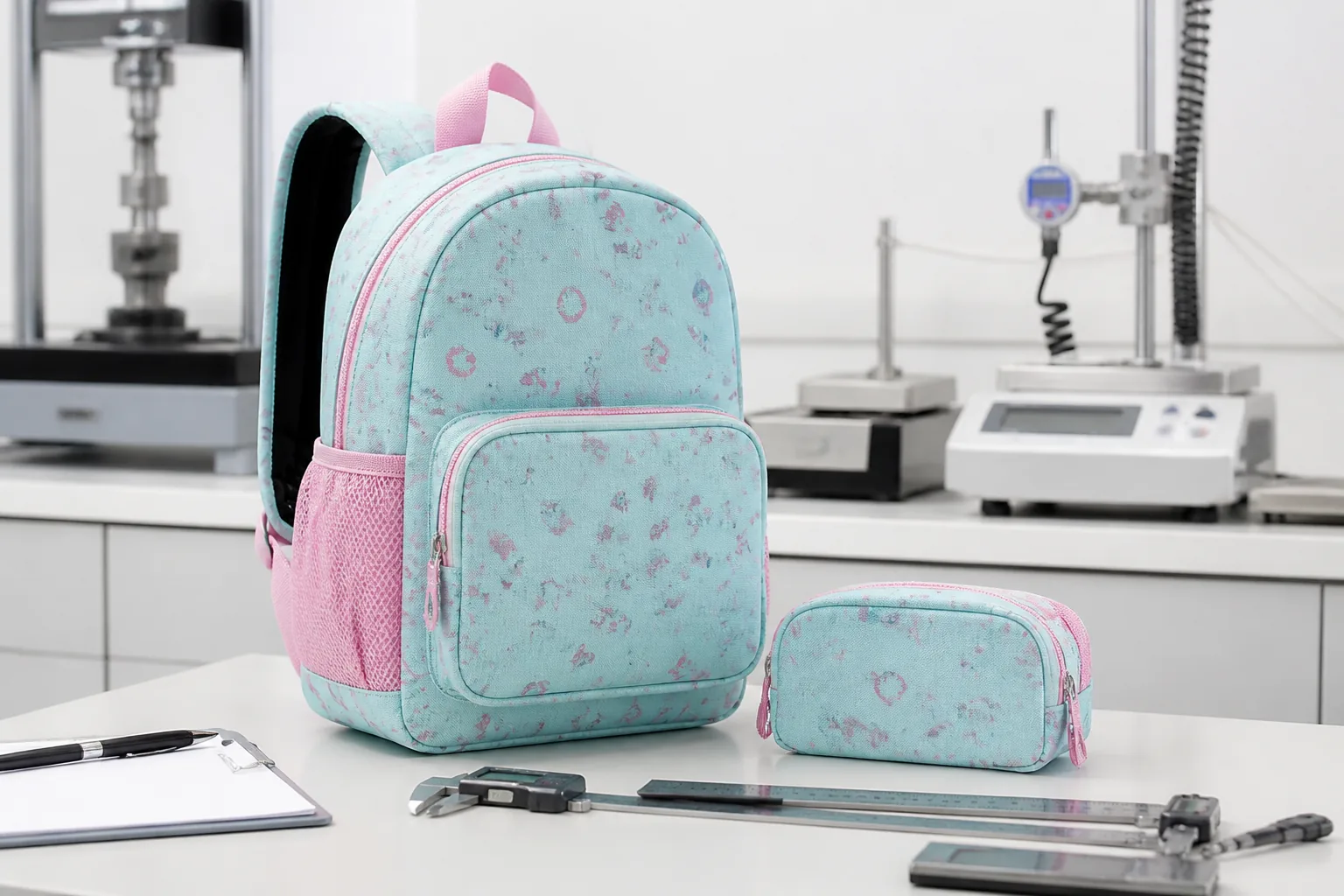
A children’s backpack on a laboratory testing bench with measuring instruments
This guide covers child safety requirements for school backpacks from a manufacturer’s perspective: why children’s bags are regulated differently from adult bags, which standards and regulations typically apply, and which physical hazards are controlled and how.
It then covers which chemical limits apply to materials and trims, how testing and certification are organised, what labelling and warnings are required, how age grading is determined, and how the supply chain is controlled so that compliance survives from the first sample to the tenth repeat order.
Regulation of children’s products rests on a simple assumption that does not apply to adult goods: that the user cannot be relied upon to avoid a hazard. The consequence is that safety has to be designed and verified rather than assumed.
The Difference Table
Dimension
Adult bag
Children’s bag
Hazard assumption
Reasonable user care
No user judgement assumed
Chemical limits
General product rules
Specific children’s limits
Cord and loop control
Voluntary or none
Regulated
Small parts
Not restricted
Restricted by age grade
Warnings
Minimal
Prescribed wording
Testing expectation
Buyer’s requirement
Regulatory requirement
Traceability
Commercial
Regulatory evidence
The Requirement Source Table
Source
Character
Children’s product safety law
Mandatory in the market
Toy safety standards
Applied to children’s accessories
Chemical restriction lists
Substance-specific limits
Labelling regulations
Prescribed information
Retailer standards
Contractual, often stricter
Voluntary standards
Referenced by buyers
The Scope Question Table
Question
Why it matters
Who is the intended user?
Determines the regime
Is it a toy or an accessory?
Changes the standard
Is it for under three years?
Triggers small parts rules
Is it worn or carried?
Affects cord control
Which markets?
Different rules per market
Which retailer?
Additional requirements
The Regime Table
Market
Typical regime
United States
Children’s product safety rules
European Union
General product safety and chemical rules
United Kingdom
Retained equivalent requirements
Canada
Children’s product requirements
Australia and New Zealand
Consumer product safety rules
The Responsibility Table
Party
Obligation
Manufacturer
Design, test, and declare
Exporter
Provide accurate documentation
Importer
Ensure compliance at import
Retailer
Verify and maintain records
Testing laboratory
Test to the stated method
Component supplier
Supply compliant materials
The Evidence Table
Evidence
Purpose
Test report
Confirms measured results
Declaration of conformity
States compliance
Bill of materials
Identifies components
Material certificates
Supports chemical compliance
Warning artwork
Shows required labelling
Age grading rationale
Supports the target age
Manufacturer note: The most expensive mistake in children’s bag programmes is deciding the age grade late. Age grading determines whether small parts rules apply, which warnings are required, and in some markets which chemical limits are tested. A factory that designs the bag first and asks about the age grade afterwards often finds that a decorative component, a cord, or a buckle has to be changed after tooling and artwork are already approved. Age grade belongs in the first specification meeting, alongside the price and the delivery date.
Applicable Standards and Their Scope
Buyers rarely specify a single standard. They specify a market, an age grade, and a retailer, and the applicable set of requirements follows from those three facts.
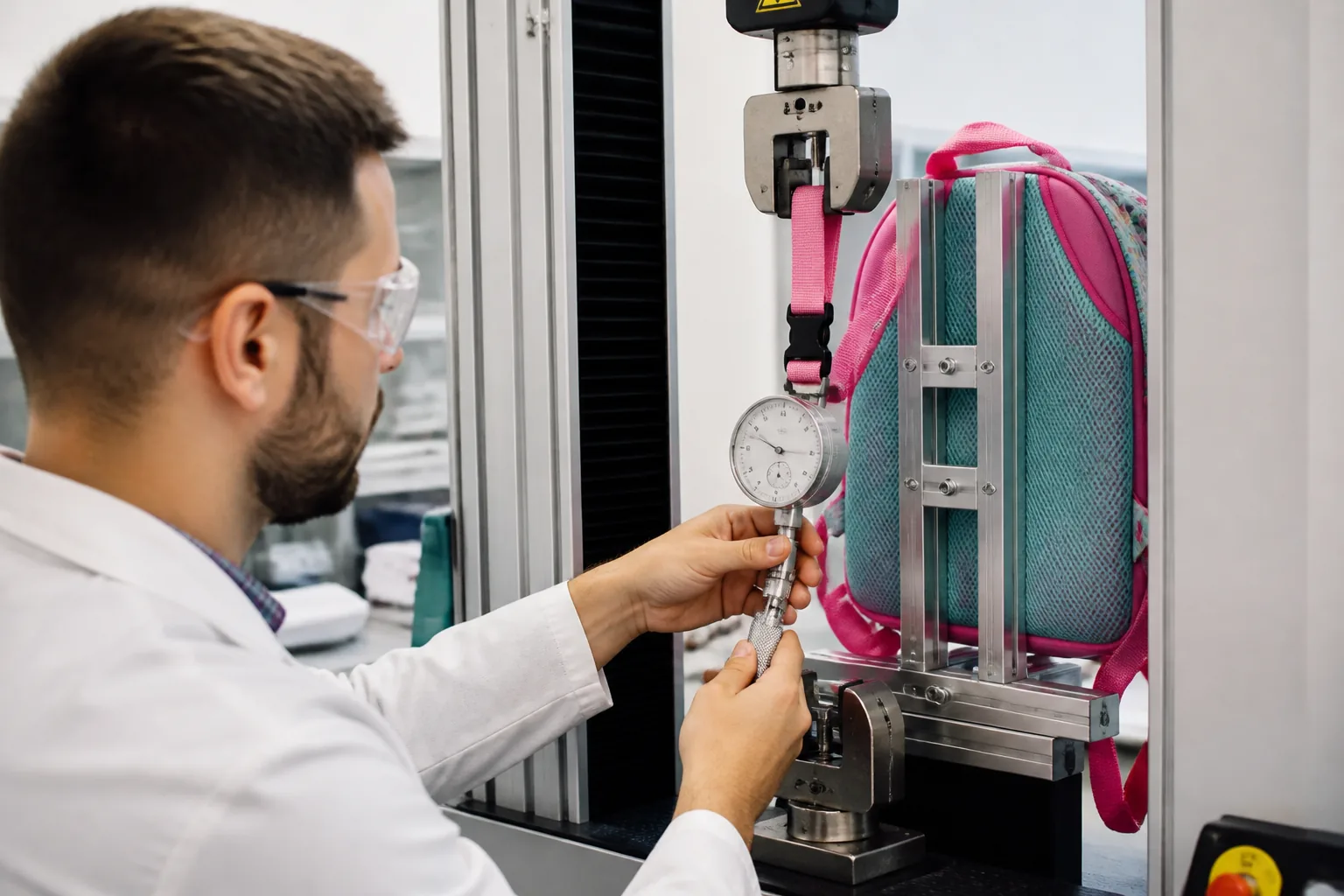
Laboratory technician testing a small backpack strap and buckle
The Standard Type Table
Type
Applies to
Physical and mechanical safety
Structure and small parts
Flammability
Materials and surface
Chemical restriction
Substances in materials
Cord and drawstring safety
Worn articles
Labelling and warnings
Consumer information
Packaging safety
Film and warnings
The Physical Requirement Table
Requirement
Object
No accessible sharp points
All surfaces
No accessible sharp edges
Metal and plastic parts
No small parts for young ages
Detachable components
No accessible points on wire
Internal wire and frame
No choking hazards
Buttons, toggles, rivets
No strangulation hazards
Cords, straps, loops
The Cord Control Table
Location
Requirement
Neck area
Restricted or eliminated
Hood and collar
Restricted
Waist and hem
Length limited
Shoulder strap
Free ends controlled
Toggle and cord end
Length and type limited
The Flammability Table
Material
Consideration
Outer fabric
Test method per market
Lining
Test method per market
Webbing
Test method per market
Foam padding
Test method per market
Trim and binding
Test method per market
Decorative elements
May be excluded or included
The Chemical Limit Table
Substance
Typical concern
Lead
Substrate and surface coating
Phthalates
Flexible plastic components
Azo dyes
Coloured textiles
Formaldehyde
Treated fabrics
Heavy metals
Coatings and inks
Nickel release
Metal hardware
Organotin
Certain coatings
The Packaging Table
Element
Consideration
Plastic film
Suffocation warning required
Bags and inserts
Age-appropriate warnings
Hangtag
Must not create a hazard
Desiccant
Must be labelled
Printed inserts
Correct information
The Documentation Table
Document
Content
Test report
Method, sample, result
Declaration
Statement of conformity
Bill of materials
Component list
Supplier declarations
Material compliance
Artwork approval
Warning text and placement
Age grade record
Basis for the age claim
Physical Hazards and Small Parts
Physical safety requirements are the ones a factory can control most directly, because they are decided by design and assembly rather than by the chemical content of a purchased material.
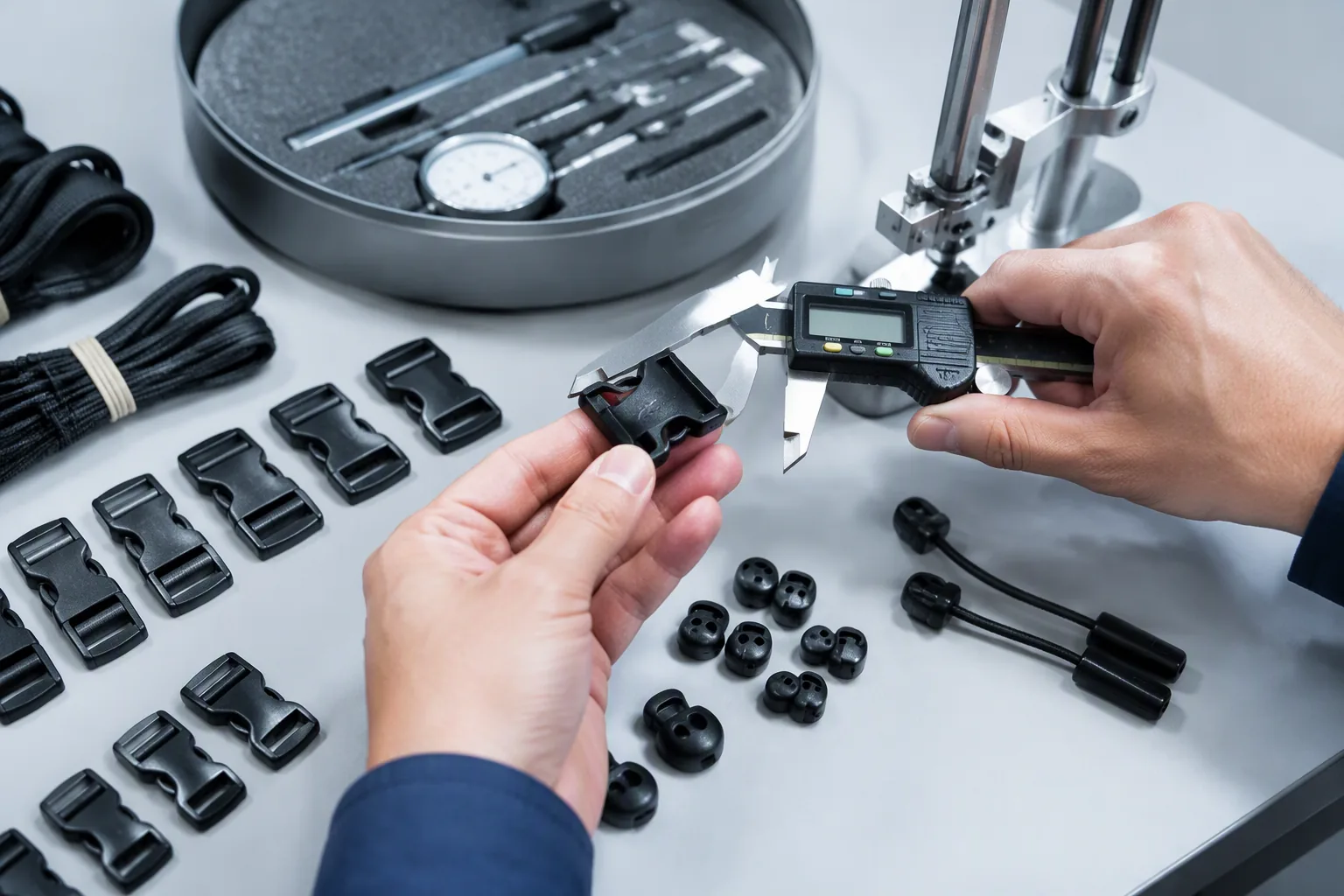
Small backpack components inspected with callipers and a small parts gauge
The Hazard Table
Hazard
Design response
Sharp point
Round or cover the point
Sharp edge
Deburr or cover
Small part
Eliminate or secure
Long cord
Shorten, remove, or add a breakaway
Pinch point
Redesign the joint
Entrapment
Remove the opening
Projection
Reduce or eliminate
The Small Parts Table
Component
Risk
Snap and rivet
Detachment under force
Button and toggle
Detachment
Decorative charm
Detachment
Zipper pull
Detachment
Buckle prong
Breakage
Cord end
Breakage
Badge and patch
Detachment
The Force Test Table
Test
Purpose
Tension test
Resistance to pulling
Torque test
Resistance to twisting
Drop test
Detachment on impact
Impact test
Breakage under impact
Compression test
Deformation under load
Cycle test
Durability of the joint
The Cord Hazard Table
Location
Control
Around the neck
Eliminate the loop
Drawstring at the top
Remove or secure
Shoulder strap end
Limit length
Side compression
Limit free length
Whistle or toggle
Length limited
Waist belt
Limit free length
The Structural Table
Element
Requirement
Frame and stay
Ends capped and not accessible
Metal insert
Fully enclosed
Wire edge
Not reachable
Handle
No sharp join
Shoulder pad
No exposed edge
Base panel
No hard projection
The Assembly Table
Operation
Control
Rivet setting
Depth and flare checked
Snap attachment
Pull test per batch
Bar-tack
Stitch density verified
Edge finishing
Binding or weld complete
Hardware attachment
Force test per batch
The Age Grade Table
Age band
Implication
Under three years
Strictest small parts rules
Three to six years
Reduced but present rules
Six years and over
Small parts generally permitted
Mixed use
Treated as the lower age
Not for children
Different regime
The Review Table
Stage
Check
Design
Hazards identified and removed
Prototype
Physical tests performed
Pre-production
Golden sample tested
Production
Batch sampling performed
Change
Re-test after any change
Chemical Limits and Material Control
Chemical compliance is decided before the bag is made, at the point where the fabric, the coating, the ink, and the plastic parts are selected. A factory cannot test its way out of a material that contains a restricted substance.
The Substance Table
Substance group
Where it appears
Phthalates
Soft plastic parts and prints
Lead
Coatings, pigments, metal
Cadmium
Pigments and plating
Azo colourants
Dyed textiles
Formaldehyde
Finishing agents
Heavy metals
Inks and coatings
Flame retardants
Treated materials
Organotin compounds
Certain coatings
The Material Table
Material
Test focus
Woven fabric
Azo dyes, formaldehyde
Coated fabric
Phthalates, heavy metals
Printed fabric
Inks and pigments
Webbing
Dyes and finishing
Plastic hardware
Phthalates, heavy metals
Metal hardware
Lead, nickel, cadmium
Foam
Flame retardants
Thread and binding
Dyes and finishes
The Supplier Control Table
Control
Purpose
Material specification
States the limit
Supplier declaration
Confirms compliance
Certificate of analysis
Evidence per lot
Approved supplier list
Restricts sources
Incoming sample testing
Verifies the claim
Change notification
Prevents silent substitution
The Testing Frequency Table
Basis
Approach
New material
Full test before use
New supplier
Full test before approval
Repeat lot
Periodic verification
Colour change
Re-test the affected part
Process change
Re-test the affected part
Buyer requirement
Per the order terms
The Failure Mode Table
Failure
Cause
Phthalate limit exceeded
Substituted plasticiser
Lead detected in print
Pigment source
Azo dye detected
Unapproved dye lot
Formaldehyde elevated
Finishing process
Nickel release high
Plating specification
The Control Table
Control
Effect
Approved material list
Restricts what enters
Specification in the purchase order
Makes the limit contractual
Declaration at each lot
Traceable evidence
Periodic independent testing
Verifies the chain
Change notification clause
Prevents substitution
Manufacturer note: Chemical non-compliance almost always arrives through a substitution made upstream rather than through a decision taken by the bag factory. A mill changes a dye supplier, a coating supplier changes a plasticiser for cost reasons, and the bag that was compliant last season is not compliant this season, with no visible difference on the shelf. The only reliable defence is to require a declaration with every lot, to test periodically against the specification rather than trusting the declaration alone, and to make the change notification obligation explicit in the purchase order so that a substitution is a breach rather than a surprise.
The Declaration Content Table
Element
Purpose
Material identified
Matches the specification
Standards referenced
States the basis
Substances declared
Confirms limits met
Batch or lot
Traceable to the delivery
Date and signature
Accountability
Validity
Currency of the claim
Testing, Certification and Labelling
Testing produces the evidence, certification connects that evidence to a market, and labelling carries the required information to the consumer. All three have to line up with the same sample and the same specification.
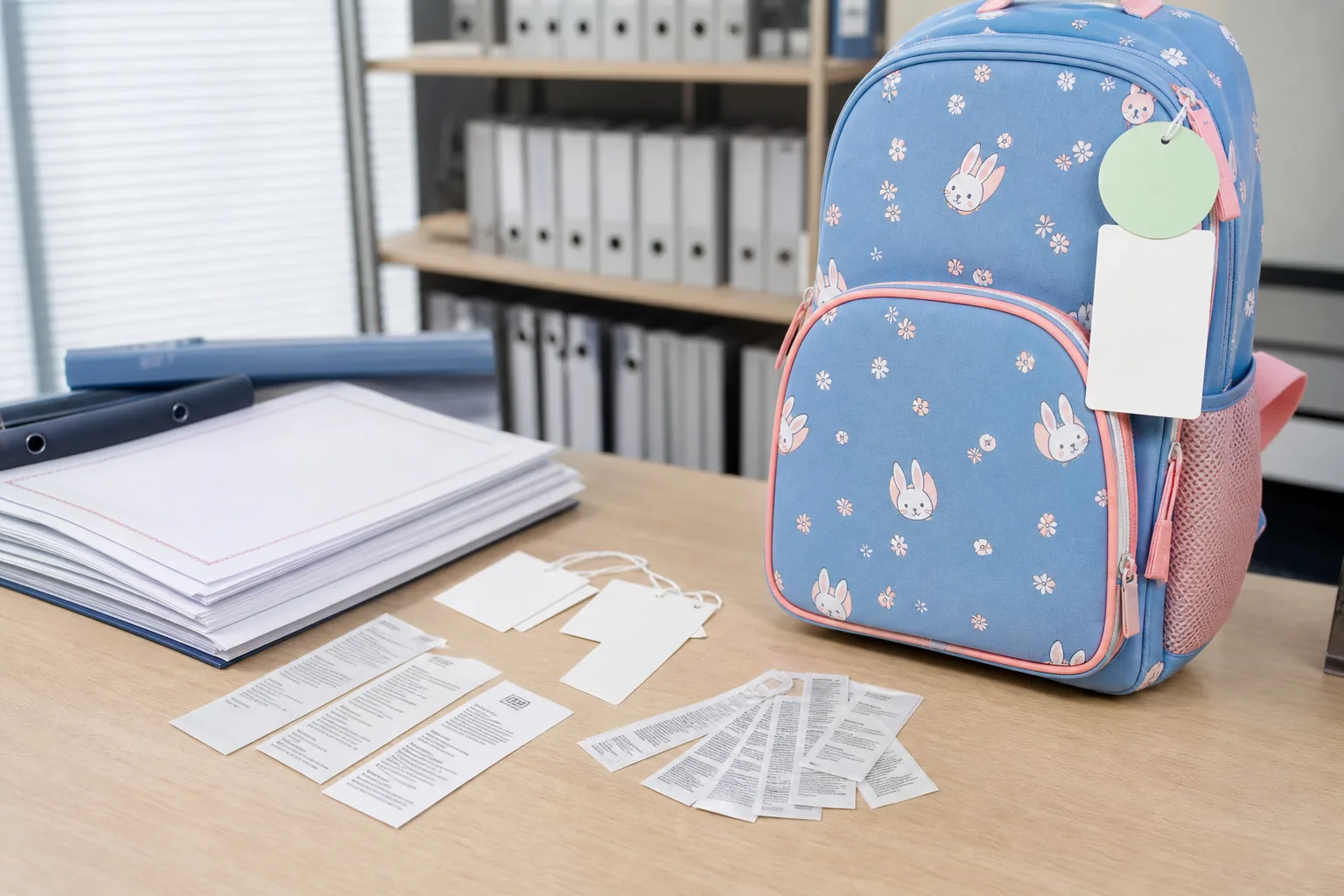
Compliance documentation and care labels beside a children’s backpack
The Test Sample Table
Aspect
Requirement
Identity
Representative of production
Source
From the actual production process
Quantity
Per the test method
Condition
As delivered
Photography
Recorded before testing
Retention
Kept for reference
The Laboratory Table
Criterion
Consideration
Accreditation
Recognised for the method
Market acceptance
Accepted by the destination
Scope
Covers the required tests
Turnaround
Fits the development timetable
Reporting
Clear and complete
Cost
Per test schedule
The Test Plan Table
Stage
Tests
Design
Physical and mechanical
Pre-production
Full requirement set
Colour change
Chemical re-test
Supplier change
Chemical re-test
Periodic
Verification of the current product
Complaint-driven
Targeted investigation
The Report Content Table
Element
Purpose
Sample description
Identifies what was tested
Photographs
Shows the sample
Methods used
States the basis
Results
States pass or fail per item
Limits applied
Shows the criteria
Conclusion
States overall outcome
Date and reference
Traceability
The Failure Handling Table
Result
Action
Pass
File the report and proceed
Borderline
Investigate and retest
Fail on design
Redesign and retest
Fail on material
Change the material
Fail on process
Correct the process and retest
Unknown cause
Investigate before proceeding
The Label Element Table
Element
Purpose
Age grading
States the target age
Warning text
Prescribed wording
Country of origin
Market requirement
Care instructions
Consumer information
Material content
Fibre labelling
Traceability mark
Manufacturer or lot
Batch code
Internal and recall use
The Warning Table
Situation
Requirement
Not suitable under three years
Prescribed warning
Small parts present
Prescribed warning
Plastic film packaging
Suffocation warning
Cord present
Warning where required
Battery or electronic part
Specific warnings
The Age Grading Table
Basis
Consideration
Intended user
Who will carry it
Size and fit
Matches the age group
Features
Complexity and function
Hazards present
Small parts and cords
Retailer criteria
Their own age bands
Marketing claim
Must match the design
The Label Control Table
Control
Purpose
Artwork version
Prevents outdated labels
Buyer approval
Confirms the wording
Placement check
Confirms the position
Language check
Confirms the market
Legibility check
Confirms durability
The Declaration Table
Document
Issued by
Declaration of conformity
Manufacturer
Test report
Accredited laboratory
Material declaration
Supplier
Age grade statement
Manufacturer
Artwork approval
Buyer
Manufacturer note: Labelling is the cheapest element to get right and one of the most common reasons a shipment is held. Prescribed warning wording cannot be paraphrased, translated freely, or omitted for a market that requires it, and a label that was correct for one retailer’s programme is frequently wrong for another’s even when the bag is identical. The practical control is to treat the label as a controlled drawing with a version number and a buyer approval, in the same way as the bag pattern, and to verify the label on the packed unit rather than on the approved artwork file.
Controlling Compliance Through Production
Compliance is established at design and preserved by production control. A programme that passes its first test and then drifts through substitution, process change, or relaxed inspection ends up with a compliant sample and a non-compliant shipment.
The Control Point Table
Point
Control
Material approval
Tested before use
Supplier approval
Audited and listed
Incoming inspection
Declaration and sampling
Cutting and assembly
No unapproved substitution
Hardware attachment
Force tested per batch
Final inspection
Label and hazard check
Packing
Warning and film check
Shipment
Document set complete
The Change Control Table
Change
Action required
Material supplier
Re-test the affected part
Material specification
Re-test and re-declare
Colour or dye
Re-test for chemical limits
Hardware supplier
Physical and chemical re-test
Process or equipment
Review and re-test if affected
Label artwork
Buyer approval and re-verify
Age grade
Full review of the requirement set
The Substitution Risk Table
Risk
Prevention
Alternative thread used
Specify and verify
Different plasticiser
Supplier declaration per lot
Different dye lot
Colour approval and testing
Different hardware grade
Approved supplier list
Recycled content changed
Specification and declaration
Packaging film changed
Specification and check
The Inspection Table
Stage
Check
Incoming material
Declaration, colour, identity
Cutting
Pattern and quantity
Assembly
Attachment integrity
Hardware setting
Force test per batch
Final
Hazard and label check
Packing
Warning and film check
The Training Table
Audience
Content
Designers
Hazard awareness
Purchasing
Supplier requirements
Incoming inspection
Declaration checks
Operators
Attachment and finish
Final inspection
Hazard and label checks
Warehouse
Film and warning handling
The Complaint Table
Signal
Response
Detached component reported
Investigate the batch
Cord hazard reported
Check the design against the rule
Chemical concern raised
Retest the material
Label missing or wrong
Check the label control
Repeat complaint
Full programme review
Records, Audits and Retailer Verification
Children’s product compliance is verified after the sale as well as before it. Retailers audit their suppliers, and authorities can request evidence years after the goods were shipped.
The Record Table
Record
Retention driver
Test reports
Compliance evidence
Declarations of conformity
Compliance statement
Material declarations
Substance evidence
Bill of materials
Component identification
Artwork approvals
Labelling evidence
Age grade rationale
Age claim support
Inspection records
Production control
Complaint records
Post-market evidence
The Audit Type Table
Audit
Focus
Retailer supplier audit
System and records
Social compliance audit
Labour conditions
Technical audit
Product and process
Unannounced inspection
Actual practice
Document request
Specific evidence
The Audit Preparation Table
Requirement
Practice
Documents current
Reviewed on a schedule
Records retrievable
Indexed and accessible
Sample retained
Kept with the report
Staff informed
Know their part
Corrective actions closed
Evidence available
The Finding Table
Finding
Typical action
Missing declaration
Obtain and file
Expired test report
Retest
Label discrepancy
Correct artwork
Process not followed
Retrain and verify
Record not retrievable
Improve the index
Repeat finding
Escalate and review
The Traceability Table
Question
Record needed
What was in this bag?
Bill of materials
Who supplied the fabric?
Purchase record
Which lot was used?
Production record
What was tested?
Test report
Which label applied?
Artwork approval
Where was it shipped?
Shipping record
The Programme Review Table
Item
Frequency
Test reports currency
Annually
Supplier declarations
Per lot
Age grade and labelling
Per programme
Hazard review
On design change
Record index
Annually
Complaint trend
Monthly
Manufacturer note: Retailer audits of children’s product programmes rarely fail on the product. They fail on records. A factory that can show a compliant bag but cannot retrieve the test report, the material declaration, or the approved artwork within the auditor’s visit is treated as a factory that does not control its compliance, because the auditor has no other way to judge it. Keeping a current, indexed, retrievable file is not administrative overhead in this category; it is the product of the compliance programme.
The Document Set Table
Document
Kept by
Test report
Factory and buyer
Declaration of conformity
Factory
Material declaration
Factory and supplier
Artwork approval
Factory and buyer
Inspection records
Factory
Age grade rationale
Factory
The Child Safety Compliance Checklist
Specification
Item
Done
Intended age grade agreed
☐
Destination markets identified
☐
Applicable standards listed
☐
Retailer requirements obtained
☐
Chemical limits specified
☐
Labelling requirements confirmed
☐
Design
Item
Done
Sharp points and edges reviewed
☐
Small parts assessed against the age grade
☐
Cord and loop locations reviewed
☐
Cord free lengths limited
☐
Internal wire and frame enclosed
☐
Flammability considered
☐
Materials
Item
Done
Materials specified with limits
☐
Suppliers approved and listed
☐
Declarations obtained per lot
☐
Certificates of analysis filed
☐
Change notification required
☐
Testing
Item
Done
Test plan agreed with the buyer
☐
Laboratory accredited and accepted
☐
Physical tests completed
☐
Chemical tests completed
☐
Reports reviewed for completeness
☐
Failures investigated and retested
☐
Labelling
Item
Done
Prescribed warning wording verified
☐
Age grading stated
☐
Country of origin marked
☐
Care and material labelling correct
☐
Artwork version approved
☐
Label checked on the packed unit
☐
Production
Item
Done
No unapproved substitution
☐
Attachment force tested per batch
☐
Final hazard check performed
☐
Packing film and warning checked
☐
Changes assessed and re-tested
☐
Records
Item
Done
Test reports filed and indexed
☐
Declarations retained
☐
Reference sample kept
☐
Inspection records retained
☐
Records retrievable at audit
☐
The Eight Rules
Rule
Reason
Fix the age grade at the first meeting
It drives the whole requirement set
Design hazards out before testing
Testing cannot remove a hazard
Specify chemical limits in the purchase order
Makes compliance contractual
Require a declaration with every lot
Detects upstream substitution
Treat the label as a controlled drawing
Prescribed wording cannot be paraphrased
Re-test after any change
Change is the commonest cause of failure
Keep a retrievable, indexed file
Audits are decided on records
Verify on the packed unit
Approval is not the same as production
FAQ
When does a backpack count as a children’s product?
When it is designed, marketed, or intended for use by children, which in most markets means the primary user is twelve years old or younger. The determination looks at the intended user rather than at the size of the bag, and it includes how the product is presented, packaged, and advertised. A bag sized for a small adult but marketed with a cartoon character to schoolchildren can be treated as a children’s product in the market’s assessment. Because the classification drives the testing, labelling, and chemical requirements, it should be settled in writing with the buyer before the design is finalised rather than inferred from the product category.
Does the age grade change which tests are required?
Yes, and materially. The strictest small parts requirements generally apply to products intended for children under three years, because that age group is most likely to mouth and detach components. Products for older children may be permitted to contain small parts, but cord, strangulation, and chemical requirements still apply. Some markets also apply additional substance restrictions based on the age group. Because the age grade determines the requirement set, deciding it late forces redesign and retesting, which is why it belongs in the first specification discussion alongside price and lead time.
How often should an approved material be retested?
There is no single interval that fits every programme, because the risk depends on the material, the supplier, and the market. The practical approach is to test a material fully before first use, test again whenever the supplier, the specification, the colour, or the process changes, and then verify periodically against the specification for materials that remain in continuous production. Where a buyer imposes their own testing frequency, that schedule governs. The important principle is that a declaration alone is not verification: periodic independent testing is what confirms that the declaration still describes what is actually being supplied.
What is a declaration of conformity and who issues it?
It is a document in which the responsible party states that the product meets the applicable requirements, usually identifying the product, the standards relied upon, and the basis on which conformity is asserted, most often a test report. In most markets the manufacturer or the importer is responsible for the declaration, depending on the regime and on who places the product on the market. A declaration that references a test report from a sample that no longer matches production, or that covers a specification that has since changed, is of little value. The declaration should be issued against a defined version of the product.
Can a supplier’s material certificate replace our own testing?
It can reduce the frequency of testing but it should not replace it entirely. A supplier certificate is evidence that the supplier believes the material meets the specification, and it is the primary control for chemical compliance because the substances are fixed at the material stage rather than at the bag factory. However, certificates are issued per lot by a party with a commercial interest, and substitutions upstream are precisely the failure mode that chemical restrictions are meant to catch. Periodic independent testing against the specification is what verifies that the certificate continues to describe reality.
What happens if a shipped order is found non-compliant?
The consequences depend on the market and the nature of the failure, and they can extend beyond the shipment itself. Regulators may require a withdrawal or recall, retailers may require the supplier to fund the retrieval and disposal, and the factory may face a claim for the retailer’s costs as well as the loss of the programme. Where a hazard is involved, the priority is containment: identifying which batches are affected using the traceability records, notifying the buyer, and stopping further shipment of the affected product. This is the situation in which the records kept during production are the only practical tool available.
Are adult backpacks and children’s backpacks tested to the same standards?
No. Adult bags are generally subject to general product safety and chemical restrictions that apply to all consumer goods, while children’s bags are subject to the additional requirements that apply to products intended for children. In practice this means the children’s version may need cord and loop controls, small parts assessment, additional substance limits, prescribed warnings, and documented age grading that the adult version does not. A factory that sells both should keep the requirement sets separate in its files, because applying the adult specification to a children’s order is a common and avoidable source of non-compliance.
Do packaging warnings apply to the polybag as well as the bag?
Yes, and packaging is frequently overlooked because attention is fixed on the product. Plastic film used to wrap a bag is subject to suffocation warnings in several markets, with prescribed wording and, in some cases, a minimum thickness or perforation requirement that applies regardless of the bag itself. Other packaging elements can also carry obligations: desiccants must be labelled, inserts must carry accurate information, and the hangtag must not introduce a hazard of its own. The practical discipline is to treat packaging as part of the compliance file rather than as a logistics detail, with its own specification, artwork approval, and check at the packing station.
How should we handle a change of fabric supplier mid-programme?
Treat it as a compliance event rather than a purchasing decision. The new supplier’s material must be assessed against the same specification, its declarations collected, and the affected tests repeated, because a dye source, a finishing agent, or a plasticiser can change without any visible difference in the delivered fabric. The buyer should be notified where the programme’s terms require it, and the label or declaration updated if any statement in them depends on the material. Where the change cannot be verified in time for the next shipment, the remaining stock of the approved material should be used first and the change deferred.
Conclusion
Child safety compliance in backpack manufacturing is decided by three things that happen before the bag is made and one that happens after: the age grade, the design, the material specification, and the records.
The age grade determines which requirements apply. The design determines whether physical hazards exist at all, because a hazard that is designed in cannot be tested out. The material specification determines chemical compliance, since the substances are fixed at the mill, the coater, and the moulder rather than at the sewing line. The records are what allow all of it to be demonstrated to a retailer or an authority months or years later.
The controls that hold this together are not expensive. Decide the age grade in the first specification meeting and write it down. Review the design against the hazard list before tooling is committed. Specify chemical limits in the purchase order, require a declaration with every lot, and verify periodically with independent testing.
Treat labelling as a controlled drawing with a version number and an approval, and check the label on the packed unit rather than on the artwork file. Re-test after any change, because change is the most common route to non-compliance. Keep the file current and indexed so that it can be produced during an audit rather than assembled after one.
For factories, the return is access to programmes that are otherwise closed. Children’s product requirements exclude suppliers who cannot document compliance, and the exclusion is absolute rather than a matter of price. A plant that can produce test reports, declarations, and approved artwork for a children’s order is competing in a smaller field with a defensible position.
For buyers, the practical test is to ask the supplier for the age grade rationale, the test reports covering the current specification, the material declarations behind them, and the approved label artwork, and to ask how quickly all four can be produced. A supplier who answers immediately is running a compliance programme. A supplier who has to go and look is running a risk that will eventually be transferred to the buyer.