Reflective Materials for Bags: How Do Factories Verify Brightness?
Reflective Materials for Bags: How Do Factories Verify Brightness?
A reflective strip on a backpack is one of the few components that is bought for a condition the wearer cannot see. In daylight it reads as a grey or silver band and looks unremarkable. At night, when headlights strike it at the right angle, it returns the light directly to the driver and becomes the most visible part of the person carrying it.
That dual behaviour is exactly what makes the material difficult to buy and to verify. A tape that looks correct on the table can return almost no light at the viewing angle that matters, and a factory that accepts the visual appearance as proof is relying on the one condition in which the material is doing nothing.
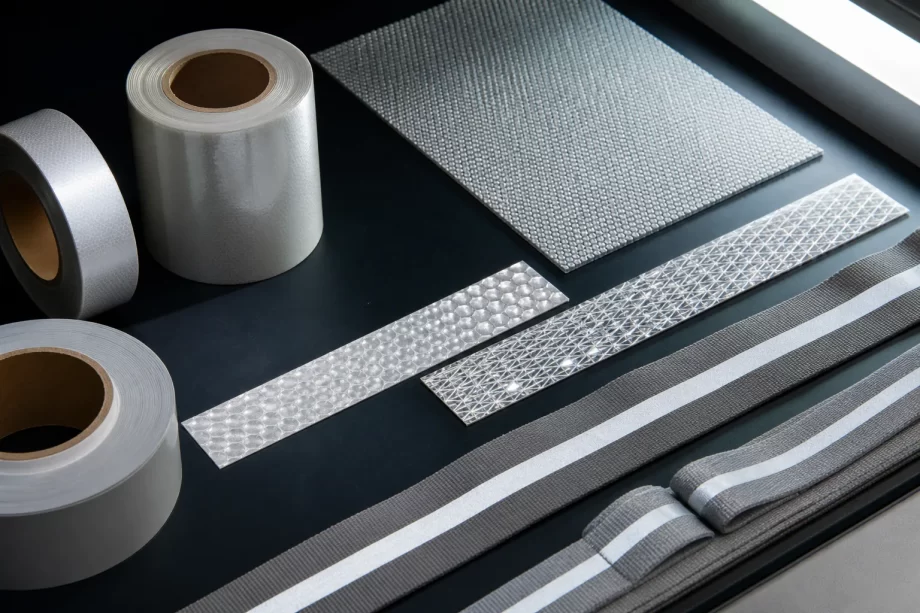
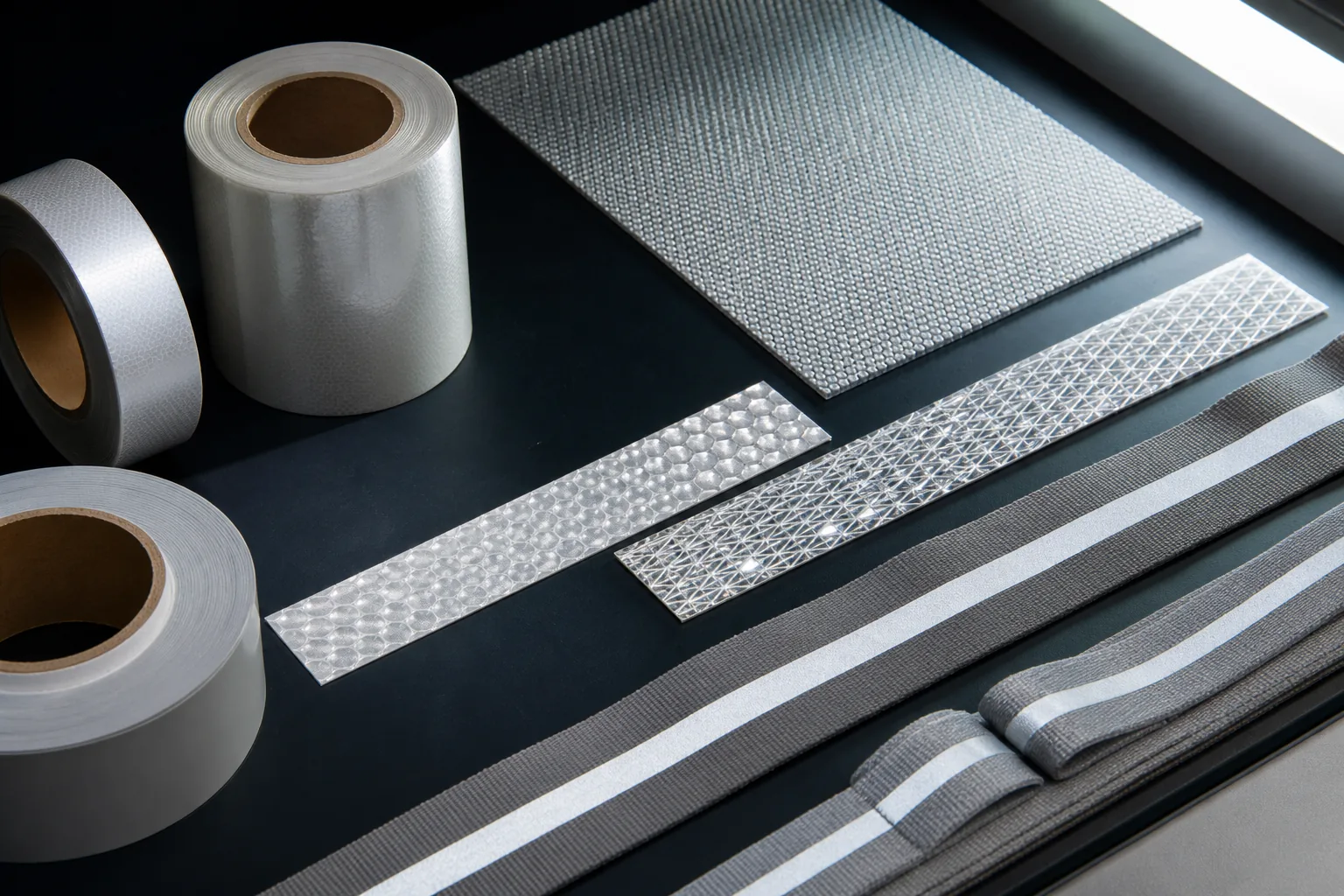
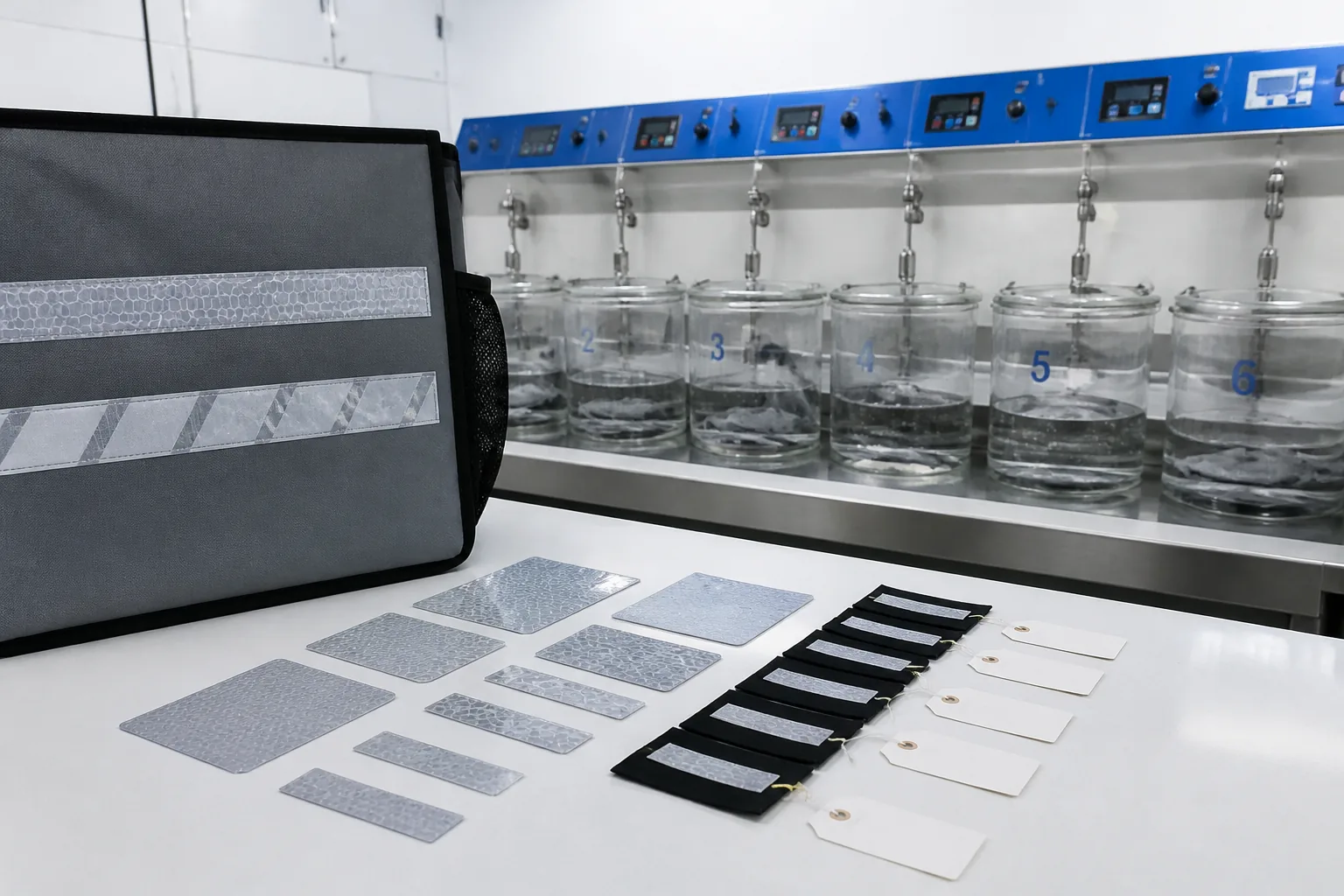
Rolls and swatches of retroreflective tape and webbing laid out on an inspection bench
This guide covers reflective and high-visibility materials from a backpack manufacturer’s perspective: why retroreflection matters in a bag programme, how glass-bead and microprismatic constructions differ, and how performance is graded and specified.
It then covers how the right product is selected for an application, where reflective elements should sit on a bag, how brightness is verified in production, how durability through washing and abrasion is assessed, how the material is sourced and controlled, and which compliance obligations attach to a visibility claim.
Why Reflective Materials Matter in Bag Manufacturing
Reflective trim is a safety feature, an aesthetic choice, and a compliance item depending on the market and the end use. A school bag for a market with a visibility requirement is a different product from a fashion backpack with a decorative silver band.
The Application Driver Table
Application
Why reflective trim is used
School bags
Pedestrian visibility
Commuting bags
Cyclist and pedestrian safety
Running and cycling packs
Active user visibility
Workwear and industrial bags
Site safety requirements
Promotional bags
Brand differentiation
Fashion bags
Decorative metallic effect
The Buying Risk Table
Risk
Consequence
Visually similar but non-retroreflective trim
No safety benefit
Grade too low for the end use
Fails the specification
Wash durability unverified
Performance lost after cleaning
Wrong placement
Hidden at the critical angle
Unverified supplier claim
Undetectable until testing
The Sight-Line Table
Condition
What the user sees
Daylight, direct
A grey or silver band
Daylight, grazing angle
A brighter metallic highlight
Headlight, near axis
Intense return to the source
Headlight, wide angle
Weak or negligible return
Camera flash at night
Strong return to the lens
The Requirement Source Table
Source
Basis
End-user specification
Buyer’s own requirement
Sector standard
Industry visibility rules
Retailer requirement
Programme-specific
Regulatory requirement
Market-specific mandate
Brand standard
Own quality level
Manufacturer note: Reflective trim is the component most often substituted without anyone noticing. A supplier sends a tape that matches the approved colour and width but is built for a decorative metallic look rather than for retroreflection, and it passes every visual check on the inspection table. The failure only appears when a retroreflectometer is applied or when a headlight is directed at the finished bag. This is why the specification has to be written in performance terms and why the verification step has to be a measurement rather than an inspection.
How Retroreflective Materials Work
Retroreflection means returning light back towards its source rather than scattering it. Two optical constructions dominate the market, and they behave differently in ways that matter to a bag programme.
The Construction Table
Type
How it returns light
Glass-bead
Beads beneath a reflective layer
Microprismatic
Faceted cube-corner structure
Beaded fabric
Beads bonded to a woven base
Beaded film
Beads on a flexible film
Prismatic film
Sealed cube-corner sheet
Reflective print
Beads or prisms in an ink system
The Comparison Table
Property
Glass-bead
Microprismatic
Brightness at full angle
Moderate to high
Very high
Brightness at wide angle
Good
More variable
Flexibility
High
Lower
Hand and drape
Softer
Stiffer
Cost
Lower
Higher
Abrasion resistance
Moderate
Higher, if sealed
Washing behaviour
Generally good
Depends on sealing
Printability
Limited
Limited
The Performance Factor Table
Factor
Effect on performance
Viewing angle
Return falls as the angle widens
Entry angle
Return changes with approach angle
Surface contamination
Reduces return
Creasing
Breaks the optical path
Abrasion
Removes or dulls the optics
Wetting
May alter return
Colour
Affects observed brightness
The Colour Table
Colour
Typical use
Silver
Highest return, general use
White
High return, softer look
Fluorescent yellow
Daytime visibility
Fluorescent orange
Daytime visibility
Coloured prismatic
Fashion and brand
Black prismatic
Low-light styling
The Base Material Table
Base
Suitability
Sew-on fabric
Stitched directly to panels
Heat-transfer film
Applied by press
Adhesive film
Applied to flat surfaces
Elastic webbing
Straps and bands
Piping and cord
Edging and trim
Mesh
Panels and pockets
The Limitation Table
Limitation
Implication
Performance varies with angle
Specify the geometry
Not all trims reflect
Verify by measurement
Washing can degrade
Test to the intended care
Abrasion dulls the surface
Consider placement
Creasing is permanent
Avoid sharp folds
Contamination reduces return
Keep covered until use
The Specification Vocabulary Table
Term
Meaning
Coefficient of retroreflection
Return per unit area and illuminance
Observation angle
Angle between source and viewer
Entrance angle
Angle of the incoming light
Performance class
Graded brightness band
Retroreflective
Returns light to source
Fluorescent
Emits visible light under UV
Retroreflective Performance Grades and Standards
Performance is graded rather than binary. A tape is not reflective or non-reflective; it returns a measurable amount of light under defined geometry, and the grade states how much.
The Grading Table
Grade level
Typical intent
Highest class
High-risk and high-speed contexts
Mid class
General road and outdoor use
Entry class
Decorative or low-risk use
Below entry
Decorative metallic only
The Test Geometry Table
Parameter
Purpose
Observation angle
Mimics the driver’s eye position
Entrance angle
Mimics the approach direction
Rotation angle
Orientation of the sample
Illuminant
Defines the light source
Distance
Part of the geometry setup
The Standard Type Table
Standard type
Applies to
Retroreflective sheeting standard
Film and tape performance
High-visibility clothing standard
Garments and some bags
Reflective trim standard
Trim products
Test method standard
How the measurement is made
Buyer specification
Programme-specific
The Report Content Table
Element
Purpose
Product identification
Matches the delivered item
Construction type
Bead or prismatic
Colour
Silver, fluorescent, other
Test geometry
Observation and entrance angle
Result
Measured coefficient
Grade claimed
Class or level
Test method
How it was measured
The Grade Selection Table
End use
Grade direction
Children’s school bag
Per the market requirement
Cyclist commuter pack
Mid to high
Running and trail pack
Mid to high
Industrial workwear bag
Per site or sector rule
Promotional item
Entry or decorative
The Claim Table
Claim
Requires
Retroreflective
A measured coefficient
High visibility
Daytime colour plus reflective
Certified to a standard
A report against that standard
Class or grade stated
A grade-tested report
Washable
A wash-durability result
Selecting the Right Reflective Product for the Application
Selection follows from four questions: what the bag is for, how bright the trim must be, how the trim will be attached, and what the bag will be subjected to. Answering them in that order prevents the common mistake of choosing on appearance.
The Selection Sequence Table
Step
Question
One
What is the end use?
Two
What grade is required?
Three
How will it be attached?
Four
What care will the bag receive?
Five
What colour and width are wanted?
Six
What price band applies?
The Attachment Table
Method
Consideration
Sewn
Needle damage to the optics
Heat transfer
Temperature and pressure window
Adhesive
Surface energy and cleanliness
Welded
Material compatibility
Inserted in a seam
Accessibility at the edge
Applied as piping
Radius and curvature
The Substrate Table
Substrate
Consideration
Woven nylon or polyester
Stable, sews well
Coated fabric
Adhesive may not bond
Mesh
Support may be insufficient
Elastic
Stretch affects application
Foam-backed panel
Compression during pressing
The Cost Driver Table
Driver
Effect
Construction type
Prismatic costs more
Grade
Higher grade costs more
Width
More material per unit
Colour
Speciality colours cost more
Attachment method
Labour and equipment
Testing requirement
Report cost
The Alternative Table
Alternative
Use
Reflective piping
Continuous outline
Reflective print
Logo and graphics
Reflective webbing
Straps and handles
Reflective cord
Zipper pulls and loops
Fluorescent fabric
Daytime visibility only
Combination trim
Day and night visibility
Manufacturer note: The most common specification error is to write the reflective requirement as a colour and a width rather than as a performance level at a defined geometry. Two tapes that match on colour, width, and price can differ by a factor of several in returned brightness, and both will look correct in a photograph. Writing the requirement as a performance value at a stated observation and entrance angle is what makes the specification enforceable, and it is also what allows an incoming inspection to reject a substitution with evidence rather than with an opinion.
Verification: Testing Brightness in Production
Verification is a measurement, not an inspection. The instrument and the geometry matter as much as the sample, because the same tape returns very different values depending on how the light approaches it and where the observer stands.
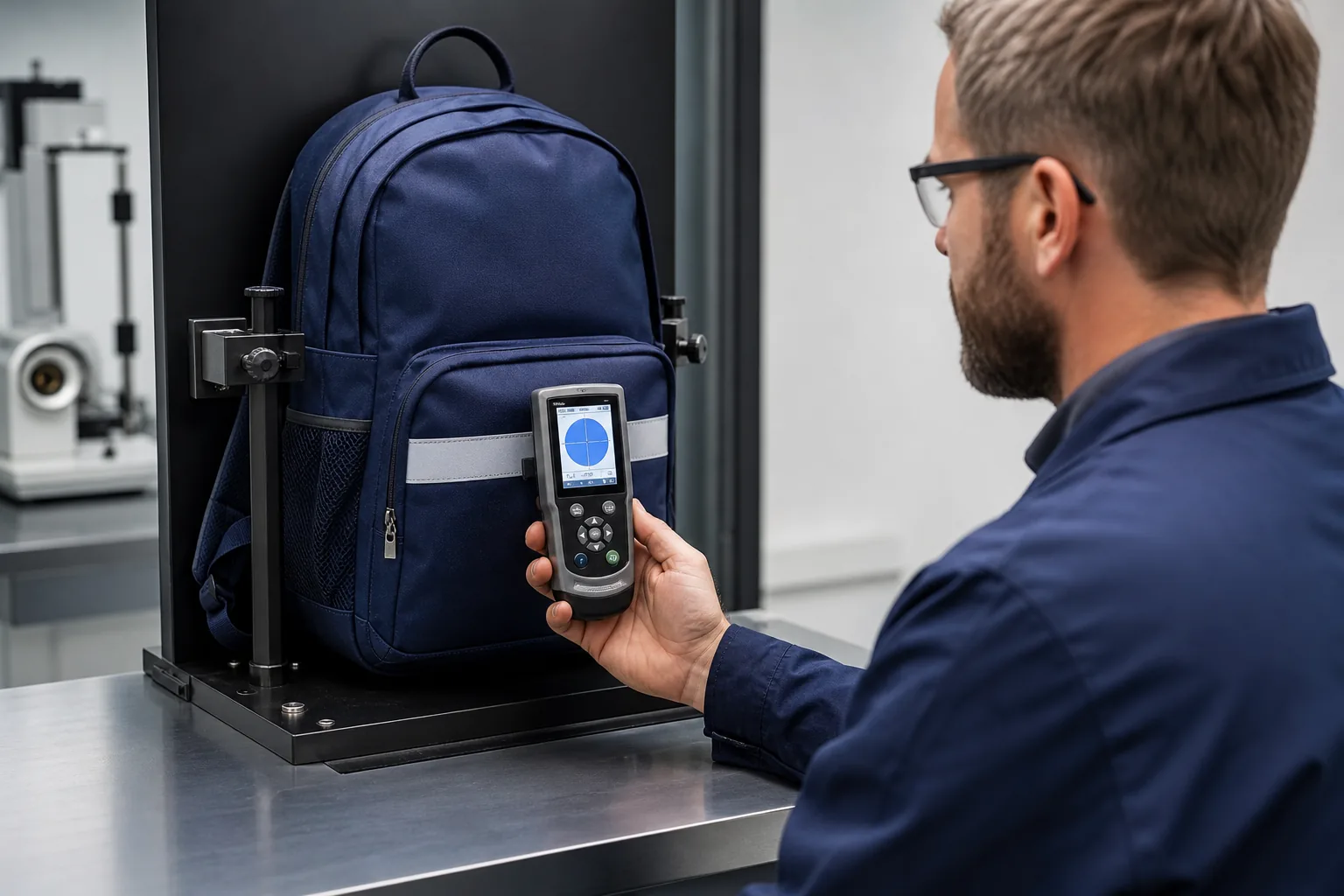
A technician measuring a reflective strip on a backpack with a handheld retroreflectometer
The Instrument Table
Instrument
Use
Portable retroreflectometer
Production and incoming checks
Laboratory instrument
Formal testing and reporting
Reference standard
Instrument calibration
Spectrophotometer
Colour and fluorescence
Visual comparison chart
Screening only
The Calibration Table
Element
Practice
Reference standard
Traceable and current
Calibration interval
Per the instrument plan
Zero and span check
Before each session
Operator technique
Trained and consistent
Environment
Per the method
The Sampling Table
Stage
Sample
Incoming material
Per delivery or lot
Finished trim
After attachment
Finished bag
After assembly
Post-wash
After the care cycle
Periodic
Current production
The Verification Point Table
Point
What is checked
Incoming
Roll identification and grade
Cutting
Correct product used
After sewing
No needle or fold damage
After pressing
No heat damage
Final
Measured value recorded
Post-wash
Retained value
The Failure Table
Failure
Likely cause
Low reading at incoming
Wrong product supplied
Low reading after sewing
Needle damage to optics
Low reading after pressing
Overheated or over-pressed
Patchy reading
Contamination or creasing
Low reading after washing
Unverified wash performance
Reading varies across the roll
Manufacturing variability
The Record Table
Record
Purpose
Supplier report
Material claim
Incoming result
Verification
Attachment setting
Process control
Final measurement
Production evidence
Post-wash result
Durability evidence
Batch code
Traceability
Placement and Design on the Bag
Reflective trim only works if it is positioned where a driver’s light will strike it and where the return reaches the driver’s eye. Placement is a design decision that determines whether the trim performs at all.
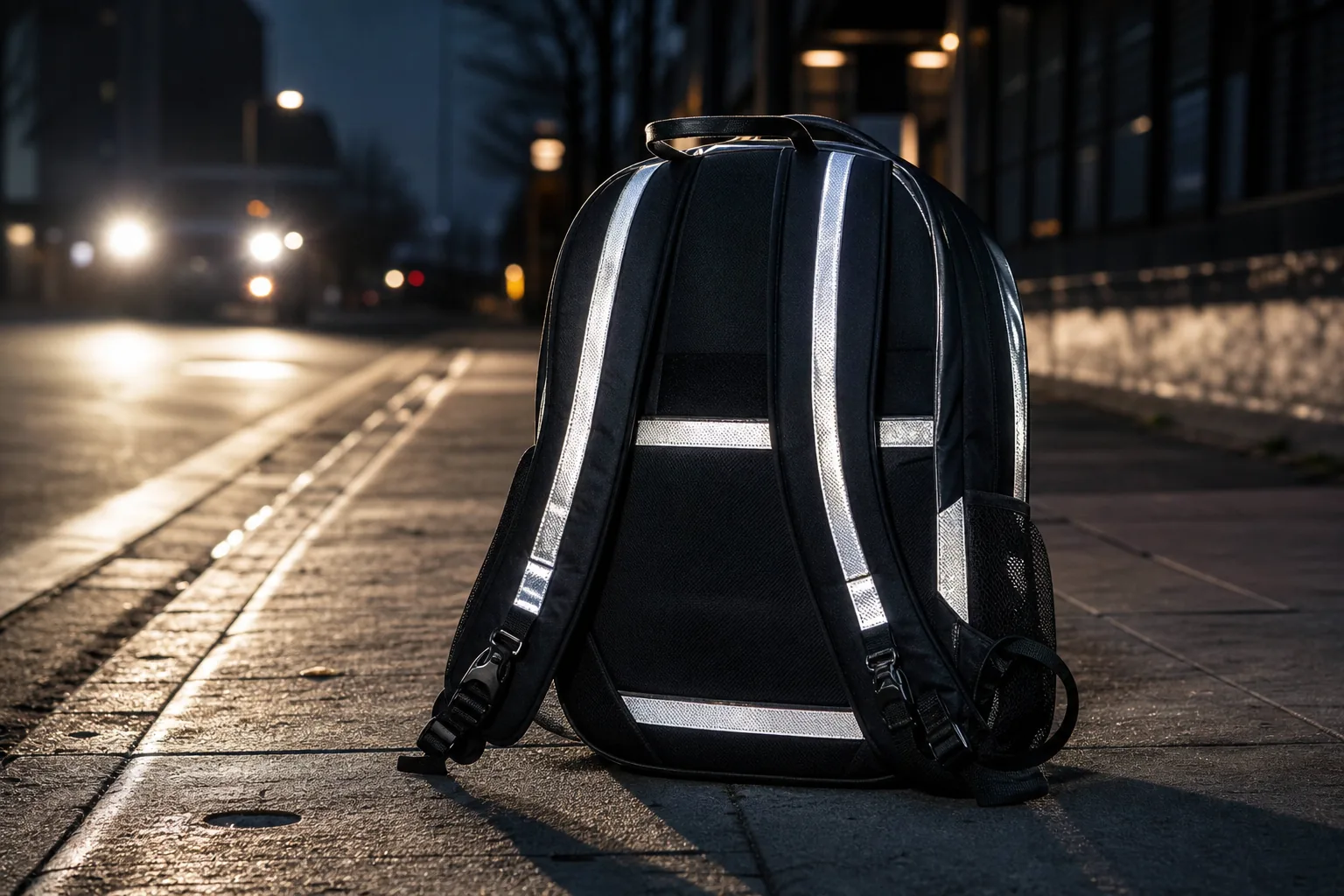
A backpack with reflective strips glowing under vehicle headlights at dusk
The Placement Table
Position
Reason
Shoulder straps, front
Faces oncoming traffic
Back panel, upper
Visible from behind
Side panels
Lateral visibility
Bottom edge
Low-angle visibility
Handle
Visible when carried by hand
Zipper pulls
Small moving highlight
The Coverage Table
Level
Effect
Minimal accent
Styling, limited visibility
Moderate banding
Practical visibility
Continuous outline
Strong silhouette
Full panel
Maximum visibility
Combined with fluorescent
Day and night
The Angle Table
Consideration
Design response
Wide observation angle
Increase the reflective area
Low entrance angle
Position on a near-vertical face
Curvature
Use flexible trim
Folding
Avoid creasing the trim
Occlusion by contents
Keep panels flat
The Integration Table
Integration
Consideration
Seam insertion
Edge exposure and stitch type
Surface stitching
Needle size and density
Heat application
Pressure, temperature, time
Print integration
Ink compatibility
Piping and binding
Radius and feed
Hardware proximity
Avoid abrasion points
The Aesthetic Table
Design direction
Approach
Technical and functional
Silver banding
Urban and minimal
Thin piping
Sports
Colour-matched prismatic
Children’s
Colourful prints and shapes
Corporate
Logo in reflective print
The Durability Placement Table
Location
Abrasion risk
Bottom edge
High contact
Side panel
Moderate
Shoulder strap
Moderate to high
Back panel
Low
Handle
High
Piping
Moderate
Manufacturer note: Most reflective trim failures on finished bags are geometric rather than material. A silver band sewn into a seam that folds back on itself loses its return, and a strip placed on a curved lower panel may face the ground rather than the road. The practical check is to fit the finished bag on a person or a mannequin in the actual carrying position and look at which surfaces face forward, backward, and sideways. Trim that faces none of those directions is decoration, not safety, and it should be specified as decoration so that the buyer’s expectations and the material grade match.
Durability: Washing, Abrasion and Weathering
A reflective bag is expected to stay reflective for the life of the bag, and the factors that reduce performance are predictable: washing, abrasion, creasing, and contamination. Each can be tested, and each should be stated in the care instructions.
Reflective samples and a bag panel beside a laboratory laundering test setup
The Degradation Table
Factor
Mechanism
Washing
Binder softening and bead loss
Abrasion
Surface optics scratched or removed
Flexing
Cracking of the reflective layer
Creasing
Permanent optical disruption
Contamination
Reduced light transmission
Heat
Deformation of the prismatic structure
Ageing
Gradual loss of efficiency
The Wash Test Table
Parameter
Consideration
Cycle temperature
Per the care label
Cycle count
Per the programme requirement
Detergent type
Domestic or specified
Drying method
Line or tumble
Retained performance
Measured after cycles
Visual change
Cracking, peeling, dulling
The Abrasion Table
Method
Application
Taber-type abrasion
Flat material samples
Martindale
Fabric and trim
Rub test
Surface coatings
Field wear
Finished product
The Performance Retention Table
Condition
Expectation
Before washing
Reference value
After one cycle
Slight reduction
After multiple cycles
Graded retention
After abrasion
Depends on construction
After ageing
Gradual loss
The Care Instruction Table
Instruction
Reason
Wash temperature limit
Protects the binder
No fabric softener
Coats the optics
No bleach
Degrades the layer
Line dry preferred
Avoids heat damage
Do not iron the trim
Melts the optics
Do not dry clean
Solvent attack
The Cord and Trim Table
Element
Durability note
Elastic reflective band
Stretch cycling
Piping
Edge abrasion
Cord
Fraying at the ends
Print
Coverage and adhesion
Webbing
Edge wear
Sewn tape
Stitch-line damage
The Field Feedback Table
Complaint
Likely cause
Dull after washing
Unverified wash retention
Peeling at the edge
Adhesion or stitch damage
Cracks along a fold
Creasing
Patchy appearance
Contamination
Lost brightness overall
Wrong grade supplied
Sourcing and Quality Control
Reflective materials are a small share of the bill of materials and a large share of the compliance risk, because the property that matters cannot be verified by looking. Control therefore has to be built around documents, approved sources, and measurement.
The Supplier Requirement Table
Requirement
Purpose
Declared construction
Bead or prismatic
Declared grade
Performance level
Test report
Evidence of the claim
Wash performance
Care instruction support
Colour and width tolerance
Match to the specification
Change notification
Prevents silent substitution
The Approved Source Table
Control
Effect
Approved supplier list
Restricts what can be used
Brand and article number
Identifies the product
Reference sample
Physical standard
Specification sheet
Written requirement
Purchase order clause
Contractual basis
Substitution ban
Prevents drift
The Incoming Control Table
Check
Method
Identity
Label, packing, article number
Width
Measurement
Appearance
Visual against the standard
Retroreflection
Instrument measurement
Wash performance
Report review
Sample retention
Keep a reference piece
The Traceability Table
Question
Record
Which roll was used?
Batch code
Who supplied it?
Purchase record
What was its grade?
Supplier report
What did we measure?
Incoming record
Which bags used it?
Work order
What was shipped?
Shipping record
The Change Control Table
Change
Action
New supplier
Full verification
New article number
Re-verify and re-report
New colour
Re-measure and re-test
New width
Verify and adjust patterns
Process change
Re-verify after attachment
Care instruction change
Re-test washing
The Cost Versus Risk Table
Option
Trade-off
Lowest-cost trim
Highest verification burden
Mid-grade verified trim
Balanced
Highest-grade trim
Cost with margin for error
Decorative metallic
Not a safety claim
Manufacturer note: It is worth separating two conversations that are often confused in a bag programme. One is whether the trim is bright enough for the intended use. The other is whether the programme can prove it. The first is settled by a specification and a measurement. The second is settled by a file that contains the supplier’s report, the incoming measurement, the attachment setting, and the post-wash result. A factory that has the first without the second will win the development sample and lose the audit, because the buyer’s technical team will eventually ask for the evidence behind the claim.
Compliance, Labelling and Claims
A visibility claim is a claim like any other, and in some markets it is a regulated one. Whether the bag is a school bag, a workwear accessory, or a promotional item determines how tightly the claim will be read.
The Requirement Table
Requirement
Applies when
Performance standard
A safety claim is made
Test report
A grade or class is claimed
Care labelling
Washing instructions are given
Origin marking
Market requirement
Substance limits
Children’s product rules
Language and wording
Market-specific
The Claim Risk Table
Claim
Risk if unverified
Certified
Report requested and absent
Class or grade stated
Grade not supported
Washable
Retention not tested
High visibility
Depends on colour plus reflection
Safety feature
Raised expectation of performance
The Label Table
Element
Purpose
Care instructions
Protects the trim
Material content
Fibre labelling
Origin
Market requirement
Warning, if any
Product-specific
Batch code
Traceability
Reflective mention
Must be supportable
The Documentation Table
Document
Held by
Supplier test report
Factory and buyer
Incoming measurement record
Factory
Attachment process setting
Factory
Post-wash result
Factory
Care label artwork
Factory and buyer
Reference sample
Factory
The Marking Table
Marking
Note
Care symbols
Must match the tested care
Fibre content
Accurate composition
Origin
Correct statement
Size marking
Accurate grading
Brand marking
Buyer-controlled
The Review Table
Item
Frequency
Supplier report currency
Annual or per lot
Incoming measurement
Each delivery
Attachment setting
On process change
Care label against article
Each programme
Claims used in marketing
Before publication
The Reflective Materials Checklist
Specification
Item
Done
End use confirmed
☐
Required grade stated
☐
Observation and entrance angle stated
☐
Colour and width specified
☐
Attachment method specified
☐
Care conditions stated
☐
Material
Item
Done
Construction identified
☐
Supplier report obtained
☐
Reference sample retained
☐
Wash data reviewed
☐
Substance documents filed
☐
Design
Item
Done
Placement reviewed on the carried bag
☐
Surfaces facing traffic identified
☐
Creasing avoided
☐
Curvature within the material’s limit
☐
Abrasion points considered
☐
Aesthetic balance reviewed
☐
Attachment
Item
Done
Needle size and density verified
☐
Press window set and recorded
☐
Adhesion tested where used
☐
No fold through the trim
☐
Edge exposure adequate
☐
Verification
Item
Done
Instrument calibrated
☐
Incoming measurement recorded
☐
Post-attachment measurement recorded
☐
Post-wash result recorded
☐
Results filed against the batch
☐
Records
Item
Done
Supplier report filed
☐
Incoming records indexed
☐
Work order traced
☐
Care label approved
☐
Reference sample stored
☐
The Eight Rules
Rule
Reason
Specify performance, not appearance
Colour and width do not prove brightness
Name the measurement geometry
The same tape reads differently at other angles
Verify the incoming roll
Substitution is invisible by eye
Check the trim after attachment
Sewing and pressing can destroy it
Test washing to the stated care
Retention is the usual failure
Position where light will strike it
Geometry decides whether it works
Treat the claim as regulated
Claims attract evidence requests
Keep the reference sample
It settles disputes quickly
Manufacturer note: The care label and the reflective performance are connected documents. If the bag is labelled for a hot wash and a tumble dry, the trim has to be tested under those conditions; if the tested trim cannot survive them, the label has to change. Producing a bag with a wash-care instruction that invalidates its own reflective performance is a straightforward inconsistency that a buyer’s technical reviewer will find, and it is far cheaper to resolve during specification than after the labels are printed.
FAQ
How can we tell whether a tape is genuinely retroreflective?
Only by measurement. A retroreflective tape and a decorative metallic tape can look identical in daylight, in a photograph, and on a colour card, because both appear as a bright silver band under diffuse light. The difference appears when light is returned to its source rather than scattered, and that requires an instrument and a defined geometry. In practice a supplier report is the starting point, an incoming measurement with a retroreflectometer is the verification, and a reference sample retained on file settles questions later. Visual inspection is useful for spotting damage and contamination, not for establishing whether the material reflects.
What is the difference between glass-bead and microprismatic reflective materials?
Glass-bead material returns light through many small beads bonded beneath a reflective layer, which makes it flexible, soft in the hand, and relatively economical. Microprismatic material uses a faceted cube-corner structure, which generally returns more light at the full angle and resists abrasion better when well sealed, but is stiffer and more expensive. For bags, which bend and fold, the choice usually turns on how the trim will be attached and how the finished bag will be handled rather than on brightness alone. Both types exist in a range of grades, so the construction and the grade should be specified separately.
Do we need to specify the observation angle and entrance angle?
Yes, if the requirement is to be enforceable. Retroreflective performance varies strongly with both angles, so a brightness value stated without the geometry is not a specification and cannot be checked. The observation angle describes where the viewer stands relative to the light source, which for a driver is a small angle, and the entrance angle describes the direction from which the light arrives. A supplier report will state the geometry it used; the specification should require the same geometry so that the delivered material can be compared against the approved report on equal terms.
Does reflective trim survive domestic washing?
It can, but retention varies by construction, by the wash temperature, by the detergent, and by the drying method. The binder that holds the optics can soften in hot water, fabric softener can coat the surface and reduce return, and tumble drying exposes the material to heat that distorts a prismatic structure. This is why the care instruction and the wash performance have to be settled together. If the programme requires a warm wash, the trim should be tested at that temperature for the stated number of cycles, and the retained brightness recorded, rather than assuming that the trim will behave as it did on the bench.
Where should reflective elements be placed on a backpack?
Where a driver’s light will actually strike them and where the return reaches the driver’s eye. In practice that means forward-facing surfaces such as the front of the shoulder straps, the upper back panel, and the side panels, because a pedestrian walking with traffic presents those faces to oncoming vehicles. Horizontal banding around a bag’s mid-height usually reads better from a distance than a small logo, and continuous outlines create a recognisable silhouette. The reliable test is to fit the finished bag in the carrying position on a person or a mannequin and look at which surfaces face forward, backward, and sideways.
Can reflective performance be added through printing rather than trim?
Yes, reflective ink systems exist and are widely used for logos and graphics, but they behave differently from tape. Returned brightness is generally lower, coverage and adhesion depend heavily on the substrate and the print process, and the effect is more sensitive to abrasion and washing. Reflective printing is a good solution when the design needs a brand mark to light up or when a tape would break the aesthetic, and a poor solution when the requirement is a defined performance level. If the requirement is graded, tape or webbing is the more reliable route; if the requirement is visual effect, print is usually adequate.
What documentation should accompany a reflective material order?
At minimum, a supplier report identifying the product, its construction, its colour, the measurement geometry, the measured value, and the grade claimed, plus the test method used. Where a wash claim is made, the wash test result should be included. On the factory side, that material should be countered by an incoming measurement record, a reference sample, the process setting used for attachment, and the finished-goods measurement. The point of the set is to connect the claim on the label to a measurable result on the delivered bag, so that a substitution or a process problem can be identified before shipment rather than after a complaint.
How should a factory handle a request to match a competitor’s reflective bag at a lower price?
By separating the appearance from the performance. The competitor’s bag can be matched on colour, width, and placement without matching its grade, and if that is what the price allows, the difference should be stated openly rather than absorbed into a claim the material cannot support. In practice this means quoting the same visual design at the grade the budget allows, offering the higher grade as an upgrade, and making clear in the specification which surfaces are decorative and which are intended to perform. A bag sold as decoration is a legitimate product; a bag sold as a safety feature and built as decoration is a liability.
Conclusion
Reflective materials are unusual in a bill of materials because the property that justifies their cost cannot be confirmed by looking at them. In daylight they read as a grey or silver band, and the difference between a tape that returns light to a driver and one that merely looks metallic is invisible on the inspection table.
Everything that matters about the component happens under a geometry that only an instrument and a defined measurement setup can reproduce.
The consequence for a bag factory is that reflective trim has to be handled as a specified performance component rather than as a decorative material. Write the requirement as a grade at a stated observation and entrance angle, not as a colour and a width.
Verify the incoming roll by measurement, retain a reference sample, and check the trim again after sewing and pressing, because needle damage and excess heat destroy the optics before the bag ever reaches a customer. Test washing to the care instruction that will be printed on the label, and if the trim cannot survive that care, change the label rather than the test.
Placement deserves the same rigour as the material. A silver band sewn into a seam that folds back on itself, or mounted on a curved lower panel facing the ground, gives the buyer the appearance of visibility without the function. Fitting the finished bag in its carrying position and checking which surfaces face forward, backward, and sideways takes minutes and settles the design question before the patterns are cut.
For factories, the return on this discipline is access to programmes that require documented visibility, because those programmes exclude suppliers who cannot evidence the claim.
For buyers, the practical check is to ask for the supplier’s report, the incoming measurement, the post-attachment measurement, the post-wash result, and the care label that ties them together. A supplier who can produce all five is controlling a component that most of the market is only pretending to control.