Rules of Origin and Duty: How Do Bag Exporters Stay Compliant?
Rules of Origin and Duty: How Do Bag Exporters Stay Compliant?
Customs is the point in the supply chain where the buyer’s paperwork and the seller’s paperwork have to agree, and where a difference of a few characters can convert a routine clearance into a hold. A bag that has passed every quality check and loaded onto a vessel can still sit at a port because the declared value, the classification, or the origin statement does not match what the customs authority expects to see.
For a bag manufacturer, customs compliance is unusual among the requirements in this industry because it is not about the product itself. The bag can be perfect and the declaration wrong. What customs examines is the description of the transaction: what the goods are, where they were made, what they are worth, and under what terms they were sold. Each of those four questions is answered by a document, and each document must agree with the others.
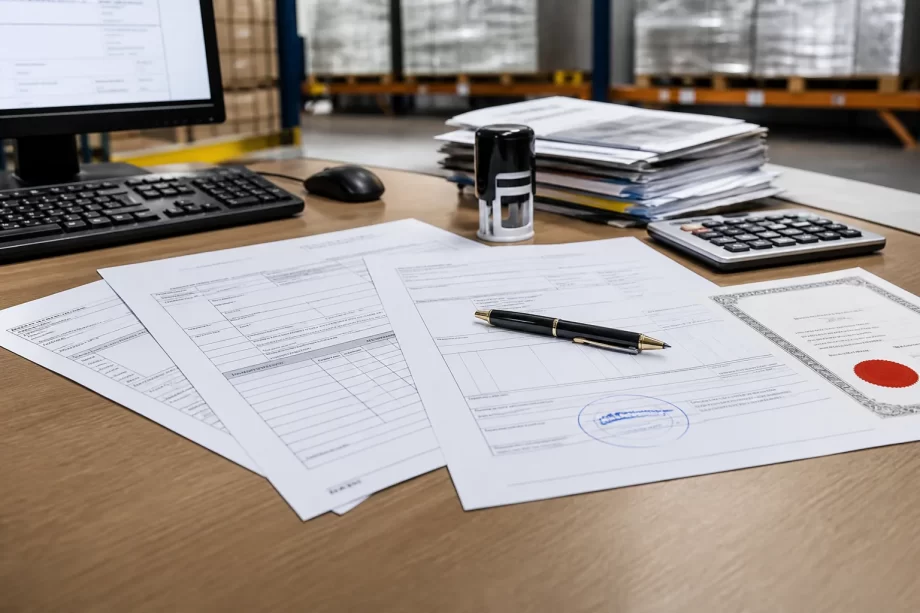
Export customs paperwork and declaration forms on a factory office desk
This guide covers customs, duty, and origin rules from a bag exporter’s perspective: why classification and declaration accuracy matter commercially, how goods are classified and how duty is calculated, and how rules of origin and preferential trade agreements work.
It then covers what documentation customs expects and how consistency between documents is maintained, how valuation and delivery terms affect the landed cost, how brokers and forwarders are coordinated, and how post-clearance audits and penalties are managed. It closes with the trade remedy measures that change duties without warning and the failures that recur in export programmes.
Customs decisions affect the price a buyer pays and the date goods arrive. Both effects are larger than most factories assume, and both are avoidable.
The Consequence Table
Error
Effect
Wrong classification
Higher duty or held shipment
Understated value
Penalty and reassessment
Origin overstated
Preferential claim rejected
Inconsistent documents
Clearance delay
Missing certificate
Loss of preference
Incorrect marking
Market entry refusal
Late submission
Storage and demurrage
The Cost Element Table
Element
Basis
Duty
Rate applied to value
Value added tax
On the dutiable value
Anti-dumping duty
Where applicable
Customs broker fee
Per entry
Inspection cost
If selected
Storage and demurrage
Per day of delay
Documentary correction
Time and fee
The Responsibility Table
Party
Responsibility
Exporter
Accurate invoice and origin data
Manufacturer
Classification and origin evidence
Buyer
Import declaration and duty payment
Broker
Entry preparation and filing
Forwarder
Transport and delivery data
Customs authority
Verification and enforcement
The Timing Table
Stage
Customs relevance
Quotation
Duty affects the landed price
Order
Terms and value agreed
Production
Origin determined by processing
Shipment preparation
Documents compiled
Export declaration
Filed with the export authority
Import clearance
Duty assessed and paid
Post-clearance
Records may be audited
The Document Table
Document
Function
Commercial invoice
States the transaction
Packing list
States the contents
Bill of lading
Evidence of carriage
Certificate of origin
Supports a preference claim
Export declaration
Filed with the export authority
Insurance certificate
Value evidence
Product declaration
Confirms compliance
Manufacturer note: Customs works by comparing documents against each other rather than by examining the goods in most cases. The description on the invoice is checked against the packing list, the origin statement against the certificate, and the value against the terms of sale. A shipment is most often delayed not because one document is wrong but because two documents disagree. The practical implication for a factory is that the last person who touches the document set before shipment should be checking it for internal agreement rather than simply adding a page.
Classification and Duty Calculation
The classification code determines the duty rate, and it is the single most consequential number on the paperwork. It is also the element most often inherited from a previous order without review.
Customs classification review with swatches and hardware samples
The Classification Basis Table
Basis
Consideration
Essential character
What gives the article its identity
Material composition
Predominant material
Outer surface
For many textile articles
Function
What the article is designed to do
Presentation
Sets, kits, or single articles
The Bag Classification Table
Article
Typical basis
Backpack with textile outer surface
Textile outer surface
Bag with plastic sheeting surface
Plastic surface
Leather-trimmed bag
Predominant material
Insulated bag
Function and lining
Tool or utility bag
Function
Bag with rigid frame
Structure
Set of bags
Essential character
The Code Structure Table
Level
Meaning
Chapter
Broad product family
Heading
Product group
Subheading
More specific group
Tariff item
National detail
Statistical suffix
Reporting detail
The Duty Calculation Table
Element
Basis
Customs value
Transaction value adjusted
Duty rate
Per the classification
Duty amount
Value multiplied by rate
Additional duties
Trade remedy measures
Tax base
Value plus duty
Destination charge
Where applicable
The Valuation Table
Addition
Subtraction
Price paid or payable
Discounts allowed
Certain commissions
Certain transport after import
Packing cost
Duties already paid
Assist contributions
Certain buying commissions
Royalties where required
—
The Delivery Term Table
Term
Freight and duty
Ex works
Buyer arranges all
FOB
Buyer arranges freight
CFR
Seller pays freight, buyer duty
CIF
Seller pays freight and insurance
DDP
Seller pays duty as well
The Classification Risk Table
Risk
Control
Classification drift between orders
Written classification record
Multiple codes for one article
Single agreed code
Unreviewed inherited code
Periodic review
Code changed without notice
Confirm before shipment
Different code on export and import
Consistency check
Rules of Origin and Preferential Agreements
Origin is not where a product is shipped from, and it is not where the brand is registered. It is determined by where the goods were wholly obtained or underwent sufficient processing, and it decides whether a preferential duty rate is available.
Bag manufacturing stages from cut panels to finished backpack
The Origin Concept Table
Concept
Meaning
Wholly obtained
Produced entirely in one country
Substantial transformation
Changed into a new article
Tariff shift
Change in classification
Value added
Regional value content
Specific process
A required operation
Minimal operation
Insufficient on its own
The Sufficient Processing Table
Operation
Typically sufficient
Cutting and sewing fabric into a bag
Yes, in most rules
Attaching hardware to a finished shell
Often not
Packing and labelling only
No
Simple assembly of components
Depends on the rule
Coating or lamination
Depends on the rule
Combining imported panels
Depends on the rule
The Insufficient Operation Table
Operation
Why insufficient
Packing and repacking
Minimal
Labelling and marking
Minimal
Simple cutting
Minimal in some rules
Mixing of materials
Minimal
Affixing the brand
Minimal
The Preference Table
Element
Requirement
Agreement in force
Between the two countries
Qualifying origin
Per the agreement’s rule
Documentation
Certificate or declaration
Direct consignment
Routing requirement
Validity period
Time limit on the claim
Retention
Records kept for audit
The Certificate Table
Type
Character
Issued certificate
From an authorised body
Self-declaration
By the exporter
Approved exporter
Authorised to self-declare
Statement on invoice
Where permitted
Electronic certificate
Increasingly common
The Origin Evidence Table
Evidence
Purpose
Bill of materials
Shows component origin
Supplier declarations
Confirms input origin
Production records
Shows where operations occurred
Cost calculation
Supports value content
Process description
Supports tariff shift
The Traceability Table
Question
Record needed
Where was the fabric made?
Supplier declaration
Where was the hardware made?
Supplier declaration
Where was the bag assembled?
Production record
What operations were performed?
Process record
What was the value added?
Cost calculation
The Preference Risk Table
Risk
Consequence
Origin overstated
Claim rejected and penalty
Supplier declaration missing
No evidence for the claim
Insufficient processing
Preference denied
Direct consignment broken
Preference denied
Certificate expired
Claim refused
Records not retained
Cannot defend an audit
The Agreement Selection Table
Situation
Consideration
Multiple sourcing options
Compare duty outcomes
Inputs from several countries
Rules on accumulation
Low regional content
May not qualify
Buyer’s market has an agreement
Check the rule first
No agreement
Standard rate applies
Documentation Consistency
Customs assesses a shipment by comparing its documents. Consistency between them is the single most effective protection against delay.
The Consistency Field Table
Field
Appears in
Description
Invoice, packing list, declaration
Quantity
Invoice, packing list
Weight
Packing list, transport document
Value
Invoice, declaration, insurance
Origin
Declaration, certificate
Terms
Invoice, contract
Marks and numbers
Carton, packing list, bill of lading
The Description Table
Practice
Reason
Use the same wording everywhere
Avoids mismatch
Describe the article, not the brand
Customs describes goods
State the material
Supports classification
Avoid vague terms
Invites inspection
Match the classification
Supports the code
The Quantity Table
Field
Source
Units per carton
Packing record
Total units
Sum of cartons
Cartons shipped
Loading record
Gross weight
Measured
Net weight
Measured
The Value Table
Element
Consistency requirement
Unit price
Matches the invoice
Total value
Matches the invoice sum
Currency
Same across documents
Terms
Matches the contract
Adjustments
Documented
The Marks Table
Element
Requirement
Shipping marks
On cartons and documents
Carton numbers
Sequential and complete
Country of origin
On the goods where required
Handling symbols
Consistent with content
The Error Table
Error
Detection point
Spelling difference in a description
Document review
Quantity mismatch
Invoice against packing list
Weight estimated rather than measured
Weighing record
Currency mismatch
Document review
Missing certificate
Pre-shipment checklist
Expired certificate
Validity check
The Review Table
Step
Action
1
Compile the full document set
2
Check the description across documents
3
Check quantities and weights
4
Check values and currency
5
Check origin statements and certificates
6
Check marks and numbers
7
Confirm signatures and dates
Landed Cost, Valuation and Delivery Terms
A factory quotation is not a landed cost. Between the two sit freight, insurance, duty, brokerage, and the cost of delay, and the delivery term decides which of those the exporter has agreed to bear.
Export cartons loaded into a container at a factory dock
The Landed Cost Table
Element
Who usually bears it
Ex-works price
Exporter’s quote
Inland transport
Per the term
Export clearance
Per the term
Ocean freight
Per the term
Insurance
Per the term
Import duty
Per the term
Brokerage
Buyer in most cases
Delivery to warehouse
Per the term
The Valuation Method Table
Method
Applied when
Transaction value
Price actually paid
Identical goods
No transaction value available
Similar goods
No identical goods available
Deductive value
Based on resale
Computed value
Based on cost
Fallback
Reasonable means
The Adjustment Table
Item
Treatment
Freight to the port of import
Usually included
Freight after import
Excluded
Insurance
Usually included
Buying commission
Usually excluded
Selling commission
Usually included
Royalties
Included if a condition of sale
Discounts
Deducted if agreed in advance
The Transfer Pricing Table
Risk
Consequence
Price below market
Questioned on valuation
Related-party transaction
Additional scrutiny
Inconsistent prices across buyers
Comparison risk
Undocumented adjustments
Valuation challenge
The Term Selection Table
Term
Suited to
Ex works
Buyer with strong logistics
FOB
Common for container shipping
CFR or CIF
Seller arranges freight
DDP
Buyer wants a single price
DAP
Duty still the buyer’s
The Delay Cost Table
Cause
Cost
Documentation query
Storage and demurrage
Inspection
Time and handling
Duty dispute
Detention
Preference rejection
Duty reassessment
Missing certificate
Delay for issuance
The Quotation Table
Element
Should state
Unit price
Currency and basis
Delivery term
Which term applies
Packing
Standard included
Validity
Period the price holds
Duty assumption
Who bears what
Origin statement
What will be declared
Working with Brokers and Forwarders
The broker files the entry; the forwarder moves the goods. Both depend on the accuracy of what the factory provides, and neither can correct a specification the factory got wrong.
The Responsibility Split Table
Function
Party
Export booking
Forwarder
Container loading
Factory and forwarder
Export declaration
Factory or forwarder
Transport documents
Carrier or forwarder
Import entry
Broker
Duty payment
Importer
Post-clearance support
Broker with factory input
The Information Table
Information
Provided by
Commercial invoice
Factory
Packing list
Factory
Classification code
Factory, agreed with the buyer
Origin statement
Factory
Weight and dimensions
Factory
Shipping marks
Factory
Certificate of origin
Factory or chamber
The Selection Table
Criterion
Consideration
Licence and coverage
Authorised in the destination
Experience
With bags and textiles
Systems
Electronic filing capability
Responsiveness
Reachable during transit
Fees
Transparent structure
Audit record
Compliance history
The Instruction Table
Instruction
Content
Classification
Agreed code
Value
Per the invoice
Origin
Per the evidence
Preference
Whether claimed
Special requirements
Marking or permits
Contact
Who answers queries
The Communication Table
Event
Action
Booking confirmed
Share the packing data
Documents issued
Review before filing
Query raised
Respond within the day
Inspection ordered
Provide samples and records
Clearance completed
Confirm and reconcile
The Reconciliation Table
Item
Compared
Units shipped
Against the order
Units cleared
Against the documents
Duty assessed
Against the expectation
Fees charged
Against the quotation
Delay cause
Recorded for the next shipment
Audits, Penalties and Record Keeping
Customs authorities verify declarations after clearance as well as at the border. A shipment that cleared without inspection can still be examined two or three years later, and the factory is often the only party that holds the underlying evidence.
The Audit Type Table
Audit
Focus
Documentary
Records against declarations
Origin verification
Evidence for a preference claim
Valuation review
Price and adjustment support
Classification review
Technical basis for the code
Full compliance audit
All of the above
The Record Table
Record
Retention driver
Commercial invoice
Value evidence
Packing list
Quantity evidence
Transport document
Shipment evidence
Certificate of origin
Preference evidence
Supplier declarations
Origin evidence
Production records
Processing evidence
Payment records
Value confirmation
Correspondence
Context and agreements
The Penalty Table
Finding
Typical consequence
Administrative error
Correction and fee
Understated value
Duty reassessment and penalty
Incorrect classification
Duty adjustment
Unsupported preference
Duty recovered
Deliberate misdeclaration
Substantial penalty
Repeated errors
Increased scrutiny
The Defence Table
Evidence
Purpose
Written classification reasoning
Supports the code
Supplier declarations
Supports origin
Cost calculation
Supports value content
Process records
Supports transformation
Consistency history
Shows good faith
Correction record
Shows self-correction
The Corrective Action Table
Stage
Action
Error identified internally
Correct the declaration
Error identified by customs
Cooperate and correct
Systemic cause found
Fix the process
Repeat risk
Add a control point
Disclosure required
Follow the applicable procedure
The Risk Table
Risk
Likelihood driver
Classification challenge
Novel or ambiguous article
Valuation query
Related-party or unusual pricing
Origin verification
Preference claimed without evidence
Inspection
Destination and product profile
Delay
Document inconsistency
The Control Table
Control
Purpose
Written classification record
Consistency
Standard document checklist
Completeness
Pre-shipment document review
Consistency
Supplier declaration register
Origin evidence
Retention index
Audit readiness
Error log and review
Improvement
Common Failures in Export Documentation
Customs problems repeat across programmes because the underlying causes repeat. Naming them makes them preventable.
The Problem Table
Problem
Underlying cause
Description differs between documents
Documents prepared separately
Quantity mismatch
Packing list written before final packing
Weight estimated
No weighing step
Origin statement unsupported
Supplier declarations not collected
Certificate issued late
Origin work left to the end
Classification inherited
No review on a new article
Value inconsistent
Currency or terms confusion
Marks not matching
Cartons marked after documentation
The Cause Table
Cause
Corrective focus
No single owner for the document set
Assign responsibility
No pre-shipment review
Add the review step
Origin evidence not requested
Add to the purchase process
No weighing station
Establish one
Classification not recorded
Keep a classification file
Terms not confirmed in writing
Confirm at order
The Correction Table
Problem
Immediate
Permanent
Description mismatch
Reissue the document
Single source of wording
Quantity mismatch
Recount and reissue
Pack before documenting
Unsupported origin
Obtain declarations
Add to the supplier process
Late certificate
Expedite issuance
Start origin work at order
Wrong classification
File a correction
Review before shipment
Value inconsistency
Correct the invoice
Confirm terms at order
The Prevention Table
Measure
Effect
One document owner
Removes split responsibility
Standard checklist
Removes omission
Pre-shipment review
Catches mismatch
Supplier declaration at purchase
Secures origin evidence
Weighing at packing
Replaces estimates
Classification file
Supports consistency over time
The Cost of Failure Table
Timing
Consequence
Found before shipment
Document correction
Found at export
Delay to load
Found at import
Storage and demurrage
Found after clearance
Duty and penalty
Found at audit
Recovery and scrutiny
Manufacturer note: Origin evidence is the element most often discovered to be missing late, and it is the one that cannot be created retrospectively in a defensible way. A supplier declaration for the fabric and the hardware either exists at the time of purchase or does not, and reconstructing it after a claim is queried invites doubt about its accuracy. Factories that export under preference claims should treat supplier declarations as a purchasing requirement in the same category as the specification, collected at the point of order rather than assembled at the point of shipment.
The Programme Review Table
Item
Frequency
Classification accuracy
On a new article and periodically
Origin evidence currency
Annually
Document checklist
After each shipment with an issue
Broker performance
Quarterly
Error log
Monthly
Retention completeness
Annually
Trade Remedies and Anti-Dumping Measures
Beyond the ordinary duty rate, some markets apply additional measures to imports that are found to be traded unfairly or that are suspected of injuring domestic producers. These measures change the landed cost materially and they change without notice.
The Measure Table
Measure
Character
Anti-dumping duty
Against sales below fair value
Countervailing duty
Against subsidised imports
Safeguard measure
Against a surge in imports
Tariff quota
Volume-limited concession
Additional levy
Trade policy measure
The Exposure Table
Factor
Relevance
Product scope
Whether bags fall within the order
Country scope
Which origins are covered
Rate applicable
Per exporter or country-wide
Registration requirement
Whether the buyer must register
Effective date
When the measure applies
Review cycle
When it may change
The Buyer Impact Table
Situation
Consequence
Measure applies to the origin
Higher landed cost
Exporter-specific rate
Rate depends on the shipper
Rate applied at entry
Duty payable on import
Price not adjusted
Margin absorbed by one party
Alternative origin available
Sourcing reconsidered
The Monitoring Table
Source
Use
Destination customs notices
Confirms measures in force
Trade association updates
Early warning
Broker advice
Practical application
Buyer communication
Contractual exposure
The Response Table
Option
Consideration
Adjust the pricing
Reflects the true cost
Change the origin of supply
Requires qualifying origin
Reclassify where justified
Must be defensible
Absorb the cost
Only where the margin allows
Revisit the programme
Sourcing review
Manufacturer note: Trade remedy measures are the element of customs exposure that factories least often monitor, because they are decided in the destination market rather than at the point of production. A duty that appears without warning can consume the margin on an entire season, and the price agreed months earlier cannot be reopened without the buyer’s cooperation. Monitoring the destination’s customs notices and confirming the position with the buyer before the order is confirmed is a low-cost habit that prevents a high-cost surprise.
The Export Compliance Checklist
Classification
Item
Done
Classification code agreed and recorded
☐
Reasoning documented
☐
Basis of the code identified
☐
Code reviewed for a new article
☐
Same code used by both parties
☐
Code consistent between shipments
☐
Origin
Item
Done
Origin rule for the destination confirmed
☐
Processing assessed against the rule
☐
Supplier declarations collected
☐
Value content calculated where required
☐
Direct consignment requirement met
☐
Certificate issued before shipment
☐
Validity period checked
☐
Documents
Item
Done
Description identical across documents
☐
Quantities agree
☐
Weights measured rather than estimated
☐
Values and currency agree
☐
Terms of sale stated and consistent
☐
Marks and carton numbers match
☐
Signatures and dates complete
☐
Full set reviewed before filing
☐
Valuation
Item
Done
Price basis documented
☐
Adjustments identified
☐
Commissions treated correctly
☐
Related-party pricing defensible
☐
Freight and insurance apportioned
☐
Records
Item
Done
Retention period confirmed
☐
Records indexed by shipment
☐
Evidence stored accessibly
☐
Error log maintained
☐
Broker records reconciled
☐
The Eight Rules
Rule
Reason
Record the classification and its reasoning
Consistency over orders
Collect supplier declarations at purchase
Reconstructed evidence is weak
Describe the article, not the brand
Customs classifies goods
Measure weight and quantity
Estimates fail comparison
Use one wording for the description everywhere
Mismatch causes delay
Confirm the origin rule before quoting
Duty changes the landed cost
Review the full set before filing
Detection is cheaper than correction
Keep everything for the retention period
Audits come later
FAQ
Who is responsible for the classification code, the exporter or the importer?
In most jurisdictions the importer is legally responsible for the declaration made at import, because the entry is filed in the importer’s name and the duty is the importer’s liability. In practice, however, the code is almost always proposed by the manufacturer or the exporter, because only they know the product in enough detail to describe it accurately. The practical arrangement is that the manufacturer proposes a code with written reasoning, the buyer confirms it before the first shipment, and the agreed code is then used consistently on both sides. Disagreement discovered at the border is more expensive than disagreement resolved at the quotation stage.
Does assembling imported parts into a bag in our country make it originate there?
Not automatically, and the answer depends on the specific rule in the agreement or the destination’s non-preferential rules. Most rules for bags require a change in tariff classification or a minimum regional value content, and cutting and sewing fabric into a finished bag usually satisfies a tariff shift while simply attaching hardware to an imported shell often does not. The safest approach is to identify the rule that applies to the exact classification code and market first, then assess the actual operations against it, then collect supplier declarations for the inputs. Assuming that assembly confers origin is one of the most common and most costly errors in export programmes.
What happens if the buyer and the factory use different classification codes?
The import declaration will be based on the code the importer files, and if that differs from the code on the export documents, the shipment is likely to be flagged. The consequences range from a request for explanation to a reassessment of duty, depending on the difference in rate and the authority’s assessment of intent. Because the customs authority compares documents, consistency between the two sides matters more than which of two defensible codes is chosen. Where a genuine disagreement exists, it should be resolved before shipment, in writing, with the reasoning recorded for both parties.
How long should export records be kept?
For the retention period required by the destination market, which in most jurisdictions runs several years from the date of importation or the date the entry was filed. Because the retention obligation usually rests on the importer but the supporting evidence sits with the manufacturer, the practical answer for a factory is to keep its records at least as long as the longest period among the markets it ships to. Records should be indexed by shipment or invoice number so they can be retrieved quickly, because an audit response that takes weeks to assemble weakens the position even when the underlying transaction was correct.
Does a delivery term change our customs exposure?
Yes, substantially, because it changes both the customs value and who is responsible for compliance. Under a term where the seller arranges freight and insurance, those costs may be included in the customs value even though they are not part of the factory’s own price. Under a term where the seller bears duty, the factory has taken on a liability it may not be equipped to calculate or control. The practical discipline is to state the term in writing at the quotation stage, to understand what it includes, and to price the obligation deliberately rather than discovering it when the first shipment is cleared.
How do we handle a customs query after the goods have cleared?
By responding from records rather than from memory. The first step is to identify exactly what is being queried — classification, value, origin, or a document — and to locate the corresponding evidence for that specific shipment. The response should be factual, supported by documents, and consistent with what was declared. Where an error is found, correcting it voluntarily and promptly is almost always better than defending an incorrect position, because the authority’s assessment of the exporter’s good faith affects how the matter is resolved. Every query should also trigger a review of whether the cause is systemic.
What is the most common cause of customs delays for bag shipments?
Documents that disagree with each other. In practice, delays are caused far more often by a description that differs between the invoice and the packing list, a quantity that was written before the cartons were finally packed, or a weight that was estimated rather than measured, than by the goods themselves. The second most common cause is unsupported origin, where a preference is claimed but the supplier declarations behind it were never collected. Both causes are addressed by process rather than expertise: a single owner for the document set, a standard checklist, a review before filing, and a weighing step at packing.
How does a factory know whether a preference claim is available?
By checking three things before quoting. First, whether a trade agreement is in force between the exporting country and the destination market for the classification code in question. Second, what that agreement’s rule of origin requires for that code — a tariff shift, a value content threshold, or a specific process. Third, whether the evidence needed to support the rule can actually be obtained, which in most cases means supplier declarations from the fabric mill and the hardware supplier. Where all three can be satisfied, the preference changes the landed cost and should be reflected in the offer. Where any one cannot, the standard rate should be assumed and stated plainly rather than hoped for.
Conclusion
Customs compliance is ultimately a documentation discipline. The bag is not examined in most transactions; the description of the bag is. Classification decides the duty rate, origin decides whether a preferential rate is available, and valuation decides the base the rate is applied to.
Consistency between the documents decides whether the shipment is released or held for explanation. Each of those four elements is answerable from a record that either exists or does not.
The controls that make this reliable are simple and unglamorous. Agree a classification code with the buyer and write down the reasoning behind it, so that the same article is classified the same way next season. Identify the origin rule that applies before quoting rather than after, and collect supplier declarations at the point of purchase, because origin evidence cannot be reconstructed convincingly.
Describe the article rather than the brand, use the same wording everywhere, measure weights rather than estimating them, and review the entire document set once before it is filed. State the delivery term in writing and understand what it obliges the factory to bear. Retain everything for the required period and keep it indexed, because an audit arrives years later and the factory is often the only party that still holds the evidence.
For factories, the return is fewer holds, fewer demurrage charges, and a quotation that reflects the true landed cost rather than a duty figure discovered later. A plant whose classification and origin records are complete can defend its declarations and support its buyers.
For buyers, the practical test is to ask the supplier for three things before an order is placed: the classification code with its written basis, the origin position for the destination market, and evidence that the supplier declarations supporting it have been obtained. A supplier who can answer all three is managing customs as a process. A supplier who answers from the shipping clerk is managing it as an accident waiting to happen.