
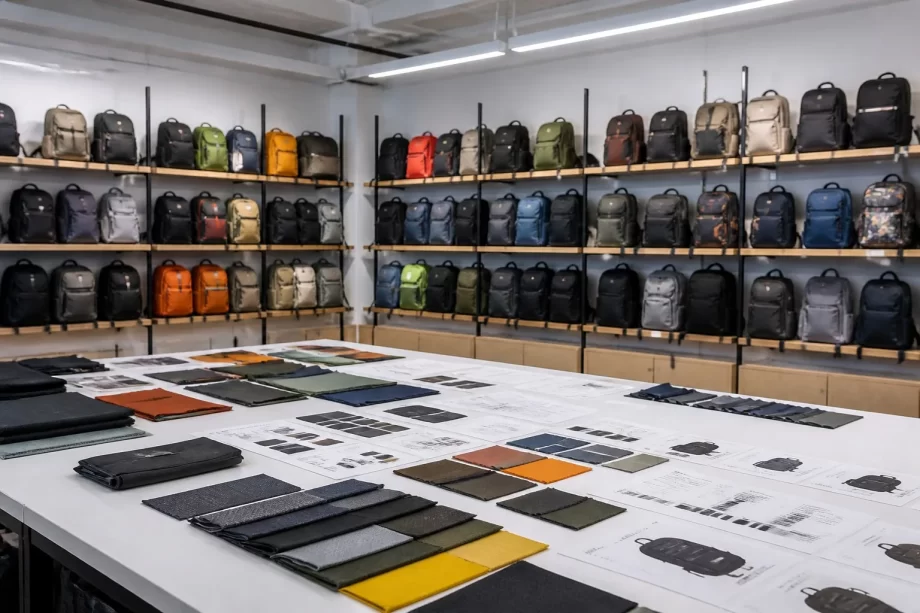
OEM and ODM Backpack Manufacturing: A Complete Guide for Importers
Every major backpack brand on the market — from the ones in department stores to the ones in outdoor gear shops — was built on the same foundation: a manufacturing partnership with a factory that turns an idea into a product. Most of those brands do not own a single sewing machine. They own a brand, a design, a market, and a relationship.
For importers and brand owners, the OEM (Original Equipment Manufacturing) and ODM (Original Design Manufacturing) model is the standard path to bringing a backpack product to market. But the path is full of decisions that are hard to reverse: choosing the right factory, negotiating the right terms, managing sampling, and protecting your quality and intellectual property across thousands of miles.
This guide is written from the factory side of the table. It walks through the complete OEM/ODM journey for backpack manufacturing — from the first factory inquiry to the final container — and explains what importers should know, ask, and do at every stage to get the best result.
- OEM vs ODM: Understanding the Two Models
- Step 1: Finding and Vetting the Right Factory
- Step 2: Sending the Inquiry and Getting Quotes
- Step 3: Sampling — The Make-or-Break Stage
- Step 4: The Production Agreement
- Step 5: Production and Quality Control
- Step 6: Shipping, Documentation, and Payment
- Cost Breakdown: Where Your Money Goes
- Common Mistakes Importers Make
- Communicating Effectively with Your Factory
- FAQ
- Conclusion
OEM vs ODM: Understanding the Two Models
The first decision is which model you need. The two terms are often used interchangeably, but they describe fundamentally different relationships.
| Aspect | OEM | ODM |
|---|---|---|
| Who owns the design | You (the buyer) | The factory (or shared) |
| What you provide | Complete specs, patterns, or samples | A concept, brief, or reference product |
| Factory role | Manufacture to your spec | Design + manufacture |
| Typical customer | Established brands | New brands, first-time importers |
| Development cost | Lower (you did the design) | Higher (factory design work) |
| Exclusivity | Usually exclusive to you | Depends on agreement; often exclusive |
| Time to market | Longer (your design cycle) | Faster (factory has ready designs) |
When to Choose OEM
- You have a complete design — technical drawings, patterns, or an existing product to replicate.
- You have a clear brand identity and need exact control over every detail.
- You are a second- or third-order buyer with an established product.
- You need precise material and construction specs that are already proven.
When to Choose ODM
- You are launching a brand and need a product fast without a full design team.
- You have a concept, market knowledge, and reference products but no technical drawings.
- You want to leverage the factory’s existing patterns, materials, and production expertise.
- You are testing a market and want low-risk product development.
Manufacturer’s note: Many importers think ODM means “lower quality.” It does not. A good factory’s ODM line is built from patterns and materials proven in production, which often means fewer development problems and faster delivery than a fully custom OEM project. The risk in ODM is not quality — it is losing design control and ending up with a product too similar to the factory’s other clients.
The Hybrid Model
Most real projects sit between the two: an importer takes a factory’s existing ODM base design and customizes it — changing colors, fabrics, hardware, and branding. This “semi-custom” path combines the speed of ODM with the distinctiveness of OEM, and it is the most common model in the industry.
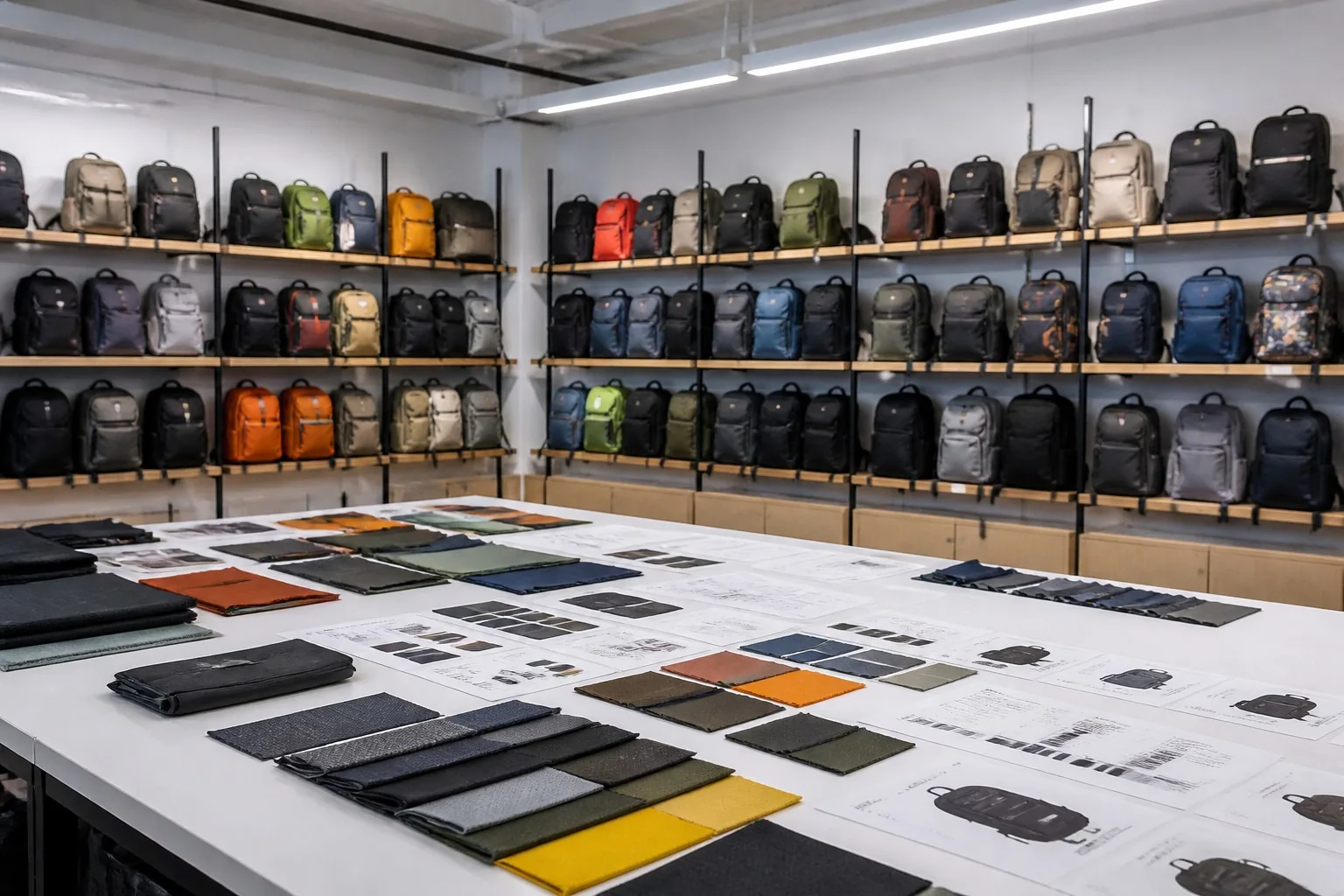
Step 1: Finding and Vetting the Right Factory
The factory choice determines everything downstream. Spend the time here.
Where to Find Factories
- Trade platforms — Alibaba, Global Sources, Made-in-China: useful for discovery, but verify every claim.
- Trade shows — Canton Fair (Guangzhou), Global Sources shows, Magic Vegas: meet factories face to face, see products live.
- Industry directories — verified factory directories and industry associations.
- Referrals — the most reliable source; brands in your network who already use a factory.
The Verification Checklist
Before sending money or committing to a project, verify:
| Check | How | Red flags |
|---|---|---|
| Legal registration | Request business license, company registration | Cannot or will not share |
| Factory vs trading company | Ask for factory address, request video tour | Only shares office address |
| Production capability | Ask about lines, capacity, equipment | Vague or inconsistent answers |
| Export experience | Request export records, current clients | No references |
| Compliance | Ask about certifications, audits | No documentation |
| Financial stability | Payment terms, years in business | Very young, poor communication |
Manufacturer’s note: A trading company is not automatically bad — many excellent traders manage quality well. But know what you are dealing with. If you are quoted a price that seems too low for a “factory,” it is often a trader sourcing from a factory you have never met. The risk is quality control and accountability, not the price itself.
The Factory Audit
For serious orders, consider a factory audit — either your own visit or a third-party audit (SGS, Bureau Veritas, Intertek). An audit verifies:
- Real production capacity (machines running, not a showroom)
- Worker conditions and safety (relevant for compliance markets)
- Quality systems (QC stations, testing equipment, documentation)
- Financial health signals (order books, supplier relationships)
Step 2: Sending the Inquiry and Getting Quotes
The quality of your inquiry determines the quality of the quotes you receive. Vague inquiries get vague quotes.
What to Include in an Inquiry
- Product type — school backpack, laptop pack, hiking pack, etc.
- Target quantity — MOQ is quantity-sensitive; state your realistic volume.
- Target price — your budget range (be honest; it filters factories).
- Design status — do you have drawings/patterns, or do you need ODM?
- Materials — any required fabrics, hardware brands, or sustainability requirements.
- Timeline — when do you need samples and bulk?
- Market — destination markets (affects compliance requirements).
Understanding the Quote
A professional quote breaks down the price:
| Quote component | What it covers |
|---|---|
| FOB unit price | Cost of the product loaded onto the ship at the port |
| Tooling / mold cost | One-time cost for new molds, dies, or patterns |
| Sample cost | Development and sample shipping costs |
| Packaging | Polybag, carton, and packing materials |
| Testing cost | Any required lab testing |
| Payment terms | Typically 30% deposit, 70% before shipment |
The MOQ Question
MOQ (Minimum Order Quantity) is one of the most common sources of misunderstanding:
- Standard ODM products — MOQs as low as 200–500 units.
- Custom OEM with new patterns — MOQs typically 500–1,000+ units.
- Custom hardware, molds, or prints — MOQs rise to cover tooling amortization.
- The real cost — MOQ exists because setup costs (pattern, cutting, line change) are fixed; below the MOQ the per-unit price explodes.
Manufacturer’s note: Do not negotiate MOQ alone. Negotiate the combination: MOQ, unit price, and tooling. A factory can often lower the MOQ by spreading tooling cost into the unit price, or lower the unit price with a higher first order. The right package depends on your cash flow and sales forecast, not just the “lowest MOQ.”
Step 3: Sampling — The Make-or-Break Stage
Sampling is where most projects succeed or fail. A good sample process has multiple stages, and skipping stages saves time only to lose it later in production problems.
The Sample Stages
| Sample type | Purpose | Typical timing |
|---|---|---|
| Development sample | Validate design, materials, and construction | 7–15 days after spec confirmation |
| Photo sample | Marketing-quality photos for pre-sales | Same as development |
| Pre-production sample (PP) | Made from final materials and production process | 3–7 days before bulk starts |
| Production sample | Random sample from the bulk run | During/after production |
How to Evaluate a Sample
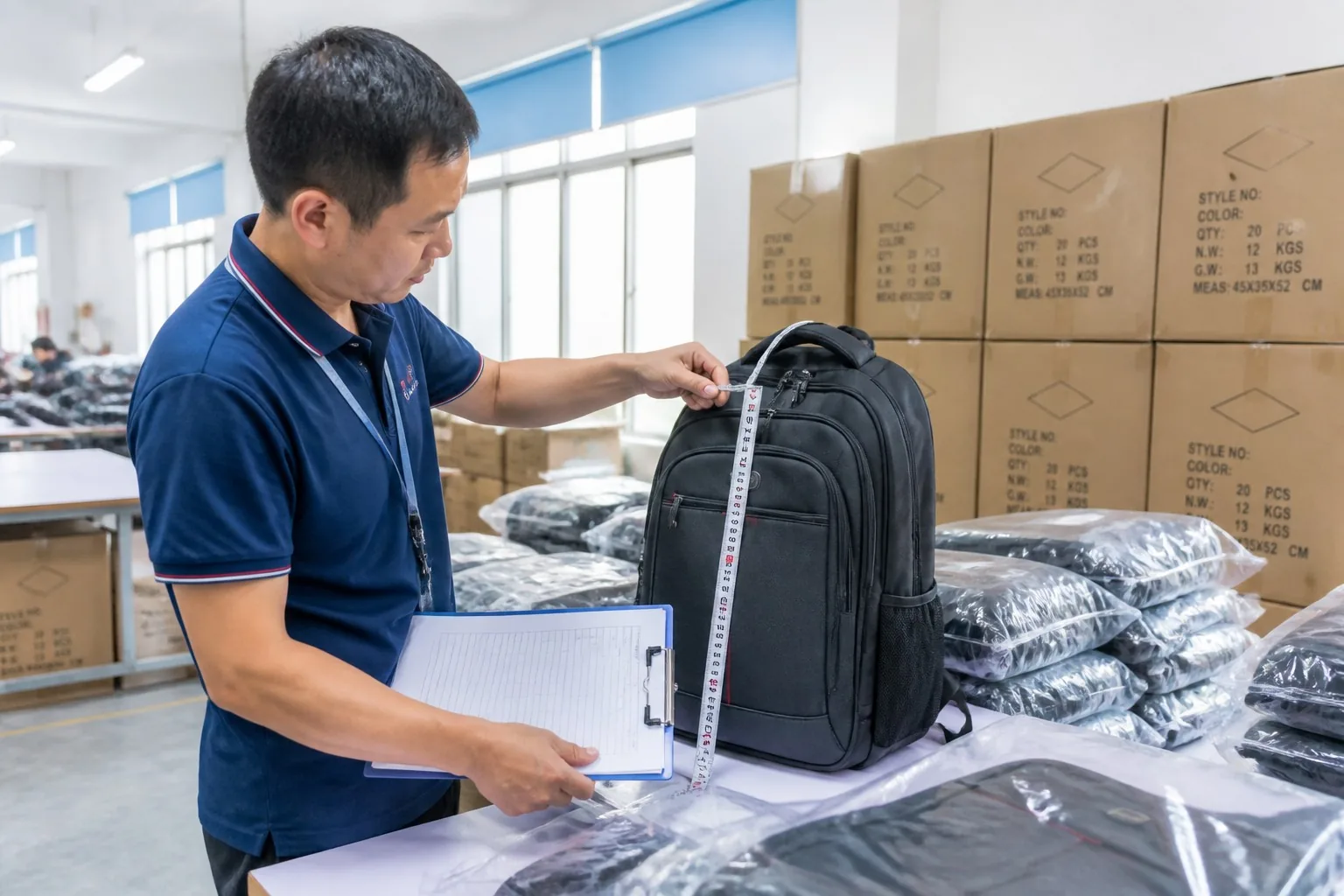
- Measure it — check dimensions against spec; do not judge by eye.
- Weigh it — fabric and hardware substitutions change weight; a spec deviation is a warning.
- Stress it — pull straps, zip repeatedly, load it, check bar-tacks.
- Check the details — stitch density, seam alignment, zipper function, hardware action, label placement.
- Document everything — take photos, write notes, and send clear feedback in one message (not scattered comments).
The Feedback Loop
The fastest sample cycles happen when the buyer gives complete, written feedback:
- Reference the sample and each specific issue (e.g., “strap length 3 cm too short”).
- Include photos or annotated images.
- Prioritize: must-fix vs nice-to-have.
- Set a clear deadline for the revised sample.
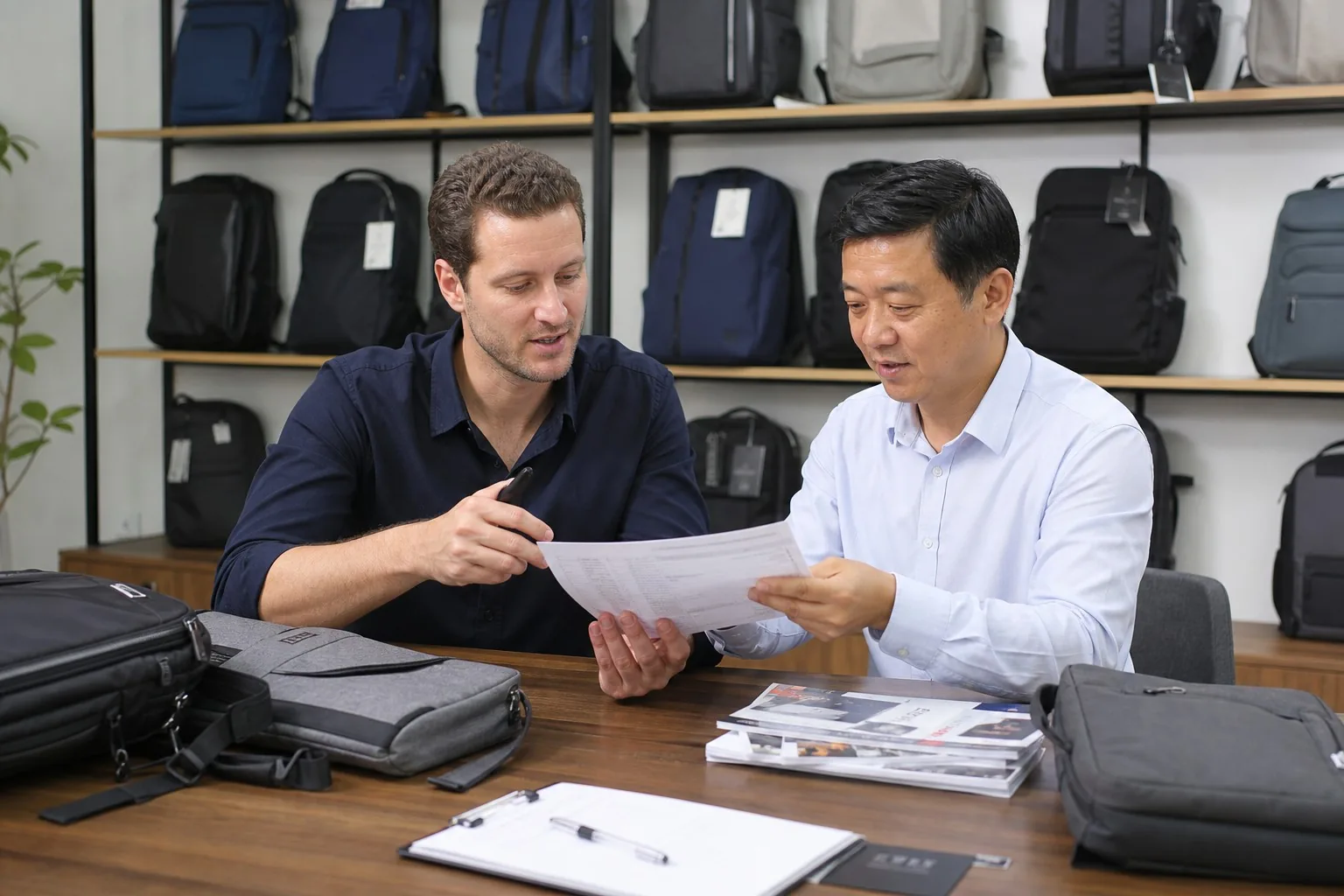
Step 4: The Production Agreement
Before production starts, the commercial terms should be locked in writing. Verbal agreements and WeChat promises are not contracts.
The Key Terms
- Price — FOB, CIF, or EXW basis, and what is included.
- Payment terms — typically 30% deposit with order, 70% balance against B/L copy; letters of credit for larger orders.
- Delivery date — a firm date with a realistic buffer, and consequences for delay.
- Specification sheet — the full technical spec attached to the order.
- Quality standards — AQL levels, test requirements, inspection protocol.
- Inspection — who inspects, when (mid-production, pre-shipment), and by whom (buyer, third-party).
- Claims and remedies — what happens with defects: repair, replacement, discount, or refund.
- Intellectual property — who owns the design and patterns, and exclusivity terms.
The Specification Sheet
The specification sheet is the backbone of the whole order. It should include:
- Product drawings with dimensions and tolerances
- Fabric specs (type, denier, GSM, color codes, coating)
- Hardware specs (brand, size, material, finish)
- Construction details (stitch density, seam allowances, bar-tack locations)
- Label and packaging requirements
- Test and compliance requirements
Manufacturer’s note: The factory that asks the most detailed questions before quoting is usually the factory that delivers. Detail in the spec sheet is not bureaucracy — it is the difference between a smooth production run and a stream of “we understood it differently” problems.
Step 5: Production and Quality Control
Once production starts, your involvement shifts from design to quality assurance.
In-Line vs Pre-Shipment Inspection
- In-line inspection (mid-production) — catches problems while they are cheap to fix. Best done at 30–50% of production, when most components are in work.
- Pre-shipment inspection (PSI) — the final gate before shipping, based on AQL sampling.
AQL in Simple Terms
AQL (Acceptable Quality Limit) sampling means inspecting a random sample and accepting or rejecting the lot based on the number of defects found. For backpack programs, a common standard is:
| Defect type | Typical AQL level |
|---|---|
| Critical (safety, function) | 0–1.0 |
| Major (visible defects, function issues) | 1.5–2.5 |
| Minor (cosmetic) | 4.0 |
What a Good Inspection Covers
- Quantity verification against the order
- Appearance (stains, shading, color match)
- Construction (stitch quality, bar-tacks, seam integrity)
- Function (zippers, buckles, straps, load test)
- Labels (brand, care, compliance, fiber content)
- Packing (polybag, carton, marks, moisture protection)
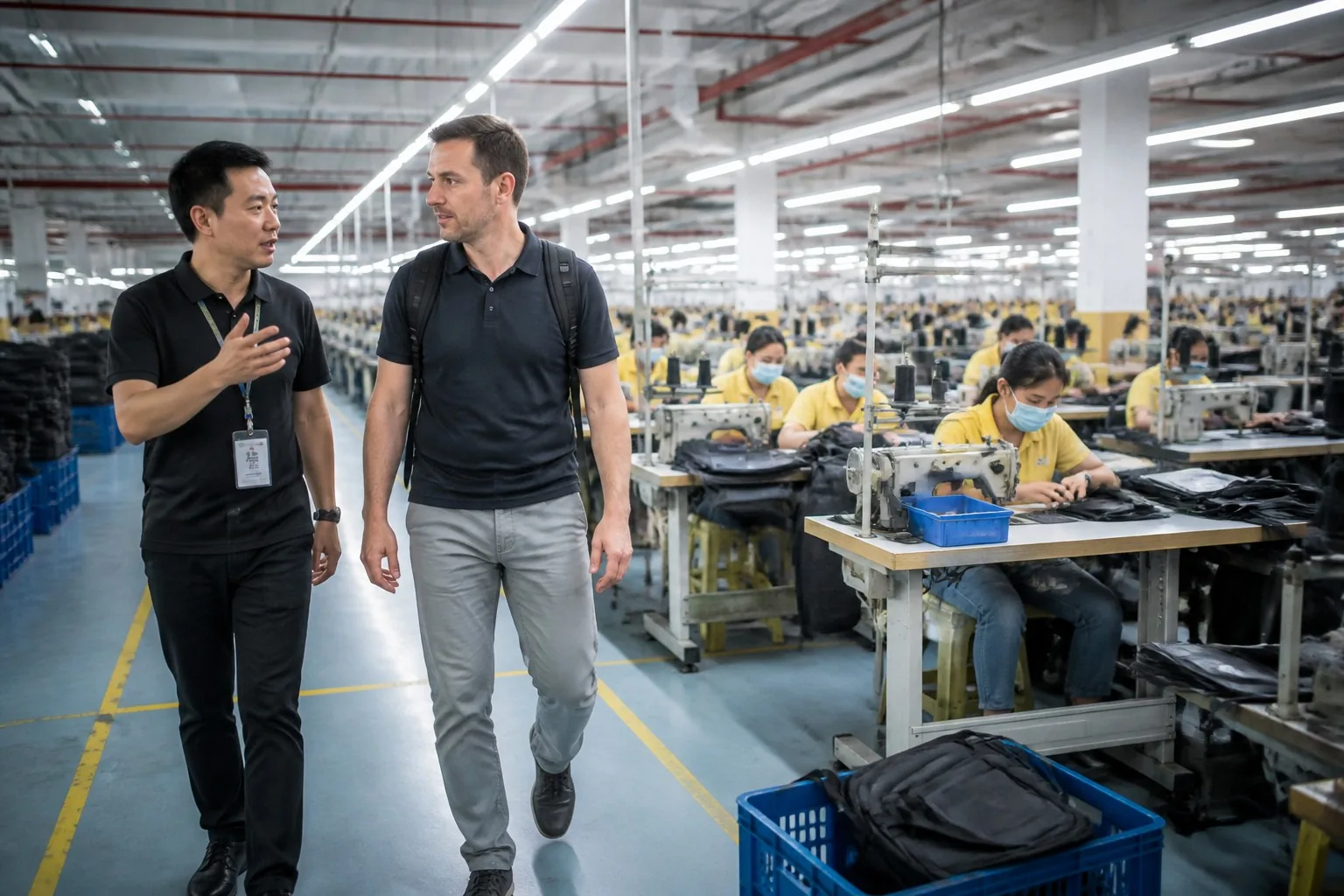
Step 6: Shipping, Documentation, and Payment
The last mile of the transaction has its own pitfalls.
Shipping Terms
| Term | Who pays freight | Who bears risk |
|---|---|---|
| EXW | Buyer | Buyer at factory gate |
| FOB | Buyer | Buyer once loaded on vessel |
| CIF | Seller | Buyer (seller pays freight + insurance) |
| DDP | Seller | Seller until delivered |
Choose terms that match your logistics capability. First-time importers often prefer FOB with their own freight forwarder for control and transparency.
Key Documents
- Commercial invoice
- Packing list
- Bill of lading (or air waybill)
- Certificate of origin
- Inspection reports
- Test certificates (fabric, compliance)
- Export license/declarations as required
Payment Protection
- T/T (bank transfer) — standard for mid-size orders; 30/70 is typical.
- L/C (letter of credit) — bank-backed; good for large orders, more paperwork.
- Escrow / trade assurance — platform-backed protection on marketplaces.
- Balance against documents — releasing the balance against B/L copy keeps leverage until shipment.
Cost Breakdown: Where Your Money Goes
To negotiate effectively, understand the cost structure of your product:
| Cost component | Typical share |
|---|---|
| Materials (fabric, hardware, zippers, packaging) | 45–60% |
| Labor (cutting, sewing, assembly) | 20–30% |
| Factory overhead (utilities, rent, admin) | 8–12% |
| QC and packing | 5–8% |
| Factory margin | 5–10% |
When a quote seems high, ask which line is driving it — the answer tells you where to negotiate. When a quote seems impossibly low, ask what is being cut; the answer is usually quality.
Common Mistakes Importers Make
Learning from others’ mistakes is cheaper than making them:
Mistake 1: Choosing on Price Alone
The cheapest quote usually is the cheapest for a reason. A $0.50 difference per unit disappears in the cost of one return shipment, one bad review, or one retail failure. Weigh the quote against the factory’s capability, communication, and track record.
Mistake 2: Skipping the Sample Stage
“The design is simple, we can go straight to production” is one of the most expensive sentences in importing. Every skipped sample stage moves the risk into the bulk run, where defects cost thousands of times more to fix.
Mistake 3: Changing the Spec Mid-Production
Spec changes during production cause confusion, rework, and disputes. If a change is essential, make it in writing with clear cost and timeline implications — and expect both to move.
Mistake 4: Not Understanding the MOQ Math
Asking “can you do 100 units?” when the factory’s MOQ is 500 is not a negotiation — it is asking the factory to lose money. Understand what drives the MOQ (tooling, setup, materials) and negotiate the package, not the number.
Mistake 5: Poor Documentation
Orders run on documentation. Without a written spec sheet, payment terms, and quality standards, every dispute becomes a he-said-she-said — and the party with the better documents usually wins, regardless of who is “right.”
Communicating Effectively with Your Factory
The quality of the relationship often determines the quality of the product. Factories are staffed by people, and clear, respectful communication gets better results than pressure and ambiguity.
The Communication Golden Rules
- One message, one topic — batch your feedback into a single structured message per issue. Scattered comments across days create confusion and rework.
- Write everything down — any decision that affects the product, price, or timeline goes into writing (email or a shared document), not just chat messages.
- Answer quickly — factories run on schedules; a delayed answer from the buyer delays the whole chain. Set response expectations at the start.
- Be specific, not emotional — “the zipper feels cheap” is a feeling; “the main zipper jams when opening with one hand, please switch to a #8 molded zipper with a YKK slider” is an instruction.
- Respect time zones and working days — a Chinese factory’s Friday evening is your decision point; plan around it for weekly deadlines.
- Learn the product vocabulary — knowing denier, GSM, bar-tack, and seam allowance earns respect and prevents misunderstandings. You do not need to be an expert — just literate.
The Weekly Rhythm That Works
A structured weekly rhythm keeps projects moving:
- Monday — receive the factory’s production status update and plan the week.
- Mid-week — send any decisions or feedback; factories confirm feasibility by Friday.
- Friday — lock the week’s decisions in writing; confirm the next week’s milestones.
Building a Long-Term Relationship
The best pricing, priority, and quality come from repeat business:
- Pay on time — the single strongest signal of a serious buyer.
- Give clear forecasts — share your pipeline so the factory can plan capacity; this earns scheduling priority.
- Share feedback after delivery — what sold well, what failed in the field; factories use this to improve and to trust you as a partner.
- Visit when you can — even one factory visit changes the relationship; you become a person, not an order number.
- Bring problems early — if sales are slow and you need to delay an order, say so early; factories can often accommodate with notice and appreciate the honesty.
Manufacturer’s note: Our best clients are not the ones who order the most — they are the ones who communicate clearly and pay on time. They get first access to new capacity, better scheduling flexibility, and honest advice on when a spec is over-engineered or a price is unrealistic. The relationship is the asset that compounds.
FAQ
What is the difference between OEM and ODM in backpack manufacturing?
OEM means you provide the design and the factory manufactures to your spec. ODM means the factory provides the design (or you customize one of their existing designs) and manufactures it. Semi-custom ODM — customizing a factory base design with your colors, fabrics, and branding — is the most common path.
What is a typical MOQ for custom backpacks?
Standard ODM products can start around 200–500 units. Fully custom OEM with new patterns and hardware typically requires 500–1,000+ units. The real driver is tooling and setup cost amortization — negotiate MOQ, unit price, and tooling as a package.
How long does the OEM/ODM process take?
Typical timeline: factory search and vetting 2–4 weeks, sampling 3–6 weeks, production 3–6 weeks, shipping 2–6 weeks. A complete first order from first contact to delivery usually takes 3–5 months. Plan ahead, especially for seasonal products.
Should I use a third-party inspection company?
For first orders and large orders, yes. A pre-shipment inspection (AQL-based) costs a fraction of the order value and verifies quantity, quality, and packing before your money and the container leave the factory. Consider mid-production inspection for complex products.
How do I protect my design when working with a factory?
Put IP ownership in the written agreement: the design and patterns are your property, the factory cannot produce the same design for other clients, and exclusivity terms apply for a defined period. For high-value designs, register your IP and use NDAs before sharing full specifications.
What payment terms are standard in backpack manufacturing?
The most common is 30% deposit with the order and 70% balance against the bill of lading copy. Letters of credit suit large orders. Trade assurance or escrow adds platform-backed protection on marketplace transactions. Never pay 100% upfront.
Conclusion
The OEM/ODM path to a backpack product is proven, but it rewards preparation. Choose the right model for your stage — OEM for full design control, ODM for speed, semi-custom for the best of both. Vet the factory properly, write complete specs, invest in the sample stages, lock the commercial terms in writing, and inspect before you pay the balance.
The importers who succeed are not the ones who find the cheapest factory — they are the ones who build the strongest process: clear specs, disciplined sampling, written agreements, and quality gates at every step. That process is what turns a factory relationship into a dependable supply chain.
If you are planning a backpack line, our team can walk you through the OEM and ODM options, show you our development process, and give you a transparent quote with a clear timeline — so you can see exactly what the journey looks like before you commit.