Pattern Making for Backpacks: How Is Fit Engineered Before Cutting?
Pattern Making for Backpacks: How Is Fit Engineered Before Cutting?
A backpack is designed on paper long before it is sewn. The pattern pieces decide where every seam falls, how the bag stands when it is empty, whether the shoulder straps sit flat or roll, how much fabric is consumed per unit, and whether a size run grows in a way a wearer will accept. None of those outcomes can be fixed at the sewing machine.
This guide covers pattern making and grading from a backpack manufacturer’s perspective: why the pattern is the decision point in a bag programme, how a pattern set is developed from a design, how digital pattern making changes the workflow, how sizes are graded, how panels are engineered for construction, how markers affect fabric yield, how samples and fit are approved, and how pattern files are controlled and archived.
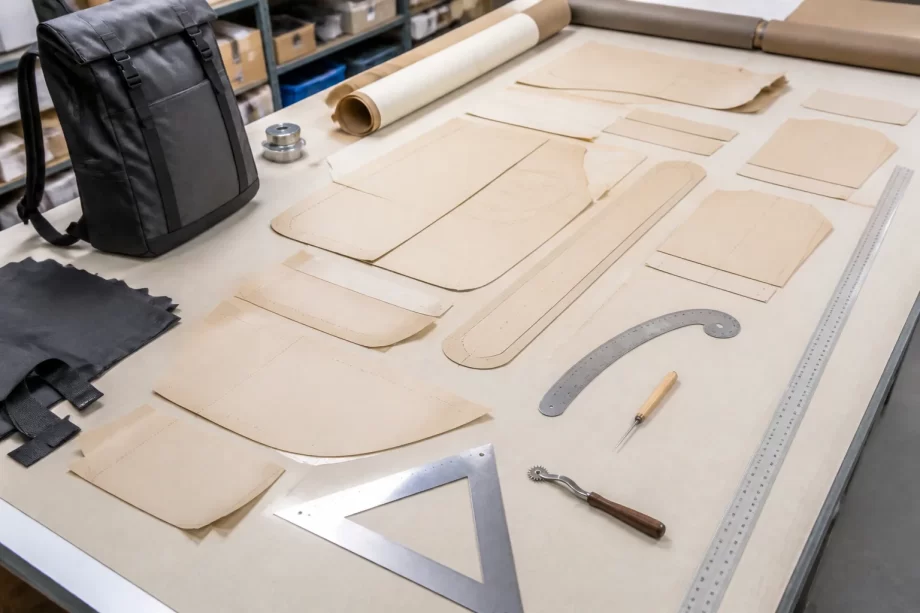
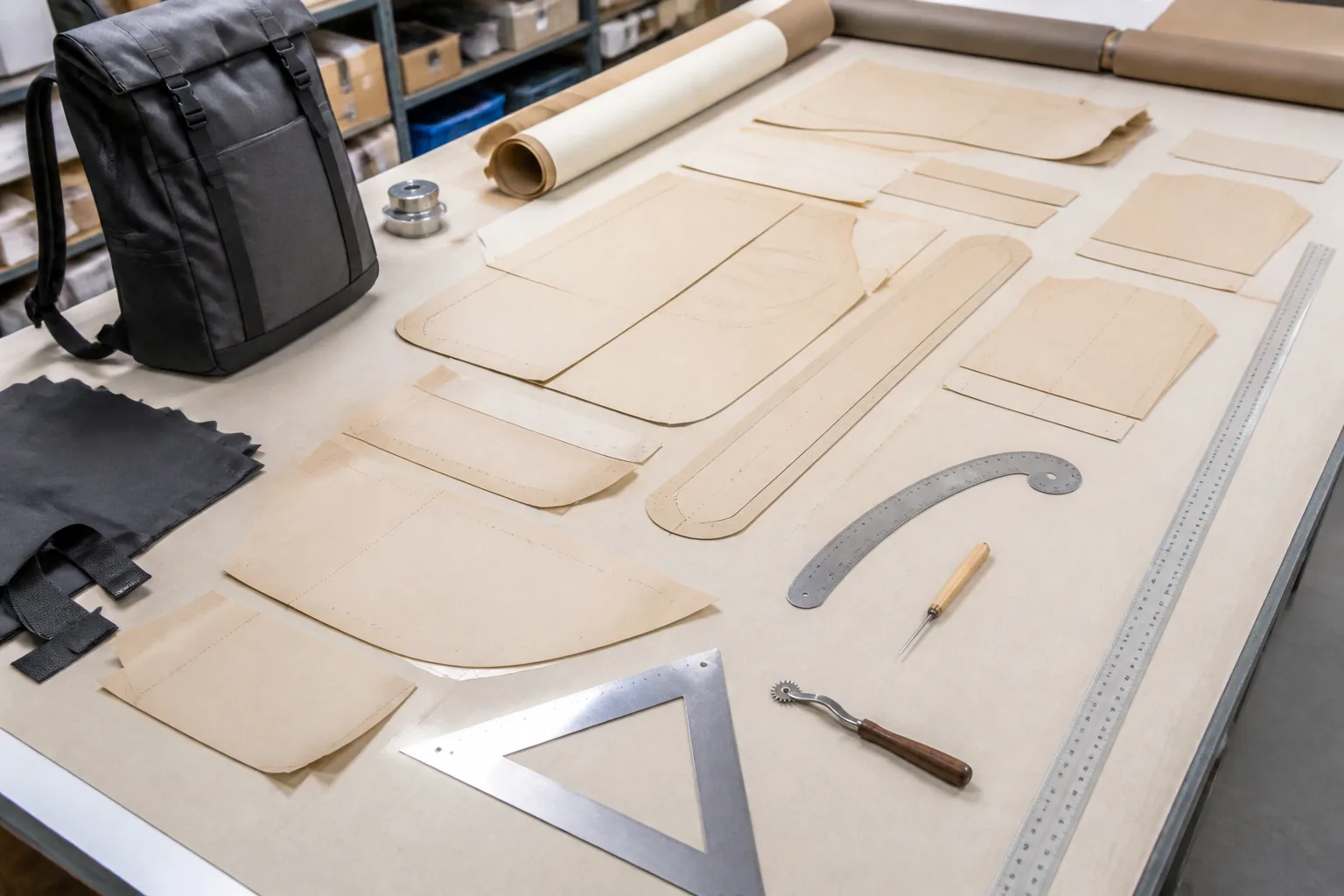
Pattern pieces for a backpack laid out on a pattern making bench with drafting tools
Pattern making sits between design and production, which is why it is the most common source of late and expensive changes. A revision at the drawing stage costs a discussion, a revision at the pattern stage costs a day, and a revision after tooling, dyeing, and cutting has started costs a programme.
The pattern is not a translation of the design; it is the point at which the design becomes manufacturable. Several properties a buyer experiences are decided here and cannot be corrected later.
The Decision Table
Property
Decided by
Silhouette
Panel shapes
Volume
Panel dimensions and gusset
Strap comfort
Strap curve and pad shape
Bag stability
Base panel and reinforcement
Fabric consumption
Panel area and marker
Sewing difficulty
Seam placement and curvature
The Cost of Error Table
Stage
Cost of change
Sketch
Hours
Pattern
Days
Sample
Weeks
Tooling and dies
Significant
Production
Programme risk
After shipment
Claim
The Ownership Table
Function
Responsibility
Design
Intent and proportion
Pattern
Manufacturability
Engineering
Construction method
Sampling
Fit and function
Production
Consistency
Quality
Conformance
The Input Table
Input
Source
Design drawing
Designer or buyer
Dimension specification
Buyer
Material data
Fabric and trim supply
Construction standard
Factory engineering
Target cost
Commercial team
Reference sample
Buyer or benchmark
The Constraint Table
Constraint
Effect on the pattern
Fabric width
Panel placement and seams
Fabric stretch
Panel allowance
Coating stiffness
Seam feasibility
Zipper availability
Panel length limits
Hardware size
Panel and pocket dimensions
Machine capability
Curvature and layer count
The Quality Attribute Table
Attribute
Pattern contribution
Symmetry
Mirrored panels
Balance
Panel proportions
Comfort
Strap and back panel shape
Access
Opening placement
Durability
Stress point reinforcement
Appearance
Clean silhouette
The Pattern Development Workflow
Pattern development follows a sequence that moves from intent to a set of cuttable pieces, and each stage has a defined output that the next stage depends on.
The Workflow Table
Stage
Output
Design analysis
Understood intent
Block development
Base pattern
Style development
Styled panels
Construction review
Sewing sequence
Mock-up
Physical check
Final pattern set
Approved pieces
The Analysis Table
Question
Why it matters
What is the bag for?
Drives structure
What load will it carry?
Drives reinforcement
What is the target volume?
Drives dimensions
Which materials are fixed?
Drives allowances
What is the price point?
Drives complexity
Which market is it for?
Drives size range
The Block Table
Block element
Function
Body block
Base silhouette
Gusset block
Depth and volume
Lid or flap block
Closure
Strap block
Carrying system
Base block
Stability and wear
Pocket block
Access and organisation
The Allowance Table
Allowance
Applied for
Seam allowance
Joining panels
Turn of cloth
Fabric thickness
Shrinkage
Finishing and washing
Stretch recovery
Knit and elastic
Coating thickness
Sealed seams
Trim bulk
Binding and piping
The Mock-up Table
Purpose
Method
Check proportion
Paper or card build
Check volume
Non-woven assembly
Check fit
Wearer trial
Check construction
Sewn prototype
Check materials
Actual fabric trial
Check cost
Time and consumption
The Handoff Table
To
What is passed
Engineering
Panel set and sequencing
Sampling
Cuttable pieces
Costing
Consumption and labour
Production
Approved pattern
Quality
Measurement points
Archive
Versioned files
Digital Pattern Making and CAD
Digital pattern making replaces paper handling with files that can be edited, graded, nested, and archived without redrawing. The benefit is not only speed but the ability to keep every derived size exactly consistent with the base pattern.
Pattern technician digitising and editing backpack panels at a CAD workstation
The Digital Workflow Table
Step
Activity
Digitising
Existing pattern into the system
Drafting
Building from measurements
Editing
Adjusting the base pattern
Grading
Generating the size run
Nesting
Marker creation
Output
Plotting or cutting files
The System Capability Table
Capability
Benefit
Parametric rules
Consistent adjustment
Grading tables
Repeatable size growth
Nesting engine
Reduced waste
Seam library
Standard allowances
Version history
Traceability
Measurement export
Specification alignment
The Paper Versus CAD Table
Aspect
Paper
CAD
Amendment
Redraw or patch
Edit and re-issue
Grading
Manual, error-prone
Rule-based
Storage
Physical, damage risk
Digital, versioned
Sharing
Copies diverge
Single source
Consumption
Estimated
Calculated
Marker
Manual nesting
Optimised
The Data Table
Data
Use
Base measurements
Pattern drafting
Grading increments
Size run
Seam allowances
Construction
Fabric width
Nesting
Shrinkage factors
Final sizing
Consumption
Costing
The Risk Table
Risk
Control
Wrong file used
Version control
Uncontrolled edit
Approval workflow
Grading error
Rule validation
Plot scale mistake
Calibration check
Missing piece
Set checklist
Data loss
Backups and archive
The Output Table
Output
Recipient
Plotter drawings
Sample room
Cutting files
Cutting or die making
Measurement chart
Quality and buyer
Consumption report
Costing
Marker file
Cutting floor
Archive record
Pattern library
Manufacturer note: Digital pattern making produces its clearest return on a programme with a size run and a repeat order. On a single-size bag made once, paper is often faster, and a factory that converts everything to CAD for its own sake adds cost without benefit. The value appears at the second and third repetition, when a file can be re-issued with a corrected allowance in minutes instead of being redrawn, and when every graded size can be regenerated from the same rules rather than being rebuilt by hand by whoever happens to be available.
Grading Across Sizes
Grading is the systematic enlargement and reduction of a base pattern, and it is described by rules that must hold for every piece in the set. A size run is graded well when the proportion is preserved and poorly when a bag simply becomes a scaled photograph with distorted curves.
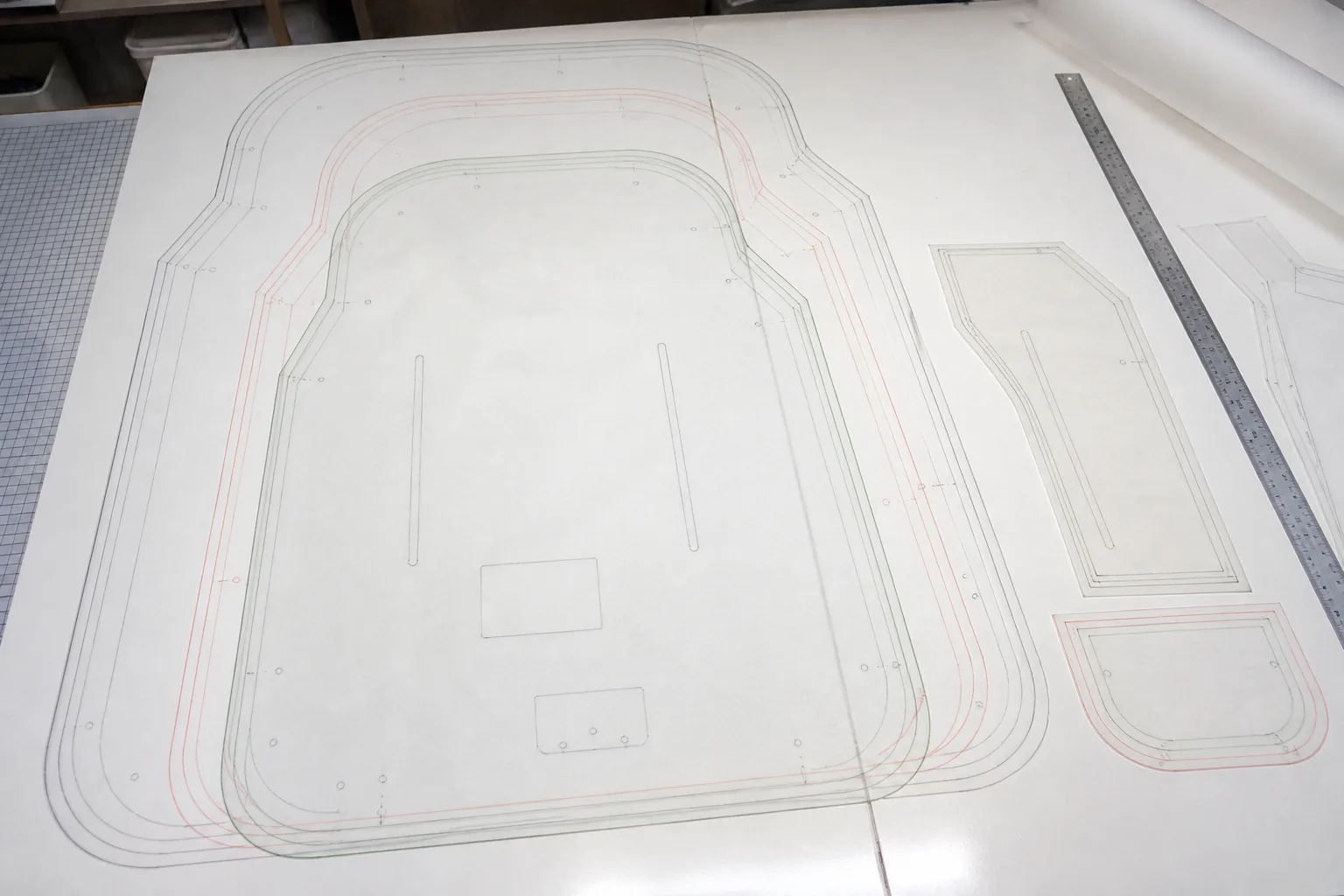
Nested graded pattern pieces for a backpack in three increasing sizes on a cutting table
The Grading Concept Table
Concept
Meaning
Base size
Reference pattern
Grade rule
Increment per size
Grade point
Where the change is applied
Increment
Amount of change
Rule set
Full set of increments
Nested set
All sizes together
The Increment Table
Dimension
Typical behaviour
Width
Increases moderately
Height
Increases more than width
Depth
Increases least
Strap length
Adjustable, limited change
Opening
Matches the body
Pocket
Follows the panel
The Grading Approach Table
Approach
Suited to
Linear grading
Regular shapes
Two-dimensional grading
Panels with width and height
Break grading
Multiple size groups
Point grading
Irregular curves
Proportional grading
Similar styles
Manual grading
Complex or unique pieces
The Distortion Table
Fault
Cause
Stretched curves
Uniform increments on a curved panel
Lost proportion
Independent grading of related pieces
Mismatched seams
Different rules on adjoining panels
Strap drift
Ignored attachment position
Hardware mismatch
Unchanged trim with changed panel
Zipper length error
No corresponding tape grading
The Joint Table
Joint
Requirement
Side seams
Equal lengths after grading
Base to body
Matching perimeter
Strap to body
Attachment points aligned
Zipper to opening
Graded consistently
Lining to shell
Same rules applied
Pocket to panel
Position preserved
The Verification Table
Check
Method
Seam matching
Measure joined lengths
Perimeter match
Sum panel edges
Curve integrity
Visual and template check
Attachment alignment
Overlay check
Measurement chart
Confirm against spec
Sample size trial
Sewn check
The Range Table
Range
Consideration
Single size
No grading required
Two to three sizes
Simple increments
Four to six sizes
Rule validation needed
Wide range
Break grading likely
Children’s sizes
Different proportions
Special sizes
May need separate patterns
Panel Engineering and Construction
A pattern can be geometrically correct and still be difficult or impossible to sew. Panel engineering reconciles the shape the designer wants with the way the bag is actually assembled.
The Construction Table
Method
Where used
Flat sewn then turned
Simple panels
Sewn and bound
Visible seams
Laminated then cut
Coated fabric
Welded or sealed
Waterproof
Molded base
Structured bags
Panelled assembly
Complex shapes
The Panel Table
Panel
Engineering focus
Front
Opening and pocket placement
Back
Padding and ventilation
Base
Wear and rigidity
Side gusset
Depth and access
Lid or flap
Closure and coverage
Strap
Curve and load path
The Stress Table
Point
Reinforcement
Strap attachment
Bar tacks and webbing
Handle
Multi-layer tacking
Zipper ends
Reinforcement patch
Base corners
Layered material
Load bearing seam
Double stitching
Hardware anchor
Backing patch
The Seam Table
Seam
Application
Plain seam
Flat panels
Bound seam
Thin materials
Lapped seam
Coated fabric
Flat felled
Strength and finish
Double stitched
Stress areas
Box-X stitch
Strap ends
The Feasibility Table
Issue
Design response
Tight radius
Increase radius or split the seam
Multiple layers
Redistribute bulk
Seam over hardware
Move the hardware
Curved zipper
Adjust the panel or use a knit tape
Thin material
Reduce layer count
Thick coating
Avoid turning
The Tolerance Table
Dimension
Tolerance consideration
Overall height
Material and process
Overall width
Cutting and sewing
Depth
Gusset assembly
Strap length
Adjustment range
Pocket position
Alignment
Hardware position
Template accuracy
Manufacturer note: Grading errors rarely announce themselves at the pattern table. They appear in the sample room as a strap that no longer meets the body panel cleanly, or on the cutting floor as a zipper whose tape is the wrong length for a graded opening. The practical defence is to grade the whole set together, including lining, pocket, and zipper tape, and then to verify seam matching by measurement before any sample is cut. A graded set that has never been seam-checked is a set that will be checked by the first sewers who receive it.
Manufacturer note: The most frequent pattern revision in a bag programme is not aesthetic. It is a panel that cannot be sewn at the specified radius on the specified machine with the specified number of layers. Reviewing each new shape against the factory’s actual capability, before the pattern is released for sampling, converts a sample-room discovery into a pattern-table adjustment and saves a full sampling round.
Markers, Cutting Efficiency and Yield
The pattern determines how much fabric a bag consumes, but the marker determines how much is wasted. Two factories making the same bag from the same pattern can differ by several percentage points in consumption purely through the way pieces are nested on the fabric.
The Yield Table
Term
Meaning
Marker
Layout of pieces on fabric
Nesting
Arranging pieces to minimise waste
Utilisation
Proportion of fabric used
Yield
Units per metre
Waste
Unused fabric
Consumption
Fabric per unit
The Marker Factor Table
Factor
Effect on waste
Panel shape
Curved pieces waste more
Fabric width
Wider allows better nesting
Directional restriction
Limits rotation
Pattern repeat
Constrains placement
Size mix
Affects the marker
Quantity
Longer markers use better
The Directional Table
Material
Restriction
Woven with nap
One direction only
Coated fabric
Pattern and grain aligned
Printed fabric
Repeat and direction
Mesh
Directional stretch
Webbing
Lengthwise only
Foam
Usually unrestricted
The Comparison Table
Approach
Character
Manual nesting
Flexible, operator dependent
Software nesting
Consistent, optimised
Single-size marker
Simple, higher waste
Multi-size marker
Better utilisation
Single-layer cutting
Precise, slower
Multi-layer cutting
Fast, height limited
The Waste Table
Source
Reduction
Poor nesting
Marker optimisation
Offcuts
Small-part reuse
Edge trim
Width selection
Defects
Inspection before cutting
Wrong direction
Clear nesting rules
Overcut
Accurate measurement
The Consumption Table
Driver
Note
Panel area
Determined by pattern
Seam allowance
Determined by construction
Marker efficiency
Determined by nesting
Fabric width
Determined by supply
Size mix
Determined by order
Tolerance
Determined by cutting accuracy
The Cost Impact Table
Change
Effect on annual fabric spend
Panel widened
Higher consumption
Marker improved
Lower waste
Size mix changed
Different utilisation
Fabric width changed
Re-nesting required
Seam allowance reduced
Lower consumption
Offcut reuse introduced
Waste recovered
A pattern decision and a purchasing decision meet in the marker. When a panel is widened, a seam allowance is added, or a sizes mix shifts toward larger units, the fabric bill moves with it, and the movement is invisible unless consumption is tracked per size rather than per order.
The Record Table
Record
Purpose
Marker file
Reproducibility
Consumption per size
Costing
Utilisation percentage
Efficiency tracking
Waste quantity
Cost visibility
Fabric batch
Traceability
Cut quantity
Production control
Manufacturer note: A pattern revision that adds two centimetres to a panel edge is rarely discussed in terms of fabric cost, and it should be. On a bag produced in tens of thousands of units a year, a small increase in panel area compounds through the marker into a measurable annual spend. Pattern changes are therefore commercial changes, and the consumption figure should be recalculated and recorded whenever a panel is altered, not estimated from the previous version.
Sample Development and Fit Approval
Sampling exists to prove the pattern, and the sample room is where geometric intent meets the behaviour of actual materials. A pattern that measures correctly on paper can still produce a bag that hangs badly, sits uncomfortably, or cannot be sewn at the specified tolerance.
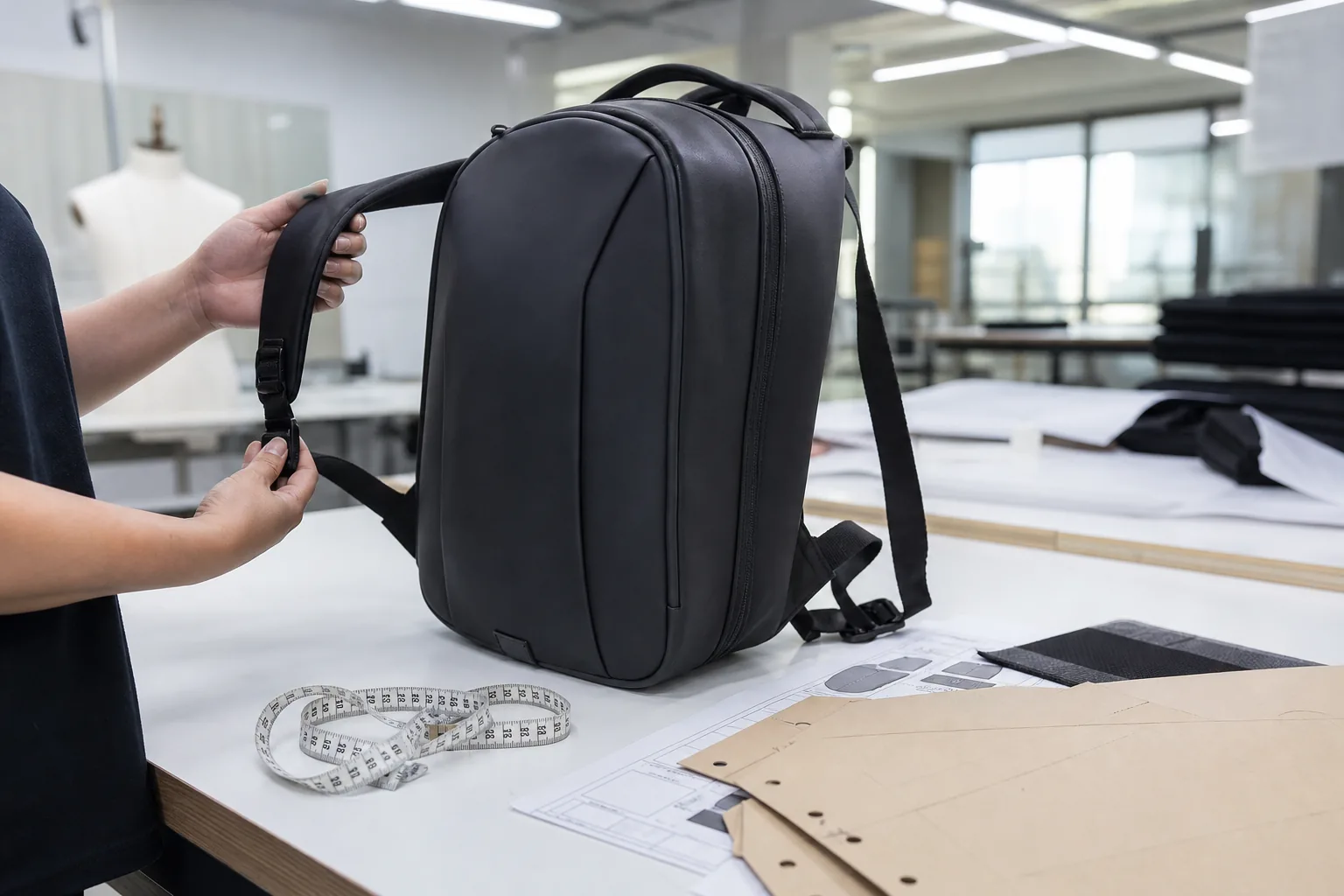
A first fit sample backpack on a sample room table with measuring tape and specification sheets
The Sample Stage Table
Stage
Purpose
Prototype
Prove concept
Fit sample
Prove dimensions
Construction sample
Prove sewing
Pre-production sample
Prove the line
Golden sample
Reference standard
Shipment sample
Verify production
The Fit Criteria Table
Criterion
Check
Volume
Meets the specification
Balance
Sits correctly when loaded
Strap position
Comfortable and stable
Back panel
Contact and ventilation
Opening
Reachable and adequate
Proportion
Meets the design intent
The Measurement Table
Point
Verified
Overall height
Against specification
Overall width
Against specification
Depth
Against specification
Strap length
Within the adjustment range
Pocket position
Against the drawing
Hardware position
Against the drawing
The Trial Table
Trial
Method
Wearer test
Loaded carry trial
Load test
Specified weight
Sewing trial
Full assembly
Material trial
Actual production fabric
Hardware trial
Functional cycling
Cost trial
Time and consumption
The Feedback Table
Source
Input
Buyer
Fit and appearance
Designer
Proportion and detail
Sample room
Construction difficulty
Production
Line feasibility
Quality
Measurability
Costing
Consumption accuracy
The Revision Table
Revision type
Typical cause
Dimensional
Fit outside tolerance
Structural
Reinforcement insufficient
Construction
Line not feasible
Material
Behaviour differs from trial
Trim
Hardware or zipper mismatch
Aesthetic
Proportion not accepted
The Approval Table
Item
Confirmed by
Pattern set
Pattern and engineering
Measurements
Quality and buyer
Construction
Production
Materials
Sourcing
Colour and trim
Buyer
Reference sample
Sealed and archived
Manufacturer note: The fit sample is the cheapest place in the entire programme to discover a problem, and the fitting table is therefore worth attention disproportionate to its size. A factory that brings the pattern maker, the sample sewer, and the production supervisor to the same review will surface construction and line-feasibility issues in the same meeting that the buyer reviews the fit, and can decide on revisions before the sample is repeated. A factory that sends the sample out for comment and waits converts a half-day review into a two-week exchange.
Pattern Files, Versions and Control
A pattern is a controlled document. Once a bag is in production, the pattern in use defines the product, and an uncontrolled copy circulating in the sample room or the cutting floor will eventually produce a unit that does not match the approved sample.
The Version Table
Element
Content
Version number
Sequential identifier
Date
Issue date
Author
Who changed it
Reason
What changed
Approval
Who authorised it
Effect
Which sizes and orders
The Storage Table
Format
Consideration
Digital master
Single source of truth
Plotted copy
Controlled and stamped
Physical master
Sealed reference
Backup
Separate location
Access
Restricted to authorised
Retention
Programme plus defined period
The Distribution Table
Recipient
What they receive
Sample room
Current plot
Cutting floor
Marker and consumption
Quality
Measurement chart
Sourcing
Trim and material list
Costing
Consumption figures
Buyer
Approved measurement chart
The Control Risk Table
Risk
Consequence
Outdated copy in use
Non-conforming production
Unrecorded change
Untraceable defect
Duplicate versions
Confusion and rework
Missing page
Incomplete panel set
Unauthorised edit
Unapproved product change
Lost archive
Inability to repeat
The Change Table
Change
Approval needed
Allowance adjustment
Pattern and engineering
Panel dimension
Buyer if specified
Grading rule
Pattern and buyer
Construction change
Engineering and production
Material-driven change
Sourcing and engineering
Trim change
Buyer and quality
The Audit Table
Check
Frequency
Version list current
Per issue
Floor copy matches master
Periodic
Measurement chart current
Per revision
Archive complete
Per programme
Backup verified
Scheduled
Access list reviewed
Periodic
The Archive Value Table
Situation
Archive benefit
Repeat order
Exact reproduction
Colour extension
Same fit retained
Size extension
Grading reused
Claim investigation
Traceable decision
Pattern maker departure
Knowledge retained
Benchmarking
Comparison possible
Manufacturer note: The most common pattern failure in an established factory is not a drafting error but a version error. A revised panel is issued, the sample room uses the new plot, the cutting floor still holds the previous one, and the first indication of the problem is a shipment that measures correctly at the sample stage and incorrectly at the carton. The control that prevents it is unglamorous: one master, a version number visible on the plot, the previous copy withdrawn rather than left in circulation, and a signature against the change.
The Pattern and Grading Checklist
Design and Inputs
Item
Done
Design intent understood
☐
Target volume agreed
☐
Size range defined
☐
Materials confirmed
☐
Construction standard available
☐
Target cost understood
☐
Pattern Development
Item
Done
Block developed
☐
Style panels drafted
☐
Allowances applied
☐
Shrinkage factored
☐
Mock-up built
☐
Panel set completed
☐
Grading
Item
Done
Base size fixed
☐
Increments defined
☐
Whole set graded together
☐
Seam lengths verified
☐
Attachment points checked
☐
Measurement chart issued
☐
Construction Feasibility
Item
Done
Machine capability reviewed
☐
Curvature within limits
☐
Layer count acceptable
☐
Stress points reinforced
☐
Seam sequence defined
☐
Tolerances set
☐
Cutting and Yield
Item
Done
Marker created
☐
Utilisation recorded
☐
Consumption per size calculated
☐
Directional rules respected
☐
Waste quantity tracked
☐
Cost updated
☐
Sampling and Approval
Item
Done
Fit sample measured
☐
Wearer trial completed
☐
Construction proven
☐
Pre-production sample passed
☐
Golden sample sealed
☐
Buyer approval recorded
☐
Control and Archive
Item
Done
Version number issued
☐
Master stored
☐
Floor copies updated
☐
Old copies withdrawn
☐
Backup verified
☐
Archive complete
☐
The Eight Rules
Rule
Reason
Settle the pattern before tooling
Changes become expensive downstream
Grade the whole set together
Partial grading breaks seam matching
Verify seam matches by measurement
Errors surface at the machine otherwise
Review every shape against machine capability
Feasibility is a pattern decision
Recalculate consumption after any panel change
Pattern changes are cost changes
Hold the fit review with all functions present
Cheapest place to find problems
Keep one master with a visible version
Prevents floor copies diverging
Seal a golden sample at approval
Defines what production must match
Manufacturer note: Pattern knowledge in most factories sits with two or three people, and it leaves when they leave. The practical mitigation costs little: keep the reasoning with the file. A note explaining why an allowance was increased, why a radius was relaxed, or why a strap block was moved onto a shorter curve preserves the decision for the next person who opens the pattern, and turns an archive from a folder of shapes into a record of how the product was actually engineered.
FAQ
What is the difference between a block pattern and a production pattern?
A block is the plain working shape of a bag without styling, closures, or pockets, and it exists to establish proportion and basic fit. A production pattern is the block plus every styled element, with seam allowances, turn of cloth, shrinkage allowances, and the full panel set that includes lining, interfacing, pocket pieces, and any reinforcement. A factory that issues a styled pattern directly from a drawing without developing a block tends to carry an unstable base, which shows up later as small dimensional drifts every time a related style is developed from the same shape.
How many sizes should a backpack programme grade?
It depends on the market, but the practical principle is that grading works well over a moderate range and increasingly poorly as the range widens, because the underlying body proportions change. Most backpack programmes grade four to six sizes comfortably from a single base. Beyond that, break grading becomes advisable, which means grading within size groups rather than across the whole range in one rule set, and beyond a certain point the honest answer is a second base pattern rather than a long rule set that no longer represents a wearer.
Why does a graded bag look wrong even though the measurements match?
Because measurements match while proportion has drifted. Grading applies increments to edges and curves, and if a curved panel receives uniform increments in both directions it will enlarge rather than grow in proportion, so the bag becomes wider than it should be relative to its height. The same effect appears when related pieces are graded independently: the body gains depth while the gusset does not, or a strap attachment point moves while the strap block stays fixed. Looking wrong while measuring correctly is the signature of a grading rule that was applied to shapes rather than to structure.
Can we grade a pattern ourselves if the factory only made one size?
You can, but the quality of the result depends entirely on whether the increments are defined deliberately. Making a size run by multiplying dimensions will produce three bags and one stretched photograph. A proper grading pass defines an increment per grade point, checks that adjoining panels still match along their seams, confirms that the attachment points for straps and hardware remain aligned, and verifies the whole run against a measurement chart before a single sample is cut. The verification step is the part that is usually skipped and the part that decides whether the run is usable.
Does digital pattern making always beat paper?
No, and treating it as an automatic upgrade is a common mistake. For a single-size bag made once, paper is often faster, because drafting a simple set by hand takes less time than digitising an existing shape and building the parameters. Digital pattern making earns its place through editing, grading, nesting, and archiving, which means its value scales with repetition and with the size of the range. On a programme with a size run, a repeat order, and periodic revisions, the ability to re-issue a corrected pattern in minutes instead of redrawing it is substantial.
How much does a pattern change really cost?
More than the change itself, because the cost is the sum of everything that has to move. A panel dimension change may require a new marker, a new consumption figure, an updated cost, a revised measurement chart, a new sample, and a new buyer approval, and it may also invalidate a die or a cutting template that has already been made. The pattern change is therefore priced at the most expensive stage it touches, not at the pattern table. This is the practical reason the pattern should be settled before tooling, and the reason consumption should be recalculated rather than estimated after any panel is altered.
What causes a first sample to fail fit most often?
Usually a mismatch between the pattern and the material rather than a drafting error. A bag pattern developed and trialled on a stable woven fabric behaves differently in a coated fabric that does not compress at the seam, or in a knit that stretches when loaded. The second most common cause is a strap block that was developed on a flat plane and does not sit flat on a curved back panel. Both are resolved by building the mock-up in the actual production material rather than in a convenient substitute, which is why a material substitution late in development is often more disruptive to fit than a design change.
How should pattern files be archived?
One digital master, sealed and access-controlled, with a version number, an issue date, a named author, the reason for the change, and the approval recorded against it. Plotted copies for the sample room and the cutting floor should carry the version number visibly, and the previous version should be withdrawn from circulation rather than left available, because a floor copy that stays in reach is a floor copy that will eventually be used. A physical master of the approved pattern, sealed alongside the golden sample, gives a reference that does not depend on the file server, and the whole set should be retained for a defined period after the programme ends.
Conclusion
Pattern making is the stage where a bag stops being a drawing and starts being a set of manufacturing decisions, and almost every expensive change in a bag programme traces back to something that was decided or left undecided on the pattern table. The silhouette, the volume, the comfort of the straps, the stability of the base, the fabric consumption, and the difficulty of sewing are all fixed there, and none of them can be repaired at the machine.
The work divides into four disciplines. The first is development: build a block before styling, understand the end use and the load, apply allowances for seams, cloth thickness, and shrinkage, and prove the shape with a mock-up in the actual material.
The second is grading: define increments deliberately per grade point, grade the whole set together including lining and zipper tape, and verify seam matching by measurement before anything is cut, because a graded set that has never been seam-checked will be checked by the first sewers who receive it.
The third is feasibility and yield. Every new shape should be reviewed against what the machines and operators can actually do at the specified number of layers, and the marker efficiency and consumption figure should be recalculated and recorded whenever a panel changes, because a pattern change is also a cost change.
The fourth is control: one master, a visible version number on every plot in use, the previous version withdrawn, the reason for each change recorded, and the reasoning kept with the file so that the knowledge survives the person who made the decision.
For buyers, the practical questions are whether a block was developed before styling, whether the size run was graded as a set and verified by measurement, whether the consumption figure reflects the current pattern, and whether the approved pattern is versioned and sealed against a golden sample.
For factories, the return is the same in every programme: fewer sampling rounds, fewer line-side surprises, predictable consumption, and a repeat order that reproduces the original bag exactly rather than approximately.