Retail Packaging Requirements: How Do Bag Suppliers Meet Them?
Retail Packaging Requirements: How Do Bag Suppliers Meet Them?
A backpack leaves the factory in a carton, but it arrives on a shelf inside a package that carries the brand’s promise. The carton protects it through transit; the retail packaging sells it, identifies it, and increasingly has to satisfy requirements about what it is made of and what happens to it after the customer takes the bag home.
For a bag manufacturer, retail packaging is the part of the order where the buyer’s requirements are most detailed and least forgiving.
A hangtag printed with the wrong barcode stops a shipment at the retailer’s distribution centre. An inner pack that is twenty grams heavier than the buyer’s sustainability limit fails an audit. A polybag without the required warning cannot be placed on a shelf in some markets at all. None of these are manufacturing defects, and all of them can hold up a delivery.
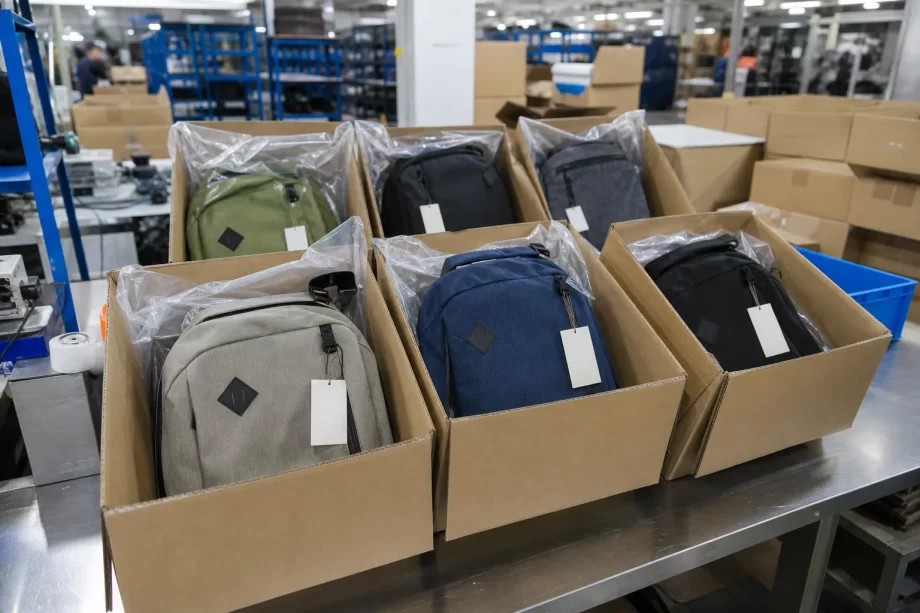
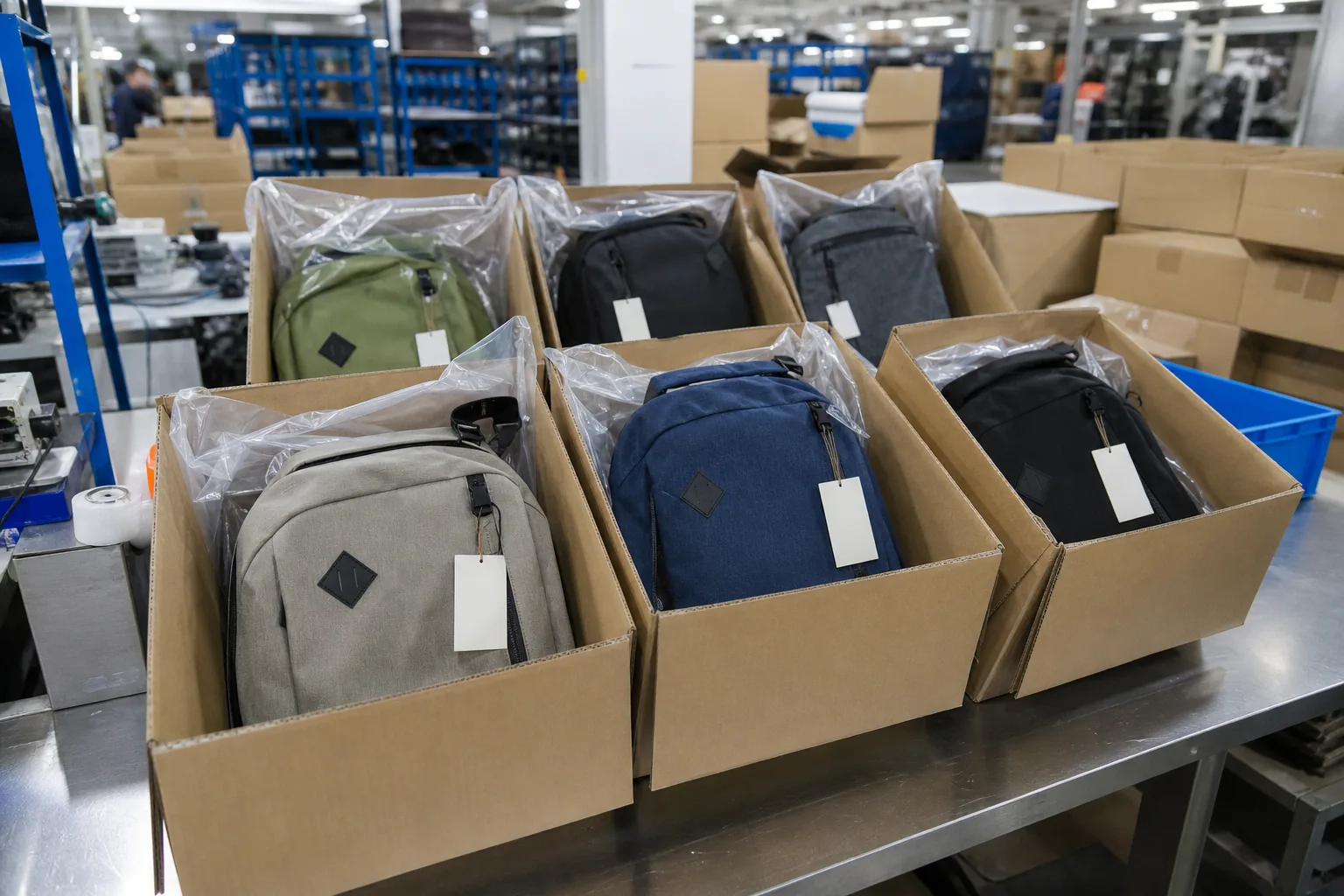
Finished backpacks packed in retail-ready cartons on a packing bench
This guide covers retail packaging and shelf-ready requirements from a bag manufacturer’s perspective: what the packaging has to achieve, how each component is specified, and how hangtags and barcodes are controlled.
It then covers how inner packs and cartons are configured for the retail and e-commerce channels, how packaging is tested for transit protection, how sustainability and compliance requirements are met, and how the specification is approved and documented. It closes with where packaging programmes most often fail.
Packaging is the only part of a bag that performs a function for two different customers: the retailer in the supply chain and the consumer in the store. Each has requirements, and they do not always point in the same direction.
The Function Table
Function
Requirement
Protect
Survive transit and handling
Identify
Correct product and variant
Inform
Care, materials, compliance
Display
Attractive on shelf or online
Secure
Prevent theft and tampering
Comply
Meet market regulations
Ship
Fit the retail or parcel channel
The Two-Customer Table
Requirement
Retail channel
E-commerce channel
Protection level
Carton and pallet
Parcel handling
Display
Shelf and hang
Photograph and unbox
Labelling
Shelf-edge and packaging
Parcel and returns label
Security
Tag or lock
Packaging integrity
Sizing
Case pack standard
Parcel size efficiency
The Packaging Component Table
Component
Purpose
Polybag or sleeve
Dust and handling protection
Hangtag
Brand and identification
Barcode label
Retail scanning
Care and content label
Consumer information
Security tag or lock
Theft deterrence
Desiccant
Moisture control
Inner pack
Retail case configuration
Master carton
Transit and storage
The Requirement Source Table
Source
Typical content
Buyer packaging manual
Specification and artwork rules
Retailer receiving guide
Barcode and case standards
Market regulation
Warnings and material rules
Sustainability policy
Material and weight limits
Logistics provider
Carton and pallet specification
The Specification Table
Element
Definition needed
Material
Type, thickness, recycled content
Dimensions
Finished size and tolerance
Printing
Colour, method, placement
Artwork
Version and approval route
Closure
How the pack is sealed
Marking
Barcode and variable data
Pack quantity
Units per inner and carton
Weight limit
Maximum per pack or carton
The Cost Element Table
Element
Character
Packaging material
Per unit, recurring
Printing plates and tooling
One-off
Artwork and pre-press
Per change
Packing labour
Per unit
Weight in freight
Recurring
Compliance testing
Periodic
Replacement on error
Unplanned
Manufacturer note: The most expensive packaging error is not the one that costs the most material; it is the one discovered after the goods have shipped. A barcode that cannot be scanned at the retailer’s receiving dock, a case pack that does not match the agreed configuration, or a care label missing a required language will hold the shipment at the distribution centre while a correction is negotiated. Packaging requirements should therefore be frozen and approved at the same stage as the product specification, not finalised at the packing line.
Specifying Each Packaging Component
Each component has its own specification, and each one can fail independently. Writing the requirement per component is what makes the packaging reproducible across orders.
A backpack in a protective polybag with a hangtag and care insert
The Polybag Table
Parameter
Consideration
Material
Polyethylene type and grade
Thickness
Protection against tearing
Recycled content
Buyer or market requirement
Size
Fits without stress on the straps
Ventilation
Required in some markets
Warning statement
Mandated in some children’s markets
Sealing
Closure method and integrity
The Hangtag Table
Element
Requirement
Material
Board or recycled board
Size
Per the buyer’s template
Printing
Colour match to the brand standard
Attachment
String, loop, or plastic fastener
Placement
Defined point on the bag
Barcode
Correct variant and price
Variation
Colour or size markers
The Attachment Table
Method
Consideration
String loop
Traditional, recyclable
Plastic fastener
Secure, plastic content
Adhesive
Fast, residue risk
Sewn label
Permanent, costlier
Metal pin
Prohibited in some markets
The Care Label Table
Content
Requirement
Fibre content
Per market rules
Care instructions
Washing and drying
Country of origin
Per customs and trade rules
Language set
Required by the destination market
Symbols
Correct and current standard
Placement
Permanent and legible
The Security Table
Device
Consideration
Electronic article surveillance tag
Applied where and how
Hard tag
Position and removal at the till
Safer lock
High-value programs
Concealed label
Lower visibility
Tamper seal
Packaging integrity
The Desiccant Table
Situation
Practice
Humid transit
Include a sachet
Long storage
Include a sachet
Coated fabric
Protection against blocking
Metal hardware
Protection against corrosion
Placement
Inside the polybag or carton
The Inner Pack Table
Element
Definition
Units per pack
Standard case configuration
Assortment
Single style or mixed
Ratio
Size or colour split
Marking
Content and quantity
Handling
Whether the retailer breaks it
The Master Carton Table
Parameter
Consideration
Board grade
Strength for the load
Compression
Stacking height in transit
Dimensions
Pallet and container fit
Closure
Tape, glue, or strapping
Marking
Shipping marks and barcode
Weight
Handling and manual limits
Pallet pattern
Units per layer and height
Hangtags, Barcodes and Marking Control
Barcodes and variable data are the packaging elements most likely to cause a shipment to be rejected, because they are validated by machines that do not accept an explanation.
Barcode tags and labels being applied to inner packs and cartons
The Barcode Type Table
Code
Application
Retail unit code
Consumer unit scan
Inner pack code
Case or pack scan
Carton code
Distribution scan
Serial or batch
Traceability
QR code
Digital content link
Country or safety mark
Market compliance
The Barcode Parameter Table
Parameter
Requirement
Symbology
As specified by the buyer
Size
Minimum and preferred
Quiet zone
Clear space around the symbol
Contrast
Dark bars on a light background
Print quality
Grade acceptable to the scanner
Placement
Flat and unobstructed
Orientation
Fixed for consistent scanning
The Data Accuracy Table
Risk
Control
Wrong variant code
Verify against the order
Wrong price encoded
Confirm the price list version
Wrong quantity on the carton
Verify the pack count
Duplicate serial numbers
Sequential generation
Mixed codes in one carton
Segregation at packing
Outdated code version
Version control on artwork
The Artwork Control Table
Stage
Control
Version issued
Numbered and dated
Proof produced
Checked against the version
Approval obtained
Signature and date
Change requested
Re-versioned, not edited
Printing plate made
Matched to the approved version
First print checked
Before the run continues
Retained copy
Kept for reference
The Pre-Press Check Table
Item
Checked
Text accuracy
Spelling and language
Barcode scannability
Verified by scanner
Colour accuracy
Against the brand reference
Size and bleed
Per the template
Position of elements
Per the layout
Regulatory statements
Complete and current
The Marking Table
Marking
Content
Shipping marks
Buyer, order, destination
Case number
Sequential within the shipment
Gross and net weight
Measured, not estimated
Dimensions
Measured
Handling symbols
Correct for the content
Country of origin
As required
The Verification Table
Method
Purpose
Scanner verification
Confirms readability
Print grade check
Confirms quality
Sample audit
Confirms accuracy
Photography record
Confirms as shipped
Inner Packs, Case Configuration and Palletisation
How units are grouped determines how the retailer receives them, how much handling is required, and how well the shipment survives the journey.
The Case Configuration Table
Configuration
Suited to
Single unit
High-value or bulky bags
Fixed multipack
Standard assortment
Assorted by size
Range programs
Assorted by colour
Seasonal ranges
Flat packed
Space-efficient shipping
Hanging pack
Shelf presentation
The Pallet Table
Element
Specification
Pallet size
Standard for the destination
Pattern
Units per layer
Height
Within the transport limit
Overhang
None permitted
Corner protection
For stacking
Strapping
Vertical and horizontal
Label
Pallet and handling marks
The Container Loading Table
Factor
Consideration
Volume utilisation
Cost per unit shipped
Weight limit
Road and container limits
Stacking
Crush risk on lower cartons
Loading sequence
Destination order
Humidity
Ventilation and desiccant
Security
Seals and records
The Transit Stress Table
Stress
Source
Compression
Stacking in the container
Vibration
Road and rail transport
Impact
Handling and drops
Humidity
Sea transit
Temperature
Route and season
Puncture
Handling at the dock
The Testing Table
Test
Purpose
Carton compression
Stacking strength
Drop test
Impact survival
Vibration
Transit simulation
Incline impact
Rail and shunting
Humidity conditioning
Sea transit
Seal integrity
Pallet stability
The Failure Table
Failure
Consequence
Carton crush
Damaged bags
Tape failure
Contents lost
Pallet collapse
Handling incident
Moisture ingress
Mould and corrosion
Bag deformation
Retail rejection
Sustainability and Compliance Requirements
Packaging regulation has moved from guidance to requirement in many markets, and buyers increasingly pass those requirements down the supply chain as contractual conditions rather than preferences.
The Sustainability Requirement Table
Requirement
Typical form
Recycled content
Minimum percentage in board or film
Recyclability
Mono-material design
Reduction
Maximum weight per unit
Plastic elimination
Paper alternatives
Certification
Chain of custody evidence
Reporting
Data supplied with the shipment
The Material Table
Material
Character
Corrugated board
Widely recyclable
Recycled board
Meets content targets
Polyethylene film
Recyclable in some schemes
Recycled film
Content and strength trade-off
Paper tape
Plastic-free closure
Paper void fill
Replaces film
Bio-based film
Compostability claims vary
The Prohibited Table
Item
Status in some markets
Single-use plastic void fill
Restricted
Expanded polystyrene
Restricted
PVC film
Restricted
Plastic window in a paper pack
Restricted by separation rules
Opaque dark film
Difficult to sort
Metal fasteners
Restricted in some markets
The Evidence Table
Evidence
Purpose
Material certificate
Confirms the grade
Recycled content statement
Confirms the percentage
Chain of custody
Confirms the source
Test report
Confirms a property
Declaration of conformity
Confirms compliance
Packaging weight record
Confirms a target
The Compliance Table
Area
Requirement
Consumer information
Content and care in the required languages
Safety warnings
Where mandated, and in what form
Country of origin
Marked as required
Food-contact or child safety
Where applicable
Retailer standards
Their own packaging manual
The Cost Trade-Off Table
Change
Effect
Thinner board
Lower weight, lower strength
Recycled content
Meets target, may reduce strength
Paper tape
Removes plastic, needs the right adhesive
Reduced pack size
Saves material, may reduce protection
Retail and E-Commerce Packaging Compared
The same bag often ships to two channels, and the packaging requirements diverge. Treating them as one specification is a common source of rework.
The Comparison Table
Aspect
Retail
E-commerce
Primary pack
Shelf-ready and display oriented
Protective and compact
Hangtag
Important for the shelf
Often retained
Polybag
Standard protection
Sometimes replaced
Carton
Case packed for the store
Parcel sized for the courier
Labelling
Shelf and unit barcode
Parcel and returns label
Security tag
Frequently required
Usually not fitted
Returns
Store process
Courier return process
Void fill
Minimal
Parcel protection
The Parcel Requirement Table
Requirement
Consideration
Parcel size range
Carrier network limits
Weight limit
Handling and rate band
Protection level
Multiple handling events
Presentation
Unboxing experience
Returns
Reusable or resealable pack
Labelling
Variable data per parcel
The Unboxing Table
Element
Purpose
Outer pack
Protection and branding
Inner wrapping
Product presentation
Insert card
Instructions or promotion
Tissue or sleeve
Premium presentation
Return label
Convenience
The Returns Table
Aspect
Retail
E-commerce
Pack condition
Handling by the store
Courier transit
Reusability
Not required
Frequently required
Reseal
Not required
Often required
Label
Not required
Usually supplied
The Decision Table
Situation
Recommendation
Both channels, one product
Separate specifications
Retail primary
Shelf-ready with a protective carton
Online primary
Parcel-optimised protective pack
High return rate
Resealable, printable design
Sampling, Documentation and Change Control
Packaging is approved as a physical and documented package, not as a printed sheet. The approval and change discipline determines whether the tenth order matches the first.
The Sampling Table
Sample
Purpose
Material swatch
Confirms grade and finish
Printed proof
Confirms artwork
Physical dummy
Confirms size and function
Pre-production sample
Confirms the whole pack
Reference pack
Retained for comparison
The Approval Table
Element
Evidence
Artwork
Signed proof
Material
Certificate
Barcode
Scan verification
Structure
Physical sample
Weight
Measured figure
Compliance
Declaration
The Documentation Table
Document
Content
Packaging specification
Full requirement
Artwork file
Approved version
Barcode list
Codes and mapping
Packing instruction
How to pack
Case configuration
Units and ratios
Weight and dimension record
Measured values
The Change Control Table
Change
Action required
Artwork revision
New version and approval
Material substitution
Certificate and approval
Size change
New sample and barcode check
Supplier change
Full re-approval
Barcode change
Verification and mapping update
The Packing Instruction Table
Step
Content
Orientation
How the bag is placed
Components
What goes in the pack
Attachment
Where the tag is fixed
Sealing
Method and position
Marking
What is applied and where
Counting
How the case is confirmed
Records
What is recorded
The Verification Table
Check
When
Artwork match
First print
Barcode scan
First print and each lot
Component presence
Each packing run
Case count
Each carton
Weight
Sampled
Carton marking
Each carton
Common Packaging Failures and Their Causes
Packaging problems cluster around a small number of causes, most of which originate in how the requirement was written rather than in how the pack was made.
Stacked export cartons with strapping and corner protection in a warehouse
The Failure Table
Failure
Underlying cause
Barcode will not scan
Print quality or placement
Wrong variant on the tag
Artwork or mapping error
Case count wrong
Counting at packing
Carton crushed in transit
Insufficient board grade
Bag marked by the packaging
Contact or material reaction
Moisture damage
No desiccant or ventilation
Missing care label language
Destination rule not applied
Security tag in the wrong place
Placement not specified
Packaging weight over limit
Not measured during design
The Root Cause Table
Cause
Corrective focus
Requirement not written
Complete the specification
Artwork not versioned
Version control
No first-print approval
Approval gate
Barcode not verified
Scanner check at first print
Packing instruction absent
Written instruction
Measurement skipped
Weigh and record
Market rules not confirmed
Compliance review
The Correction Table
Problem
Immediate
Permanent
Unscannable barcode
Re-label
Fix print and verify
Wrong tag
Replace tags
Fix mapping and approval
Wrong count
Recount and correct
Counting control
Crushed carton
Re-pack
Board grade review
Damage to the bag
Repack and inspect
Material compatibility test
Moisture
Dry and inspect
Desiccant and ventilation
The Prevention Table
Measure
Effect
Approved specification per program
Removes interpretation
First-print sign-off
Catches artwork errors early
Scanner verification
Catches unreadable codes
Physical sample approval
Catches structural issues
Packing instruction at the station
Removes variation
Weight and dimension record
Catches freight surprises
The Escalation Table
Timing
Consequence
Before packing
Correction is cheap
After packing, before shipping
Re-pack cost
After shipping
Held shipment and negotiation
After receipt at retail
Return and penalty
Managing the Packaging Programme
Packaging involves parties outside the factory: the buyer’s design team, the printer, the packaging supplier, and the retailer’s compliance function. Coordinating them is part of the manufacturer’s job.
The Responsibility Table
Party
Responsibility
Buyer
Requirement and approval
Factory packaging engineer
Specification and coordination
Printer
Artwork reproduction
Packaging supplier
Material supply
Compliance team
Market rule verification
Packing line
Execution per instruction
The Timeline Table
Stage
Lead time driver
Requirement issued
Buyer decision
Artwork development
Design and review cycles
Proof approval
Buyer sign-off
Tooling and plates
Manufacturing time
Material procurement
Supply lead time
First article
Production and review
Bulk packaging
Aligned to the ship date
The Coordination Table
Interface
Risk
Buyer and printer
Artwork version mismatch
Printer and factory
Colour and size variation
Packaging supplier and factory
Material arrival timing
Factory and retailer
Compliance requirement
Factory and forwarder
Carton and pallet spec
The Cost Control Table
Lever
Effect
Standardise pack sizes
Fewer tooling changes
Consolidate artwork versions
Fewer plate changes
Optimise carton dimensions
Better container fill
Reduce pack weight
Lower freight
Reuse packaging for samples
Lower development cost
The Risk Table
Risk
Mitigation
Late artwork approval
Set a hard approval date
Barcode change late
Freeze the code list early
Packaging material late
Order ahead of the ship date
Compliance change mid-program
Monitor and confirm
Printer quality drift
First-article and periodic checks
The Performance Table
Metric
Purpose
On-time packaging availability
Protects the ship date
First-print approval rate
Measures artwork quality
Barcode scan pass rate
Measures print control
Packaging complaint rate
Measures execution
Rework cost
Measures the total
Manufacturer note: In most factories the packaging specification is written last, after the bag is approved, and the packaging supplier is asked to deliver against a deadline that has already been reduced by the delay. That sequence guarantees a rush, and a rush is when artwork versions are confused and barcodes are printed from an old file. The packaging specification should be started in parallel with the bag specification, because the two decisions — what protects the product and what identifies it — both have to be wrong-proofed before the first carton is sealed.
The Programme Review Table
Item
Frequency
Specification validity
Per program
Barcode mapping
Per order
Compliance requirement
Per program and on change
Packaging cost
Per season
Failure review
On event and periodically
The Seasonal Table
Period
Risk
Peak season
Printer and supplier capacity
New range launch
Many artwork changes at once
Promotion period
Sticker and price changes
Post-season
Surplus packaging material
The Surplus Table
Situation
Action
Program discontinued
Dispose or return
Artwork superseded
Withdraw from use
Over-supply
Review the order quantity
Reusable cartons
Return to stock
The Communication Table
Message
Content
To the buyer
Specification status and approval needs
To the printer
Approved version and deadline
To the packaging supplier
Delivery and specification
To the packing line
Instruction and change notice
To the forwarder
Carton and pallet data
The Retail Packaging Checklist
Specification
Item
Done
Packaging specification written per program
☐
Material and grade defined
☐
Dimensions and tolerances stated
☐
Recycled content stated where required
☐
Weight limit stated
☐
Components listed
☐
Case configuration defined
☐
Artwork and Barcode
Item
Done
Artwork version numbered and dated
☐
Proof checked against the version
☐
Buyer approval obtained
☐
Barcode symbology and size confirmed
☐
Barcode scanned and verified
☐
Quiet zone respected
☐
Variable data mapping confirmed
☐
Compliance
Item
Done
Destination language set confirmed
☐
Required warnings included
☐
Country of origin marked
☐
Care and content information correct
☐
Retailer packaging standard applied
☐
Prohibited materials avoided
☐
Evidence documents collected
☐
Packing and Protection
Item
Done
Packing instruction issued to the line
☐
Polybag size and sealing verified
☐
Desiccant included where required
☐
Security device placed per the requirement
☐
Case count verified
☐
Carton grade suitable for stacking
☐
Pallet pattern and strapping applied
☐
Records
Item
Done
Reference pack retained
☐
Weight and dimensions measured
☐
Photographs of the packed configuration kept
☐
First-article approval recorded
☐
Changes re-approved and logged
☐
The Eight Rules
Rule
Reason
Freeze the specification with the product
Packaging decided late creates a rush
Approve artwork by version
Edited files lose their history
Scan every barcode before the run
A machine will decide at the dock
Approve a physical pack, not a drawing
Structure cannot be assessed on paper
Measure weight and dimensions
Freight and limits depend on them
Confirm the destination rules
Requirements differ by market
Write the packing instruction
Variation comes from interpretation
Keep a reference pack
It settles later disputes
FAQ
When should packaging requirements be confirmed in a bag program?
In parallel with the product specification, not after it. The packaging specification depends on decisions that are made during product development: the dimensions of the packed bag, the placement of straps and attachment points, the material of the hardware, and the target channels. Every one of those affects the pack design. When packaging is confirmed late, the artwork, tooling, and material lead times all compress into the final weeks before shipment, which is when version errors and printing mistakes are most likely. The practical rule is to start the packaging specification as soon as the product dimensions are frozen.
Why do barcodes cause so many shipment rejections?
Because they are validated by scanning equipment that accepts no explanation, and because they are printed from files that can easily be out of date. A barcode that is too small, placed too close to a fold, printed at insufficient contrast, or generated from a previous revision of the artwork will fail at the retailer’s receiving dock regardless of how correct the rest of the packaging is. The control is straightforward: confirm the symbology and size against the buyer’s standard, respect the quiet zone, verify every code with a scanner before the print run continues, and never edit an approved file in place — issue a new version instead.
What is the difference between retail and e-commerce packaging for the same bag?
The protection requirement and the presentation requirement differ, and often in opposite directions. Retail packaging is designed to be placed on a shelf or hung on a peg, so it carries a hangtag, a security device, and shelf-facing artwork, and it is case-packed for store delivery. E-commerce packaging has to survive repeated parcel handling, so it favours a compact protective pack with void fill, a resalable or resealable structure where returns are likely, and variable parcel labelling. Where a product sells through both channels, the practical answer is two specifications rather than one compromise that satisfies neither.
How do we meet recycled content requirements without weakening the packaging?
By testing rather than assuming. Recycled board and film can meet a content target while behaving differently from virgin material in strength, printability, and moisture resistance, and the difference matters most in the carton that carries the stacking load. The approach is to specify the recycled content the buyer requires, then verify the strength properties that the application actually needs through a compression or drop test rather than relying on the material name. Where a higher recycled content reduces strength, the response is usually a design change — a slightly different board grade, a different flute, or a revised pack size — rather than abandoning the target.
How should packaging be tested before shipment?
Against the stresses the shipment will actually experience, which depend on the route and the mode. A carton that travels by sea in a humid container needs humidity conditioning as well as compression testing; a shipment that moves by rail needs incline impact; and any carton that is stacked in a warehouse needs a compression figure that reflects the intended stack height rather than a nominal rating. Testing the finished packed configuration, including the inner packs and the pallet pattern, is more informative than testing a carton in isolation, because the failure often occurs at the interface between the pack and the load above it.
Who should be responsible for packaging compliance in a factory?
A named individual, with input from others. Compliance requirements come from several directions — the buyer’s specification, the retailer’s receiving standard, and the destination market’s regulations — and they change. Assigning responsibility to a specific packaging engineer, rather than assuming the buyer will catch it, means that someone is checking the destination rules, the language set, the warning requirements, and the prohibited material list before the order is packed. That person also owns the evidence file: certificates, declarations, and the packaging weight record that buyers increasingly request with the shipment.
What should a packing instruction contain?
Enough that a person who has never packed the product can do it correctly. That means the orientation of the bag, which components go in or on the pack, where the hangtag is attached, how the pack is sealed, what markings are applied and where, how the case is counted, and what is recorded. It should be illustrated rather than only written, because packaging errors are usually spatial. It should also state what the packer should do when something does not fit or a component is missing, because an instruction that assumes everything is present will be improvised when it is not.
How do we handle a packaging change requested after approval?
By re-verifying the affected part rather than the whole package. A change to artwork requires a new version number, a new proof, and a scanning check if the barcode area is touched. A change to material or board grade requires a strength assessment and a new certificate. A change to pack size requires a new physical sample and a fresh check that the barcode still scans flat. A change to a supplier of packaging requires a full re-approval, because the equipment and the process are different. The reference pack that was retained should be replaced each time, so that the standard on file always matches what is currently being shipped.
Conclusion
Retail packaging is where the bag stops being a product and becomes a purchase. It has to protect the item through transit, identify it correctly for a scanning machine, inform the consumer in the language and form the market requires, and secure it against theft where the retailer asks for it.
Increasingly it also has to do all of that within limits on material, weight, and recyclability. The requirements come from the buyer, the retailer, and the market at once, and the manufacturer is responsible for meeting all of them.
The discipline that makes this manageable is the same at every step. Write the specification while the product is being developed, so that packaging is not the item that absorbs the delay. Approve artwork by version, and verify every barcode with a scanner before the run continues. Approve a physical pack rather than a drawing, and keep one as a reference.
Confirm the destination market’s rules rather than assuming them, and collect the evidence documents as the order is packed. Write the packing instruction so that the pack is built the same way on every shift.
Measure the weight and the dimensions, because freight and handling limits depend on figures rather than intentions. And start the review from the buyer’s packaging manual rather than from the previous order, because the manual is what the retailer will audit against.
For factories, the return is fewer held shipments, fewer re-packs, and fewer disputes at the receiving dock. A plant whose packaging specification is complete and approved is a plant whose cartons are accepted.
For buyers, the practical test is to ask for three things before a shipment leaves: the approved specification with its artwork version number, the retained reference pack, and the scan verification record for every barcode in the order. A supplier who can produce all three is controlling packaging as a process. A supplier who answers from the packing line is controlling it as an improvisation.